


Black ice: the invisible enemy


 02-23-15 | 11:38 AM
#52

Senior Member

Joined: Aug 2011
Posts: 22,676
Likes: 2,642
From: CID
Bikes: 1991 Bianchi Eros, 1964 Armstrong, 1988 Diamondback Ascent, 1988 Bianchi Premio, 1987 Bianchi Sport SX, 1980s Raleigh mixte (hers), All-City Space Horse (hers)
Pedals/foot retention in a context of black ice can be different to the one without black ice as in the black ice case chances are that there will be no warning. It isn't like coming to a stop or hitting a vehicle where you have time to see it coming even if it is in the 100 of ms range. Your wheel may slip with little to no warning. Therefore talking about it here isn't redundant with other thread since the context is different in my opinion but there is plenty of things to talk about on this subject.
02-23-15 | 11:40 AM
#53
Senior Member
Joined: Sep 2012
Posts: 1,666
Likes: 1
From: 6367 km away from the center of the Earth
On ice because it can happens fast and without any warning, your bike usually falls before you realize that your bike is falling. With clipless your feet are still attached to the pedals before you start reacting, on platforms your feet are free to move in all but one direction therefore can lose contact or not with pedals before you realize your bike is falling. Since we're talking falling on ice chances are that your bike will fall on one side or the other. Therefore, one pedal may go up and one may go down so chances are that you may start losing contact with one pedal while increasing contact with the other one because of inertia while the bike is slipping. At this time platforms offer the advantage to not contribute to you rotating contrary to clipless. While falling your body gather energy before the reaction occurs. Then comes the reaction...At this time on platforms you have the option to move your feet in nearly all directions while with clipless you need to unclip unless it is a relatively violent falls that make you unclip automatically.
You can guess it from this video
https://www.youtube.com/watch?v=TxpB1TszKME
I went down for the first time on the new bike a few minutes ago on black ice that was literally in the process of forming. The ONLY warning was my rear wheel slipping but i thought at first the N360 may have a problem (one i could deal with later) but no it was simply slipping on ice that had formed literally minutes before i rode over it. As soon as the sun goes down, the IR light keeping things wet vs frozen goes away, it seems. I am OK, bike is OK, broke strap on one of my shoes, but that is fixable as i have a pack of plastic rivets.
Has this happened to anyone else, where the black ice simply wasn't there not too long before (under an hour)?
I am really looking forward to getting a winter wheelset this autumn if possible, and maybe even a set of studded tires in addition to a default set of slightly knobby tires.
- Andy
Has this happened to anyone else, where the black ice simply wasn't there not too long before (under an hour)?
I am really looking forward to getting a winter wheelset this autumn if possible, and maybe even a set of studded tires in addition to a default set of slightly knobby tires.
- Andy
It seems that there is so many variables to black ice forming that i don't think there is a way to predict where and when black ice is going to form.
I've noticed though that there is usually more black ice in small unplowed streets than in wide busy streets and along where cars usually park.
That's usually a dilemma for me. Small and slippy streets with just few cars passing or ice free (for the most part) but wide and busy streets.
Last edited by erig007; 02-23-15 at 01:29 PM.
02-23-15 | 12:34 PM
#54
Senior Member

Joined: Jun 2003
Posts: 18,138
Likes: 324
Bikes: 2 many
Riding on ice, or any slippery surface, one should turn while keeping the bike straight up. However studs up on the sides of the tread are important, like when riding straight over refrozen foot prints in the ice. The pressure should also be as low as you can without getting pinch flats. But, still keep the bike upright at all times. The big ruts and holes will be slightly better with studs on the outside edge of the tread. When I go over 3" foot prints, or worse, I have about 15 psi in the front and about 20 in the back. 26 x 2.35 tires.
02-23-15 | 12:44 PM
#55
Senior Member
Joined: Aug 2011
Posts: 22,676
Likes: 2,642
From: CID
Bikes: 1991 Bianchi Eros, 1964 Armstrong, 1988 Diamondback Ascent, 1988 Bianchi Premio, 1987 Bianchi Sport SX, 1980s Raleigh mixte (hers), All-City Space Horse (hers)
02-23-15 | 12:49 PM
#56
Senior Member
Joined: Sep 2012
Posts: 1,666
Likes: 1
From: 6367 km away from the center of the Earth
02-23-15 | 12:57 PM
#57
Senior Member
Joined: Aug 2011
Posts: 22,676
Likes: 2,642
From: CID
Bikes: 1991 Bianchi Eros, 1964 Armstrong, 1988 Diamondback Ascent, 1988 Bianchi Premio, 1987 Bianchi Sport SX, 1980s Raleigh mixte (hers), All-City Space Horse (hers)
It's your contention that it takes longer to get out of clipless pedals. It's not true for someone who knows how to use them.
02-23-15 | 01:03 PM
#58
Senior Member
Joined: Sep 2012
Posts: 1,666
Likes: 1
From: 6367 km away from the center of the Earth
Usually the cyclist ends up on the ground with the bike, but occasionally not. Happens regardless of the pedal type. If you think platforms help, now would be the time for some data to back you up.
It's your contention that it takes longer to get out of clipless pedals. It's not true for someone who knows how to use them.
It's your contention that it takes longer to get out of clipless pedals. It's not true for someone who knows how to use them.
 02-23-15 | 01:23 PM
#59

Thread Starter
contiuniously variable
Joined: Apr 2014
Posts: 2,280
Likes: 9
From: Southeastern Pennsylvania
Bikes: 2012 Breezer Uptown Infinity, Fuji Varsity
I bought the Kendas Klondikes, much cheaper than other offerings, studs are carbide/long lasting just like the expensive tires. They ride like rocks in the cold but it doesn't bother me. I was attending a brewery event on Saturday, the weather went from wet to a flash freeze with snow on top. My Klondikes took me home safe and sound. Here it doesn't stay cold all winter long like Chicago, I'm building a second set of wheels so I can swap if it's going to go below freezing.
Black ice often forms in cold-spots on otherwise warm roads; places such as shadows, dips where cold air collects.
It forms on untreated cyclepaths alongside roads that have been safely gritted.
At near-zero C (ie freezing point) black ice may have a layer of meltwater for extra concealement and slipperyness.
There are other kinds of ice on the road, but black ice is the most hazardous. If you ride with any dependance on tyre traction (ie lean, steer, road camber, slick tarmac, brake or balance recovery) you are going down fast.
Studded winter tyres are a solution but black ice can sneak in on otherwise clear and cold mornings when you might not be using studs. If your winter is long, cold and icy, you should be using studs the whole time. In more temperate climates, cold days can be exceptional and no-one wants to use studs if they don't have to.
Black ice may form on rough surfaces (unworn chip and seal) but this presents no real danger. You need a smooth surface to be really dangerous.
Note the micro-climates on your route esp cold spots where black ice can form.
It forms on untreated cyclepaths alongside roads that have been safely gritted.
At near-zero C (ie freezing point) black ice may have a layer of meltwater for extra concealement and slipperyness.
There are other kinds of ice on the road, but black ice is the most hazardous. If you ride with any dependance on tyre traction (ie lean, steer, road camber, slick tarmac, brake or balance recovery) you are going down fast.
Studded winter tyres are a solution but black ice can sneak in on otherwise clear and cold mornings when you might not be using studs. If your winter is long, cold and icy, you should be using studs the whole time. In more temperate climates, cold days can be exceptional and no-one wants to use studs if they don't have to.
Black ice may form on rough surfaces (unworn chip and seal) but this presents no real danger. You need a smooth surface to be really dangerous.
Note the micro-climates on your route esp cold spots where black ice can form.
@Darth Lefty. That is an appropriate title.
I went down once due to black ice, it was a late November morning many years ago. I knew I had the risk of black ice on this 90° corner, so I took it slow and cautious and made it through. Then as I went straight I thought okay I'm in the clear, only to have that thought disrupted by sliding along the road.
This reminded me when there is a risk of black ice never get complacent in your thoughts. Lucky for me there was no lasting damage to me or the bike.
I got studded tires this year and put them on any time the temperature was near freezing. I didn't want to take the risk.
I went down once due to black ice, it was a late November morning many years ago. I knew I had the risk of black ice on this 90° corner, so I took it slow and cautious and made it through. Then as I went straight I thought okay I'm in the clear, only to have that thought disrupted by sliding along the road.
This reminded me when there is a risk of black ice never get complacent in your thoughts. Lucky for me there was no lasting damage to me or the bike.
I got studded tires this year and put them on any time the temperature was near freezing. I didn't want to take the risk.
My hairiest encounter with ice was when I was in college. I was riding a squirrely racing bike with a rack on the back and my book bag strapped to the rack. I reached a pinch-point in the road, going under an overpass with a bike-tire-eating sewer grate. I had to move to the left to avoid the grate, but there was a bus coming up from behind, and suddenly, I hit ice. My rear end fishtailed, and I thought, OK, now I'm going to die, because the bus was right behind me. Somehow I stayed up and lived to tell this tale. I will never know how.
And I fell on ice twice in one ride last winter. I did not get hurt thanks to some interesting luck. I had previously taught adults how to ride a bike, and a technique I have for allaying their fears of falling is teaching them the "stage fall." This is how a stage actor falls, when the script calls for it. You bend your ankle to the side, then fall on your ankle, knee, hip, elbow, then shoulder. We do it on the grass in slow motion. Well, when I fell on the ice, that practice came into use without my thinking about it. The rehearsal paid off for the performance.
I recommend everyone practice falling. It will pay off eventually.
I recommend everyone practice falling. It will pay off eventually.
- Andy
02-23-15 | 01:35 PM
#60
Senior Member
Joined: Jul 2013
Posts: 3,498
Likes: 646
From: Toronto
Bikes: Sekine 1979 ten speed racer
I went down for the first time on the new bike a few minutes ago on black ice that was literally in the process of forming…
I am really looking forward to getting a winter wheelset this autumn if possible, and maybe even a set of studded tires in addition to a default set of slightly knobby tires.
- Andy
I am really looking forward to getting a winter wheelset this autumn if possible, and maybe even a set of studded tires in addition to a default set of slightly knobby tires.
- Andy
When I was preparing for the winter, the first thing I thought of was getting winter tires. First it was winter treads for my 27in road bike, then studded 26in tires for my son’s mountain bike.
02-23-15 | 01:44 PM
#61

Bicycle Repair Man !!!
Joined: Sep 2007
Posts: 27,266
Likes: 150
From: YEG
Bikes: See my sig...
Black ice forms when moist air or rain freezes on frozen roads, it also forms at -18C and lower when car exhaust condenses and freezes and when road de-icer stops working.
High traffic areas are really dangerous in very cold weather as even the roads that look clear could be more suitable for shinny than for walking or riding.
Studded tyres and good riding skills solve most of that, riding through packed ice is a different beast as then you need more off camber studs to let your tyres crawl up and down and provide extra lateral stability and braking.
High traffic areas are really dangerous in very cold weather as even the roads that look clear could be more suitable for shinny than for walking or riding.
Studded tyres and good riding skills solve most of that, riding through packed ice is a different beast as then you need more off camber studs to let your tyres crawl up and down and provide extra lateral stability and braking.
02-23-15 | 02:00 PM
#63

Senior Member


Joined: Apr 2012
Posts: 21,774
Likes: 5,685
From: Middle Earth (aka IA)
Bikes: A bunch of old bikes and a few new ones
There's a lot to be said for wearing winter boots/thick socks in winter which probably means using platform pedals regardless of how you feel about SPDs and black ice. No way I'm paying big money for insulated winter cycling shoes when I have boots that do the job just great.
02-23-15 | 02:01 PM
#64
Senior Member
Joined: Sep 2012
Posts: 1,666
Likes: 1
From: 6367 km away from the center of the Earth
If you ride with any dependance on tyre traction (ie lean, steer, road camber, slick tarmac, brake or balance recovery) you are going down fast.
Studded winter tyres are a solution but black ice can sneak in on otherwise clear and cold mornings when you might not be using studs. If your winter is long, cold and icy, you should be using studs the whole time. In more temperate climates, cold days can be exceptional and no-one wants to use studs if they don't have to.
Black ice may form on rough surfaces (unworn chip and seal) but this presents no real danger. You need a smooth surface to be really dangerous.
Note the micro-climates on your route esp cold spots where black ice can form.
Studded winter tyres are a solution but black ice can sneak in on otherwise clear and cold mornings when you might not be using studs. If your winter is long, cold and icy, you should be using studs the whole time. In more temperate climates, cold days can be exceptional and no-one wants to use studs if they don't have to.
Black ice may form on rough surfaces (unworn chip and seal) but this presents no real danger. You need a smooth surface to be really dangerous.
Note the micro-climates on your route esp cold spots where black ice can form.
My near fall event this winter was due to ice forming everywhere including in the middle of the street under the snow that lie in between the left and right car's wheels. It was steep from the middle and not flat. Without stud on that was fun

Something similar to this
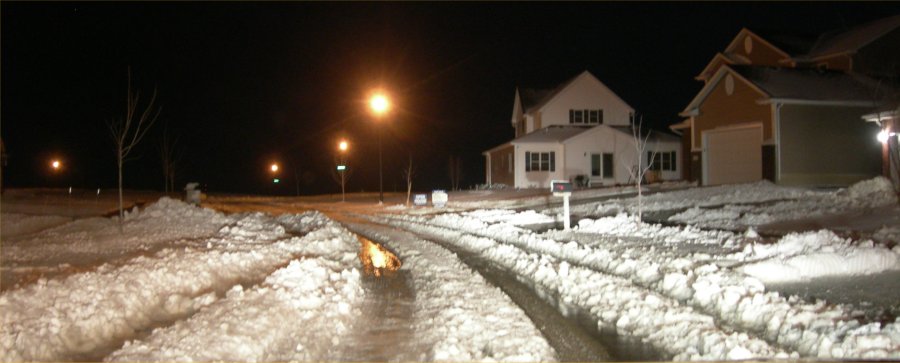
Last edited by erig007; 02-23-15 at 02:05 PM.
02-23-15 | 02:01 PM
#65

afraid of whales
Joined: Apr 2009
Posts: 4,306
Likes: 6
From: Front Range, CO
02-23-15 | 02:13 PM
#67
Registered User
Joined: Jan 2011
Posts: 4,267
Likes: 7
From: NA
Bikes: NA
That's why i usually avoid those tyre traction dependance moments if i can and it usually is just fine most of the time (no lean, no hard braking and only from the rear, no unecessary steering....)
My near fall event this winter was due to ice forming everywhere including in the middle of the street under the snow that lie in between the left and right car's wheels. It was steep from the middle and not flat. Without stud on that was fun
Something similar to this
My near fall event this winter was due to ice forming everywhere including in the middle of the street under the snow that lie in between the left and right car's wheels. It was steep from the middle and not flat. Without stud on that was fun
Something similar to this
02-23-15 | 02:16 PM
#68

meh
Joined: Jul 2014
Posts: 4,742
Likes: 1,129
From: Hopkins, MN
Bikes: 23 Cutthroat, 21 CoMotion Java; 21 Bianchi Infinito; 15 Surly Pugsley; 11 Globe Daily; 09 Kona Dew Drop; 96 Mondonico
I went down for the first time on the new bike a few minutes ago on black ice that was literally in the process of forming. The ONLY warning was my rear wheel slipping but i thought at first the N360 may have a problem (one i could deal with later) but no it was simply slipping on ice that had formed literally minutes before i rode over it. As soon as the sun goes down, the IR light keeping things wet vs frozen goes away, it seems. I am OK, bike is OK, broke strap on one of my shoes, but that is fixable as i have a pack of plastic rivets.
Has this happened to anyone else, where the black ice simply wasn't there not too long before (under an hour)?
I am really looking forward to getting a winter wheelset this autumn if possible, and maybe even a set of studded tires in addition to a default set of slightly knobby tires.
- Andy
Has this happened to anyone else, where the black ice simply wasn't there not too long before (under an hour)?
I am really looking forward to getting a winter wheelset this autumn if possible, and maybe even a set of studded tires in addition to a default set of slightly knobby tires.
- Andy
This was AM ice on brand-new blacktop, going from the sunny section to the shady part of the road. I was going so slow and taking such care to make an easy turn, but the ice won.
If there is ice, I will only ride my Marin with studded front tire. I won't even ride my fatbike on icy conditions, without studs, a fatbike isn't much better than the Kona.
The best compromise if you want to avoid studded tires but get better grip on winter conditions, Continental Top Contact. I've used Top Contacts for one winter on front and back wheels, but they weren't a match for bare ice. Now I have the Top Contact rear and Mount & Ground (studded) front - (knocking on wood) no wrecks with this combo.
02-23-15 | 02:17 PM
#69
Senior Member

Joined: Apr 2009
Posts: 39,897
Likes: 3,865
From: New Rochelle, NY
Bikes: too many bikes from 1967 10s (5x2)Frejus to a Sumitomo Ti/Chorus aluminum 10s (10x2), plus one non-susp mtn bike I use as my commuter
The thing to keep in mind about black ice is that it's different than normal cold weather ice or icy roads in general.
Black ice forms only within a narrow temperature band near 32F. (lower on salted roads). There are many techniques for riding safely on icy roads, but black ice hazards relate to riding on roads that are generally clear or unfrozen. So it's the element of surprise that creates the greatest danger.
Sometimes you'll see black ice even when it's above freezing and you have no reason to expect it. For example after a bitter cold spell road surface temperatures can vary greatly. The sun warms most of the road, but a section shaded by buildings may stay colder, so melt across the road freezes on contact. If the ice patch is short enough you'll be past it and able to recover before you go down, but a long patch on the north side of a tall building can nail you when you least expect it.
Black ice forms only within a narrow temperature band near 32F. (lower on salted roads). There are many techniques for riding safely on icy roads, but black ice hazards relate to riding on roads that are generally clear or unfrozen. So it's the element of surprise that creates the greatest danger.
Sometimes you'll see black ice even when it's above freezing and you have no reason to expect it. For example after a bitter cold spell road surface temperatures can vary greatly. The sun warms most of the road, but a section shaded by buildings may stay colder, so melt across the road freezes on contact. If the ice patch is short enough you'll be past it and able to recover before you go down, but a long patch on the north side of a tall building can nail you when you least expect it.
__________________
FB
Chain-L site
An ounce of diagnosis is worth a pound of cure.
Just because I'm tired of arguing, doesn't mean you're right.
“One accurate measurement is worth a thousand expert opinions” - Adm Grace Murray Hopper - USN
WARNING, I'm from New York. Thin skinned people should maintain safe distance.
FB
Chain-L site
An ounce of diagnosis is worth a pound of cure.
Just because I'm tired of arguing, doesn't mean you're right.
“One accurate measurement is worth a thousand expert opinions” - Adm Grace Murray Hopper - USN
WARNING, I'm from New York. Thin skinned people should maintain safe distance.
02-23-15 | 02:22 PM
#70
Senior Member
Joined: Sep 2012
Posts: 1,666
Likes: 1
From: 6367 km away from the center of the Earth
Not if you don't lean your bike while turning (going slowly). At least it works for me most of the time. If you're going for speed you're looking for trouble.
Last edited by erig007; 02-23-15 at 02:32 PM.
02-23-15 | 02:29 PM
#71
Senior Member
Joined: Jan 2002
Posts: 3,724
Likes: 106
From: Washington, DC
Actually, that's when it stops sounding like frying bacon. Frying bacon is the normal sound of studs on dry pavement - that's the sound of my ride from December to March.
It's amazing how silence is such a winter thing. I remember waking up in the morning, not hearing the steady clatter of tire chains on pavement, and realizing that new snow was muffling the sound and school was probably off. Wonderful memories.
It's amazing how silence is such a winter thing. I remember waking up in the morning, not hearing the steady clatter of tire chains on pavement, and realizing that new snow was muffling the sound and school was probably off. Wonderful memories.
02-23-15 | 02:31 PM
#72

Senior Member
Joined: Feb 2005
Posts: 261
Likes: 0
From: St. Louis
Bikes: 2011 Surly LHT, 2007 Specialized Roubaix, 2004 Giant Cypress, 1990 Simoncini Super Professional
Two winters ago I hit a patch that had no sheen whatsoever, completely invisible.
It was just after sunrise. Air temp was about 34F, and we'd had dry weather for weeks. But it was in a spot in a park that never gets direct sun, and I think a thin frost had formed there.
I hit my face, broke a tooth and bit all the way through my upper lip.
I still commute in winter, but I still get nervous when the temp hovers around that freezing mark. And I no longer lean into curves when it's cold.
It was just after sunrise. Air temp was about 34F, and we'd had dry weather for weeks. But it was in a spot in a park that never gets direct sun, and I think a thin frost had formed there.
I hit my face, broke a tooth and bit all the way through my upper lip.
I still commute in winter, but I still get nervous when the temp hovers around that freezing mark. And I no longer lean into curves when it's cold.
02-23-15 | 02:39 PM
#73
Senior Member
Joined: Sep 2012
Posts: 1,666
Likes: 1
From: 6367 km away from the center of the Earth

Two winters ago I hit a patch that had no sheen whatsoever, completely invisible.
It was just after sunrise. Air temp was about 34F, and we'd had dry weather for weeks. But it was in a spot in a park that never gets direct sun, and I think a thin frost had formed there.
I hit my face, broke a tooth and bit all the way through my upper lip.
I still commute in winter, but I still get nervous when the temp hovers around that freezing mark. And I no longer lean into curves when it's cold.
It was just after sunrise. Air temp was about 34F, and we'd had dry weather for weeks. But it was in a spot in a park that never gets direct sun, and I think a thin frost had formed there.
I hit my face, broke a tooth and bit all the way through my upper lip.
I still commute in winter, but I still get nervous when the temp hovers around that freezing mark. And I no longer lean into curves when it's cold.
Last edited by erig007; 02-23-15 at 02:43 PM.
02-23-15 | 02:45 PM
#74

Senior Member
Joined: Jun 2007
Posts: 8,101
Likes: 17
From: Minneapolis
Black ice forms only within a narrow temperature band near 32F. (lower on salted roads). There are many techniques for riding safely on icy roads, but black ice hazards relate to riding on roads that are generally clear or unfrozen. So it's the element of surprise that creates the greatest danger.
What I grew up thinking of as black ice is formed under different conditions. Black ice to me is when it's so cold that the water vapor from car exhaust freezes on the pavement while the cars are stopped at lights. It's especially treacherous because it's at intersections where people are trying to stop. It's also too cold for salt to have any effect.
Last edited by tjspiel; 02-23-15 at 02:50 PM.
02-23-15 | 03:34 PM
#75

Señior Member
Joined: Sep 2005
Posts: 13,748
Likes: 10
From: Michigan
Bikes: Windsor Fens, Giant Seek 0 (2014, Alfine 8 + discs)
MAYBE EVEN a set of studded tires?
I find it hard to believe that anyone rides without them if ice is even a possibility.
I have never gone down once while riding with my Nokians. The biggest problem I have is remembering that it's slippery when I stop and put a foot down.
I find it hard to believe that anyone rides without them if ice is even a possibility.
I have never gone down once while riding with my Nokians. The biggest problem I have is remembering that it's slippery when I stop and put a foot down.
__________________
Work: the 8 hours that separates bike rides.
Work: the 8 hours that separates bike rides.