


Bottom Bracket Shell Hole Angles

 11-15-18 | 08:46 PM
#2
Randomhead
Joined: Aug 2008
Posts: 25,930
Likes: 4,825
From: Happy Valley, Pennsylvania
There is enough slop in the chainstay sockets that the rear dropout spacing doesn't really affect the angle. Maybe you would have to bend the sockets a little to get out to 148mm, but I'm not even sure about that.
Pardon me if I'm wrong, but IIRC you are obsessed with lug angles to a degree that nobody else is. I suggest you draft things out to figure out questions like this for yourself. I am pretty sure that the chainstay view of rattlecad will answer this particular question fairly quickly. it also might help to buy a tube/lug set and play with it a little
Pardon me if I'm wrong, but IIRC you are obsessed with lug angles to a degree that nobody else is. I suggest you draft things out to figure out questions like this for yourself. I am pretty sure that the chainstay view of rattlecad will answer this particular question fairly quickly. it also might help to buy a tube/lug set and play with it a little
11-15-18 | 09:11 PM
#3

Senior Member


Joined: Feb 2012
Posts: 19,362
Likes: 5,503
From: Rochester, NY
Bikes: Stewart S&S coupled sport tourer, Stewart Sunday light, Stewart Commuting, Stewart Touring, Co Motion Tandem, Stewart 3-Spd, Stewart Track, Fuji Finest, Mongoose Tomac ATB, GT Bravado ATB, JCP Folder, Stewart 650B ATB
The answer is yes, the chain stay sockets were made to line up with 120 and 126mm spreads.
The angular difference between a 120 and a 126 socket angle is about .4 degrees, over about 405mm of stay. It's generally considered that lugs and other sockets have about 1 degree plus/minus of working range from intended angle. Almost every BB stay socket that I've worked with (not a pro so only a few dozens) needed some form of blacksmithy to open up, close down gaps or even get that stay to slide in to begin with.
Eric is correct, IMO, about miss placed obsession Re: lug/socket angles. IIRC I've mentioned before that when you start working with this stuff for real you'll see why we question your questions. Andy
The angular difference between a 120 and a 126 socket angle is about .4 degrees, over about 405mm of stay. It's generally considered that lugs and other sockets have about 1 degree plus/minus of working range from intended angle. Almost every BB stay socket that I've worked with (not a pro so only a few dozens) needed some form of blacksmithy to open up, close down gaps or even get that stay to slide in to begin with.
Eric is correct, IMO, about miss placed obsession Re: lug/socket angles. IIRC I've mentioned before that when you start working with this stuff for real you'll see why we question your questions. Andy
__________________
AndrewRStewart
AndrewRStewart
11-16-18 | 12:31 PM
#4


Senior Member

Joined: Jun 2004
Posts: 3,161
Likes: 571
From: Torrance, CA
Bikes: Homebuilt steel
For what it's worth, the chain stay holes on most bottom bracket shells I've messed with (30x16 type) don't even come close to matching up with the stays themselves. I blame the stays more than the shell but regardless, a lot of stay manipulation is needed to get a decent fit. I made a couple of wood cradles that can be used to crush and squeeze the stays in order to get the proper shape for clean plug in. I also try to fatten up the cross section as much as possible to resist sideways bending. At the end of the day a small angle misalignment at the shell is the least of my worries.
11-16-18 | 06:12 PM
#5
Randomhead
Joined: Aug 2008
Posts: 25,930
Likes: 4,825
From: Happy Valley, Pennsylvania
I just went through that with a new bike, trying to get some s-bend stays in a shell and the stays were horrible. So I put them in the vise and reshaped them. I need to bend the sockets out a little. Maybe I should make some wood blocks. I think Columbus is trying to do better with most of their stays that are meant for lugged bb shells
11-20-18 | 07:01 PM
#6
Thread Starter
Full Member

Joined: May 2009
Posts: 484
Likes: 9
There is enough slop in the chainstay sockets that the rear dropout spacing doesn't really affect the angle. Maybe you would have to bend the sockets a little to get out to 148mm, but I'm not even sure about that.
Pardon me if I'm wrong, but IIRC you are obsessed with lug angles to a degree that nobody else is. I suggest you draft things out to figure out questions like this for yourself. I am pretty sure that the chainstay view of rattlecad will answer this particular question fairly quickly. it also might help to buy a tube/lug set and play with it a little
Pardon me if I'm wrong, but IIRC you are obsessed with lug angles to a degree that nobody else is. I suggest you draft things out to figure out questions like this for yourself. I am pretty sure that the chainstay view of rattlecad will answer this particular question fairly quickly. it also might help to buy a tube/lug set and play with it a little
Thanks for the answer.
11-20-18 | 07:04 PM
#7
Thread Starter
Full Member
Joined: May 2009
Posts: 484
Likes: 9
11-20-18 | 07:18 PM
#9
Thread Starter
Full Member
Joined: May 2009
Posts: 484
Likes: 9
11-21-18 | 12:45 PM
#10
Senior Member
Joined: Aug 2012
Posts: 681
Likes: 283
From: Seattle
__________________
https://www.flickr.com/photos/54319503@N05/
https://www.draper-cycles.com
https://www.flickr.com/photos/54319503@N05/
https://www.draper-cycles.com
11-21-18 | 02:47 PM
#11
Senior Member
Joined: Jun 2004
Posts: 3,161
Likes: 571
From: Torrance, CA
Bikes: Homebuilt steel
Do you have a similar tool for oval stays?
11-21-18 | 03:56 PM
#13
Randomhead
Joined: Aug 2008
Posts: 25,930
Likes: 4,825
From: Happy Valley, Pennsylvania
11-21-18 | 03:58 PM
#14
Senior Member
Joined: Aug 2012
Posts: 681
Likes: 283
From: Seattle
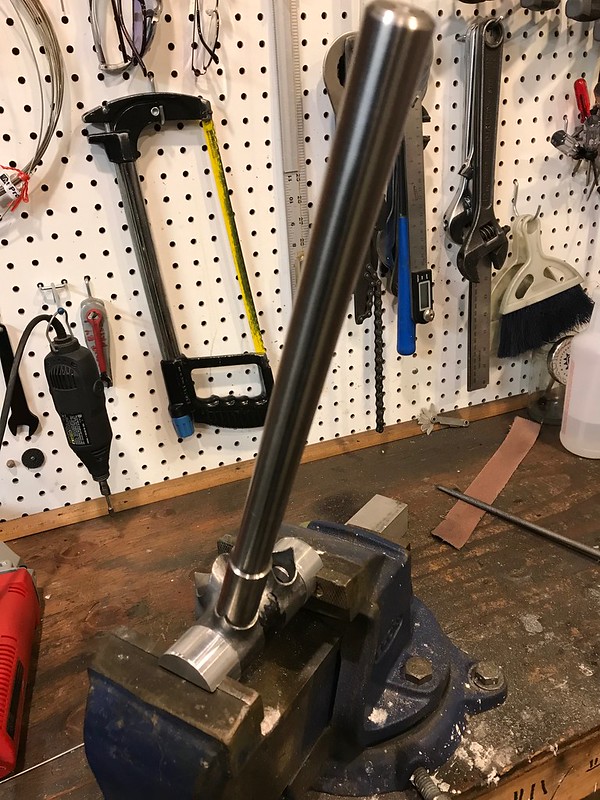
I have made them for common sized lugs/shells and the rear round sockets but haven't done any for the oval sockets. It shouldn't be too hard to take a 1-1/2 " bar and turn down one end to ~30mm diameter and then use belt sander/grinder to shape the sides.
The one in the picture was just scrap bar I had that happened to fit the 22mm sockets. It gave me the idea to make more. I bought 4 1ft long chunks of 1-1/2" round steel (1018 I think). I then chucked them in the lathe and turned about 2 inches on each end to sizes that fit most frame tubes - 25.4, 28.6, 31.8 & 35mm. Then I took a hole saw in the mill and carved out where ST/DT meet in the BB shell and when I get to it, i'll do the same for HT and ST/TT joints. It might require making more but i'll cross that one when I get there. It could probably also be done cheaper/more efficiently than I did.
The 1-1/2'' round bar I used for lug socket benders is a bit cumbersome/heavy but not too bad. The benefits of using big heavy steel with a slip fit is
The one in the picture was just scrap bar I had that happened to fit the 22mm sockets. It gave me the idea to make more. I bought 4 1ft long chunks of 1-1/2" round steel (1018 I think). I then chucked them in the lathe and turned about 2 inches on each end to sizes that fit most frame tubes - 25.4, 28.6, 31.8 & 35mm. Then I took a hole saw in the mill and carved out where ST/DT meet in the BB shell and when I get to it, i'll do the same for HT and ST/TT joints. It might require making more but i'll cross that one when I get there. It could probably also be done cheaper/more efficiently than I did.
The 1-1/2'' round bar I used for lug socket benders is a bit cumbersome/heavy but not too bad. The benefits of using big heavy steel with a slip fit is
- it maintains the round socket shape as you move the socket around,
- it provides more surface area for measuring angles with a protractor and
- it acts as an anvil inside the socket to close up gaps around the perimeter.
__________________
https://www.flickr.com/photos/54319503@N05/
https://www.draper-cycles.com
https://www.flickr.com/photos/54319503@N05/
https://www.draper-cycles.com
11-21-18 | 04:02 PM
#15
Senior Member
Joined: Aug 2012
Posts: 681
Likes: 283
From: Seattle
In the picture I was opening up the angle to the ST on track bikes. I agree, width isn't generally too difficult get a couple extra degrees and that can take you from 120 to 135 even. I do like having these bars as anvils inside the sockets to tighten everything back up before brazing. I use an aluminum bar with blunt end as a punch.
__________________
https://www.flickr.com/photos/54319503@N05/
https://www.draper-cycles.com
https://www.flickr.com/photos/54319503@N05/
https://www.draper-cycles.com
11-21-18 | 05:33 PM
#16
Randomhead
Joined: Aug 2008
Posts: 25,930
Likes: 4,825
From: Happy Valley, Pennsylvania
22.2mm is 7/8", so it's not unlikely to find a piece of bar that size in a big enough scrap pile. I have a 5 foot long piece that I don't remember acquiring. First time I used it, I ovalized the shell fairly badly.
I'll have to look to see if I can find something to make into an oval. Angle grinder should make fairly quick work of removing the bulk of the material.
I'll have to look to see if I can find something to make into an oval. Angle grinder should make fairly quick work of removing the bulk of the material.
11-21-18 | 06:45 PM
#17
Senior Member
Joined: Feb 2012
Posts: 19,362
Likes: 5,503
From: Rochester, NY
Bikes: Stewart S&S coupled sport tourer, Stewart Sunday light, Stewart Commuting, Stewart Touring, Co Motion Tandem, Stewart 3-Spd, Stewart Track, Fuji Finest, Mongoose Tomac ATB, GT Bravado ATB, JCP Folder, Stewart 650B ATB
Omar Kheil (Oasis Custom Cycles) made bending bars years ago. The shipping cost more then the steel did. You can see the concaved mitered ends that some have. Above them is a 7/8" bender, it's working end bonded to a narrower tube. This is my general bending section of tools with pry bars, pickle fork, crank arm bender, head tube jack and an early attempt at a stay crimper/channel locks. Not doing much with lugs lately these bending bars are mostly holding down the peg board. Andy
__________________
AndrewRStewart
AndrewRStewart

Thread
Thread Starter
Forum
Replies
Last Post
PrairieDog
Framebuilders
15
11-04-11 04:04 PM


