


First crash, flip over
 06-15-17 | 05:55 PM
#1
Thread Starter
Member
Joined: Mar 2017
Posts: 33
Likes: 0
From: Oregon City, Oregon
First crash, flip over
Yesterday did a complete flip over landing on the pavement on my road bike. Was total surprise as I at the moment when I pulled the front brake thought was no different than thousands of times before, but in a flash I was aware I was in midair going over. No broken bones but definite deep bruising. Shoulder, side of face, elbow, knee and edge of helmet took the brunt.
I have spent the day in bed trying to figure out just what went wrong. Have I been on the edge of flipping but just hadn't gotten there or was something different?
Its a new bike to me, just built it up. A move from a converted mountain bike to a Lemonds wayzata. I was going fairly fast had just rounded a corner and slowing for an intersection. But either applied mega force to the brake immediately or it reacted differently. Im not sure but i may of been in the lower position with the right hand on the furthest out hand position (not the TT bars they were not involved) and the left hand pulled back to apply the brake.
All I can think of is that maybe my center of weight was too far forward? Or the front brake just grabbed too quick?
I do love to ride fast, its an adrenalin rush but I've decided I dont like going over head first and slapping payment. Any thoughts appreciated on sorting this out in an attempt to not repeat it. (good news is bike is almost unscathed, seat took the hit)

[IMG]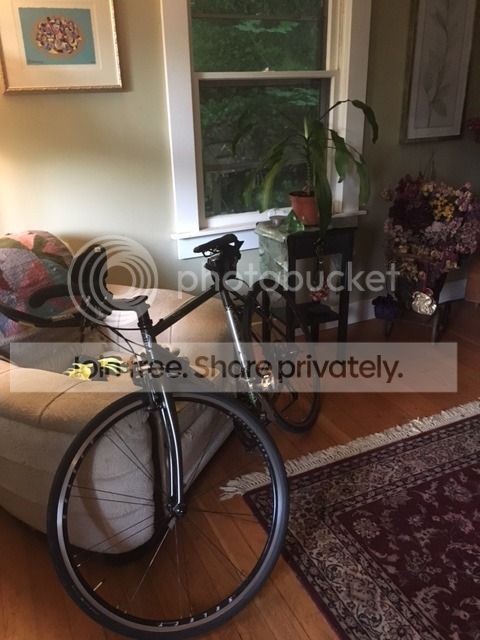 [/IMG]
I have spent the day in bed trying to figure out just what went wrong. Have I been on the edge of flipping but just hadn't gotten there or was something different?
Its a new bike to me, just built it up. A move from a converted mountain bike to a Lemonds wayzata. I was going fairly fast had just rounded a corner and slowing for an intersection. But either applied mega force to the brake immediately or it reacted differently. Im not sure but i may of been in the lower position with the right hand on the furthest out hand position (not the TT bars they were not involved) and the left hand pulled back to apply the brake.
All I can think of is that maybe my center of weight was too far forward? Or the front brake just grabbed too quick?
I do love to ride fast, its an adrenalin rush but I've decided I dont like going over head first and slapping payment. Any thoughts appreciated on sorting this out in an attempt to not repeat it. (good news is bike is almost unscathed, seat took the hit)

[IMG]
 [/IMG]
Last edited by leavingsuburbia; 06-15-17 at 06:03 PM. Reason: image not showing up
 06-15-17 | 06:03 PM
#2
Senior Member


Joined: Apr 2009
Posts: 39,897
Likes: 3,865
From: New Rochelle, NY
Bikes: too many bikes from 1967 10s (5x2)Frejus to a Sumitomo Ti/Chorus aluminum 10s (10x2), plus one non-susp mtn bike I use as my commuter
Two of the common cause of front brake endoscopy are not having enough weight on the saddle, and letting the bike stop but not the body.
The first is pretty obvious, if you don't have your ass firmly on the seat, it let's the rear wheel lift in response to the front brake force. Once that begins, the geometry changes, and less force is needed to continue the roll.
The second is vertical different. The bike weighs between a fifth and tenth what you do. So very little is needed to stop it. If you don't brace with your arms, the bike stops suddenly, but you keep moving forward, until you go as far as you can, then your momentum takes you and the bike into a rollover. It's analogous to a passenger in a car without a seat belt hitting the windshield, but plays out differently.
The second is pretty common, and a good reason to take descents in the drops. You get to descend faster, but are in a properly seated and braced position so you and the bike are one.
The first is pretty obvious, if you don't have your ass firmly on the seat, it let's the rear wheel lift in response to the front brake force. Once that begins, the geometry changes, and less force is needed to continue the roll.
The second is vertical different. The bike weighs between a fifth and tenth what you do. So very little is needed to stop it. If you don't brace with your arms, the bike stops suddenly, but you keep moving forward, until you go as far as you can, then your momentum takes you and the bike into a rollover. It's analogous to a passenger in a car without a seat belt hitting the windshield, but plays out differently.
The second is pretty common, and a good reason to take descents in the drops. You get to descend faster, but are in a properly seated and braced position so you and the bike are one.
__________________
FB
Chain-L site
An ounce of diagnosis is worth a pound of cure.
Just because I'm tired of arguing, doesn't mean you're right.
“One accurate measurement is worth a thousand expert opinions” - Adm Grace Murray Hopper - USN
WARNING, I'm from New York. Thin skinned people should maintain safe distance.
FB
Chain-L site
An ounce of diagnosis is worth a pound of cure.
Just because I'm tired of arguing, doesn't mean you're right.
“One accurate measurement is worth a thousand expert opinions” - Adm Grace Murray Hopper - USN
WARNING, I'm from New York. Thin skinned people should maintain safe distance.
Last edited by FBinNY; 06-15-17 at 06:09 PM.
06-15-17 | 06:11 PM
#3
Thread Starter
Member
Joined: Mar 2017
Posts: 33
Likes: 0
From: Oregon City, Oregon
Two of the common cause of front brake endoscopy are not having enough weight on the saddle, and letting the bike stop but not the body.
The first is pretty obvious, if you don't have your ass firmly on the seat, it let's through rear wheel lift in response to the front brake force. Once that begins, the geometry changes, and less force is needed to continue the roll.
The second is vertical different. The bike weighs between a fifth and tenth
The first is pretty obvious, if you don't have your ass firmly on the seat, it let's through rear wheel lift in response to the front brake force. Once that begins, the geometry changes, and less force is needed to continue the roll.
The second is vertical different. The bike weighs between a fifth and tenth
I am thinking of removing the extended stem 140 and putting back the original 120, then adjusting the seat back by that much. I am comfortable with the current setup, no knee soreness (took some dialing in to get that), I do tend to slide back on the seat. Maybe even 20mm would change the geometry a bit?
Would weighing the front wheel and rear wheel with me on the bike give me an indication of my weight distribution on the wheels?
06-15-17 | 06:13 PM
#4
Thread Starter
Member
Joined: Mar 2017
Posts: 33
Likes: 0
From: Oregon City, Oregon
Two of the common cause of front brake endoscopy are not having enough weight on the saddle, and letting the bike stop but not the body.
The first is pretty obvious, if you don't have your ass firmly on the seat, it let's the rear wheel lift in response to the front brake force. Once that begins, the geometry changes, and less force is needed to continue the roll.
The second is vertical different. The bike weighs between a fifth and tenth what you do. So very little is needed to stop it. If you don't brace with your arms, the bike stops suddenly, but you keep moving forward, until you go as far as you can, then your momentum takes you and the bike into a rollover. It's analogous to a passenger in a car without a seat belt hitting the windshield, but plays out differently.
The second is pretty common, and a good reason to take descents in the drops. You get to descend faster, but are in a properly seated and braced position so you and the bike are one.
The first is pretty obvious, if you don't have your ass firmly on the seat, it let's the rear wheel lift in response to the front brake force. Once that begins, the geometry changes, and less force is needed to continue the roll.
The second is vertical different. The bike weighs between a fifth and tenth what you do. So very little is needed to stop it. If you don't brace with your arms, the bike stops suddenly, but you keep moving forward, until you go as far as you can, then your momentum takes you and the bike into a rollover. It's analogous to a passenger in a car without a seat belt hitting the windshield, but plays out differently.
The second is pretty common, and a good reason to take descents in the drops. You get to descend faster, but are in a properly seated and braced position so you and the bike are one.
06-15-17 | 06:19 PM
#5
Senior Member
Joined: Apr 2009
Posts: 39,897
Likes: 3,865
From: New Rochelle, NY
Bikes: too many bikes from 1967 10s (5x2)Frejus to a Sumitomo Ti/Chorus aluminum 10s (10x2), plus one non-susp mtn bike I use as my commuter
Raise the bars if necessary. It's hard to get your ass back and down on the seat, and arms braced levering the brake's over the hoods.
__________________
FB
Chain-L site
An ounce of diagnosis is worth a pound of cure.
Just because I'm tired of arguing, doesn't mean you're right.
“One accurate measurement is worth a thousand expert opinions” - Adm Grace Murray Hopper - USN
WARNING, I'm from New York. Thin skinned people should maintain safe distance.
FB
Chain-L site
An ounce of diagnosis is worth a pound of cure.
Just because I'm tired of arguing, doesn't mean you're right.
“One accurate measurement is worth a thousand expert opinions” - Adm Grace Murray Hopper - USN
WARNING, I'm from New York. Thin skinned people should maintain safe distance.
06-15-17 | 06:33 PM
#6

Senior Member

Joined: Dec 2004
Posts: 12,560
Likes: 799
From: Middle of da Mitten
Bikes: Trek 7500, RANS V-Rex, Optima Baron, Velokraft NoCom, M-5 Carbon Highracer, Bacchetta Quattro, Catrike Speed
Weight distribution combined with height. If deceleration moves your COM past the front axle, then you're gonna do a Superman Dismount. Some bikes are more resistant than others; I'm not sure that even a stick in the front spokes would do it to me on my avatar bike. Anyway, it's good to hear you're not a new member of the broken clavicle club.
 06-15-17 | 06:58 PM
#9
Thread Starter
Member
Joined: Mar 2017
Posts: 33
Likes: 0
From: Oregon City, Oregon
06-15-17 | 07:14 PM
#11
Senior Member
Joined: Apr 2009
Posts: 39,897
Likes: 3,865
From: New Rochelle, NY
Bikes: too many bikes from 1967 10s (5x2)Frejus to a Sumitomo Ti/Chorus aluminum 10s (10x2), plus one non-susp mtn bike I use as my commuter
photo added after my post.
Other than the discussion of the drops, all the rest applies. "seatbelting" your ass in the saddle via proper bracing is a key element of controlled hard braking.
In any case, it might help is the OP observed his position on the bike while riding. When I'm working with someone one on one, I take them to the strip mall and have them look at reflections of themselves in storefront windows. Sometimes I'll ride next them the reflections superimpose and they can compare their position to mine.
Other than the discussion of the drops, all the rest applies. "seatbelting" your ass in the saddle via proper bracing is a key element of controlled hard braking.
In any case, it might help is the OP observed his position on the bike while riding. When I'm working with someone one on one, I take them to the strip mall and have them look at reflections of themselves in storefront windows. Sometimes I'll ride next them the reflections superimpose and they can compare their position to mine.
__________________
FB
Chain-L site
An ounce of diagnosis is worth a pound of cure.
Just because I'm tired of arguing, doesn't mean you're right.
“One accurate measurement is worth a thousand expert opinions” - Adm Grace Murray Hopper - USN
WARNING, I'm from New York. Thin skinned people should maintain safe distance.
FB
Chain-L site
An ounce of diagnosis is worth a pound of cure.
Just because I'm tired of arguing, doesn't mean you're right.
“One accurate measurement is worth a thousand expert opinions” - Adm Grace Murray Hopper - USN
WARNING, I'm from New York. Thin skinned people should maintain safe distance.
06-15-17 | 08:17 PM
#12

Me duelen las nalgas

Joined: Aug 2015
Posts: 13,519
Likes: 2,832
From: Texas
Bikes: Centurion Ironman, Trek 5900, Univega Via Carisma, Globe Carmel
With any new-to-you bike, always practice emergency braking in various conditions before hitting the road -- literally.
And be prepared to sacrifice some rubber or skin in pursuit of learning the balance and characteristics of your bike and tires. It's gonna come off your brake pads, tires, shoes or body. With luck it'll all be rubber, no skin.
When I got my first bike, a heavy comfort hybrid, in 2015 after 30 years away from cycling I practiced emergency braking, first on grass to get accustomed to the skidding characteristics. That was fine with the original tires. But when I put on new tires with more aggressive tread and repeated the exercise the front tire dug in rather than skidding. I went over the bars feet first and landed on my feet. It was nearly a perfect dismount -- until I realized what I'd done and flopped on the ground out of shock. Good thing I practiced on fairly soft grass first.
I repeated the exercise when I got a rigid frame 1990s mountain bike last year. It skids predictably and doesn't nose dive like the comfort hybrid with spring suspension fork.
And I repeated the exercises again with the road bike I got last week. Very different creature. With skinny 700x23 tires and nominal tread, and incredibly sensitive side pull brakes, it likes to skid that rear tire just for giggles. And while I like the comfort of the Lycra fabric over foam saddle, it tends to have a bit of friction that hinders quickly scooting backward off the saddle to prevent endos. So I need to keep working on that.
So, while you're recuperating, watch some YouTube tutorials on emergency braking and maneuvers, and practice them after you're feeling better. Get a mentor or guide if you're not sure. Practice doesn't make perfect. Perfect practice makes perfect. If you practice the wrong stuff it'll get embedded in muscle memory and will lead you astray later.
And be prepared to sacrifice some rubber or skin in pursuit of learning the balance and characteristics of your bike and tires. It's gonna come off your brake pads, tires, shoes or body. With luck it'll all be rubber, no skin.
When I got my first bike, a heavy comfort hybrid, in 2015 after 30 years away from cycling I practiced emergency braking, first on grass to get accustomed to the skidding characteristics. That was fine with the original tires. But when I put on new tires with more aggressive tread and repeated the exercise the front tire dug in rather than skidding. I went over the bars feet first and landed on my feet. It was nearly a perfect dismount -- until I realized what I'd done and flopped on the ground out of shock. Good thing I practiced on fairly soft grass first.
I repeated the exercise when I got a rigid frame 1990s mountain bike last year. It skids predictably and doesn't nose dive like the comfort hybrid with spring suspension fork.
And I repeated the exercises again with the road bike I got last week. Very different creature. With skinny 700x23 tires and nominal tread, and incredibly sensitive side pull brakes, it likes to skid that rear tire just for giggles. And while I like the comfort of the Lycra fabric over foam saddle, it tends to have a bit of friction that hinders quickly scooting backward off the saddle to prevent endos. So I need to keep working on that.
So, while you're recuperating, watch some YouTube tutorials on emergency braking and maneuvers, and practice them after you're feeling better. Get a mentor or guide if you're not sure. Practice doesn't make perfect. Perfect practice makes perfect. If you practice the wrong stuff it'll get embedded in muscle memory and will lead you astray later.
06-15-17 | 08:48 PM
#13
Senior Member
Joined: Apr 2014
Posts: 2,368
Likes: 159
From: Meridian, ID
Bikes: '96 Trek 850, '08 Specialized Roubaix Comp, '18 Niner RLT RDO
The second is vertical different. The bike weighs between a fifth and tenth what you do. So very little is needed to stop it. If you don't brace with your arms, the bike stops suddenly, but you keep moving forward, until you go as far as you can, then your momentum takes you and the bike into a rollover.
06-15-17 | 08:56 PM
#14
Thread Starter
Member
Joined: Mar 2017
Posts: 33
Likes: 0
From: Oregon City, Oregon
photo added after my post.
Other than the discussion of the drops, all the rest applies. "seatbelting" your ass in the saddle via proper bracing is a key element of controlled hard braking.
In any case, it might help is the OP observed his position on the bike while riding. When I'm working with someone one on one, I take them to the strip mall and have them look at reflections of themselves in storefront windows. Sometimes I'll ride next them the reflections superimpose and they can compare their position to mine.
Other than the discussion of the drops, all the rest applies. "seatbelting" your ass in the saddle via proper bracing is a key element of controlled hard braking.
In any case, it might help is the OP observed his position on the bike while riding. When I'm working with someone one on one, I take them to the strip mall and have them look at reflections of themselves in storefront windows. Sometimes I'll ride next them the reflections superimpose and they can compare their position to mine.
06-15-17 | 08:58 PM
#15

Old fart

Joined: Nov 2004
Posts: 26,404
Likes: 5,338
From: Appleton WI
Bikes: Several, mostly not name brands.
06-15-17 | 09:05 PM
#16
Thread Starter
Member
Joined: Mar 2017
Posts: 33
Likes: 0
From: Oregon City, Oregon
With any new-to-you bike, always practice emergency braking in various conditions before hitting the road -- literally.
And be prepared to sacrifice some rubber or skin in pursuit of learning the balance and characteristics of your bike and tires. It's gonna come off your brake pads, tires, shoes or body. With luck it'll all be rubber, no skin.
When I got my first bike, a heavy comfort hybrid, in 2015 after 30 years away from cycling I practiced emergency braking, first on grass to get accustomed to the skidding characteristics. That was fine with the original tires. But when I put on new tires with more aggressive tread and repeated the exercise the front tire dug in rather than skidding. I went over the bars feet first and landed on my feet. It was nearly a perfect dismount -- until I realized what I'd done and flopped on the ground out of shock. Good thing I practiced on fairly soft grass first.
I repeated the exercise when I got a rigid frame 1990s mountain bike last year. It skids predictably and doesn't nose dive like the comfort hybrid with spring suspension fork.
And I repeated the exercises again with the road bike I got last week. Very different creature. With skinny 700x23 tires and nominal tread, and incredibly sensitive side pull brakes, it likes to skid that rear tire just for giggles. And while I like the comfort of the Lycra fabric over foam saddle, it tends to have a bit of friction that hinders quickly scooting backward off the saddle to prevent endos. So I need to keep working on that.
So, while you're recuperating, watch some YouTube tutorials on emergency braking and maneuvers, and practice them after you're feeling better. Get a mentor or guide if you're not sure. Practice doesn't make perfect. Perfect practice makes perfect. If you practice the wrong stuff it'll get embedded in muscle memory and will lead you astray later.
And be prepared to sacrifice some rubber or skin in pursuit of learning the balance and characteristics of your bike and tires. It's gonna come off your brake pads, tires, shoes or body. With luck it'll all be rubber, no skin.
When I got my first bike, a heavy comfort hybrid, in 2015 after 30 years away from cycling I practiced emergency braking, first on grass to get accustomed to the skidding characteristics. That was fine with the original tires. But when I put on new tires with more aggressive tread and repeated the exercise the front tire dug in rather than skidding. I went over the bars feet first and landed on my feet. It was nearly a perfect dismount -- until I realized what I'd done and flopped on the ground out of shock. Good thing I practiced on fairly soft grass first.
I repeated the exercise when I got a rigid frame 1990s mountain bike last year. It skids predictably and doesn't nose dive like the comfort hybrid with spring suspension fork.
And I repeated the exercises again with the road bike I got last week. Very different creature. With skinny 700x23 tires and nominal tread, and incredibly sensitive side pull brakes, it likes to skid that rear tire just for giggles. And while I like the comfort of the Lycra fabric over foam saddle, it tends to have a bit of friction that hinders quickly scooting backward off the saddle to prevent endos. So I need to keep working on that.
So, while you're recuperating, watch some YouTube tutorials on emergency braking and maneuvers, and practice them after you're feeling better. Get a mentor or guide if you're not sure. Practice doesn't make perfect. Perfect practice makes perfect. If you practice the wrong stuff it'll get embedded in muscle memory and will lead you astray later.
Setup and started riding the Lemond a month ago, have experienced several rear wheel skids and can predict when it will skid and where the skid will go. I ride in a hilly city, every ride has steep hills up and down, never any issues or problems. Yet on a flat part of my 15 mile longer ride, I flip. That's what has me thinking it is a riding behavior I am expressing that isnt done on the down hills, which is the stretch out, I keep my hands on the flat part of the bars with hands on brake levers on the hills, too many road repairs etc to play Russian roulette with.
06-15-17 | 09:07 PM
#17
Thread Starter
Member
Joined: Mar 2017
Posts: 33
Likes: 0
From: Oregon City, Oregon
That brings up a question, is the balance sensitive enough to tip the wrong way with the pound added by the aero bars? I wasn't on them at the time...
06-15-17 | 09:12 PM
#18
Old fart
Joined: Nov 2004
Posts: 26,404
Likes: 5,338
From: Appleton WI
Bikes: Several, mostly not name brands.
06-15-17 | 09:14 PM
#19
Thread Starter
Member
Joined: Mar 2017
Posts: 33
Likes: 0
From: Oregon City, Oregon
06-15-17 | 09:21 PM
#20
Senior Member
Joined: Apr 2009
Posts: 39,897
Likes: 3,865
From: New Rochelle, NY
Bikes: too many bikes from 1967 10s (5x2)Frejus to a Sumitomo Ti/Chorus aluminum 10s (10x2), plus one non-susp mtn bike I use as my commuter
But if the arrangement of main bars is such that you're more forward or your torso is higher, that does matter.
One thing we used to do BITD before the "scientists" took over was look down to the front wheel between the axle and point of contact on the ground. How our line of sight passed those references gave us a sense of where our heads were, and by extension our bodies.
50 years later, I still take that visual reference when I'm on a strange bike and it helps me tune my expectations. I'll also do a brake punch from time to time, locking the front wheel momentarily and lifting the rear before dropping it back down. Keeping tuned to how the bike handles makes me better equipped for the unexpected.
__________________
FB
Chain-L site
An ounce of diagnosis is worth a pound of cure.
Just because I'm tired of arguing, doesn't mean you're right.
“One accurate measurement is worth a thousand expert opinions” - Adm Grace Murray Hopper - USN
WARNING, I'm from New York. Thin skinned people should maintain safe distance.
FB
Chain-L site
An ounce of diagnosis is worth a pound of cure.
Just because I'm tired of arguing, doesn't mean you're right.
“One accurate measurement is worth a thousand expert opinions” - Adm Grace Murray Hopper - USN
WARNING, I'm from New York. Thin skinned people should maintain safe distance.
06-15-17 | 09:37 PM
#21


Joined: Oct 2015
Posts: 1,036
Likes: 8
From: NoVA - DC Metro
Bikes: 1987 Schwinn Prelude
In any case, it might help is the OP observed his position on the bike while riding. When I'm working with someone one on one, I take them to the strip mall and have them look at reflections of themselves in storefront windows. Sometimes I'll ride next them the reflections superimpose and they can compare their position to mine.
06-15-17 | 09:52 PM
#22

Senior Member
Joined: Mar 2016
Posts: 2,093
Likes: 591
Bikes: '87-ish Pinarello Montello; '89 Nishiki Ariel; '85 Raleigh Wyoming, '16 Wabi Special, '16 Wabi Classic, '14 Kona Cinder Cone, 2023 Surly Disk Trucker
Always put a new bike through its paces before you go on a serious ride. I'll try the front and rear brakes together light-pull, individually light-pull, then medium pull then hard pull to see how the bike and I react. Brakes today exert a lot of force with the advancement in technology. That can be good but it can also come as a nasty surprise as you found out.
Front brakes can be dangerous things if not worked correctly with the back brake. Yes, the front brakes apply better leverage for braking but I don't rely on my front brake most of the time. I brake routinely with mostly my back brake. If I have to stop in a hurry I modulate the front brake while squeezing slightly harder with the front brake while increasing pressure with the back brake. If the back brake locks up the wheel it's not nearly as big a problem as the front brake locking up the front wheel.
Get back on the bike and ride. Put the brakes through their paces on dry and wet pavement. One thing that has really brought me to the ground in a hurry is if I'm applying the brakes moderately hard and hit a rut in the road. That sudden weight shift can spell disaster. Was there a slight rut or bump in the road when you went over?
Front brakes can be dangerous things if not worked correctly with the back brake. Yes, the front brakes apply better leverage for braking but I don't rely on my front brake most of the time. I brake routinely with mostly my back brake. If I have to stop in a hurry I modulate the front brake while squeezing slightly harder with the front brake while increasing pressure with the back brake. If the back brake locks up the wheel it's not nearly as big a problem as the front brake locking up the front wheel.
Get back on the bike and ride. Put the brakes through their paces on dry and wet pavement. One thing that has really brought me to the ground in a hurry is if I'm applying the brakes moderately hard and hit a rut in the road. That sudden weight shift can spell disaster. Was there a slight rut or bump in the road when you went over?
06-15-17 | 10:03 PM
#23
Thread Starter
Member
Joined: Mar 2017
Posts: 33
Likes: 0
From: Oregon City, Oregon
Always put a new bike through its paces before you go on a serious ride. I'll try the front and rear brakes together light-pull, individually light-pull, then medium pull then hard pull to see how the bike and I react. Brakes today exert a lot of force with the advancement in technology. That can be good but it can also come as a nasty surprise as you found out.
Front brakes can be dangerous things if not worked correctly with the back brake. Yes, the front brakes apply better leverage for braking but I don't rely on my front brake most of the time. I brake routinely with mostly my back brake. If I have to stop in a hurry I modulate the front brake while squeezing slightly harder with the front brake while in creasing pressure with the back brake. If the back brake locks up the wheel it's not nearly as big a problem as the front brake locking up the front wheel.
Get back on the bike and ride. Put the brakes through their paces on dry and wet pavement. One thing that has really brought me to the ground in a hurry is if I'm applying the brakes moderately hard and hit a rut in the road. That sudden weight shift can spell disaster. Was there a slight rut or bump in the road when you went over?
Front brakes can be dangerous things if not worked correctly with the back brake. Yes, the front brakes apply better leverage for braking but I don't rely on my front brake most of the time. I brake routinely with mostly my back brake. If I have to stop in a hurry I modulate the front brake while squeezing slightly harder with the front brake while in creasing pressure with the back brake. If the back brake locks up the wheel it's not nearly as big a problem as the front brake locking up the front wheel.
Get back on the bike and ride. Put the brakes through their paces on dry and wet pavement. One thing that has really brought me to the ground in a hurry is if I'm applying the brakes moderately hard and hit a rut in the road. That sudden weight shift can spell disaster. Was there a slight rut or bump in the road when you went over?
06-15-17 | 11:02 PM
#24
- Soli Deo Gloria -
Joined: Aug 2015
Posts: 14,779
Likes: 743
From: Northwest Georgia
Bikes: 2018 Rodriguez Custom Fixed Gear, 2017 Niner RLT 9 RDO, 2015 Bianchi Pista, 2002 Fuji Robaix
The bike has V-Brakes.
Sounds like the OP is just jamming them on.
The aero bars are not right for that bike. They have to go.
And the saddle looks pushed back.
A Lemond Wayzata isn't a TT bike but it is being ridden like one.
-Tim-
Sounds like the OP is just jamming them on.
The aero bars are not right for that bike. They have to go.
And the saddle looks pushed back.
A Lemond Wayzata isn't a TT bike but it is being ridden like one.
-Tim-
Last edited by TimothyH; 06-15-17 at 11:08 PM.
06-16-17 | 03:28 AM
#25
Senior Member
Joined: Jan 2011
Posts: 2,977
Likes: 780