


Sit bones measured
 04-09-18 | 05:56 PM
#1

Thread Starter
Senior Member
Joined: Feb 2018
Posts: 588
Likes: 17
Bikes: (2) 2019 Specialized Roll Sports, 1992 Merlin Road Ti, 1986 Schwinn Peloton, 2 Trek 920’s,
Sit bones measured
My wife and went to our LBS today and had our sit bones measured and only cost a few minutes of our time. A neat little device that worked well and gave us more accurate information helping us understand our correct sit bone width if and when we order new bike saddles.
Here is the SB measurement pad, pretty cool. The yellow lines indicate the approximate center of each sit bone. I measured a medium at 138mm. FWIW...
Here is the SB measurement pad, pretty cool. The yellow lines indicate the approximate center of each sit bone. I measured a medium at 138mm. FWIW...
Last edited by Patriot1; 04-10-18 at 12:35 AM.


 04-09-18 | 07:49 PM
#5

Life is good


Joined: Jan 2001
Posts: 18,208
Likes: 14
From: Not far from the Withlacoochee Trail. 🚴🏻
Bikes: 2018 Lynskey Helix Pro
What saddles did you get?
__________________
The Lord is merciful and gracious, slow to anger and abounding in steadfast love. - Psalm 103:8
I am a cyclist. I am not the fastest or the fittest. But I will get to where I'm going with a smile on my face.
The Lord is merciful and gracious, slow to anger and abounding in steadfast love. - Psalm 103:8
I am a cyclist. I am not the fastest or the fittest. But I will get to where I'm going with a smile on my face.
 04-09-18 | 08:59 PM
#8

Senior Member


Joined: Apr 2011
Posts: 12,679
Likes: 4,805
Unfortunately, cyclists largely do not sit on the "sit bones" - the ischial tuberosity. We sit on those when upright in a chair, but leaning forward on a bicycle we sit somewhere on the narrower ischium or ramus - the rocker shaped bones going from the tuberosities to the pubis.
Specialized has popularized sit bone measuring, and then matching that number to a saddle width. But bone numbers are indirect. The outer 1/2 - 1" of saddle doesn't do anything - it just completes the shape. So that width is variable in its significance to sitting area.
So while some saddle brands may have a formula for matching sit bones to saddle widths, the overall scheme is like measuring peoples ankles to sell them shoes that are measured at the outer width of the sole, rather than measuring feet and the last.
The only really good way of finding a saddle is to sit on them. I have customers with sit bone widths exceeding the total width of the saddle. But they aren't sitting on those bones, and the ones they are sitting on fit the saddle perfectly.
Specialized has popularized sit bone measuring, and then matching that number to a saddle width. But bone numbers are indirect. The outer 1/2 - 1" of saddle doesn't do anything - it just completes the shape. So that width is variable in its significance to sitting area.
So while some saddle brands may have a formula for matching sit bones to saddle widths, the overall scheme is like measuring peoples ankles to sell them shoes that are measured at the outer width of the sole, rather than measuring feet and the last.
The only really good way of finding a saddle is to sit on them. I have customers with sit bone widths exceeding the total width of the saddle. But they aren't sitting on those bones, and the ones they are sitting on fit the saddle perfectly.
04-10-18 | 04:14 AM
#10

Senior Member
Joined: Oct 2004
Posts: 7,124
Likes: 111
From: Huntington Beach, CA
Bikes: Cervelo Prodigy
Unfortunately, cyclists largely do not sit on the "sit bones" - the ischial tuberosity. We sit on those when upright in a chair, but leaning forward on a bicycle we sit somewhere on the narrower ischium or ramus - the rocker shaped bones going from the tuberosities to the pubis.
Specialized has popularized sit bone measuring, and then matching that number to a saddle width. But bone numbers are indirect. The outer 1/2 - 1" of saddle doesn't do anything - it just completes the shape. So that width is variable in its significance to sitting area.
So while some saddle brands may have a formula for matching sit bones to saddle widths, the overall scheme is like measuring peoples ankles to sell them shoes that are measured at the outer width of the sole, rather than measuring feet and the last.
The only really good way of finding a saddle is to sit on them. I have customers with sit bone widths exceeding the total width of the saddle. But they aren't sitting on those bones, and the ones they are sitting on fit the saddle perfectly.
Specialized has popularized sit bone measuring, and then matching that number to a saddle width. But bone numbers are indirect. The outer 1/2 - 1" of saddle doesn't do anything - it just completes the shape. So that width is variable in its significance to sitting area.
So while some saddle brands may have a formula for matching sit bones to saddle widths, the overall scheme is like measuring peoples ankles to sell them shoes that are measured at the outer width of the sole, rather than measuring feet and the last.
The only really good way of finding a saddle is to sit on them. I have customers with sit bone widths exceeding the total width of the saddle. But they aren't sitting on those bones, and the ones they are sitting on fit the saddle perfectly.
04-10-18 | 04:26 AM
#11
Senior Member
Joined: Jul 2008
Posts: 9,176
Likes: 653
From: Minas Ithil
You can do it at home with a big piece of aluminum foil on the carpet floor that you sit on and a tape measure.
And uh, yes, you do sit on your sitbones. That's kind of why they make like small indentations in your saddle after awhile lol
And uh, yes, you do sit on your sitbones. That's kind of why they make like small indentations in your saddle after awhile lol
Last edited by Lazyass; 04-10-18 at 04:29 AM.
04-10-18 | 04:47 AM
#12
Senior Member
Joined: Mar 2017
Posts: 531
Likes: 60
From: Williston FL
Bikes: 1988 Panasonic, 1989 Fuji, Schwinn Beach Cruiser
04-10-18 | 05:18 AM
#13


Senior Member
Joined: Apr 2005
Posts: 17,196
Likes: 761
From: Ann Arbor, MI
Bikes: 1980 Masi, 1984 Mondonico, 1984 Trek 610, 1980 Woodrup Giro, 2005 Mondonico Futura Leggera ELOS, 1967 PX10E, 1971 Peugeot UO-8
I think Kontact is saying that when you lean forward to the hoods or drops, your bone contact points with the saddle are narrower than they are when you sit straight up. For some silly reason (probably due to doctors) we have different names for the bone in those two conditions. Are they all sit bones? Well, yes, effectively they are.
04-10-18 | 05:38 AM
#14
Thread Starter
Senior Member
Joined: Feb 2018
Posts: 588
Likes: 17
Bikes: (2) 2019 Specialized Roll Sports, 1992 Merlin Road Ti, 1986 Schwinn Peloton, 2 Trek 920’s,
RonH,
We decided to give these saddles a try based on our sit bone measurements and not wanting a thick layer of foam. Naturally saddle comfort- what works for one may not work for another. That said, the Trek 30 day return policy certainly helps a buying decision as we don’t care to own a box of saddles that for whatever reason did not work out. These saddles will be mounted on our new Trek 920’s.
By the way, awesome signature line PTL! So grateful to be living an incredibly blessed life here in Western NC.
We decided to give these saddles a try based on our sit bone measurements and not wanting a thick layer of foam. Naturally saddle comfort- what works for one may not work for another. That said, the Trek 30 day return policy certainly helps a buying decision as we don’t care to own a box of saddles that for whatever reason did not work out. These saddles will be mounted on our new Trek 920’s.
By the way, awesome signature line PTL! So grateful to be living an incredibly blessed life here in Western NC.
Last edited by Patriot1; 04-10-18 at 05:43 AM.
04-10-18 | 06:05 AM
#15
Life is good
Joined: Jan 2001
Posts: 18,208
Likes: 14
From: Not far from the Withlacoochee Trail. 🚴🏻
Bikes: 2018 Lynskey Helix Pro
RonH,
We decided to give these saddles a try based on our sit bone measurements and not wanting a thick layer of foam. Naturally saddle comfort- what works for one may not work for another. That said, the Trek 30 day return policy certainly helps a buying decision as we don’t care to own a box of saddles that for whatever reason did not work out. These saddles will be mounted on our new Trek 920’s.
By the way, awesome signature line PTL! So grateful to be living an incredibly blessed life here in Western NC.
We decided to give these saddles a try based on our sit bone measurements and not wanting a thick layer of foam. Naturally saddle comfort- what works for one may not work for another. That said, the Trek 30 day return policy certainly helps a buying decision as we don’t care to own a box of saddles that for whatever reason did not work out. These saddles will be mounted on our new Trek 920’s.
By the way, awesome signature line PTL! So grateful to be living an incredibly blessed life here in Western NC.
 BTW, have you visited the Southeast Regional subforum to find locals near you? Lots of NC folks on here.
Enjoy the bikes.
__________________
The Lord is merciful and gracious, slow to anger and abounding in steadfast love. - Psalm 103:8
I am a cyclist. I am not the fastest or the fittest. But I will get to where I'm going with a smile on my face.
The Lord is merciful and gracious, slow to anger and abounding in steadfast love. - Psalm 103:8
I am a cyclist. I am not the fastest or the fittest. But I will get to where I'm going with a smile on my face.
04-10-18 | 06:09 AM
#16
Thread Starter
Senior Member
Joined: Feb 2018
Posts: 588
Likes: 17
Bikes: (2) 2019 Specialized Roll Sports, 1992 Merlin Road Ti, 1986 Schwinn Peloton, 2 Trek 920’s,
Looks like a good choice. BTW, have you visited the Southeast Regional subforum to find locals near you? Lots of NC folks on here.
Enjoy the bikes.
BTW, have you visited the Southeast Regional subforum to find locals near you? Lots of NC folks on here. Enjoy the bikes.
04-10-18 | 06:18 AM
#17
Senior Member
Joined: Jul 2008
Posts: 9,176
Likes: 653
From: Minas Ithil
I think Kontact is saying that when you lean forward to the hoods or drops, your bone contact points with the saddle are narrower than they are when you sit straight up. For some silly reason (probably due to doctors) we have different names for the bone in those two conditions. Are they all sit bones? Well, yes, effectively they are.
And I simply do not believe, as he stated, that customers with sit bone widths exceeding the total width of the saddle can ride those saddles with no other contact than the soft tissue in the sensitive areas. There's just no way.
04-10-18 | 06:54 AM
#18

Senior Member
Joined: Mar 2018
Posts: 74
Likes: 3
From: Indiana
He stated "they aren't sitting on those bones". But yeah they are sitting on them. The sitbones have to be supported by the saddle or you wouldn't last 30 minutes. Anybody can put their hand under their butt while riding, in any bar position, and feel their sitbones pressing on the saddle. The contact points may change put it's physically impossible for the width of the sitbones to change. My leather Turbo saddles have permanent indentations from my sitbones. And the indentations aren't in multiple areas.
And I simply do not believe, as he stated, that customers with sit bone widths exceeding the total width of the saddle can ride those saddles with no other contact than the soft tissue in the sensitive areas. There's just no way.
And I simply do not believe, as he stated, that customers with sit bone widths exceeding the total width of the saddle can ride those saddles with no other contact than the soft tissue in the sensitive areas. There's just no way.
Yes it's true the width of the "sit bones" don't change, but they do not maintain the same distance from each other when viewed front to rear. One look at a pelvic bone image was worth a thousand words to me.
So as you lean forward onto the bars, the hips rotate forward to a section where the bones are closer together. Makes perfect sense, I just need a way to convert that into useful data for picking a saddle.
04-10-18 | 07:30 AM
#19
Senior Member
Joined: Jul 2008
Posts: 9,176
Likes: 653
From: Minas Ithil
I am in the same boat as the majority of people looking for a seat that isn't a pain in the @55. I get what Kontact is saying.
Yes it's true the width of the "sit bones" don't change, but they do not maintain the same distance from each other when viewed front to rear. One look at a pelvic bone image was worth a thousand words to me.
Yes it's true the width of the "sit bones" don't change, but they do not maintain the same distance from each other when viewed front to rear. One look at a pelvic bone image was worth a thousand words to me.
Perhaps I am reading this wrong. I hope so. You need a saddle wide enough to support the sitbones if you want to have children someday. You CANNOT have a saddle where your sitbones exceed the total width and your weight is supported by soft tissue.
04-10-18 | 08:17 AM
#20
Senior Member
Joined: Mar 2018
Posts: 74
Likes: 3
From: Indiana
I have customers with sit bone widths exceeding the total width of the saddle.
Perhaps I am reading this wrong. I hope so. You need a saddle wide enough to support the sitbones if you want to have children someday. You CANNOT have a saddle where your sitbones exceed the total width and your weight is supported by soft tissue.
Perhaps I am reading this wrong. I hope so. You need a saddle wide enough to support the sitbones if you want to have children someday. You CANNOT have a saddle where your sitbones exceed the total width and your weight is supported by soft tissue.
The way the sit bones are measures is from the customer sitting towards further back on sit bones than the actual riding position. So a measurement of say 148 at that position may change to 132 when the hips are rotated forward. If you then buy a seat that is 138, you technically bought a seat that is wider than the actual number.
Of course I could be missing something, but the concept makes sense.
Last edited by desmodue; 04-10-18 at 08:18 AM. Reason: changed reported number to actual number
04-10-18 | 08:37 AM
#21
Senior Member
Joined: Jul 2008
Posts: 9,176
Likes: 653
From: Minas Ithil
Obviously i can't speak for someone else, but this is how I understood his statement:
The way the sit bones are measures is from the customer sitting towards further back on sit bones than the actual riding position. So a measurement of say 148 at that position may change to 132 when the hips are rotated forward. If you then buy a seat that is 138, you technically bought a seat that is wider than the actual number.
Of course I could be missing something, but the concept makes sense.
The way the sit bones are measures is from the customer sitting towards further back on sit bones than the actual riding position. So a measurement of say 148 at that position may change to 132 when the hips are rotated forward. If you then buy a seat that is 138, you technically bought a seat that is wider than the actual number.
Of course I could be missing something, but the concept makes sense.
04-10-18 | 09:37 AM
#22
Thread Starter
Senior Member
Joined: Feb 2018
Posts: 588
Likes: 17
Bikes: (2) 2019 Specialized Roll Sports, 1992 Merlin Road Ti, 1986 Schwinn Peloton, 2 Trek 920’s,
Last edited by Patriot1; 04-10-18 at 01:05 PM.
04-10-18 | 10:28 AM
#23
Senior Member
Joined: Apr 2011
Posts: 12,679
Likes: 4,805
I have customers with sit bone widths exceeding the total width of the saddle.
Perhaps I am reading this wrong. I hope so. You need a saddle wide enough to support the sitbones if you want to have children someday. You CANNOT have a saddle where your sitbones exceed the total width and your weight is supported by soft tissue.
Perhaps I am reading this wrong. I hope so. You need a saddle wide enough to support the sitbones if you want to have children someday. You CANNOT have a saddle where your sitbones exceed the total width and your weight is supported by soft tissue.
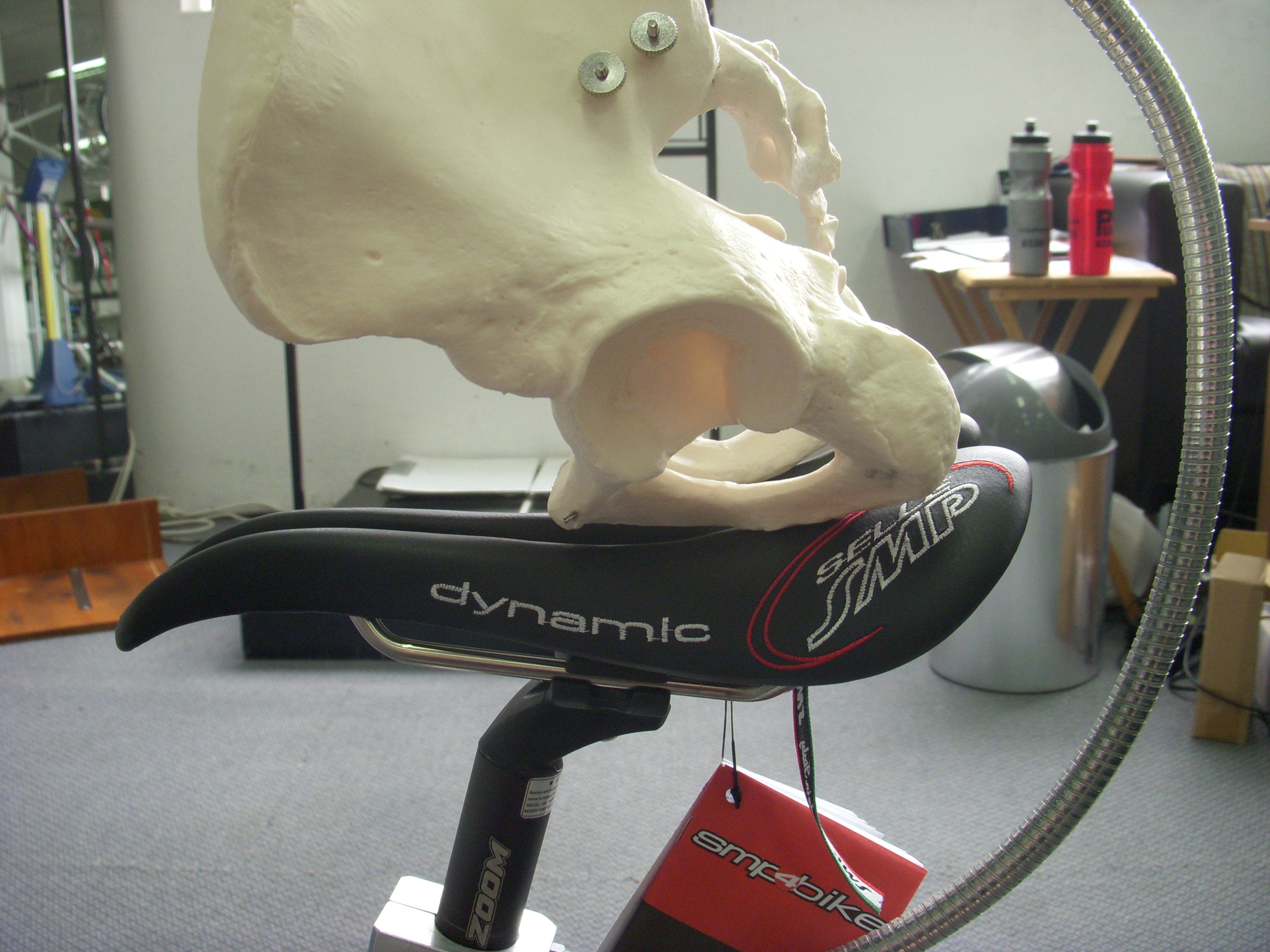
Here's Steve's model of how the pelvis interacts with the saddle:
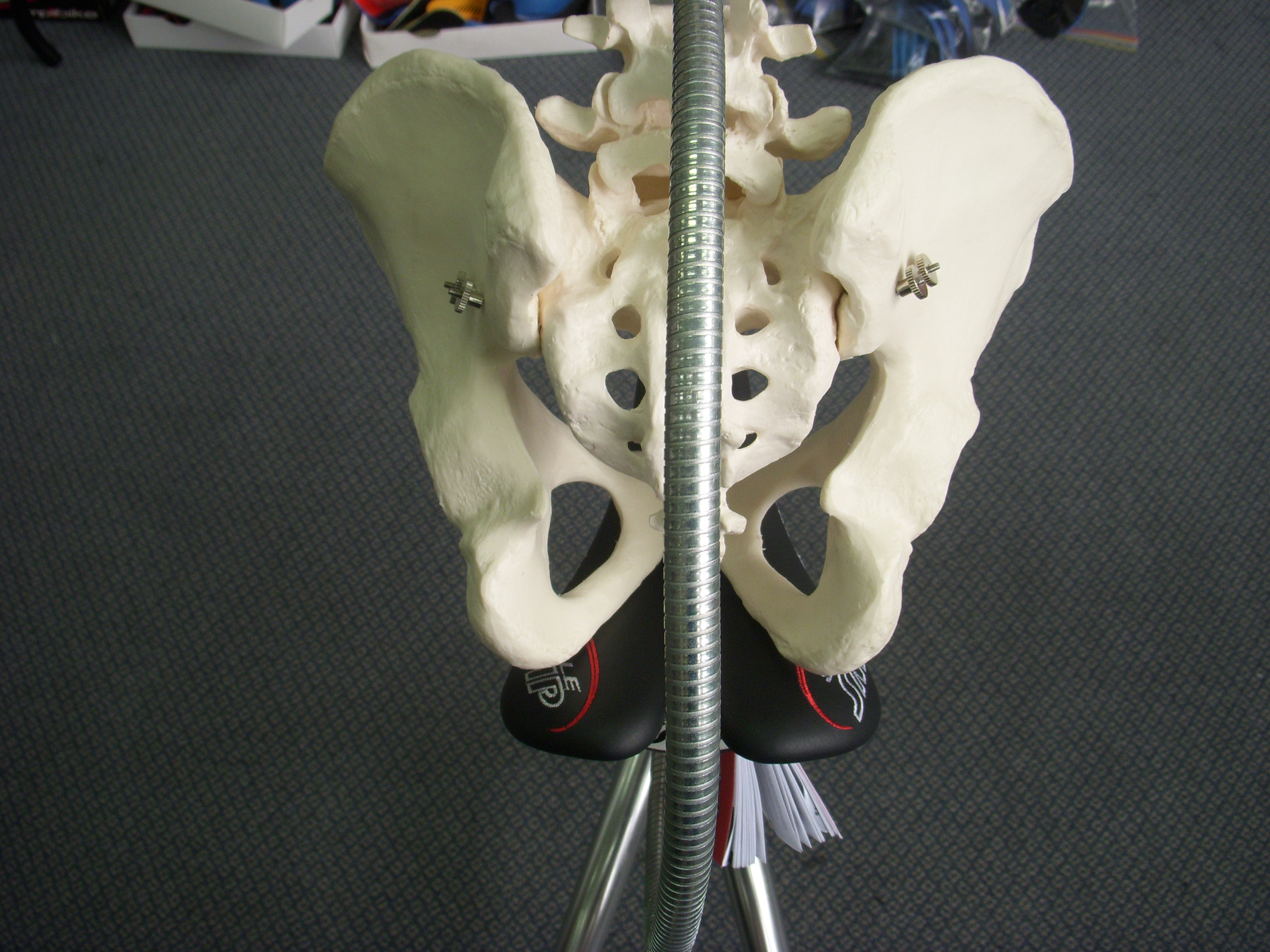
https://www.stevehoggbikefitting.com...ion-smp-seats/
As you can see, the Ischial Tuberosities are the bones floating above the P in SMP, not contacting the saddle at all at the pelvic angle at which we ride bikes.
And if you were to do the aluminum foil thing with a flat, triangular panel shaped something like a seat, you would see that the pressure marks left behind are indeed narrower than what you see when you sit on a floor because your thighs are out of the way.
Here's the kind of posture you'd need to have to get your Ischial Tuberosities in contact with the saddle:

Last edited by Kontact; 04-10-18 at 10:33 AM.
04-10-18 | 11:18 AM
#24
Senior Member
Joined: Sep 2008
Posts: 2,423
Likes: 204
From: London
Bikes: Baum Romano, Brompton S2, Homemade Bamboo!
Unfortunately, cyclists largely do not sit on the "sit bones" - the ischial tuberosity. We sit on those when upright in a chair, but leaning forward on a bicycle we sit somewhere on the narrower ischium or ramus - the rocker shaped bones going from the tuberosities to the pubis.
Specialized has popularized sit bone measuring, and then matching that number to a saddle width. But bone numbers are indirect. The outer 1/2 - 1" of saddle doesn't do anything - it just completes the shape. So that width is variable in its significance to sitting area.
So while some saddle brands may have a formula for matching sit bones to saddle widths, the overall scheme is like measuring peoples ankles to sell them shoes that are measured at the outer width of the sole, rather than measuring feet and the last.
The only really good way of finding a saddle is to sit on them. I have customers with sit bone widths exceeding the total width of the saddle. But they aren't sitting on those bones, and the ones they are sitting on fit the saddle perfectly.
Specialized has popularized sit bone measuring, and then matching that number to a saddle width. But bone numbers are indirect. The outer 1/2 - 1" of saddle doesn't do anything - it just completes the shape. So that width is variable in its significance to sitting area.
So while some saddle brands may have a formula for matching sit bones to saddle widths, the overall scheme is like measuring peoples ankles to sell them shoes that are measured at the outer width of the sole, rather than measuring feet and the last.
The only really good way of finding a saddle is to sit on them. I have customers with sit bone widths exceeding the total width of the saddle. But they aren't sitting on those bones, and the ones they are sitting on fit the saddle perfectly.
The measurement does provide a start point, but I do agree nothing replaces sitting on them.
I used to help measure for, design, and make custom seats for racing rowing (crew) boats. We got folks to sit on a foam that deformed, then we took a scaled scan of that and got to work in CAD. Once done we used a CNC router to make a seat (basically cutting custom holes in a standard seat blank).
04-10-18 | 12:20 PM
#25
Senior Member
Joined: Apr 2011
Posts: 12,679
Likes: 4,805
Pelvic angle is a far more important factor.