


Spoke tension


 12-13-21 | 08:06 AM
#28
Senior Member

Joined: Dec 2010
Posts: 9,694
Likes: 2,616
From: northern Deep South
Bikes: Fuji Touring, Novara Randonee
Two minor things you can do to mitigate the possible ill effects of this decision. First, spin the wheel before every ride. Watch the rim (or distance between brakes if you've got rim brakes) and see if it's developed a lateral hop. If it has, a spoke has come unscrewed and needs to be tightened. Second, after roughly every dozen rides, do the plink test on the NDS spokes. Again, if a plink or a plunk has progressed to a thud, that spoke needs to be re-tightened.
12-13-21 | 10:49 AM
#29
Senior Member

Joined: Jul 2014
Posts: 1,679
Likes: 826
Still, any good bike shop should have someone that can retension a wheel. It does require some experience and practice, as you've probably learned watching videos on the topic. You need to find an experienced wheelbuilder and form a relationship. Good ones are hard to find.
12-13-21 | 10:56 AM
#30
Senior Member
Joined: Mar 2012
Posts: 1,455
Likes: 987
What is missing from this discussion is how uneven the tension was before you took it to the shop. They might have really messed up the wheel or they might have done the best possible job with a wheel that uneven NDS tension to begin with. cxwrench (and others) gave good advice: if the wheel is round and true, just ride it. Keep track of how well it holds its true because if it comes out of true quickly then the wheel job wasn't a good one. Uneven tension is indeed a source of spoke breakage, but since we have no idea how much variation there actually is, we can't make any predictions.
 12-13-21 | 12:19 PM
#31

Junior Member
Joined: Sep 2016
Posts: 143
Likes: 40
From: Central Coast California
Bikes: Colnago Brain, Master Bi-Titanio, Vitus 979, Specialized Roubaix, Salsa Marrakesh, and a couple of Treks

Looks like my drive side F# is sharp
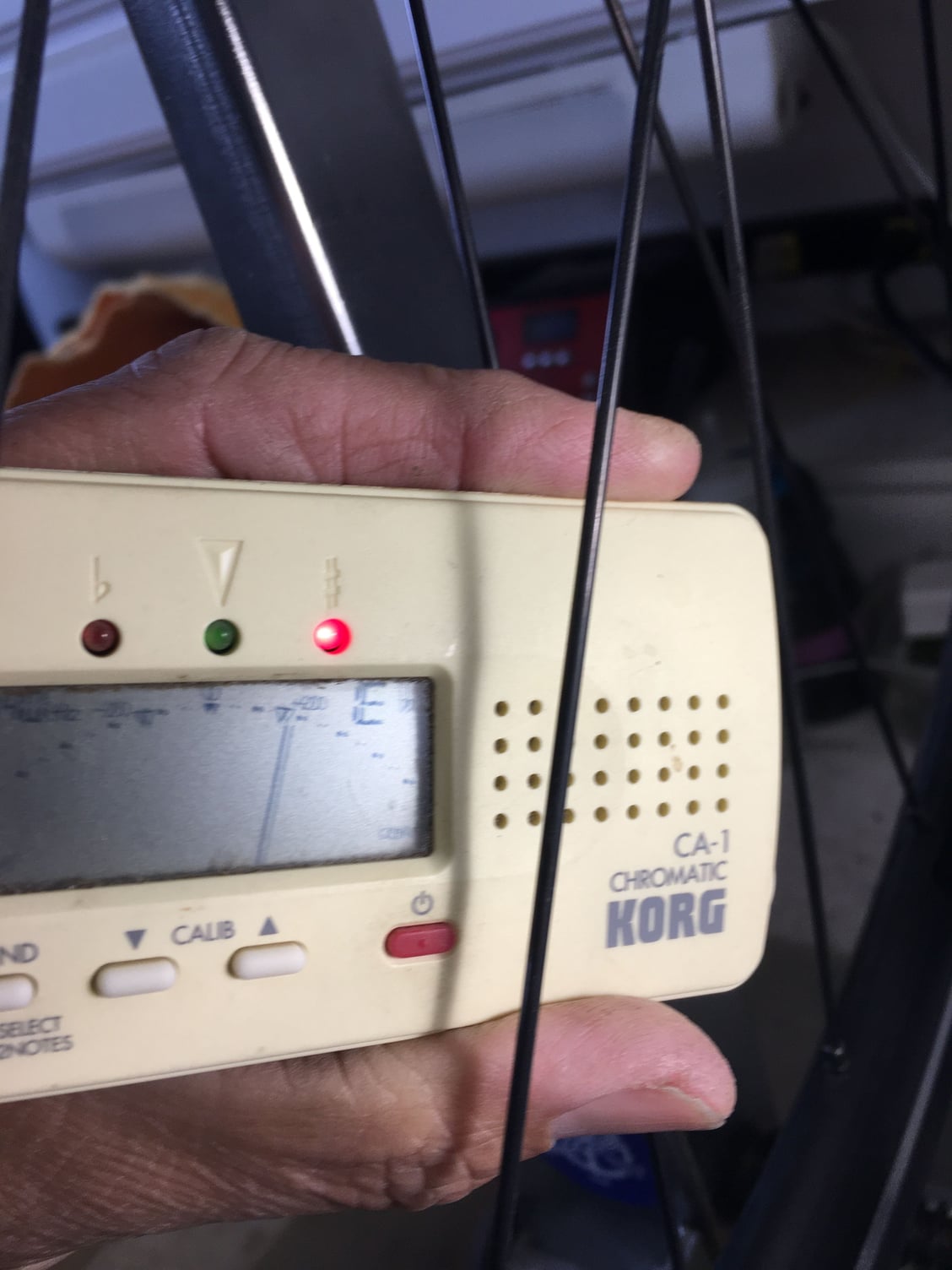
Non-drive E flat is also sharp
NDS F# ish. While the other side E flat is a little sharp. As bad as a bass player I’ll confess to, I’m worst at plucking spokes.
In general they are fine. As a Clydesdale I am not holding much hope for the cross pattern or spoke count. But much of my beliefs are old school, as the book I referenced. There are better materials now that allows for radial spokes in a rear wheel.
As @ Zandoval; mentioned, you can start getting the tools, I got my stand for $75 from a Sport’s Authorty going out of business sale.
12-13-21 | 03:00 PM
#32


Over the hill

Joined: Mar 2006
Posts: 24,626
Likes: 1,385
From: Los Angeles, CA
Bikes: Pinarello Nytro, Momentum Transend
As long as all the spokes are within a safe range of tension, it should be fine. That's hard to tell without a tension meter, though. Might want to ask the shop how they true wheels.
__________________
It's like riding a bicycle
It's like riding a bicycle
12-13-21 | 09:45 PM
#33
Senior Member
Joined: Dec 2019
Posts: 2,841
Likes: 1,062
From: South Shore of Long Island
Bikes: 2010 Carrera Volans, 2015 C-Dale Trail 2sl, 2017 Raleigh Rush Hour, 2017 Blue Proseccio, 1992 Giant Perigee, 80s Gitane Rallye Tandem
Those of us that built wheels would have the practice to really feel for what we were doing and could do it faster but that wasn't common in my experience. You can also check spoke tension visually but it is a trick, does help when truing up wheels quickly though.
12-14-21 | 06:12 AM
#34
Senior Member
Joined: Jul 2014
Posts: 1,679
Likes: 826
Reading through all of these replies, it's clear that tensioning wheels is no longer universally understood or practiced in a lot of bike shops these days. What do these shops do before they deliver a new bike to a customer? They don't check wheel true and spoke tension any more? Very few wheels come perfect right out of the box, especially with today's machine-built wheels.
It makes a huge difference in how strong the wheel is, so anyone thinking it's not important is hopefully just cruising around their neighborhood. If you're going to tour coast to coast, carrying a lot of weight or want to go bombing down a mountain trail, you need good strong wheels and that means properly tensioned spokes.
I personally don't perform this myself. I have an experienced wheelbuilder at our LBS and he does a great job on all of my wheelsets, including building new ones. If he left I would have to find another bike shop.
It makes a huge difference in how strong the wheel is, so anyone thinking it's not important is hopefully just cruising around their neighborhood. If you're going to tour coast to coast, carrying a lot of weight or want to go bombing down a mountain trail, you need good strong wheels and that means properly tensioned spokes.
I personally don't perform this myself. I have an experienced wheelbuilder at our LBS and he does a great job on all of my wheelsets, including building new ones. If he left I would have to find another bike shop.
12-14-21 | 07:58 AM
#35
Senior Member
Joined: Dec 2010
Posts: 9,694
Likes: 2,616
From: northern Deep South
Bikes: Fuji Touring, Novara Randonee
Reading through all of these replies, it's clear that tensioning wheels is no longer universally understood or practiced in a lot of bike shops these days. What do these shops do before they deliver a new bike to a customer? They don't check wheel true and spoke tension any more?.
Fast forward 10 years, getting a broken bike replaced 10 miles into my first tour. Lead mechanic (different shop) said, "You're on a cross country tour? Let me check the wheels before you leave." One wheel needed to be touched up 2,000+ miles into the ride, the other 5 minutes 1,000 miles later.
Based on those experiences, I'd guess the "standard of care" for wheels coming out of the box is ... zip. Just like checking grease in the bearings, or bearing pre-load, the default is to take it out and put the wheel on the bike. Presumably if the bike gets ridden a lot, during the warranty replacement of the first spoke they'll look at the rest of the spokes and touch them up (aka tension them adequately) at that point. Or up-sell the customer a fancy set of new wheels. Of course, as in my second example, some reason for concern comes up during the selling process, the sales person or a mechanic who overhears the conversation may take a second look at the machine built wheels.
12-14-21 | 11:09 AM
#36
Senior Member
Joined: Dec 2019
Posts: 2,841
Likes: 1,062
From: South Shore of Long Island
Bikes: 2010 Carrera Volans, 2015 C-Dale Trail 2sl, 2017 Raleigh Rush Hour, 2017 Blue Proseccio, 1992 Giant Perigee, 80s Gitane Rallye Tandem
Reading through all of these replies, it's clear that tensioning wheels is no longer universally understood or practiced in a lot of bike shops these days. What do these shops do before they deliver a new bike to a customer? They don't check wheel true and spoke tension any more? Very few wheels come perfect right out of the box, especially with today's machine-built wheels.
12-14-21 | 01:06 PM
#37
Over the hill
Joined: Mar 2006
Posts: 24,626
Likes: 1,385
From: Los Angeles, CA
Bikes: Pinarello Nytro, Momentum Transend
While it's true that machine-built wheels are usually not perfect out of the box, they are almost always safe and rideable. They're usually spec'ed very safe as well (high spoke count, strong/heavy rim). Anyone touring or racing would likely seek an expert and pay closer attention to their equipment than the typical casual rider.
__________________
It's like riding a bicycle
It's like riding a bicycle
 12-14-21 | 04:10 PM
#39
Over the hill
Joined: Mar 2006
Posts: 24,626
Likes: 1,385
From: Los Angeles, CA
Bikes: Pinarello Nytro, Momentum Transend
As a matter of fact, I recently bought a bike from Pro's Closet and technically assembled it in 15 minutes like they say. The rest of the hour was spent changing saddles, adjusting the fit, adding pedals/bottle cages/seatbag, and admiring it lovingly.
But yeah, only the top of the line downhill bike in our shop came with disc brakes back then, and the head mechanic built that. I still need to learn how to service those.
__________________
It's like riding a bicycle
It's like riding a bicycle
12-14-21 | 04:48 PM
#40
Senior Member
Joined: Feb 2018
Posts: 786
Likes: 408
The last four sets of factory wheels were perfectly functional out of the box and I've only touched them with a spoke key after significant enough crashes 🤷
I frankly wouldn't worry about it. If the wheel doesn't make any sounds and is true, I'd just ride it. If it starts to click or squeak then I'd worry about tension.
I frankly wouldn't worry about it. If the wheel doesn't make any sounds and is true, I'd just ride it. If it starts to click or squeak then I'd worry about tension.
12-14-21 | 08:12 PM
#41
Senior Member
Joined: Dec 2019
Posts: 2,841
Likes: 1,062
From: South Shore of Long Island
Bikes: 2010 Carrera Volans, 2015 C-Dale Trail 2sl, 2017 Raleigh Rush Hour, 2017 Blue Proseccio, 1992 Giant Perigee, 80s Gitane Rallye Tandem
Gonna back up urbanknight on this, when I started 22 years ago it was expected to have a bike ready to ride out the door in 20 min max, during the winter when I might spend the day doing nothing but a schwinn frontier, raleigh c30, trek 700 or something similar the first two were expected to be slower as I made sure I knew the idiosyncrasies of the bike(every c30/sc30 one year needed every cup and cone BB readjusted) and then it was expected that I would have them completely ready to ride in 15 min and the top goal was 5 an hour. Even last summer when I did some bikes, 20min for an entry level disc bike out the door wasn't all that big a deal. If you know what you're doing what to look for and how to evaluate and you're doing well over 20 bikes a day, it isn't hard to get it done and get it good.
