


Spoke tension

 12-11-21 | 07:17 PM
#2
Guest
Joined: Sep 2020
Posts: 2,886
Likes: 3,279
But out of curiosity, did you address this when you picked it up? How are you measuring the tension?
12-11-21 | 10:28 PM
#4
Senior Member
Joined: Dec 2019
Posts: 2,841
Likes: 1,062
From: South Shore of Long Island
Bikes: 2010 Carrera Volans, 2015 C-Dale Trail 2sl, 2017 Raleigh Rush Hour, 2017 Blue Proseccio, 1992 Giant Perigee, 80s Gitane Rallye Tandem
This is the pertinent question. Implicit is the understanding that tension on the non-drive is usually less than the drive and expected to be that way. As long as the wheel is straight and true. As cxwrench says, if between the spokes on one side, bring it back.
12-12-21 | 03:04 AM
#5
Senior Member

Joined: Jun 2013
Posts: 5,973
Likes: 1,397
From: SW Fl.
Bikes: 1999 DAHON Mariner, Day6 Semi Recumbent "FIREBALL", 1981 Custom Touring Paramount, 1983 Road Paramount, 2013 Giant Propel Advanced SL3, 2018 Specialized Red Roubaix Expert mech., 2002 Magna 7sp hybrid, 1976 Bassett Racing 45sp Cruiser
12-12-21 | 04:17 AM
#6
Senior Member
Joined: Mar 2008
Posts: 8,687
Likes: 301
On a bike that’s been (ab)used, sometimes you get into a tradeoff between how true you want the wheel and how even you want the spoke tension.
If the rim as such is bent, you simply can’t hit both true and even tension simultaneously.
No way to tell from here if your wheel is as good as circumstances will allow, or if it’s poor work.
If the rim as such is bent, you simply can’t hit both true and even tension simultaneously.
No way to tell from here if your wheel is as good as circumstances will allow, or if it’s poor work.
12-12-21 | 05:53 AM
#7
Thread Starter
Newbie
Joined: Nov 2021
Posts: 67
Likes: 1
It's a newish wheel, 2 months old. Pretty basic axis sport wheels. Was a little untrue so the LBS offered to true it. Went home and realised that yes the wheel is more true, but the spoke tension on the NDS is all over the place. The DS side seems even though
12-12-21 | 11:56 AM
#8

Junior Member
Joined: Sep 2016
Posts: 143
Likes: 40
From: Central Coast California
Bikes: Colnago Brain, Master Bi-Titanio, Vitus 979, Specialized Roubaix, Salsa Marrakesh, and a couple of Treks
IMHO, asking your LBS to tension the spokes and true the wheel is different than having him just true the wheel. This is based on an argument back in 1993, with a LSB about the wheels on a new bike I just purchased . It’s the age old, solve the problem or treat the symptom.
“The Bicycle Wheel”, by the late Jobst Brandt describes a wheel trueness in terms of radial, lateral, and center, as seen in the Park video. The book also goes into torsional load and stiffness. I always wondered why I could get trueness while my tension had wild variance. Once I noticed fewer spokes on wheels it occurred to me that a 24 versus a 36 spoke wheel could explain poor spoke tension uniformity (rear or front wheel). Essentially, I’m may be using fewer spokes to obtain stiffness while using the extra spokes to obtain trueness.
“The Bicycle Wheel”, by the late Jobst Brandt describes a wheel trueness in terms of radial, lateral, and center, as seen in the Park video. The book also goes into torsional load and stiffness. I always wondered why I could get trueness while my tension had wild variance. Once I noticed fewer spokes on wheels it occurred to me that a 24 versus a 36 spoke wheel could explain poor spoke tension uniformity (rear or front wheel). Essentially, I’m may be using fewer spokes to obtain stiffness while using the extra spokes to obtain trueness.
12-12-21 | 12:46 PM
#9
Thread Starter
Newbie
Joined: Nov 2021
Posts: 67
Likes: 1
Yeah, spoken to a few people who have said usually when you take a wheel to the LBS to get rid of any wobble, they usually true the wheel and as a result creates spoke tensions variances.
I know it should always be relatively equal but I wonder how many people are riding with wheels which have tension variances...
I know it should always be relatively equal but I wonder how many people are riding with wheels which have tension variances...
12-12-21 | 01:11 PM
#10

Senior Member
Joined: Aug 2011
Posts: 22,676
Likes: 2,643
From: CID
Bikes: 1991 Bianchi Eros, 1964 Armstrong, 1988 Diamondback Ascent, 1988 Bianchi Premio, 1987 Bianchi Sport SX, 1980s Raleigh mixte (hers), All-City Space Horse (hers)
 12-12-21 | 01:37 PM
#12
Thread Starter
Newbie
Joined: Nov 2021
Posts: 67
Likes: 1
12-12-21 | 02:26 PM
#13

Senior Member
Joined: Aug 2015
Posts: 2,332
Likes: 373
It might not be possible truing a used wheel and have even spoke tension at the same time. Forcing even spoke tension would likely un-true the wheel.
12-12-21 | 02:34 PM
#14

Senior Member


Joined: May 2010
Posts: 5,634
Likes: 2,504
From: Bastrop Texas
Bikes: Univega, Peu P6, Peu PR-10, Ted Williams, Peu UO-8, Peu UO-18 Mixte, Peu Dolomites
Don't have, can't afford, don't trust, can't wait, to far... bike shops. And many other reasons for doing this yourself. It's not hard. For me with bike shops 40 miles off getting the tools needed to do this at home cost less than a few trips of gas... Ha
And don't get me wrong... I love bike shops and thier people... But times are a changing...
And don't get me wrong... I love bike shops and thier people... But times are a changing...
__________________
 No matter where you're at... There you are... Δf:=f(1/2)-f(-1/2)
 12-12-21 | 04:33 PM
#16

Senior Member
Joined: Jul 2013
Posts: 3,767
Likes: 2,940
From: Nor-Cal
Bikes: lots
12-12-21 | 05:01 PM
#17
Senior Member
Joined: Jul 2014
Posts: 1,679
Likes: 827
It certainly does matter. The main cause of spokes breaking is uneven tension. A wheel needs to be both true and have even spoke tension. Small variances in tension are OK, but if they're all over the place the wheel will not be as strong and that's when spokes start breaking. That's why they make a special tool to measure it, and that should be included when any bike shop trues a wheel. If they don't have a tensionometer (or don't use it), that's not where you want to have your wheels serviced.
12-12-21 | 07:25 PM
#18


Over the hill

Joined: Mar 2006
Posts: 24,626
Likes: 1,385
From: Los Angeles, CA
Bikes: Pinarello Nytro, Momentum Transend
It's not as simple as adding or removing tension. In order to keep tension fairly even while also truing the wheel, you can often choose to loosen one while tightening the next one over (from the same side) to achieve similar trueness. Whether that is the case for the OP in this situation is up for debate.
__________________
It's like riding a bicycle
It's like riding a bicycle
12-12-21 | 07:44 PM
#19
Senior Member
Joined: Jul 2013
Posts: 3,767
Likes: 2,940
From: Nor-Cal
Bikes: lots
It certainly does matter. The main cause of spokes breaking is uneven tension. A wheel needs to be both true and have even spoke tension. Small variances in tension are OK, but if they're all over the place the wheel will not be as strong and that's when spokes start breaking. That's why they make a special tool to measure it, and that should be included when any bike shop trues a wheel. If they don't have a tensionometer (or don't use it), that's not where you want to have your wheels serviced.
It's not as simple as adding or removing tension. In order to keep tension fairly even while also truing the wheel, you can often choose to loosen one while tightening the next one over (from the same side) to achieve similar trueness. Whether that is the case for the OP in this situation is up for debate.
12-12-21 | 10:53 PM
#20
Senior Member
Joined: Dec 2019
Posts: 2,841
Likes: 1,062
From: South Shore of Long Island
Bikes: 2010 Carrera Volans, 2015 C-Dale Trail 2sl, 2017 Raleigh Rush Hour, 2017 Blue Proseccio, 1992 Giant Perigee, 80s Gitane Rallye Tandem
Video doesn't tell me anything, maybe I'm missing what you're trying to show? Easy way to get a general idea is to grab a pair of spokes and gently squeeze, do the same for all the pairs, unless you have one that is noticeably loose or really tight you're probably fine.
12-12-21 | 11:52 PM
#21
Guest
Joined: Sep 2020
Posts: 2,886
Likes: 3,279
Hmm. I don't think I've ever encountered a shop that evaluated all the spokes with a tensiometer during a routine wheel truing service.
12-13-21 | 12:30 AM
#22
Junior Member
Joined: Sep 2016
Posts: 143
Likes: 40
From: Central Coast California
Bikes: Colnago Brain, Master Bi-Titanio, Vitus 979, Specialized Roubaix, Salsa Marrakesh, and a couple of Treks
Because I’m in the middle of building my own birthday present (NOS CAAD8 frame, with take-off components from a 2015 Specialized Roubaix). I decided to check the Axis 1.0 wheels. 28 spoke, 2cross and radial lace (crazy I never noticed). After a quick and dirty lateral true, the (haven’t been used since the 90’s) Wheelsmith reading is 70 non-drive, and 90 drive. There were two out of wack non-drive reading 50, and two 100 reading on the other side. The wheels had a couple hundred miles before taken off the Roubaix.
Should I have measured before trueing…yeah.
Am I concerned about the tension…not really
Will I geek over this…only because it’s fun and makes my family avoid me if I talk about it.
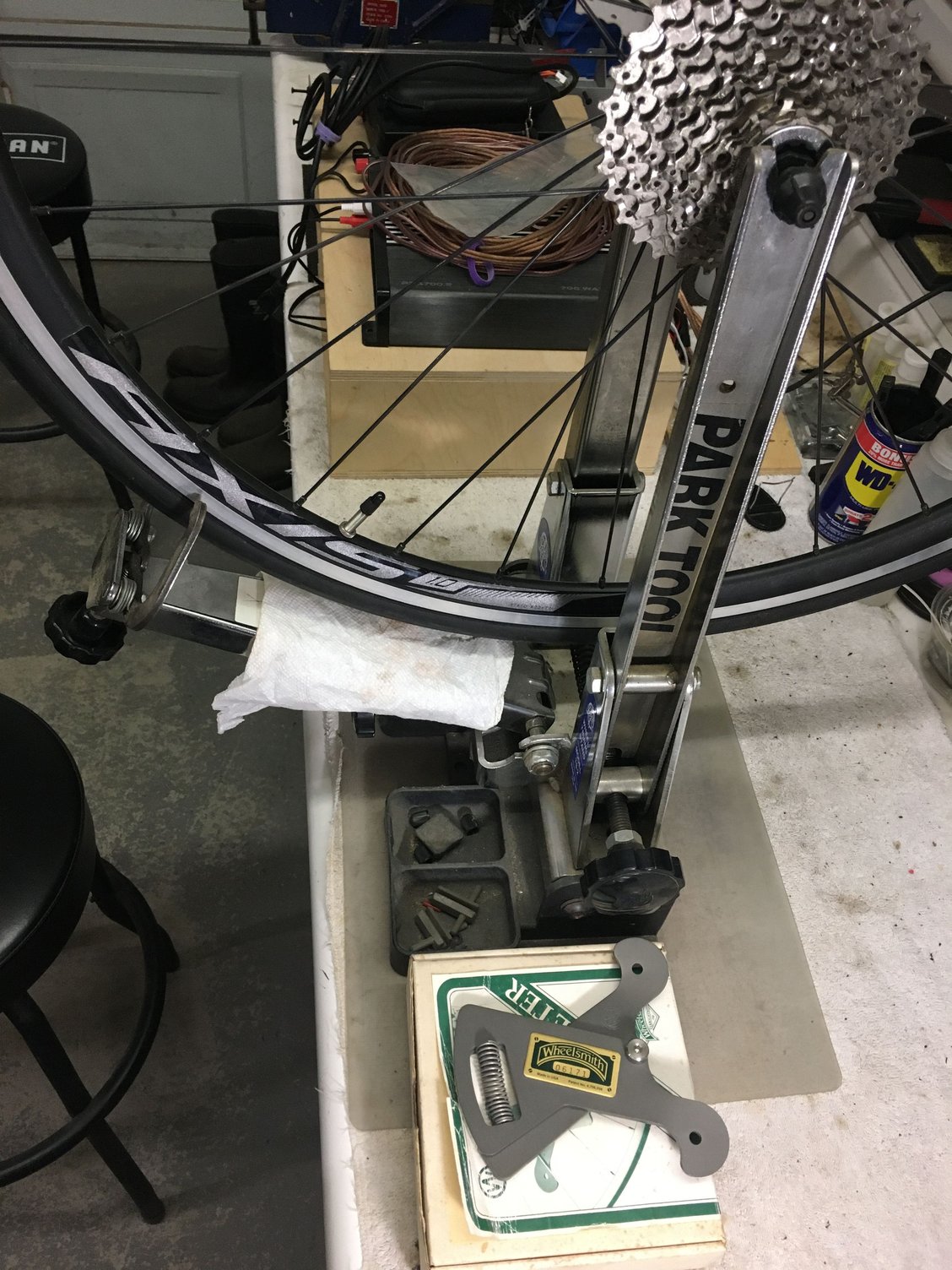
Specialized Axis 1 wheel.
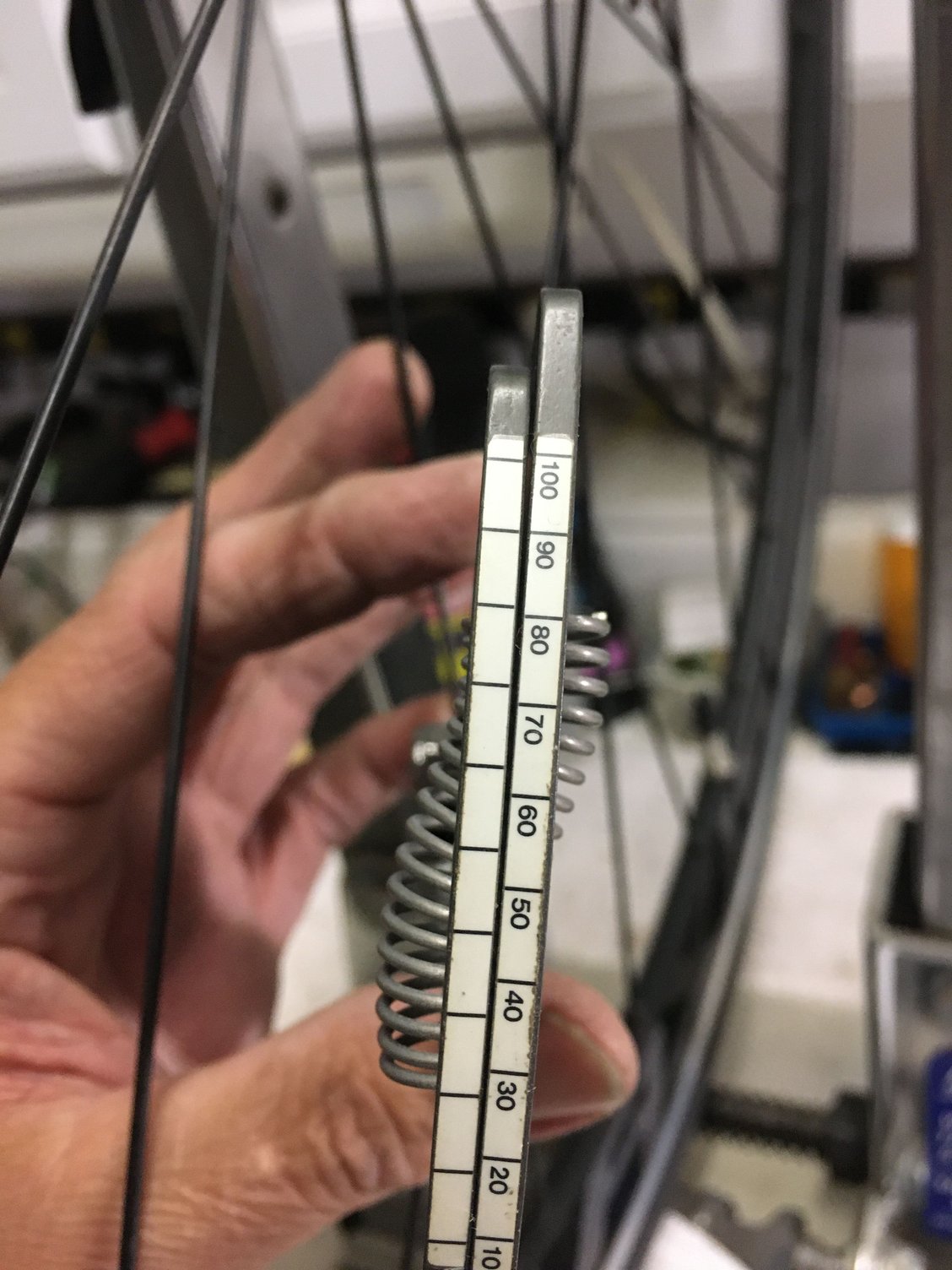
Drive side reads 90.

Non-drive reads 70.
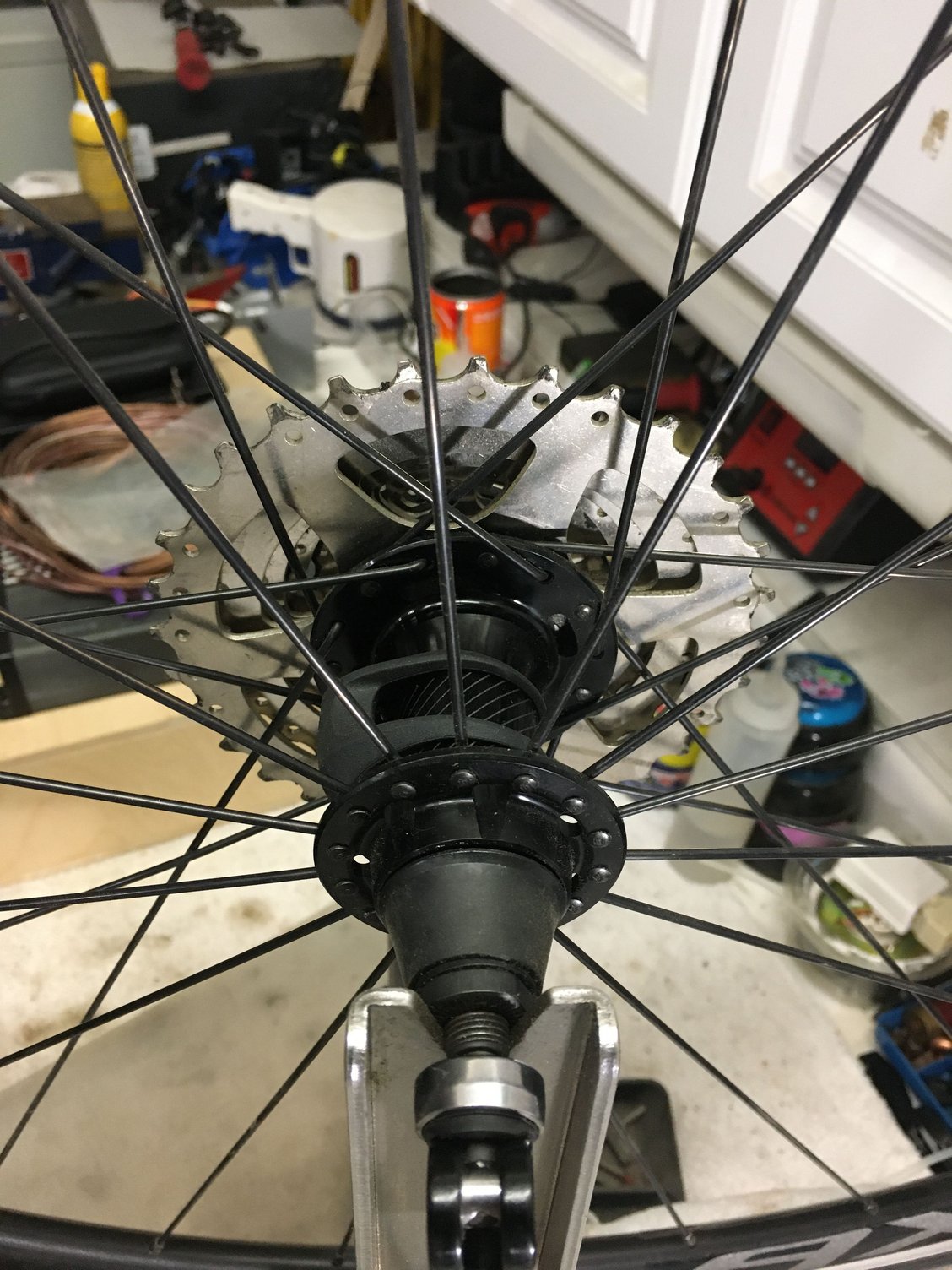
Radial spokes on the Non-drive side.
Should I have measured before trueing…yeah.
Am I concerned about the tension…not really
Will I geek over this…only because it’s fun and makes my family avoid me if I talk about it.
Specialized Axis 1 wheel.
Drive side reads 90.
Non-drive reads 70.
Radial spokes on the Non-drive side.
12-13-21 | 03:27 AM
#23
Thread Starter
Newbie
Joined: Nov 2021
Posts: 67
Likes: 1
That's where a lot of skill or a tensiometer comes in. Unless the rim is bent it is possible to even the spoke tension to within a proper range. When doing a wheel that's out of whack tension wise I check all the spokes one one side and pick a middle spot (say 100 if the spoke range is 120-60) then bring all the spokes to that tension, then the same to the other side before rechecking the 1st side. Once done bring the tension back up to close to normal, check true, straight and round and finish tension. Most don't ever need that extreme but it happens.
Video doesn't tell me anything, maybe I'm missing what you're trying to show? Easy way to get a general idea is to grab a pair of spokes and gently squeeze, do the same for all the pairs, unless you have one that is noticeably loose or really tight you're probably fine.
Video doesn't tell me anything, maybe I'm missing what you're trying to show? Easy way to get a general idea is to grab a pair of spokes and gently squeeze, do the same for all the pairs, unless you have one that is noticeably loose or really tight you're probably fine.
12-13-21 | 04:19 AM
#24
Thread Starter
Newbie
Joined: Nov 2021
Posts: 67
Likes: 1
Because I’m in the middle of building my own birthday present (NOS CAAD8 frame, with take-off components from a 2015 Specialized Roubaix). I decided to check the Axis 1.0 wheels. 28 spoke, 2cross and radial lace (crazy I never noticed). After a quick and dirty lateral true, the (haven’t been used since the 90’s) Wheelsmith reading is 70 non-drive, and 90 drive. There were two out of wack non-drive reading 50, and two 100 reading on the other side. The wheels had a couple hundred miles before taken off the Roubaix.
Should I have measured before trueing…yeah.
Am I concerned about the tension…not really
Will I geek over this…only because it’s fun and makes my family avoid me if I talk about it.
Specialized Axis 1 wheel.
Drive side reads 90.
Non-drive reads 70.
Radial spokes on the Non-drive side.
Should I have measured before trueing…yeah.
Am I concerned about the tension…not really
Will I geek over this…only because it’s fun and makes my family avoid me if I talk about it.
Specialized Axis 1 wheel.
Drive side reads 90.
Non-drive reads 70.
Radial spokes on the Non-drive side.
 , how have you found it in the long term?
12-13-21 | 05:11 AM
, how have you found it in the long term?
12-13-21 | 05:11 AM
#25
Senior Member
Joined: Jul 2014
Posts: 1,679
Likes: 827
Yes, it does. If you check Youtube you'll find a few guys showing how to measure tension with a guitar tuning app on your phone and plucking the spokes, and some old-timers claim to be able to get it pretty close by ear. The best and most accurate way is still with a tensiometer.