


Planing?
 11-20-24 | 11:19 PM
#176
Senior Member


Joined: May 2021
Posts: 3,179
Likes: 2,384
From: San Francisco
Bikes: addict, aethos, creo, vanmoof, sirrus, public ...
 ) to be used to flex the frame rather than turn the cranks? maybe because different muscles are used, at different points in the motion? and that the return of that energy is as efficient as just turning the wheel?
 11-20-24 | 11:42 PM
#177

Senior Member


Joined: Apr 2011
Posts: 12,780
Likes: 4,885
you said better. better is better. the human engine has a fixed amount of power. energy is not coming from anywhere else. are you saying it’s better for some of that energy (obviously not all ) to be used to flex the frame rather than turn the cranks? maybe because different muscles are used, at different points in the motion? and that the return of that energy is as efficient as just turning the wheel?
) to be used to flex the frame rather than turn the cranks? maybe because different muscles are used, at different points in the motion? and that the return of that energy is as efficient as just turning the wheel?The second part you are implying is a problem is the fact that I'm suggesting frame flex would be a good way to do that. And that's probably because flex is a dirty word in cycling. But in engineering it is well understood that springs are some of the most efficient devices for storing and returning energy. Steel, ti and carbon frames are composed of excellent spring materials, and the fact that all of this flexing can happen without the addition of extra linkages, bearings and hardware means that there aren't additional energy losses due to friction.
And as I mentioned, bike flex provides the same sort of pedaling smoothing as oval chainrings, but has perfect feedback since it isn't prescheduled like a machined oval chainring is. Bike flex happens instantaneously and at exactly the same level as the pedaling input force.
So while you are trying to make it sound stupid that very efficient spring flex might be better than less efficient pedaling motion - that is exactly what I'm saying. Maybe trying to get a person to emulate a motor on rigid mount is a little stupid.
11-21-24 | 12:26 AM
#178

Senior Member

Joined: Jun 2015
Posts: 3,379
Likes: 2,020
From: Pacific Northwest
Bikes: Yes.
I'm not a smart man. But I know what Google is.
I typed the phrase "cyclical addition of forces" into my favorite Internet sort engine. The top 2 useful results are linked here:
https://eng.libretexts.org/Bookshelv...ector_Addition
https://www.physicsclassroom.com/cla...tion-of-Forces
What do they mean? Well, they mean that at the right combination of inputs to a system, a new output can be achieved in a reliable & predictable manner.
As to all this talk of professional this, professional that...I have no doubt that the bikes ridden by professionals are optimized for the 350 watts at 85-95 rpm that professional tend to ride at. And also true, there is nothing to be gained and a lot to be lost for even letting the mention of the term "planing" to be heard outside the confines of the engineers desk. Why even mention it at all? None of us, the bike buying public, have the strength to take advantage of such a property even if we wanted to. Those that can? They have their bikes at the track or on the course with huge race winning smiles on their faces. Simply happy with the engineering of their race winning bike however it got them there.
The old mantra of "stiffer is always faster" has fallen by the wayside with better, more comprehensive modeling. Curious.
I see no reason that so called "planing" should be dismissed out of hand. Bikes suffer all kinds of oscillating forces that do not necessarily "cancel out." Whose to say they can not be additive as well? Indeed, the speed wobble shimmies is one such example.
I typed the phrase "cyclical addition of forces" into my favorite Internet sort engine. The top 2 useful results are linked here:
https://eng.libretexts.org/Bookshelv...ector_Addition
https://www.physicsclassroom.com/cla...tion-of-Forces
What do they mean? Well, they mean that at the right combination of inputs to a system, a new output can be achieved in a reliable & predictable manner.
As to all this talk of professional this, professional that...I have no doubt that the bikes ridden by professionals are optimized for the 350 watts at 85-95 rpm that professional tend to ride at. And also true, there is nothing to be gained and a lot to be lost for even letting the mention of the term "planing" to be heard outside the confines of the engineers desk. Why even mention it at all? None of us, the bike buying public, have the strength to take advantage of such a property even if we wanted to. Those that can? They have their bikes at the track or on the course with huge race winning smiles on their faces. Simply happy with the engineering of their race winning bike however it got them there.
The old mantra of "stiffer is always faster" has fallen by the wayside with better, more comprehensive modeling. Curious.
I see no reason that so called "planing" should be dismissed out of hand. Bikes suffer all kinds of oscillating forces that do not necessarily "cancel out." Whose to say they can not be additive as well? Indeed, the speed wobble shimmies is one such example.
11-21-24 | 06:06 AM
#179
Senior Member
Joined: Oct 2010
Posts: 8,841
Likes: 2,859
These "planing" frames are still available from Radio Flyer. There must be something to it. I don't see any pedals on that thing.
Last edited by seypat; 11-21-24 at 07:39 AM.
11-21-24 | 07:35 AM
#180
Senior Member
Joined: Apr 2011
Posts: 12,780
Likes: 4,885
Bikes are already "inchworming" because they are driven by two pistons that have short power strokes.
11-21-24 | 09:54 AM
#181
Perceptual Dullard
Joined: Sep 2009
Posts: 2,923
Likes: 1,761
11-21-24 | 10:05 AM
#182
Perceptual Dullard
Joined: Sep 2009
Posts: 2,923
Likes: 1,761
Jan Heine, Editor, Bicycle Quarterly November 28, 2014 at 7:22 am #
Just like you, I have published extensively in peer-reviewed journals in my previous career as a geologist. BQ contributor Mark Vande Kamp still works as a scientist designing exactly these kinds of studies. He frequently publishes in peer-reviewed journals.
Many people assume that Bicycle Quarterly‘s articles are not peer-reviewed. This is incorrect: All our important test articles are peer-reviewed. This is unique among cycling publications. The double-blind test was reviewed by Jim Papadopoulos and Hank Folsom. Jim is probably the most scientific of bicycle researchers, having published in Science and other prestigious journals.
Just like you, I have published extensively in peer-reviewed journals in my previous career as a geologist. BQ contributor Mark Vande Kamp still works as a scientist designing exactly these kinds of studies. He frequently publishes in peer-reviewed journals.
Many people assume that Bicycle Quarterly‘s articles are not peer-reviewed. This is incorrect: All our important test articles are peer-reviewed. This is unique among cycling publications. The double-blind test was reviewed by Jim Papadopoulos and Hank Folsom. Jim is probably the most scientific of bicycle researchers, having published in Science and other prestigious journals.
[Edited to add:] That may have sounded harsher than I intended. In my first post in this thread, I said that Jan has interesting ideas, lots of them, but doesn't do good experiments; and that I give him credit for interesting ideas but not dispositive proof. There's a place in this world for people who have interesting ideas, even if not all of them pan out. I'm not very imaginative so I like it when people with imagination contribute. The world would be duller without them.
Last edited by RChung; 11-21-24 at 10:49 AM.
11-21-24 | 10:33 AM
#183

Habitual User
Joined: Jan 2020
Posts: 9,928
Likes: 10,767
From: Altadena, CA
Bikes: 2025 Ritte Esprit, 2023 Niner RLT 9 RDO, 2022 Trek Supercaliber
__________________
RIP 01/08/25...2022 Trek Supercaliber, 2018 Storck Fascenario.3 Platinum, 2018 Trek Procaliber SL Singlespeed, 2017 Bear BR1, 2003 Time VX Special Pro, 2001 Colnago VIP, 1999 Trek 9900 singlespeed, 1977 Nishiki ONP
RIP 01/08/25...2022 Trek Supercaliber, 2018 Storck Fascenario.3 Platinum, 2018 Trek Procaliber SL Singlespeed, 2017 Bear BR1, 2003 Time VX Special Pro, 2001 Colnago VIP, 1999 Trek 9900 singlespeed, 1977 Nishiki ONP
11-21-24 | 11:56 AM
#184

Thread Starter
ignominious poltroon
Joined: Jan 2022
Posts: 6,027
Likes: 5,378

By Nick Webb. - Flickr: Oscar Pistorius., CC BY 2.0, https://commons.wikimedia.org/w/inde...curid=21029911
11-21-24 | 12:58 PM
#185
Habitual User
Joined: Jan 2020
Posts: 9,928
Likes: 10,767
From: Altadena, CA
Bikes: 2025 Ritte Esprit, 2023 Niner RLT 9 RDO, 2022 Trek Supercaliber
Your analogies with simple devices are irrelevant, because those simple devices don't behave the same as a bicycle frame. If analogies were all that were required, I'd make the (equally bad) argument that tennis racquets prove that a stiffer frame is better. (Because a stiff racquet gives you more power than a flexible racquet, and is therefore more efficient.)
In addition to the additional length for an effectively longer arm (and an additional hinge point in the system), the ball-chucker benefits from the unloading of stored energy in the flex of the shaft, similar to a hockey stick.
__________________
RIP 01/08/25...2022 Trek Supercaliber, 2018 Storck Fascenario.3 Platinum, 2018 Trek Procaliber SL Singlespeed, 2017 Bear BR1, 2003 Time VX Special Pro, 2001 Colnago VIP, 1999 Trek 9900 singlespeed, 1977 Nishiki ONP
RIP 01/08/25...2022 Trek Supercaliber, 2018 Storck Fascenario.3 Platinum, 2018 Trek Procaliber SL Singlespeed, 2017 Bear BR1, 2003 Time VX Special Pro, 2001 Colnago VIP, 1999 Trek 9900 singlespeed, 1977 Nishiki ONP
11-21-24 | 01:58 PM
#186
Senior Member
Joined: Jul 2009
Posts: 8,296
Likes: 11,380
Bikes: Colnago, Van Dessel, Factor, Cervelo, Ritchey
My comments were about a chuck-it, not prosthetic limbs. They are different.
This is true, but it misses the point. In this particular case, a stiff carbon fiber racquet frame makes the racquet more efficient, but this doesn't mean every system benefits from higher stiffness. Likewise, you can't conclude all systems benefit from more flexibility, just because some other simple systems benefit from more flexibility. You have to analyze the system of interest itself, and not blindly make analogies with simple systems that are inherently different.
11-21-24 | 02:11 PM
#187
Senior Member
Joined: Jul 2009
Posts: 8,296
Likes: 11,380
Bikes: Colnago, Van Dessel, Factor, Cervelo, Ritchey
I've taught both undergrads and graduates. I tell them that as undergrads, we teach them the simple models; as graduates, we teach them the full-on, detailed, obsessive models; and as professors we spend the rest of our careers figuring out when we have to do the detailed full-on exhaustive and exhausting thing and when we can get away with the simple thing.
11-21-24 | 02:14 PM
#188

Disco Infiltrator
Joined: May 2013
Posts: 15,350
Likes: 3,551
From: Folsom CA
Bikes: Stormchaser, Paramount, Tilt, Samba tandem
The disappointing thing about the Chuck-it is that it's only half as complex as an atlatl
__________________
Genesis 49:16-17
"Well, well!" said Holmes, impatiently. "A good cyclist does not need a high road. The moor is intersected with paths and the moon is at the full."
Genesis 49:16-17
"Well, well!" said Holmes, impatiently. "A good cyclist does not need a high road. The moor is intersected with paths and the moon is at the full."
11-21-24 | 03:20 PM
#189
Thread Starter
ignominious poltroon
Joined: Jan 2022
Posts: 6,027
Likes: 5,378
You said the only difference was that it was a limb extension. This one is a limb replacement, yet he was disqualified because it gave a mechanical advantage. Why would that be? I am genuinely stumped.
11-21-24 | 03:32 PM
#191

Klaatu..Verata..Necktie?
Joined: May 2007
Posts: 23,887
Likes: 17,295
From: SF Bay Area
Bikes: Litespeed Ultimate, Ultegra; Canyon Endurace, 105; Battaglin MAX, Chorus; Bianchi 928 Veloce; Ritchey Road Logic, Dura Ace; Cannondale R500 RX100; Schwinn Circuit, Sante; Lotus Supreme, Dura Ace
For me, the complexity of the atlatl is in the name. Is it "At-Lattle" or "Attle-Attle"?
__________________
"Don't take life so serious-it ain't nohow permanent."
"Everybody's gotta be somewhere." - Eccles
"Don't take life so serious-it ain't nohow permanent."
"Everybody's gotta be somewhere." - Eccles
11-21-24 | 04:25 PM
#192

Broken neck Ken
Joined: Oct 2008
Posts: 5,221
Likes: 3,520
From: Portland, OR
Bikes: Trek Domane SL6 Gen 3, Soma Fog Cutter, Detroit Bikes Sparrow FG, Trek Mt Track XCNimbus MUni
I dunno; I think all this talk of 'planing' is really kewl; gives new justification for the typical silly bike reviewer talk of 'steeds' that just seem to 'leap forward' once one touches the peddles pedals.
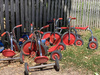
FWIW, given the latest twist on this 'theory' just upthread, I propose a new name for 'planing'; I propose 'inchworming' as a much more accurate simile. Think about it: the frame flexes, and that 'stored energy' is then somehow, by some mysterious process, fed back not to the chainset -- you know, that thing withpeddles pedals that actually is turned by the cyclist's legs and drives the bike forward by transmitting that energy to the rear wheel via the chain drive -- but directly to the rear of the frame. Happy to provide a visual demonstration of this process (caveat -- I may, of course, being a non-technical person, have misunderstood this magical mechanism):
https://www.youtube.com/watch?v=H3_H557-vBI
FWIW, given the latest twist on this 'theory' just upthread, I propose a new name for 'planing'; I propose 'inchworming' as a much more accurate simile. Think about it: the frame flexes, and that 'stored energy' is then somehow, by some mysterious process, fed back not to the chainset -- you know, that thing with
https://www.youtube.com/watch?v=H3_H557-vBI
11-21-24 | 04:47 PM
#193
Thread Starter
ignominious poltroon
Joined: Jan 2022
Posts: 6,027
Likes: 5,378
 11-21-24 | 05:05 PM
#195
Thread Starter
ignominious poltroon
Joined: Jan 2022
Posts: 6,027
Likes: 5,378
Yeah, but Nirvana was from Seattle.
11-21-24 | 06:35 PM
#196
Senior Member
Joined: Jul 2009
Posts: 8,296
Likes: 11,380
Bikes: Colnago, Van Dessel, Factor, Cervelo, Ritchey
How so? There seems to be a lot of similarities, although my example is probably more relevant.
You said the only difference was that it was a limb extension. This one is a limb replacement, yet he was disqualified because it gave a mechanical advantage. Why would that be? I am genuinely stumped.
You said the only difference was that it was a limb extension. This one is a limb replacement, yet he was disqualified because it gave a mechanical advantage. Why would that be? I am genuinely stumped.
11-21-24 | 06:39 PM
#197
Thread Starter
ignominious poltroon
Joined: Jan 2022
Posts: 6,027
Likes: 5,378
11-21-24 | 07:08 PM
#198

Senior Member
Joined: Mar 2024
Posts: 1,950
Likes: 784
From: San Diego
Bikes: Columbine, Lynskey GR300, Paramount Track Bike, Colnago Super (4), Santana Tandems (1995 & 2007), Gary Fisher Piranha (retired), Bianchi Track Bike, a couple of Honda mountain bikes
Not so fast ...
About 10 years ago we bought a trampoline for our kids. There were two options, which essentially were "lively" or "safe." We bought the safe one. I tried it a few times, and it always felt kind of dead. The lively ones are designed to be much more elastic. So for the same amount of effort, you can bounce much higher on the lively/elastic trampoline compared to the damped/safe one, which is rather inelastic, and absorbs the energy of the user trying to jump around. It is actually quite exhausting, and in my opinion, ruins the fun. But it does have the merit of reducing collisions and other injuries.
There is nothing remotely unphysical about this kind of explanation. Why would "planing" be any different?
About 10 years ago we bought a trampoline for our kids. There were two options, which essentially were "lively" or "safe." We bought the safe one. I tried it a few times, and it always felt kind of dead. The lively ones are designed to be much more elastic. So for the same amount of effort, you can bounce much higher on the lively/elastic trampoline compared to the damped/safe one, which is rather inelastic, and absorbs the energy of the user trying to jump around. It is actually quite exhausting, and in my opinion, ruins the fun. But it does have the merit of reducing collisions and other injuries.
There is nothing remotely unphysical about this kind of explanation. Why would "planing" be any different?
 11-21-24 | 08:56 PM
#199
Thread Starter
ignominious poltroon
Joined: Jan 2022
Posts: 6,027
Likes: 5,378
11-21-24 | 09:12 PM
#200

Senior Member

Joined: Jan 2005
Posts: 9,878
Likes: 160
From: BOSTON BABY
I didn’t say “FTP.” I said “power,” because that’s what Jan Heine said. I’m quoting Heine directly because I’m trying to take his idea seriously and to respond to the specific parts that I think are wrong. Other people in the thread have said FTP, but I’m not one of them. You’re saying that this claim of a 12% power increase is an anecdote about a single rider, and that’s great! I agree completely! But Jan Heine says that this anecdote proves planing, a phenomenon he defines as allowing riders to produce more power, is real. Meanwhile, another of the interlocutors in this thread has been lambasting me for rejecting this isolated data point. I get that you all aren’t coordinating, but no one here seems to agree on terms or even to be defending Jan’s actual definition of planing, instead selecting a definition that makes sense to the person writing the post. So I’ll lay out the three major categories of planing people seem to be arguing for.
1. Planing is real, strong form. This is Jan Heine’s idea that a bike that planes allows the rider to produce significantly more power, over essentially all durations. This is the idea I think is basically unsupportable given everything we know about physiology and material properties.
2. Planing is real, weak form. This is the idea that frame flex is beneficial and a flexible bike can be faster than a stiffer bike due to factors like a stiff bike causing the tires to skip about. I think this idea is very plausible but the range of circumstances where a bike could have too much drivetrain stiffness is probably pretty narrow. British Cycling has been brought up in this context, and since British Cycling is mostly concerned with track bikes, which have very short chainstays and very skinny tires, that makes sense to me. I don’t really believe that any bikes being used in professional road racing are losing power due to excessive stiffness. With 28 and 30 mm tires now standardized in pro racing, I don’t think a bike in the style of the French constructeurs can plausibly be faster than a carbon fiber superbike on this basis.
3. Not even planing. This is just about the ineffable and romantic qualities of a bike with a really magical ride quality. It’s the feeling of floating over the road while still feeling connected to it, of the mix of comfort and liveliness that the best steel and titanium frames are renowned for. This is definitely a thing and bikes like this feel great irrespective of how fast they are. They’re a joy to ride. It’s just not at all what Jan Heine means by “planing.”
It seems like you’re arguing point number 2, and as I said I don’t really have much of a beef with it. I just a) think the real world circumstances where a bike could be too stiff in the driveline are very rare and b) don’t really think this is the key idea of “planing” as described by Jan Heine.
1. Planing is real, strong form. This is Jan Heine’s idea that a bike that planes allows the rider to produce significantly more power, over essentially all durations. This is the idea I think is basically unsupportable given everything we know about physiology and material properties.
2. Planing is real, weak form. This is the idea that frame flex is beneficial and a flexible bike can be faster than a stiffer bike due to factors like a stiff bike causing the tires to skip about. I think this idea is very plausible but the range of circumstances where a bike could have too much drivetrain stiffness is probably pretty narrow. British Cycling has been brought up in this context, and since British Cycling is mostly concerned with track bikes, which have very short chainstays and very skinny tires, that makes sense to me. I don’t really believe that any bikes being used in professional road racing are losing power due to excessive stiffness. With 28 and 30 mm tires now standardized in pro racing, I don’t think a bike in the style of the French constructeurs can plausibly be faster than a carbon fiber superbike on this basis.
3. Not even planing. This is just about the ineffable and romantic qualities of a bike with a really magical ride quality. It’s the feeling of floating over the road while still feeling connected to it, of the mix of comfort and liveliness that the best steel and titanium frames are renowned for. This is definitely a thing and bikes like this feel great irrespective of how fast they are. They’re a joy to ride. It’s just not at all what Jan Heine means by “planing.”
It seems like you’re arguing point number 2, and as I said I don’t really have much of a beef with it. I just a) think the real world circumstances where a bike could be too stiff in the driveline are very rare and b) don’t really think this is the key idea of “planing” as described by Jan Heine.
Last edited by grolby; 11-21-24 at 09:34 PM.