


Planing?
 11-20-24 | 12:04 PM
#126
Banned.
Joined: Jul 2006
Posts: 4,287
Likes: 838
Probably not, the blog and previous articles are all a mess since conversion of the Rene Herse site into an SEO-optimized format.
 11-20-24 | 12:07 PM
#127
Banned.
Joined: Jul 2006
Posts: 4,287
Likes: 838
This is all non-responsive. No, Jan hasn’t provided data that supports planing. Yes, he has provided data, but the data doesn’t show what says it shows. Jan’s musings about how a “longer power stroke” allows you to put more power into the bike because you’re not pushing against a brick wall, aren’t a mechanism. He doesn’t explain why this works, and he can’t because the whole idea doesn’t conform to physical laws. Meanwhile, all you’ve got to say in response is that I’m a big dumdum who just doesn’t understand Jan’s brilliant analysis - classic appeal to authority. I’m done with this.
 11-20-24 | 12:12 PM
#128

Klaatu..Verata..Necktie?


Joined: May 2007
Posts: 23,887
Likes: 17,295
From: SF Bay Area
Bikes: Litespeed Ultimate, Ultegra; Canyon Endurace, 105; Battaglin MAX, Chorus; Bianchi 928 Veloce; Ritchey Road Logic, Dura Ace; Cannondale R500 RX100; Schwinn Circuit, Sante; Lotus Supreme, Dura Ace
Somebody should try stating it as a testable hypothesis and outline methods for testing it. Enough with the handwaving horse poop.
__________________
"Don't take life so serious-it ain't nohow permanent."
"Everybody's gotta be somewhere." - Eccles
"Don't take life so serious-it ain't nohow permanent."
"Everybody's gotta be somewhere." - Eccles
11-20-24 | 12:20 PM
#129
Banned.
Joined: Jul 2006
Posts: 4,287
Likes: 838
I'll see if I can get the full paper.
11-20-24 | 12:22 PM
#130

Edit: to make my point abundantly clear, "the flex returned to the drivetrain" is weasel wording. The flex, a.k.a. force, that is returned to the drivetrain doesn't magically leap through the bottom bracket and chainring and into the chain.
If what's happening is anything at all like the description says, the returned force is pushing the pedal against the foot, presenting another load that your foot has to work against, in addition to the load represented by pulling of the chain to drive the wheel.
Last edited by Trakhak; 11-20-24 at 12:37 PM.
11-20-24 | 12:26 PM
#131
Klaatu..Verata..Necktie?
Joined: May 2007
Posts: 23,887
Likes: 17,295
From: SF Bay Area
Bikes: Litespeed Ultimate, Ultegra; Canyon Endurace, 105; Battaglin MAX, Chorus; Bianchi 928 Veloce; Ritchey Road Logic, Dura Ace; Cannondale R500 RX100; Schwinn Circuit, Sante; Lotus Supreme, Dura Ace
It seems that this has already been done, at least once and did not replicate Jan's finding(s): https://keep.lib.asu.edu/items/134771
I'll see if I can get the full paper.
I'll see if I can get the full paper.
__________________
"Don't take life so serious-it ain't nohow permanent."
"Everybody's gotta be somewhere." - Eccles
"Don't take life so serious-it ain't nohow permanent."
"Everybody's gotta be somewhere." - Eccles
11-20-24 | 12:33 PM
#132

Senior Member

Joined: Apr 2011
Posts: 12,780
Likes: 4,885
This is all non-responsive. No, Jan hasn’t provided data that supports planing. Yes, he has provided data, but the data doesn’t show what says it shows. Jan’s musings about how a “longer power stroke” allows you to put more power into the bike because you’re not pushing against a brick wall, aren’t a mechanism. He doesn’t explain why this works, and he can’t because the whole idea doesn’t conform to physical laws. Meanwhile, all you’ve got to say in response is that I’m a big dumdum who just doesn’t understand Jan’s brilliant analysis - classic appeal to authority. I’m done with this.
Just off-the-charts motte-and-bailey argumentation from Team Planing in this thread. Start with the claim that planing is real and works the way Jan Heine says it does: a kind of flex that allows a rider to produce more power on a bike that has this property than on one that doesn’t, all other factors being equal. When challenged on that idea, retreat to a more defensible but less provocative or even straight up banal argument while pretending that’s what you were arguing all along: “Oh, it’s not 12%.” “It means storing energy in frame flex can be beneficial rather than harmful.” “It means that more comfortable bikes are faster bikes.” I’ve already received a lecture upthread about how French frame builders have been designing frames with flex and souplesse for generations, elsewhere it’s been made clear that Jan Heine is literally selling tube sets intended to “plane” for riders of a particular size and weight, and here you are saying this is a new, relatively unknown phenomenon. In the post quoted below, you suggest that planing is too unpredictable for a big manufacturer to risk incorporating into their designs, yet Jan is willing to take that chance, while elsewhere you have said “consider that major manufacturers don’t know everything about frame design,” (I apologize if that was another poster and I am misattributing, but it’s in this thread somewhere).
This is why the drum I have been beating in this thread isn’t that flexy steel frames are slow, but that “planing” isn’t a well-defined concept, its coiner and most ardent defender can’t explain how it’s supposed to work in a coherent way, and no one can bring themselves to muster a defense for the provocative claim at the heart of the idea - that planing bikes make a rider effectively much stronger than non-planing bikes - without falling back on much more banal and well understood ideas about ride quality, suspension effects and the efficient release of energy stored in frame flex, etc. I love the ride of a high-quality, flexible steel frame and I’m happy to wax philosophical about it for hours, but if that’s what “planing” is, it’s just a rephrasing of all the things people knew and liked about nice bike frames already, not anything new.
Just off-the-charts motte-and-bailey argumentation from Team Planing in this thread. Start with the claim that planing is real and works the way Jan Heine says it does: a kind of flex that allows a rider to produce more power on a bike that has this property than on one that doesn’t, all other factors being equal. When challenged on that idea, retreat to a more defensible but less provocative or even straight up banal argument while pretending that’s what you were arguing all along: “Oh, it’s not 12%.” “It means storing energy in frame flex can be beneficial rather than harmful.” “It means that more comfortable bikes are faster bikes.” I’ve already received a lecture upthread about how French frame builders have been designing frames with flex and souplesse for generations, elsewhere it’s been made clear that Jan Heine is literally selling tube sets intended to “plane” for riders of a particular size and weight, and here you are saying this is a new, relatively unknown phenomenon. In the post quoted below, you suggest that planing is too unpredictable for a big manufacturer to risk incorporating into their designs, yet Jan is willing to take that chance, while elsewhere you have said “consider that major manufacturers don’t know everything about frame design,” (I apologize if that was another poster and I am misattributing, but it’s in this thread somewhere).
This is why the drum I have been beating in this thread isn’t that flexy steel frames are slow, but that “planing” isn’t a well-defined concept, its coiner and most ardent defender can’t explain how it’s supposed to work in a coherent way, and no one can bring themselves to muster a defense for the provocative claim at the heart of the idea - that planing bikes make a rider effectively much stronger than non-planing bikes - without falling back on much more banal and well understood ideas about ride quality, suspension effects and the efficient release of energy stored in frame flex, etc. I love the ride of a high-quality, flexible steel frame and I’m happy to wax philosophical about it for hours, but if that’s what “planing” is, it’s just a rephrasing of all the things people knew and liked about nice bike frames already, not anything new.
11-20-24 | 12:34 PM
#133
Senior Member
Joined: Oct 2010
Posts: 8,841
Likes: 2,859
BTW, are we talking about an energy transfer similar to the trampoline effect in golf club faces?
11-20-24 | 12:37 PM
#134
Senior Member
Joined: Apr 2011
Posts: 12,780
Likes: 4,885
That does clarify the claim being made. So the force being returned by the frame represents an additional load that your foot has to push against (torque applied to pull the chain forward + torque applied to oppose the flex returned to the drivetrain). Sounds like more work, not less.
 11-20-24 | 01:21 PM
#136
Klaatu..Verata..Necktie?
Joined: May 2007
Posts: 23,887
Likes: 17,295
From: SF Bay Area
Bikes: Litespeed Ultimate, Ultegra; Canyon Endurace, 105; Battaglin MAX, Chorus; Bianchi 928 Veloce; Ritchey Road Logic, Dura Ace; Cannondale R500 RX100; Schwinn Circuit, Sante; Lotus Supreme, Dura Ace
I am skeptical, for the following reason. I did a ride with a friend last year, where I went as slow as I could, but he kept falling behind. This was especially pronounced on downhills where I didn't even pedal but kept rolling away from him, even though he was pedaling. After the ride, I gave his front wheel a spin, and it only spun for a second or two before slowing to a halt. He had WAY too much preload on his wheel bearings. There are many reasons one bike might require more effort to achieve the same speed, so it seems presumptuous to ascribe it to one's favorite variable.
__________________
"Don't take life so serious-it ain't nohow permanent."
"Everybody's gotta be somewhere." - Eccles
"Don't take life so serious-it ain't nohow permanent."
"Everybody's gotta be somewhere." - Eccles
11-20-24 | 01:49 PM
#138
That does clarify the claim being made. So the force being returned by the frame represents an additional load that your foot has to push against (torque applied to pull the chain forward + torque applied to oppose the flex returned to the drivetrain). Sounds like more work, not less.
Edit: to make my point abundantly clear, "the flex returned to the drivetrain" is weasel wording. The flex, a.k.a. force, that is returned to the drivetrain doesn't magically leap through the bottom bracket and chainring and into the chain.
If what's happening is anything at all like the description says, the returned force is pushing the pedal against the foot, presenting another load that your foot has to work against, in addition to the load represented by pulling of the chain to drive the wheel.
Edit: to make my point abundantly clear, "the flex returned to the drivetrain" is weasel wording. The flex, a.k.a. force, that is returned to the drivetrain doesn't magically leap through the bottom bracket and chainring and into the chain.
If what's happening is anything at all like the description says, the returned force is pushing the pedal against the foot, presenting another load that your foot has to work against, in addition to the load represented by pulling of the chain to drive the wheel.
The point I raised above---that the only way driving force can be applied to the drivetrain is through the foot, and that forces being returned as the frame flexes, such as they are, must represent an additional load that the foot must work against--- seems to me to be the core of the problem with claims about planing. If my reasoning seems faulty, please point out my mistake(s).
11-20-24 | 02:27 PM
#139
Senior Member
Joined: Apr 2011
Posts: 12,780
Likes: 4,885
RChung ,
The point I raised above---that the only way driving force can be applied to the drivetrain is through the foot, and that forces being returned as the frame flexes, such as they are, must represent an additional load that the foot must work against--- seems to me to be the core of the problem with claims about planing. If my reasoning seems faulty, please point out my mistake(s).
The point I raised above---that the only way driving force can be applied to the drivetrain is through the foot, and that forces being returned as the frame flexes, such as they are, must represent an additional load that the foot must work against--- seems to me to be the core of the problem with claims about planing. If my reasoning seems faulty, please point out my mistake(s).
11-20-24 | 02:56 PM
#140

Thread Starter
ignominious poltroon
Joined: Jan 2022
Posts: 6,027
Likes: 5,378
He actually gives two anecdotal examples. One rider shows the 12% difference. The other shows no significant difference. From this, he suggests that not all riders are equally sensitive to planing enhancements.
When I read that (just after I posted this thread), I told my wife it reminded me of audiophool claims about speaker wire. (She just finished with the book.)
When I read that (just after I posted this thread), I told my wife it reminded me of audiophool claims about speaker wire. (She just finished with the book.)
11-20-24 | 04:32 PM
#141
Perceptual Dullard
Joined: Sep 2009
Posts: 2,923
Likes: 1,761
11-20-24 | 04:40 PM
#142
Thread Starter
ignominious poltroon
Joined: Jan 2022
Posts: 6,027
Likes: 5,378
About 10 years ago we bought a trampoline for our kids. There were two options, which essentially were "lively" or "safe." We bought the safe one. I tried it a few times, and it always felt kind of dead. The lively ones are designed to be much more elastic. So for the same amount of effort, you can bounce much higher on the lively/elastic trampoline compared to the damped/safe one, which is rather inelastic, and absorbs the energy of the user trying to jump around. It is actually quite exhausting, and in my opinion, ruins the fun. But it does have the merit of reducing collisions and other injuries.
There is nothing remotely unphysical about this kind of explanation. Why would "planing" be any different?
11-20-24 | 05:08 PM
#143
Senior Member
Joined: Jul 2009
Posts: 8,296
Likes: 11,380
Bikes: Colnago, Van Dessel, Factor, Cervelo, Ritchey
Not so fast ...
About 10 years ago we bought a trampoline for our kids. There were two options, which essentially were "lively" or "safe." We bought the safe one. I tried it a few times, and it always felt kind of dead. The lively ones are designed to be much more elastic. So for the same amount of effort, you can bounce much higher on the lively/elastic trampoline compared to the damped/safe one, which is rather inelastic, and absorbs the energy of the user trying to jump around. It is actually quite exhausting, and in my opinion, ruins the fun. But it does have the merit of reducing collisions and other injuries.
There is nothing remotely unphysical about this kind of explanation. Why would "planing" be any different?
About 10 years ago we bought a trampoline for our kids. There were two options, which essentially were "lively" or "safe." We bought the safe one. I tried it a few times, and it always felt kind of dead. The lively ones are designed to be much more elastic. So for the same amount of effort, you can bounce much higher on the lively/elastic trampoline compared to the damped/safe one, which is rather inelastic, and absorbs the energy of the user trying to jump around. It is actually quite exhausting, and in my opinion, ruins the fun. But it does have the merit of reducing collisions and other injuries.
There is nothing remotely unphysical about this kind of explanation. Why would "planing" be any different?
Last edited by tomato coupe; 11-20-24 at 05:16 PM.
11-20-24 | 05:15 PM
#144

pan y agua

Joined: Aug 2005
Posts: 31,812
Likes: 1,234
From: Jacksonville
Bikes: Willier Zero 7; Merlin Extralight; Calfee Dragonfly tandem, Calfee Adventure tandem; Cervelo P2; Motebecane Ti Fly 29er; Motebecanne Phantom Cross; Schwinn Paramount Track bike
.
A Merlin Extralight, that flexes in such a perfectly ergonomic and efficient way it reminds me of when I was a pole vaulter - the bike stores energy and delivers it to the road with perfect efficiency. It smooths the "corners" in my pedaling without losing anything. And it roughs the bumps at the same time.
A Merlin Extralight, that flexes in such a perfectly ergonomic and efficient way it reminds me of when I was a pole vaulter - the bike stores energy and delivers it to the road with perfect efficiency. It smooths the "corners" in my pedaling without losing anything. And it roughs the bumps at the same time.
__________________
You could fall off a cliff and die.
You could get lost and die.
You could hit a tree and die.
OR YOU COULD STAY HOME AND FALL OFF THE COUCH AND DIE.
You could fall off a cliff and die.
You could get lost and die.
You could hit a tree and die.
OR YOU COULD STAY HOME AND FALL OFF THE COUCH AND DIE.
11-20-24 | 05:17 PM
#145
pan y agua
Joined: Aug 2005
Posts: 31,812
Likes: 1,234
From: Jacksonville
Bikes: Willier Zero 7; Merlin Extralight; Calfee Dragonfly tandem, Calfee Adventure tandem; Cervelo P2; Motebecane Ti Fly 29er; Motebecanne Phantom Cross; Schwinn Paramount Track bike
I think this whole theory boils down that you’ll at least feel faster, and may in fact be faster, particularly at the end of long rides, on a bike that’s comfortable and doesn’t beat you up. Which is not exactly an amazing revelation.
__________________
You could fall off a cliff and die.
You could get lost and die.
You could hit a tree and die.
OR YOU COULD STAY HOME AND FALL OFF THE COUCH AND DIE.
You could fall off a cliff and die.
You could get lost and die.
You could hit a tree and die.
OR YOU COULD STAY HOME AND FALL OFF THE COUCH AND DIE.
11-20-24 | 05:20 PM
#146
New here

Joined: Jul 2020
Posts: 15,571
Likes: 8,614
From: Tejas
He actually gives two anecdotal examples. One rider shows the 12% difference. The other shows no significant difference. From this, he suggests that not all riders are equally sensitive to planing enhancements.
When I read that (just after I posted this thread), I told my wife it reminded me of audiophool claims about speaker wire. (She just finished with the book.)
When I read that (just after I posted this thread), I told my wife it reminded me of audiophool claims about speaker wire. (She just finished with the book.)
11-20-24 | 05:23 PM
#147

Senior Member
Joined: Oct 2005
Posts: 5,559
Likes: 1,831
From: Southwestern Ontario
I dunno; I think all this talk of 'planing' is really kewl; gives new justification for the typical silly bike reviewer talk of 'steeds' that just seem to 'leap forward' once one touches the peddles pedals.
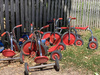
FWIW, given the latest twist on this 'theory' just upthread, I propose a new name for 'planing'; I propose 'inchworming' as a much more accurate simile. Think about it: the frame flexes, and that 'stored energy' is then somehow, by some mysterious process, fed back not to the chainset -- you know, that thing withpeddles pedals that actually is turned by the cyclist's legs and drives the bike forward by transmitting that energy to the rear wheel via the chain drive -- but directly to the rear of the frame. Happy to provide a visual demonstration of this process (caveat -- I may, of course, being a non-technical person, have misunderstood this magical mechanism):
FWIW, given the latest twist on this 'theory' just upthread, I propose a new name for 'planing'; I propose 'inchworming' as a much more accurate simile. Think about it: the frame flexes, and that 'stored energy' is then somehow, by some mysterious process, fed back not to the chainset -- you know, that thing with
11-20-24 | 06:21 PM
#148
Senior Member
Joined: Jul 2009
Posts: 8,296
Likes: 11,380
Bikes: Colnago, Van Dessel, Factor, Cervelo, Ritchey
I dunno; I think all this talk of 'planing' is really kewl; gives new justification for the typical silly bike reviewer talk of 'steeds' that just seem to 'leap forward' once one touches the peddles pedals.
FWIW, given the latest twist on this 'theory' just upthread, I propose a new name for 'planing'; I propose 'inchworming' as a much more accurate simile. Think about it: the frame flexes, and that 'stored energy' is then somehow, by some mysterious process, fed back not to the chainset -- you know, that thing withpeddles pedals that actually is turned by the cyclist's legs and drives the bike forward by transmitting that energy to the rear wheel via the chain drive -- but directly to the rear of the frame. Happy to provide a visual demonstration of this process (caveat -- I may, of course, being a non-technical person, have misunderstood this magical mechanism):
https://www.youtube.com/watch?v=H3_H557-vBI
FWIW, given the latest twist on this 'theory' just upthread, I propose a new name for 'planing'; I propose 'inchworming' as a much more accurate simile. Think about it: the frame flexes, and that 'stored energy' is then somehow, by some mysterious process, fed back not to the chainset -- you know, that thing with
https://www.youtube.com/watch?v=H3_H557-vBI
11-20-24 | 06:24 PM
#149
Senior Member
Joined: Apr 2011
Posts: 12,780
Likes: 4,885
This doesn't do anything significantly different than an oval chainring in that it lowers the effective gearing at peak load and increases the effective gearing by adding to the amount of chain pulled by the chainwheel at low load. And that is a very simplified example of how a flexible bike stores and releases energy. Which is not "planing", but a contribution to the whole system (I would think). My Merlin does this in a fairly obvious way (to me) when climbing out of the saddle. I do not know if that means I experience planing per se, but I don't see why not.
11-20-24 | 06:45 PM
#150
Senior Member
Joined: Apr 2011
Posts: 12,780
Likes: 4,885
My frustration with this thread is that this isn't important. If you are interested in planing - get some kind of bike that might do it and see if you like it. If not, ride what you got.
This isn't all a conspiracy to deprive pros of a necessary advantage. It probably isn't worth giving up aerodynamics just to get "proper" frame flex.
The only reason I participate in these discussions is that it is interesting to me how fervently people want to deny that it is even possible that the flex of a springy bike could have a positive upside. I assume the same people who are so against this possibility had similar feelings about riding tires under 115psi - until the flipped on that. Because it is pretty much the same thing: Sometimes not-so-rigid machinery works really well with humans.
This isn't all a conspiracy to deprive pros of a necessary advantage. It probably isn't worth giving up aerodynamics just to get "proper" frame flex.
The only reason I participate in these discussions is that it is interesting to me how fervently people want to deny that it is even possible that the flex of a springy bike could have a positive upside. I assume the same people who are so against this possibility had similar feelings about riding tires under 115psi - until the flipped on that. Because it is pretty much the same thing: Sometimes not-so-rigid machinery works really well with humans.