


Fork Rake


 08-02-11 | 11:51 PM
#2

Senior Member
Joined: Nov 2006
Posts: 1,620
Likes: 0
From: Portland, ME
The rake is like a modification of the head-tube angle. The greater the rake, the less the HT angle. It won't act exactly like a HT of a degree measured to the front axle though, because it has more of a curve. This creates a smoother ride, but less 'connected' to the road, or quick in handling or perception.
To put it in a simple term; the greater the rake measurement, the plush the "plush" the bike is.
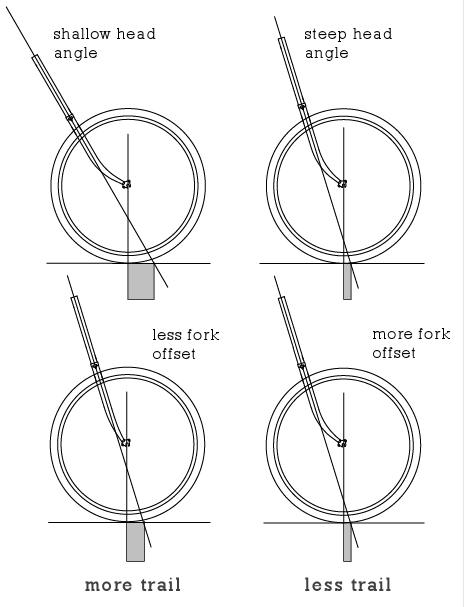
To put it in a simple term; the greater the rake measurement, the plush the "plush" the bike is.
08-03-11 | 04:59 AM
#7
Senior Member
Joined: Aug 2006
Posts: 935
Likes: 0
From: Perth, W.A.
I think the OP was assuming that the HT angle didn't change, just different forks on the same bike.
But if not, then, yes, HT angle and rake combine to create trail which is the real thing that affects the handling. This paper from Calfee explains it pretty well.
https://www.calfeedesign.com/tech-pap...bike-handling/
But if not, then, yes, HT angle and rake combine to create trail which is the real thing that affects the handling. This paper from Calfee explains it pretty well.
https://www.calfeedesign.com/tech-pap...bike-handling/
08-03-11 | 05:17 AM
#8

Senior Member
Joined: Dec 2009
Posts: 9,563
Likes: 735
From: Melbourne, Oz
Bikes: https://weightweenies.starbike.com/forum/viewtopic.php?f=10&t=152015&p=1404231
Swapping forks may actually alter the head angle by a poofteenth (like fitting a smaller tyre in front), but I was getting at the fact that a certain amount of rake may be right for one bike, but not for another, due to the head angle.
08-03-11 | 08:27 AM
#9

John Wayne Toilet Paper
Joined: Feb 2006
Posts: 1,952
Likes: 0
From: Roanoke
Bikes: BH carbon, Ritchey steel, Kona aluminum
The rake is like a modification of the head-tube angle. The greater the rake, the less the HT angle. It won't act exactly like a HT of a degree measured to the front axle though, because it has more of a curve. This creates a smoother ride, but less 'connected' to the road, or quick in handling or perception.
https://www.dclxvi.org/chunk/tech/trail/
08-03-11 | 08:49 AM
#10

Senior Member

Joined: Oct 2004
Posts: 7,123
Likes: 111
From: Huntington Beach, CA
Bikes: Cervelo Prodigy
This is backwards. A greater rake decreases trail, the same effect as increasing/steepening the head angle. A lower amount of rake creates a larger trail and therefore more of a caster stabilizing effect. It's easier to ride a bike no hands that has more trail.
https://www.dclxvi.org/chunk/tech/trail/
https://www.dclxvi.org/chunk/tech/trail/
08-03-11 | 08:51 AM
#11
John Wayne Toilet Paper
Joined: Feb 2006
Posts: 1,952
Likes: 0
From: Roanoke
Bikes: BH carbon, Ritchey steel, Kona aluminum
08-03-11 | 08:57 AM
#12

Gluteus Enormus
Joined: Dec 2007
Posts: 2,245
Likes: 0
From: Raleigh, NC
Bikes: Yes
If you notice any diff at all is that the bike could feel a tiny smidge more stable with the 43. All else being equal you probably won't notice a difference. Your fork tips move more than 2mm fore-aft just riding, hitting bumps, and braking.
08-03-11 | 09:00 AM
#13


Decrepit Member
Joined: Aug 2005
Posts: 10,488
Likes: 92
From: Santa Rosa, California
Bikes: Waterford 953 RS-22, several Paramounts
It is highly unlikely that other parameters being equal (head tube angle, fork length measured parallel to the steerer from from the bottom of the lower bearing race to the center of the front wheel axle), that you would notice any difference between a 43mm rake and a 45mm rake. On a bike with 700c rims, the 43mm rake fork will give you 2mm more of trail.

 08-03-11 | 09:48 AM
#14

Over the hill
Joined: Mar 2006
Posts: 24,587
Likes: 1,356
From: Los Angeles, CA
Bikes: Pinarello Nytro, Momentum Transend
__________________
It's like riding a bicycle
It's like riding a bicycle
08-03-11 | 10:54 AM
#15
Decrepit Member
Joined: Aug 2005
Posts: 10,488
Likes: 92
From: Santa Rosa, California
Bikes: Waterford 953 RS-22, several Paramounts
FWIW, retired framebuilder Dave Moulton has a couple of great blog articles you might find informative.
"As with any design aspect, more is not necessarily better; for a road bike with a 73 degree head angle the optimum trail seems to be around 2 to 2 ½ inches (50 to 63mm.)", so 56mm - 58mm of trail is pretty optimal.
Trail, fork rake, and a little bit of history
Head Angles and Steering
"As with any design aspect, more is not necessarily better; for a road bike with a 73 degree head angle the optimum trail seems to be around 2 to 2 ½ inches (50 to 63mm.)", so 56mm - 58mm of trail is pretty optimal.
Trail, fork rake, and a little bit of history
Head Angles and Steering
Last edited by Scooper; 08-03-11 at 11:00 AM.
08-03-11 | 01:44 PM
#16
Senior Member
Joined: Jun 2009
Posts: 493
Likes: 0
From: Huntington Beach
Swapping forks does not change the head angle, only rake! Unless the fork is shorter or longer in which case the whole geometry of the bike is in the crapper!

 08-04-11 | 01:29 AM
#18
Senior Member
Joined: Dec 2009
Posts: 9,563
Likes: 735
From: Melbourne, Oz
Bikes: https://weightweenies.starbike.com/forum/viewtopic.php?f=10&t=152015&p=1404231
Do a little bit of trigonometry and you'll find that it'll take an awful lot of difference in fork length to make much difference to the head angle though. But, swapping forks may affect it slightly, as I said.
08-04-11 | 12:10 PM
#19
Decrepit Member
Joined: Aug 2005
Posts: 10,488
Likes: 92
From: Santa Rosa, California
Bikes: Waterford 953 RS-22, several Paramounts
There's nothing incredible about the possibility of different forks being slightly different lengths; in fact it's quite likely.
Do a little bit of trigonometry and you'll find that it'll take an awful lot of difference in fork length to make much difference to the head angle though. But, swapping forks may affect it slightly, as I said.
Do a little bit of trigonometry and you'll find that it'll take an awful lot of difference in fork length to make much difference to the head angle though. But, swapping forks may affect it slightly, as I said.
A picture may help. Remember that HTA and STA are the angles the head tube and seat tube make with a baseline through the dropout centers, so adding 18% to the length of the fork will move the front of the frame higher, making the HTA and the STA 2° less than they with with the original fork. Putting on a fork that is 118% of the original fork isn't something you'd ordinarily do, but the drawing is exaggerated to demonstrate the effect.


Thread
Thread Starter
Forum
Replies
Last Post
calstar
Framebuilders
22
05-24-12 11:36 AM
Daspydyr
Bicycle Mechanics
5
12-11-09 06:57 PM


