


OT: Just for pwned by my professor
 11-05-07 | 04:34 PM
#26
Senior Member
Joined: Aug 2007
Posts: 999
Likes: 1
From: the land of ice and snow
My girlfriend in Chicago worked for an org that used empty plots of land in the city as gardens run by the homeless. They'd be paid with the money earned from selling the produce to local restaurants, and they could eat the food too, obviously. Great concept.
 11-05-07 | 04:54 PM
#27

vernal stylostixis
Joined: Jul 2007
Posts: 300
Likes: 0
https://my.stratos.net/~mmoss/public%...griculture.pdf
"In this article we examine trends in urban agriculture in the United States with a particular focus on the public health potential and pitfalls of urban agriculture. We explore the role of urban agriculture for nutritional health and food security, personal wellness and community betterment, and environmental health. And we suggest policy changes that could favorably advance the potential of urban agriculture for public health benefits in these areas."
"In this article we examine trends in urban agriculture in the United States with a particular focus on the public health potential and pitfalls of urban agriculture. We explore the role of urban agriculture for nutritional health and food security, personal wellness and community betterment, and environmental health. And we suggest policy changes that could favorably advance the potential of urban agriculture for public health benefits in these areas."
11-05-07 | 05:04 PM
#28
THIS SPACE FOR RENT
Joined: Jan 2006
Posts: 2,849
Likes: 1
City farming can't provide a very large portion of people's diets on a % of calories basis, there just isn't enough land even if you use rooftops and whatnot. However, urban and peri-urban farming can provide a huge portion (like 50%+) of people's fresh fruit and vegetable needs, which is especially helpful because these foods are the most expensive to transport and are otherwise difficult to obtain for poorer people. In eastern Europe people never really stopped growing food in the course of urbanization, and even today there is a substantial amount of food grown in or near the city almost everywhere except in western Europe and the US/Canada.
11-05-07 | 05:47 PM
#29

Look at all these buttons
Joined: Oct 2007
Posts: 984
Likes: 0
#1 saying that a city couldn't provide enough food to support its own population based on land space alone is like saying a city couldn't support its population in jobs by not having enough office space. there is absolutely a possibility that a city COULD if they in fact wanted to, be self sufficient with farming. Its just a matter of feasability.
#2 If your professor truly graded you the way that you said they did, they're an idiot. If a student is allowed to choose a topic for a paper and writes the paper using proper english and uses credible sources to support their data and ideas, and the professor grades it based on the fact that THEY believe its unfeasable is ridiculous.
I recommend having a talk with the professor to see how they graded it and on what criteria. If it was for a specific purpose or something and you went out on a limb then thats one thing, but if they gave you a crappy grade because they don't think your idea would work theyre morons. If the wright brothers never ran off that hill, no one would've believed that some huge contraption could fly.
#2 If your professor truly graded you the way that you said they did, they're an idiot. If a student is allowed to choose a topic for a paper and writes the paper using proper english and uses credible sources to support their data and ideas, and the professor grades it based on the fact that THEY believe its unfeasable is ridiculous.
I recommend having a talk with the professor to see how they graded it and on what criteria. If it was for a specific purpose or something and you went out on a limb then thats one thing, but if they gave you a crappy grade because they don't think your idea would work theyre morons. If the wright brothers never ran off that hill, no one would've believed that some huge contraption could fly.
11-05-07 | 06:15 PM
#30
THIS SPACE FOR RENT
Joined: Jan 2006
Posts: 2,849
Likes: 1
#1 saying that a city couldn't provide enough food to support its own population based on land space alone is like saying a city couldn't support its population in jobs by not having enough office space. there is absolutely a possibility that a city COULD if they in fact wanted to, be self sufficient with farming. Its just a matter of feasability.
 11-05-07 | 06:41 PM
#32

CO2+H20 => CH2O+O2!
Joined: Mar 2006
Posts: 91
Likes: 0
From: Colorado
Bikes: 2011 Masi Randonneur, 1979 Univega Viva Sport, Early 90's Hardrock Fixed Gear Conversion (Commuter); velospace.org/user/5321
Strange coincidence (in my head) but my horticulture professor was just mentioning how it is a shame that most American cities are built upon some of the higher quality crop-land, (near rivers or other water, (at least originally) great soil, flat ground, transportation etc.) and how it is a shame we build buildings on top of such great land. Of course each geographic area would have a varying degree of resources and pollution, so these generalizations do not amount to much. Just a thought, but maybe your professor was saying that if you do not spend time on research he doesn't have to either, so he says, bah bad soil pollution, and bad grade?
Or it could be something else entirely, on some bike forum, and as I know nothing about your paper or anything about the situation I couldn't say. If you are serious about improving your grade maybe you could talk to him about a re-write?
One developing area that is really interesting to me is phytoremediation, which uses plants to suck the heavy metals and other pollutants out of the soil. The plants (which become storage for the pollution) can be properly disposed of and the land is left clean. Then we have tons of places to plant food =)
Or it could be something else entirely, on some bike forum, and as I know nothing about your paper or anything about the situation I couldn't say. If you are serious about improving your grade maybe you could talk to him about a re-write?
One developing area that is really interesting to me is phytoremediation, which uses plants to suck the heavy metals and other pollutants out of the soil. The plants (which become storage for the pollution) can be properly disposed of and the land is left clean. Then we have tons of places to plant food =)
11-05-07 | 08:17 PM
#34

Ho-Jahm
Joined: Nov 2006
Posts: 4,228
Likes: 0
From: Manchester, NH
The premise was that intensive subsistence agriculture on small plots of land could sustain a large population. His view was that most abandoned urban areas can not sustain agriculture because the soil is corrupted by pollutants. There really is not acedemic studies on community gardens--most books are written by people who want to idealize city spaces and really really like the people that visit their gardens-- thats where i failed, heh.
11-05-07 | 08:18 PM
#35
Ho-Jahm
Joined: Nov 2006
Posts: 4,228
Likes: 0
From: Manchester, NH
Not really. If you plant corn, a relatively efficient crop, wall to wall, you can feed about 10,000 people who only want to eat corn all day off of a square mile of good land. That's about as dense as Chicago, which ain't exactly all high rises (though it's twice as dense as LA and 3x as dense as Portland; bet all you Portland lovers didn't realize you were living in worse sprawl than LA itself). Start throwing in some crop diversity, maybe some fruit trees or god forbid egg or dairy production, and the numbers just don't work for a city to feed itself, especially if you're going to set aside some of the land for purposes other than food production (this being a city and all). You can grow a lot of food in a city, but you still need grain crops and protein producers that eat grain crops (you're dreaming if you think everyone will just decide to be vegan) outside of the urban area providing the majority of the calories to support anything like urban density. Of course there is some potential for doing thoroughly ridiculous stuff like building farm towers as proposed above, but I don't think anyone with a serious grip on reality and the ability to use a calculator thinks something like that is practical.
11-06-07 | 09:28 AM
#36
Senior Member
Joined: Jun 2006
Posts: 849
Likes: 1
From: Philadelphia
Bikes: 1985 Pinarello Catena Lusso / 1983 Pinarello Montello / Raleigh Marathon / Camel Cigarettes conversion / 1957 Worksman cruiser / Puch 140 / Raleigh Grand Prix
I remember talking to KRS-One about a year ago and his suggestion was to put apple trees downtown, so if you were hungry you could just pluck an apple... very pleasant dude, not unlike his raps as of the last few years.
11-06-07 | 11:54 AM
#38


some new kind of kick
Joined: May 2007
Posts: 1,542
Likes: 1
From: Smog Valley
Bikes: SOMA Rush, Miyata 912, Kogswell Mod. G, want a porteur bike
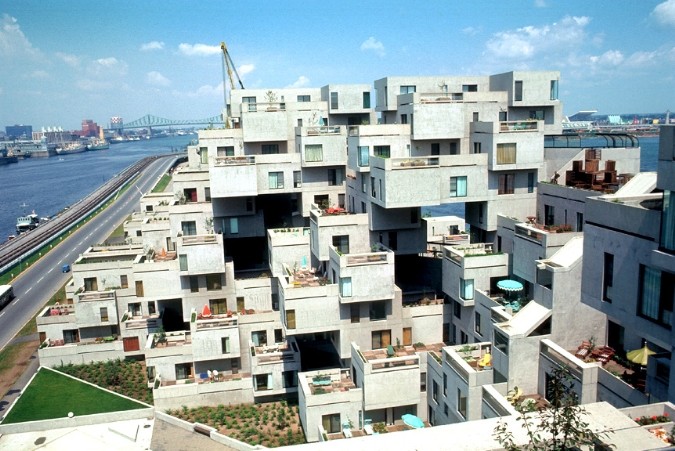 11-06-07 | 11:59 AM
#39

Dances With Cars
Joined: Jan 2006
Posts: 10,527
Likes: 0
From: Toronto, Canada
Bikes: TBL Onyx Pro(ss converted), Pake SS (starting to look kinda pimped)
That's the island city of Montreal. Ils St. Helen I believe. It was the site for the '67 expo.... It quickly became a very sought after residence complex.
11-06-07 | 12:00 PM
#40
Senior Member
Joined: Jun 2006
Posts: 849
Likes: 1
From: Philadelphia
Bikes: 1985 Pinarello Catena Lusso / 1983 Pinarello Montello / Raleigh Marathon / Camel Cigarettes conversion / 1957 Worksman cruiser / Puch 140 / Raleigh Grand Prix



 11-06-07 | 02:02 PM
#44

如果你能讀了這個你講中文
Joined: Feb 2005
Posts: 3,542
Likes: 1
From: New York
really? that's kind of interesting. your professor fails to consider bioremediating current toxins, developing new soil, and isolating toxins - growing things in bathtubs in the yard. or on the roof. or by a big ass set of windows. closed systems.
i think you're wrong, though, about there not being any academic studies on community gardens. i went to a lecture on community gardening in Cuba and its use as a grassroots food-delivery system that helped buffer against food shortages in the (i think) 80s and 90s.
also, www.rhizomecollective.org
i think you're wrong, though, about there not being any academic studies on community gardens. i went to a lecture on community gardening in Cuba and its use as a grassroots food-delivery system that helped buffer against food shortages in the (i think) 80s and 90s.
also, www.rhizomecollective.org
11-06-07 | 02:07 PM
#45

Sir Fallalot

Joined: Jul 2006
Posts: 5,288
Likes: 17
I don't know about abandoned, but close to high-traffic roads, the soil is, indeed polluted and food grown there is generally deemed unhealthy at best, and highly carcinogenic at worst.
11-06-07 | 03:26 PM
#46
Senior Member
Joined: Nov 2005
Posts: 152
Likes: 0
From: Lawrence
Bikes: 1994 Paramount conversion
https://www.localburger.com/index.php
This is a locally-owned restaurant in the community in which I live. Most of their food is sourced within about a 20-25 mile radius of the location.
They serve locally-raised buffalo, elk, and lamb burgers as well as grass-fed beef. Produce is mostly organic. It's not EXACTLY on the topic of this thread, but it's closer to the topic of this thread than this thread is to the topic of the board.
Lawrence, KS is not an urban community, of course. But a creative entrepreneur has figured out a way to package locally-produced foods and give people a model for something that could potentially be pretty self-sustaining.
This is a locally-owned restaurant in the community in which I live. Most of their food is sourced within about a 20-25 mile radius of the location.
They serve locally-raised buffalo, elk, and lamb burgers as well as grass-fed beef. Produce is mostly organic. It's not EXACTLY on the topic of this thread, but it's closer to the topic of this thread than this thread is to the topic of the board.
Lawrence, KS is not an urban community, of course. But a creative entrepreneur has figured out a way to package locally-produced foods and give people a model for something that could potentially be pretty self-sustaining.
