


Bolt on cogs.
 02-08-12 | 02:37 AM
#1

Thread Starter
Just smang it.
Joined: Feb 2011
Posts: 2,295
Likes: 1
From: Bellingham
Bikes: Felt F1X, Kilo WT, Dawes Deadeye
Bolt on cogs.
I've thought about playing with a bolt on fixed cog on my SS 29er since it has disc hubs and had a few questions.
- Any recommendations of a good cog to try? Looks like Velo Solo has a ton of options.
- Chainline... Probably one of those things that I'll just have to bolt up and see how it goes, but if you have input on it, shoot.
I'm thinking about going for a tiny ratio and learning some tricks for kicks. 32T chainring + big ass cog? I think yes...
- Any recommendations of a good cog to try? Looks like Velo Solo has a ton of options.
- Chainline... Probably one of those things that I'll just have to bolt up and see how it goes, but if you have input on it, shoot.
I'm thinking about going for a tiny ratio and learning some tricks for kicks. 32T chainring + big ass cog? I think yes...

 02-08-12 | 05:42 AM
#4
Senior Member
Joined: Nov 2006
Posts: 251
Likes: 0
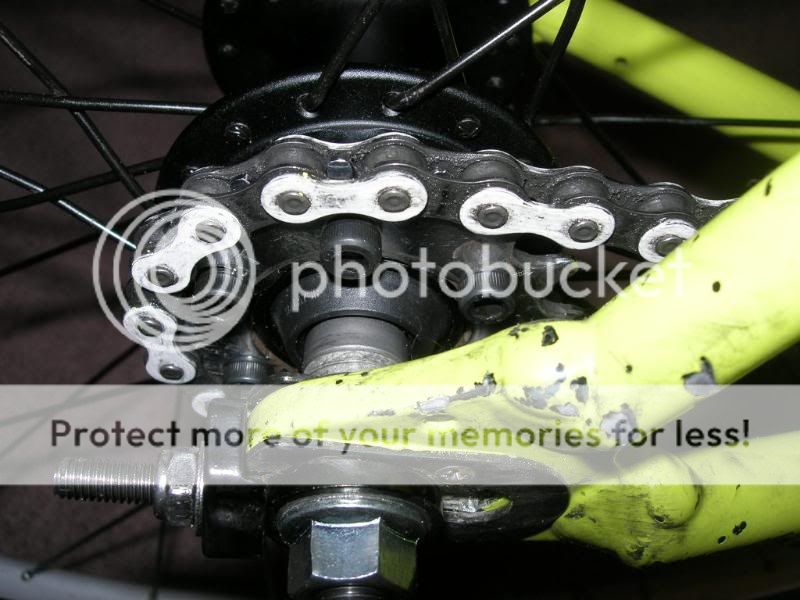
after stripping two hubs, i decided to lace up a front disc hub and bolt a cog on. drilled out a ss cog myself and the chainline worked fine. havent had a single problem with the hub in 4 years. originally the holes werent perfectly drilled, but because the splines on the cog were slightly smaller in diameter than the hub flange, it was easy to sand around with a dremel quite evenly to avoid eccentricity
02-08-12 | 06:11 AM
#5
Senior Member
Joined: Feb 2012
Posts: 131
Likes: 0
From Velosolo site:
From my understanding you can fine tune the chainline a couple of mm outwards with spacers if necessary.
4. So what will my chainline be if using a cog mounted on a disc hub?
Chainline will be as follows:
M756 disc hub converted to fit on rear of road bike with 10mm spacer each side (slightly dished wheel) = approx 41mm
As above but with 5mm spacer drive side, 15mm spacer non-drive side (non-dished wheel) = approx 46mm
Bolt on cog to rear disc hub on a 26"/29er mountain bike = approx 53mm
Chainline will be as follows:
M756 disc hub converted to fit on rear of road bike with 10mm spacer each side (slightly dished wheel) = approx 41mm
As above but with 5mm spacer drive side, 15mm spacer non-drive side (non-dished wheel) = approx 46mm
Bolt on cog to rear disc hub on a 26"/29er mountain bike = approx 53mm
 02-08-12 | 08:20 AM
#8

Chronic 1st-timer

Joined: Jan 2006
Posts: 1,140
Likes: 1
From: Lakehood, CO
Bikes: ...take me places.
02-08-12 | 08:43 AM
#9

Senior Member
Joined: Dec 2005
Posts: 6,656
Likes: 145
From: Long Island, NY
+2. I have two tomicogs (16t amd 17t) that I have been using with a surly front disc hub for several years now on an old Monocog 26er.
Don't just bolt it up and see how it goes. Use a ruler and your brain to figure out what the chainline will be beforehand. Chances are it will be close enough and/or you'll find ways to adjust it. If fixed off road is something you are into, it would be a good idea to build a second wheel. Then you don't have to muck around with removing the rotor and all that everytime you want to go fixed.
If you have canti studs on your seatstays, remove the disc brake and install a V-brake in the rear. Then you can built a flip flop out of a SS disc freehub and still have the rear brake for when you flip to the freewheel side.
Don't just bolt it up and see how it goes. Use a ruler and your brain to figure out what the chainline will be beforehand. Chances are it will be close enough and/or you'll find ways to adjust it. If fixed off road is something you are into, it would be a good idea to build a second wheel. Then you don't have to muck around with removing the rotor and all that everytime you want to go fixed.
If you have canti studs on your seatstays, remove the disc brake and install a V-brake in the rear. Then you can built a flip flop out of a SS disc freehub and still have the rear brake for when you flip to the freewheel side.
02-08-12 | 09:31 AM
#10
Senior Member

Joined: Feb 2008
Posts: 531
Likes: 0
I use Tomicogs on my fixed gear mtb, 34:18 or 34:19 depending on the trail.
Shimano XT-M756 front hubs are awesome on fixed gear road bikes with track bike chainlines and 120mm spacing. It's a front hub but it uses a 10mm axle (instead of a 9mm axle that a normal Shimano road hub would use), so you just have to replace the axle with a solid threaded axle long enough to fit your frame (Wheels Mfg stainless axles are great and super affordable) and add two 5mm axle spacers and you've got a nice, bolt-on specific fixed-only rear wheel for your track bike. The only downside is cog sizing for bolt-on cogs, which is limited by the bolt circle diameter of a 6-bolt disc mount. I think 16t is the lowest you can go.
Shimano XT-M756 front hubs are awesome on fixed gear road bikes with track bike chainlines and 120mm spacing. It's a front hub but it uses a 10mm axle (instead of a 9mm axle that a normal Shimano road hub would use), so you just have to replace the axle with a solid threaded axle long enough to fit your frame (Wheels Mfg stainless axles are great and super affordable) and add two 5mm axle spacers and you've got a nice, bolt-on specific fixed-only rear wheel for your track bike. The only downside is cog sizing for bolt-on cogs, which is limited by the bolt circle diameter of a 6-bolt disc mount. I think 16t is the lowest you can go.
02-08-12 | 10:44 AM
#11
Member
Joined: Oct 2008
Posts: 27
Likes: 0
From: Portland
Bikes: GT Pulse, Kilo
Is a 9mm axle on a front disc hub pretty standard. I am looking into using an american classic front hub but it seems they don't make one with a 10mm axle. Is this something you can convert (9mm to 10mm) easily?
Last edited by newleefixed; 02-08-12 at 11:01 AM.
02-08-12 | 11:20 AM
#12
Senior Member
Joined: Feb 2008
Posts: 531
Likes: 0
Not, it's not something you can convert easily. You'd have to find bearing cones that fit the same bearing size and layout on the cup on the hub, but are drilled and tapped for 10x1mm threads. There might be something you can cobble together with bits and pieces of several different hubs, but I've never sat down and tried. I think all of the Shimano mtb disc front hubs that you'd be doing this to in order to run it as a fixed rear hub are like the M-756 and use a stepped 10mm axle or cannot be converted as all because they use larger alloy axles, like the newer XT and XTR hubs.
9mm is the standard for quick release or track hubs for front axles/dropouts. The M-756 is interesting because it uses a 10mm axle that steps down to 9mm where it enters the dropouts (if it were 10mm straight through, it wouldn't fit in a fork).
Of course, all of this axle swapping and what-not is unique to cup-and-cone (loose-ball) hubs, like Shimano. I have no idea what your American Classic hub is like.
I think you could get away with using the locknuts/cones/axle from a Surly rear hub with a 10mm axle in a Surly front hub if you're into Surly hubs and wanted to run a Surly Disc Front Hub as a rear fixed bolt on hub. I've not seen the guts of a Surly hubset in a while, so I can't be for certain.
Side note: you can replace the "adjustable" cartridge bearings (that don't hold their adjustment) in a Surly hub with a normal non-adjustable cartridge bearing and turn it basically into a Formula-type non-adjustable hub that won't loosen up and annoy you (which is the biggest complaint of Surly hubs I've heard). An alternative solution for people who already have Surly hubs and hate that they loosen/tighten themselves over time.
Edit: 6901 bearings are standard 12x24x6 non-adjustable cartridge bearings that are a direct replacement to Surly bearings and will make your Surly hub hold its adjustment.
9mm is the standard for quick release or track hubs for front axles/dropouts. The M-756 is interesting because it uses a 10mm axle that steps down to 9mm where it enters the dropouts (if it were 10mm straight through, it wouldn't fit in a fork).
Of course, all of this axle swapping and what-not is unique to cup-and-cone (loose-ball) hubs, like Shimano. I have no idea what your American Classic hub is like.
I think you could get away with using the locknuts/cones/axle from a Surly rear hub with a 10mm axle in a Surly front hub if you're into Surly hubs and wanted to run a Surly Disc Front Hub as a rear fixed bolt on hub. I've not seen the guts of a Surly hubset in a while, so I can't be for certain.
Side note: you can replace the "adjustable" cartridge bearings (that don't hold their adjustment) in a Surly hub with a normal non-adjustable cartridge bearing and turn it basically into a Formula-type non-adjustable hub that won't loosen up and annoy you (which is the biggest complaint of Surly hubs I've heard). An alternative solution for people who already have Surly hubs and hate that they loosen/tighten themselves over time.
Edit: 6901 bearings are standard 12x24x6 non-adjustable cartridge bearings that are a direct replacement to Surly bearings and will make your Surly hub hold its adjustment.
Last edited by FKMTB07; 02-08-12 at 11:38 AM.
02-08-12 | 11:34 AM
#13
Member
Joined: Oct 2008
Posts: 27
Likes: 0
From: Portland
Bikes: GT Pulse, Kilo
after reading this https://www.fixedgeargallery.com/arti...mson/surlyhub/ it seems that the Surly front disc hub is the easiest way to go.
02-08-12 | 11:36 AM
#14
Senior Member
Joined: Feb 2008
Posts: 531
Likes: 0
after reading this https://www.fixedgeargallery.com/arti...mson/surlyhub/ it seems that the Surly front disc hub is the easiest way to go.
02-08-12 | 12:35 PM
#15
Senior Member
Joined: Feb 2012
Posts: 131
Likes: 0
I use Velosolo cog on a 26" mtb rear wheel with the casette side converted to singlespeed for a diy flipflop (very easy to match chainline to the disc side). with v-brakes. The chainline is a bit skechy for now because of mismatched cranks/bb width (too wide in front even with two 1mm spacers under the cog and chainring in middle position). I intend to fix the bb width, but so far I've had zero problems, running 1/8" chain on 1/8" VS cog and 3/32" middle ring from an mtb triple, 32/17 for winter gearing.
What's the advantage of Tomicog over Velosolo? The seem a bit more expensive, even with international shipping for VS included. For extra 2 pounds VS is also available in 15t and 22t. The quality of VS seems very high and if you wear one out you get free replacement:
Not saying Tomicogs are not of high quality, just not familiar with them. My experience with VS is very good, but I'm not an expert, this is my first fg conversion 
What's the advantage of Tomicog over Velosolo? The seem a bit more expensive, even with international shipping for VS included. For extra 2 pounds VS is also available in 15t and 22t. The quality of VS seems very high and if you wear one out you get free replacement:
We are confident these are the hardest wearing disc mount cogs available and guarantee the original purchase for life to the original owner. If you wear one out send it back and we will replace it with one of the same size free of charge. We only ask that you have run it in both directions and keep your proof of purchase.
02-08-12 | 12:56 PM
#16

Senior Member
Joined: Apr 2005
Posts: 2,174
Likes: 0
From: Brownsville, TX
Bikes: Surly CC
Seems like they're both about the same price. It would be hard to make a blind call without trying both of them. Those Velosolo Disc-hub mounted cogs look pretty sexy, in general. That, combined with a Salsa Vaya w/ eccentric BB would be interesting. I spent too much time thinking about this **** sometimes.
02-08-12 | 06:59 PM
#17
A little North of Hell
Joined: Mar 2006
Posts: 4,892
Likes: 4
Phil
 02-08-12 | 07:51 PM
#18
Senior Member
Joined: Dec 2005
Posts: 6,656
Likes: 145
From: Long Island, NY
My tomicogs look a bit more "raw", like some dude made then in his garage. In that respect, they fit well with the whole jerry rigged vibe of bolting a cog onto the rotor mount of a front hub. They function flawlessly however. There is no notable eccentricity, and mine show no signs of premature wear after several years of use. The teeth on the tomicog look really tall to me, although I haven't made any real measurements to confirm that, its just an impression. Taller teeth (if that really is the case) may reduce risk of derailment (?).
Bear in mind my tomicogs are a few years old and bought very shortly after they first became available. Perhaps the newer Tomicogs are more refined looking like the velosolo cogs, but in any case, they are well made cogs.
Last edited by mihlbach; 02-08-12 at 08:00 PM.

Thread
Thread Starter
Forum
Replies
Last Post
AlanC8
Bicycle Mechanics
7
11-11-18 05:34 AM
