


Disc vs V brakes
 05-02-11 | 12:32 PM
#51

cyclopath
Joined: Apr 2006
Posts: 5,264
Likes: 6
From: Victoria, BC
Bikes: Surly Krampus, Surly Straggler, Pivot Mach 6, Bike Friday Tikit, Bike Friday Tandem, Santa Cruz Nomad

I've toured for hundreds of KMs of muddy roads with BB7s and the caliper/disc rotor is quickly contaminated with mud [if its runny] which affects the braking performance. I think where a disc brake would be best would be in sticky mud where it's more likely to stay on the tire and where it would clog up a rim brake. I haven't toured under those conditions yet and have only mountain biked in that sort of mud a couple times. Depending where you live it might be a more common occurrence.
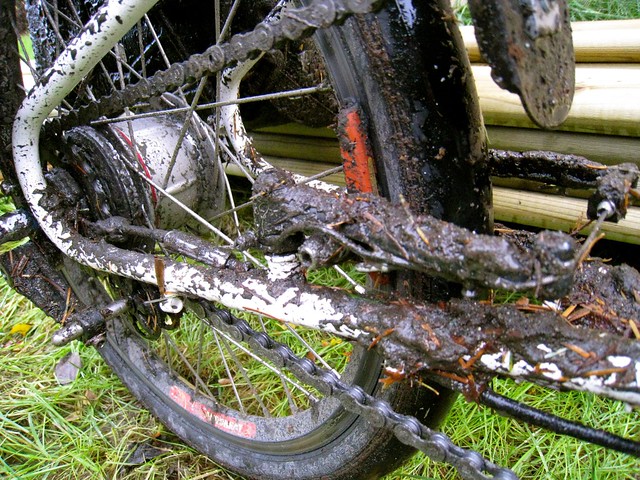
I haven't had any issues stopping my v-brake touring bikes in the rain/mud nor had any rims wear out uber fast or blown any tubes from overheating when braking.
To be honest I would like to tell you disc brakes are the silver bullet to all cycling braking needs - especially mech discs because they are easier for most folks to work on at home and easier repair in the field, but so far that just hasn't been my experience.
Last edited by vik; 05-02-11 at 12:41 PM.
 05-02-11 | 01:06 PM
#52

Mad bike riding scientist


Joined: Nov 2004
Posts: 29,141
Likes: 6,202
From: Denver, CO
Bikes: Some silver ones, a red one, a black and orange one, and a few titanium ones
A bike is limited in it's maximum braking by either the traction of the tire or by weight transfer that would otherwise cause an endo. If neither of these occur then the rider has inadequate brakes. An upright bicycle is limited in stopping deceleration to around 0.6g and increasing rotor size can't change that. All it does is reduce the effort required to make it happen (which, interestingly, the DIN tests you refer to measure).
I haven't had any issues stopping my v-brake touring bikes in the rain/mud nor had any rims wear out uber fast or blown any tubes from overheating when braking.
To be honest I would like to tell you disc brakes are the silver bullet to all cycling braking needs - especially mech discs because they are easier for most folks to work on at home and easier repair in the field, but so far that just hasn't been my experience.
To be honest I would like to tell you disc brakes are the silver bullet to all cycling braking needs - especially mech discs because they are easier for most folks to work on at home and easier repair in the field, but so far that just hasn't been my experience.
Like I said above, moving the center of mass on the bike/rider system has more influence on the deceleration of a bike. It's a lesson that most mountain bike riders have learned the hard way


Your Pugsley picture, by the way, shows that there are other ways to stop a bike
 It's not like you are going to get that one to moving so fast that braking is an issue
__________________
Stuart Black
Dreamin' of Bemidji Down the Mississippi (in part)
Plan Epsilon Around Lake Michigan in the era of Covid
Gold Fever Three days of dirt in Colorado
Pokin' around the Poconos A cold ride around Lake Erie
Dinosaurs in Colorado A mountain bike guide to the Purgatory Canyon dinosaur trackway
Solo Without Pie. The search for pie in the Midwest.
Picking the Scablands. Washington and Oregon, 2005. Pie and spiders on the Columbia River!
Stuart Black
Dreamin' of Bemidji Down the Mississippi (in part)
Plan Epsilon Around Lake Michigan in the era of Covid
Gold Fever Three days of dirt in Colorado
Pokin' around the Poconos A cold ride around Lake Erie
Dinosaurs in Colorado A mountain bike guide to the Purgatory Canyon dinosaur trackway
Solo Without Pie. The search for pie in the Midwest.
Picking the Scablands. Washington and Oregon, 2005. Pie and spiders on the Columbia River!
05-02-11 | 01:38 PM
#53
Senior Member

Joined: Jul 2010
Posts: 13,905
Likes: 1,241
From: Montreal Canada
while I too would be curious to try mech discs, to be honest, other than a few long mtns downhills (specifically with switchbacks that really did require frequent braking) I havent had issues with cantis. I do wish they were stronger for city and spirited driving at times, like V's, but do appreciate that they modulate better than Vs (which I find go from med to really hard braking quickly)
Ive put softer pads on my cantis over the winter and that should help, but over the years, Ive never had rim wear problems so all in all, non disk brakes just work well enough and are a known, simple technology that is rather inexpensive as well.
Coming also from a motorcycle background, I can see how hydraulic discs are probably very nice for their feel and modulation, but as others have stated, you get into the "simplicity" factor with cable brakes that is one less thing to worry about out in the world not near a bike shop.
Ive put softer pads on my cantis over the winter and that should help, but over the years, Ive never had rim wear problems so all in all, non disk brakes just work well enough and are a known, simple technology that is rather inexpensive as well.
Coming also from a motorcycle background, I can see how hydraulic discs are probably very nice for their feel and modulation, but as others have stated, you get into the "simplicity" factor with cable brakes that is one less thing to worry about out in the world not near a bike shop.
Last edited by djb; 05-02-11 at 01:41 PM.
05-02-11 | 03:27 PM
#54
Senior Member
Joined: Mar 2009
Posts: 737
Likes: 0
From: Edmonton, Canada
When trying to stop a spinning disc, required force is reduced by a longer moment arm. Leverage. So a larger disc can stop a bike faster using the same force, or stop the bike the same using less force. (This is also why rim brakes work fine in most instances, even with less braking force, since they have the most leverage).
The end result of how quickly you stop is going to vary directly with the amount of stress on the hub, spokes and QR. The only thing that changes with disc size is the amount of force on the caliper (and by extension, fork) to achieve the same braking performance.
Larger discs, of course, make it easier to brake past your tire's limits, particularly in the rain.
This is high school physics stuff, I don't understand why there seems to be so much confusion about the forces involved.
Last edited by neil; 05-02-11 at 03:36 PM.
05-02-11 | 08:58 PM
#55
Senior Member
Joined: Aug 2006
Posts: 1,898
Likes: 70
05-02-11 | 11:13 PM
#56
Senior Member
Joined: Apr 2008
Posts: 5,428
Likes: 2
Bikes: Cervelo RS, Specialized Stumpjumper FSR Pro, Schwinn Typhoon, Nashbar touring, custom steel MTB
1) You said that larger diameter rotors are frequently thicker than smaller diameter rotors
2) I measured rotors of different diameters and found them to be of substantially the same thickness and claimed that your assertion was incorrect.
3) You then measured a bunch of rotors of the same diameter, and...
4) You concluded that rotors of different diameter must be thicker.
In order to prove that larger diameter rotors are thicker than their smaller diameter counterparts, you'd actually have to measure the thickness of rotors with two different diameters, like I did. The only thing you've shown is that you don't know how to think logically...
01-25-12 | 08:44 PM
#57

Senior Member
Joined: Jul 2002
Posts: 625
Likes: 21
From: Seattle, WA (United States)
I'm weighing this topic, and rather than start another redundant thread, I thought I'd resserect this one. I'm putting together a Surly Troll, mainly for touring, but also for occasional local riding. I've looked at mechanical discs and V brakes, and here are my thoughts, etc:
- If you'll be riding frequently or occasionally in wet conditions, discs are definitely worth considering. They work more effectively, and are likely to greatly extend rim life.
- As others have mentioned... If you will be traveling extensively in isolated areas, I would be hesitant to use disc brakes: While mechanical discs are relatively simple, they are still more complex (more parts, longer cables, etc.) than rim brakes, so if you are victimized by Murphy's law, it will be much more problematic.
- I've only ridden disc-brake bikes a few times, but in my experience, in dry conditions there's negligible performance difference; decent V-brakes work about as well.
While I haven't firmly decided on my components, right now I'm leaning towards V-brakes: I'm an ardent subscriber to the 'Keep it simple' philosophy. While mechanical discs are still relatively simple, there's still more that can be damaged/malfunction than rim brakes. With good V-brakes, about the only thing that can go wrong is cable breakage, which is very easy to fix.
I'd certainly consider discs if I were planning to tour in inclement weather, but with careful planning I hope to avoid wet conditions. I'm not so much of an zealot that I've completely ruled out discs, so if there's another good reason to go with discs, I welcome additional input.

- If you'll be riding frequently or occasionally in wet conditions, discs are definitely worth considering. They work more effectively, and are likely to greatly extend rim life.
- As others have mentioned... If you will be traveling extensively in isolated areas, I would be hesitant to use disc brakes: While mechanical discs are relatively simple, they are still more complex (more parts, longer cables, etc.) than rim brakes, so if you are victimized by Murphy's law, it will be much more problematic.
- I've only ridden disc-brake bikes a few times, but in my experience, in dry conditions there's negligible performance difference; decent V-brakes work about as well.
While I haven't firmly decided on my components, right now I'm leaning towards V-brakes: I'm an ardent subscriber to the 'Keep it simple' philosophy. While mechanical discs are still relatively simple, there's still more that can be damaged/malfunction than rim brakes. With good V-brakes, about the only thing that can go wrong is cable breakage, which is very easy to fix.
I'd certainly consider discs if I were planning to tour in inclement weather, but with careful planning I hope to avoid wet conditions. I'm not so much of an zealot that I've completely ruled out discs, so if there's another good reason to go with discs, I welcome additional input.
01-26-12 | 01:33 AM
#58
Senior Member
Joined: Sep 2006
Posts: 960
Likes: 80
Regardless of the merits of one vs. the other, my experience has been that my Hayes-9's have been maintenance free for 6 years and nearly 5,000 miles (with the exception of one pad change). The same can't be said of my Avid Single Digit 7's, various cantilever brakes, or any other rim brake I have. My Hayes-9's stop better in all conditions and require less maintenance/adjustment.
The only mechanical discs I have tried are the Avid BB5's. They weren't nearly as good as my Tektro V-brakes. On the other hand, I also have Avid Juicy 7's and they are significantly better than the V-brakes. The only downside to the Juicy's is that they seem to need to be bled if you store the bike upside down or vertically hanging on a wall.
On one bike I have Hayes Stoker Trail hydro discs. They are very close to being as good as the Hayes 9s, though the 9s feel better to me. Both stop equally well, and both are noticeably better than the BB5s or V brakes. When bled properly, the Juicy's are about the same (IMHO) as the Stoker's, though not as good as the Hayes 9s.
The only rim brakes I have that even come close to the Hayes are the Magura hyro rim brakes with tar treatment on the rim surface (on my Team GT trials bike). They're almost as good, though not quite. Besides, I don't think tar treatment would be good for any kind of riding except trials.
Bottom line: if your bike can support disc brakes, skip the rim brakes and BB7s and get the Hayes 9s. Of all the brakes I've had, they have been and continue to be the best.
Also, I have ridden in virtually any condition (snow, ice, freezing rain, rain, slick sticky mud, sloppy drippy mud) and have never had a problem with the Hayes 9s or Hayes Stokers clogging up. They stop very well, whether wet, dry, hot, cold, muddy, or dusty. The same can't be said of rim brakes.
The only mechanical discs I have tried are the Avid BB5's. They weren't nearly as good as my Tektro V-brakes. On the other hand, I also have Avid Juicy 7's and they are significantly better than the V-brakes. The only downside to the Juicy's is that they seem to need to be bled if you store the bike upside down or vertically hanging on a wall.
On one bike I have Hayes Stoker Trail hydro discs. They are very close to being as good as the Hayes 9s, though the 9s feel better to me. Both stop equally well, and both are noticeably better than the BB5s or V brakes. When bled properly, the Juicy's are about the same (IMHO) as the Stoker's, though not as good as the Hayes 9s.
The only rim brakes I have that even come close to the Hayes are the Magura hyro rim brakes with tar treatment on the rim surface (on my Team GT trials bike). They're almost as good, though not quite. Besides, I don't think tar treatment would be good for any kind of riding except trials.
Bottom line: if your bike can support disc brakes, skip the rim brakes and BB7s and get the Hayes 9s. Of all the brakes I've had, they have been and continue to be the best.
Also, I have ridden in virtually any condition (snow, ice, freezing rain, rain, slick sticky mud, sloppy drippy mud) and have never had a problem with the Hayes 9s or Hayes Stokers clogging up. They stop very well, whether wet, dry, hot, cold, muddy, or dusty. The same can't be said of rim brakes.
Last edited by hopperja; 01-26-12 at 01:41 AM.
01-26-12 | 01:35 AM
#59
Full Member
Joined: Oct 2010
Posts: 467
Likes: 4
From: Texas
Rahr & Sons Iron Thistle
V brakes are OK, I don't care for the vagueness in the first .75 inch of lever travel and occasional centering adjustments though.
01-26-12 | 10:41 AM
#60
Senior Member
Joined: Apr 2008
Posts: 5,428
Likes: 2
Bikes: Cervelo RS, Specialized Stumpjumper FSR Pro, Schwinn Typhoon, Nashbar touring, custom steel MTB
I think people are generally more concerned about damage than they need to be. I'm a terrible mountain biker and have crashed enough that the BB7 mechanical discs and Magura Marta hydraulic discs on my two mountain bikes should have been completely destroyed by now... if they were as fragile as people in the Touring forum seem to expect. Best I could do was put a slight bend in one of the brake discs, which I was able to bend back by hand. Wish the Avid Shorty cantilever back brake on my touring bike was so reliable! That piece of junk always seems to need attention... Luckily, I have a sweet BB7 on the front!
01-26-12 | 11:35 AM
#61
Banned
Joined: Jun 2010
Posts: 43,586
Likes: 1,380
From: NW,Oregon Coast
Bikes: 8
Keep the packing the bike shipped to the dealer, it came in a box, then, after-all.
that included disc protection.
Avid BB7 on my Pocket Llama, front disc brakes aggressively, FWIW,
even with regular, ( taken off the bulk roll by BF,when they built it up ), housing.
pricier housing is a rebuild consideration, but it does not seem important, right now.
My Euro - trekking bike, a Koga Miyata WTR, came fitted with
Magura's HS[hydrostop]33, a hydraulic rim brake.
installs like a V brake, but best modulation on the planet.
Brake pads replace by unsnapping one and snapping in the new ones.
hydraulic fluid, mineral oil, is in a closed system, since braking does not heat the fluid.
once set up maintenance is just replacing pads.
there is a hand lever adjustment for pad wear..
but .. still. no Drop bar lever, I Run trekking bars , so no issue there.
that included disc protection.
Avid BB7 on my Pocket Llama, front disc brakes aggressively, FWIW,
even with regular, ( taken off the bulk roll by BF,when they built it up ), housing.
pricier housing is a rebuild consideration, but it does not seem important, right now.
My Euro - trekking bike, a Koga Miyata WTR, came fitted with
Magura's HS[hydrostop]33, a hydraulic rim brake.
installs like a V brake, but best modulation on the planet.
Brake pads replace by unsnapping one and snapping in the new ones.
hydraulic fluid, mineral oil, is in a closed system, since braking does not heat the fluid.
once set up maintenance is just replacing pads.
there is a hand lever adjustment for pad wear..
but .. still. no Drop bar lever, I Run trekking bars , so no issue there.
Last edited by fietsbob; 01-28-12 at 10:46 AM.
01-26-12 | 11:53 AM
#62

Old. Slow. Happy.
Joined: Jan 2010
Posts: 1,797
Likes: 1
From: Boulder County, CO
If you have hydraulic brakes, and damage did happen to occur, it would be more difficult/time-consuming to repair them (you'd need to bleed, etc). ANY brake can get damaged in shipping/transit. As long as the dropouts are properly blocked/protected, I wouldn't be too concerned.
01-26-12 | 02:41 PM
#63
Senior Member
Joined: Jul 2002
Posts: 625
Likes: 21
From: Seattle, WA (United States)
Hydraulic discs are absolutely out of the question! IMO, something that hi-tech/complicated is major overkill for anything but true mountain biking. While I might encounter some rough dirt roads, I don't plan on doing any serious technical/trail riding.
You have given me pause to consider mechanical discs. I'll do more research before making a decision, if discs are truly unlikely to be damaged and/or fairly easy to repair, I'll be more inclined to go with them.
You have given me pause to consider mechanical discs. I'll do more research before making a decision, if discs are truly unlikely to be damaged and/or fairly easy to repair, I'll be more inclined to go with them.
01-26-12 | 03:36 PM
#64

Senior Member
Joined: Apr 2009
Posts: 1,310
Likes: 29
From: The Pearl of the Pacific, Mexico
Bikes: '12 Rodriguez UTB Custom, '83 Miyata 610, '83 Nishiki Century Mixte (Work of Art), '18 Engin hardtail MTB
The modulation of hydraulic discs is just incredible and the levers work so smooth! I have them on my Specialized Epic and never had a single issue after using them for 6 years in really rough terrain. I understand it is different wear and tear on brakes of touring bikes. I agree that hydraulics are overkill for most touring situations though. I'll be finally upgrading my 30-year old touring bike this spring with a new Rodriguez UTB. I've decided to build it with Avid mechanicals BB7, but the frame will be ready to support cantis or V brakes if I change my mind or prefer to run a combination of brake styles.
01-27-12 | 07:52 AM
#65
Mad bike riding scientist
Joined: Nov 2004
Posts: 29,141
Likes: 6,202
From: Denver, CO
Bikes: Some silver ones, a red one, a black and orange one, and a few titanium ones
You can't just open up the space between the pads and ride the bike as you can with a rim brake. First, there's very little room between the pads and if you open the pad even a little the braking suffers. The pads have to be kept very, very, very close to the rotor. A millimeter gap on either side of the rotor is a huge gap. The calipers of a rim brake will tend to track the brake surface on a rim so that if you have a huge wobble in the rim, like a broken spoke, the pads will move with the wobble and the brakes on the bike will continue to work. With a hub mounted disc, the caliper is rigidly mounted to the frame and won't track any wobble in the disc. The disc will strike the pad on a wobble and do what the pads do, slow down the disc.
A wobbly disc rotor can be repaired and you might even be able to repair it on the road but it's a fairly tedious process that's even more tedious than truing a wheel...if that's possible.
__________________
Stuart Black
Dreamin' of Bemidji Down the Mississippi (in part)
Plan Epsilon Around Lake Michigan in the era of Covid
Gold Fever Three days of dirt in Colorado
Pokin' around the Poconos A cold ride around Lake Erie
Dinosaurs in Colorado A mountain bike guide to the Purgatory Canyon dinosaur trackway
Solo Without Pie. The search for pie in the Midwest.
Picking the Scablands. Washington and Oregon, 2005. Pie and spiders on the Columbia River!
Stuart Black
Dreamin' of Bemidji Down the Mississippi (in part)
Plan Epsilon Around Lake Michigan in the era of Covid
Gold Fever Three days of dirt in Colorado
Pokin' around the Poconos A cold ride around Lake Erie
Dinosaurs in Colorado A mountain bike guide to the Purgatory Canyon dinosaur trackway
Solo Without Pie. The search for pie in the Midwest.
Picking the Scablands. Washington and Oregon, 2005. Pie and spiders on the Columbia River!
01-27-12 | 09:54 AM
#66

Senior Member
Joined: Feb 2008
Posts: 699
Likes: 0
From: Colorado Springs
Bikes: Gunnar Crosshairs, Giant Trance, Felt Breed, Marin SS MTB, Felt Pyre BMX bike, oldschool GT trials bike
Personally the strongest brakes I have ever ridden are magura hydro rim brakes, the ones on my trials bike are probably 10 years old and have had nothing but a pad change.
I have owned hydro and mech discs, canti's and v-brakes.
I honestly feel the v-brakes I have had always had more power than any of the discs I have owned (bb7, juicy, hayes 9, tektro mech) unless it was nasty out, especially when it was 25deg and wet, standing water would splash onto the rims and it would take a little longer for them to grab, but not a big deal if you are conscious about it.
If I was building a dedicated around the world tour'er I would use bb-7's, they are unbelievably easy to set up and work on and have an outstanding track record for reliability, I would just carry a few extra sets of pads since they are so small. They are not hard at all to work on if you understand the theory, they actually set up much easier than rim brakes. The chances of a rotor getting bent are there but I have straightened some pretty horribly bent rotors with good results but if you take care like vik said when shipping the bike you should not have issues.
Hydro discs in theory are the simplest disc brakes out there, a few pistons, brake lines and some fluid. The only problem on a touring bike for out of the country is that lines can be hard to find and many take a special kit to be able to bleed them. I would save these for the mtb.
Rim brakes are also very proven and have a ton of stopping power as well, and with the right pads stop well when it is wet too. The only problem is rim wear, I have had one rim blow out a sidewall and another get concaved enough that I should have replaced it, it was always in the back of my mind on long downhills.
I think it comes down to, are you comfortable with setting up disc brakes, or mechanically inclined enough to learn? If so I think bb-7's are tough to top although when set up wrong they will feel like poo. If you are not comfortable and do not pick up mechanical things well then keeping with rim brakes might be your best option, either way you can not go wrong, both will serve you well if properly set up.
I have owned hydro and mech discs, canti's and v-brakes.
I honestly feel the v-brakes I have had always had more power than any of the discs I have owned (bb7, juicy, hayes 9, tektro mech) unless it was nasty out, especially when it was 25deg and wet, standing water would splash onto the rims and it would take a little longer for them to grab, but not a big deal if you are conscious about it.
If I was building a dedicated around the world tour'er I would use bb-7's, they are unbelievably easy to set up and work on and have an outstanding track record for reliability, I would just carry a few extra sets of pads since they are so small. They are not hard at all to work on if you understand the theory, they actually set up much easier than rim brakes. The chances of a rotor getting bent are there but I have straightened some pretty horribly bent rotors with good results but if you take care like vik said when shipping the bike you should not have issues.
Hydro discs in theory are the simplest disc brakes out there, a few pistons, brake lines and some fluid. The only problem on a touring bike for out of the country is that lines can be hard to find and many take a special kit to be able to bleed them. I would save these for the mtb.
Rim brakes are also very proven and have a ton of stopping power as well, and with the right pads stop well when it is wet too. The only problem is rim wear, I have had one rim blow out a sidewall and another get concaved enough that I should have replaced it, it was always in the back of my mind on long downhills.
I think it comes down to, are you comfortable with setting up disc brakes, or mechanically inclined enough to learn? If so I think bb-7's are tough to top although when set up wrong they will feel like poo. If you are not comfortable and do not pick up mechanical things well then keeping with rim brakes might be your best option, either way you can not go wrong, both will serve you well if properly set up.
01-27-12 | 10:25 AM
#67
Senior Member
Joined: Apr 2008
Posts: 5,428
Likes: 2
Bikes: Cervelo RS, Specialized Stumpjumper FSR Pro, Schwinn Typhoon, Nashbar touring, custom steel MTB
Discs aren't impervious to damage. If anything they are slightly more delicate than rims. A disc requires hyper-straight rotors to continue working. Even a slight bend to the rotor will cause rubbing at the very least. Stuff happens out in the real world that could easily result in hub mounted discs being completely unworkable.


 01-27-12 | 06:23 PM
#69
Mad bike riding scientist
Joined: Nov 2004
Posts: 29,141
Likes: 6,202
From: Denver, CO
Bikes: Some silver ones, a red one, a black and orange one, and a few titanium ones
As usual, I think you're over-stating the fragility of disc brakes. In my experience, it's difficult to bend a 160mm brake disc to the point where it becomes unusable without also causing serious damage to the surrounding components (ex: wheel, fork, frame, rider). The best I've been able to do in my numerous mountain bike crashes, was bend the brake rotor to the point where it rubbed the pads a bit... just like an out-of-true wheel tends to rub against rim brake pads. In both cases, braking performance suffers. Luckily, most bikes have two brakes.
The two brake thing works well for rims because the rim caliper opens up. Fork mounted calipers don't. About the only option you'd have if you have a rotor that can't be straightened out is to remove the caliper or the rotor. It's not as simple as just releasing the cable.
I take some issue with your statement "As usual, I think you're over-stating the fragility of disc brakes". It's difficult for something to be 'usual' when this is the first instance of me mentioning it.
__________________
Stuart Black
Dreamin' of Bemidji Down the Mississippi (in part)
Plan Epsilon Around Lake Michigan in the era of Covid
Gold Fever Three days of dirt in Colorado
Pokin' around the Poconos A cold ride around Lake Erie
Dinosaurs in Colorado A mountain bike guide to the Purgatory Canyon dinosaur trackway
Solo Without Pie. The search for pie in the Midwest.
Picking the Scablands. Washington and Oregon, 2005. Pie and spiders on the Columbia River!
Stuart Black
Dreamin' of Bemidji Down the Mississippi (in part)
Plan Epsilon Around Lake Michigan in the era of Covid
Gold Fever Three days of dirt in Colorado
Pokin' around the Poconos A cold ride around Lake Erie
Dinosaurs in Colorado A mountain bike guide to the Purgatory Canyon dinosaur trackway
Solo Without Pie. The search for pie in the Midwest.
Picking the Scablands. Washington and Oregon, 2005. Pie and spiders on the Columbia River!
Last edited by cyccommute; 01-27-12 at 07:10 PM.
01-28-12 | 01:18 AM
#70
Senior Member
Joined: Apr 2008
Posts: 5,428
Likes: 2
Bikes: Cervelo RS, Specialized Stumpjumper FSR Pro, Schwinn Typhoon, Nashbar touring, custom steel MTB
The two brake thing works well for rims because the rim caliper opens up. Fork mounted calipers don't. About the only option you'd have if you have a rotor that can't be straightened out is to remove the caliper or the rotor. It's not as simple as just releasing the cable.
For the kinds of riding and touring I do, it doesn't make sense to try to optimize for a condition that occurs exceedingly rarely (in my experience).
I take some issue with your statement "As usual, I think you're over-stating the fragility of disc brakes". It's difficult for something to be 'usual' when this is the first instance of me mentioning it.
01-28-12 | 10:01 AM
#71
Senior Member
Joined: Jul 2010
Posts: 13,905
Likes: 1,241
From: Montreal Canada
Here is my take, which I suspect is a good example of many riders like myself. As I said in this thread a while back, I would be very curious to try out discs on a bicycle, as I had motorcycles for years and cirucuit raced a bit, I can completely appreciate the modulation and all the other good stuff.
In general, Im happy with cantis and Vs, especially with good pads and keeping rims clean--but can completely see how grungy conditions etc are where its at with discs.
Its good to see comments from mtn bikers who have crashed their brains out for years using discs give comments on how a rotor doesnt go "patooey" with any fall, and Im sure much of my hesitation for discs is simply because I dont have experience with them, and so also dont have the experience mucking around with them mechanically. For this reason, a bike with Vs or cantis is a completely known situation, and you know that throwing your bike into the trunk of a car or on top of a bus will not ding them, and tools wise its pretty much a no brainer to change pads etc or adjust them. (again though, its probably not much to learn this stuff with discs).
I can completely see going mechanical so one doesnt have to worry about bleeding issues (as mentioned, hanging a bike from a hook can cause bubbles--some other persons comment, not mine)
When the point about a slightly warped disc rubbing pads comes up, this does pique my interest. Ive read cycco saying that 1mm is all the play one has--and then others say they've slightly bent a rotor and straightened it by hand and it was fine....so as someone with no bicycle disc experience, how does one take these diff takes on it?
I personally hate having pads rubbing on a rim on a bike, it bugs the heck out of me, but then Im pretty careful with keeping my bikes in good shape in general--but then I wonder is cycco overexaggerating? Cycco, I suspect that you are a real picky fellow for things so its hard to know how to take your point of view over the mtn bike guys who say they toss their bikes off trails regularly and dont have issues. It really is hard to know for someone without experience. I guess I will just have to own a disc equipped bike to see how pad rub is in real life and if it bugs me or not.
I suspect too that diff mech disc models play a part here, diff build quality etc (as with anything) and so perhaps diff models are much better for keeping tolerances and/or tweaking of things.
In general, Im happy with cantis and Vs, especially with good pads and keeping rims clean--but can completely see how grungy conditions etc are where its at with discs.
Its good to see comments from mtn bikers who have crashed their brains out for years using discs give comments on how a rotor doesnt go "patooey" with any fall, and Im sure much of my hesitation for discs is simply because I dont have experience with them, and so also dont have the experience mucking around with them mechanically. For this reason, a bike with Vs or cantis is a completely known situation, and you know that throwing your bike into the trunk of a car or on top of a bus will not ding them, and tools wise its pretty much a no brainer to change pads etc or adjust them. (again though, its probably not much to learn this stuff with discs).
I can completely see going mechanical so one doesnt have to worry about bleeding issues (as mentioned, hanging a bike from a hook can cause bubbles--some other persons comment, not mine)
When the point about a slightly warped disc rubbing pads comes up, this does pique my interest. Ive read cycco saying that 1mm is all the play one has--and then others say they've slightly bent a rotor and straightened it by hand and it was fine....so as someone with no bicycle disc experience, how does one take these diff takes on it?
I personally hate having pads rubbing on a rim on a bike, it bugs the heck out of me, but then Im pretty careful with keeping my bikes in good shape in general--but then I wonder is cycco overexaggerating? Cycco, I suspect that you are a real picky fellow for things so its hard to know how to take your point of view over the mtn bike guys who say they toss their bikes off trails regularly and dont have issues. It really is hard to know for someone without experience. I guess I will just have to own a disc equipped bike to see how pad rub is in real life and if it bugs me or not.
I suspect too that diff mech disc models play a part here, diff build quality etc (as with anything) and so perhaps diff models are much better for keeping tolerances and/or tweaking of things.
01-28-12 | 10:20 AM
#72
Mad bike riding scientist
Joined: Nov 2004
Posts: 29,141
Likes: 6,202
From: Denver, CO
Bikes: Some silver ones, a red one, a black and orange one, and a few titanium ones
I think this is a spurious argument. If you've damaged your bike so much that one of your brakes is completely non-functional does it really matter than you've got to loosen two bolts so you can remove the caliper? Honestly, in that situation the fact that I can release a canti or V-brake cable in 2 seconds isn't going to change my mood: I'll likely still be miffed that my bike is damaged.
For the kinds of riding and touring I do, it doesn't make sense to try to optimize for a condition that occurs exceedingly rarely (in my experience).
For the kinds of riding and touring I do, it doesn't make sense to try to optimize for a condition that occurs exceedingly rarely (in my experience).
If, on the other hand, I managed to damage the rotor on a hub mounted disc, I wouldn't just say 'Damn it '. I'd probably cuss up a storm because it's not as easy to fix. Whether or not you could just loosen bolts to remove the caliper is dependent on the brakes. If the brakes are cable actuated, it's possible. If the brakes are hydraulic, it's much more problematic. You can't just take the caliper off. You have to remove the caliper, the hose and the levers. You'd probably be better off removing the rotor...if you remembered to bring the torx tool along.
And I can see lots of situations where a rotor could get damaged. The rear one is fairly safe since it has lots of stuff around it. But, for example, you could hook a rotor on something while leaning the bike up against a building. People tend to pull on stuff when it's hooked and you could easily bend the rotor a couple of millimeters. People do lots of silly things like using a $500 flyrod to get a $2 fly out of a tree.
I've trued disc brake rotors and was amazed at how little torque is required to bend the rotor. I'm not saying that hub mounted discs are inherently fragile. But they do have weaknesses...the hypertruness of the rotor being one...that you need to think about before you find yourself miles from the nearest bike shop with an unrideable bike.
Being prepared makes the difference between enjoying your vacation and spending it waiting for repairs. I, personally, know how to take remove, repair, reinstall and/or work around every part on my bike. If I can't fix it, I can McGyver my way out of it. I'm sure you have similar skills and knowledge but many people don't have those skills. Those people are the ones who should consider the issues before they go.
__________________
Stuart Black
Dreamin' of Bemidji Down the Mississippi (in part)
Plan Epsilon Around Lake Michigan in the era of Covid
Gold Fever Three days of dirt in Colorado
Pokin' around the Poconos A cold ride around Lake Erie
Dinosaurs in Colorado A mountain bike guide to the Purgatory Canyon dinosaur trackway
Solo Without Pie. The search for pie in the Midwest.
Picking the Scablands. Washington and Oregon, 2005. Pie and spiders on the Columbia River!
Stuart Black
Dreamin' of Bemidji Down the Mississippi (in part)
Plan Epsilon Around Lake Michigan in the era of Covid
Gold Fever Three days of dirt in Colorado
Pokin' around the Poconos A cold ride around Lake Erie
Dinosaurs in Colorado A mountain bike guide to the Purgatory Canyon dinosaur trackway
Solo Without Pie. The search for pie in the Midwest.
Picking the Scablands. Washington and Oregon, 2005. Pie and spiders on the Columbia River!
01-28-12 | 10:34 AM
#73
Senior Member
Joined: Jul 2010
Posts: 13,905
Likes: 1,241
From: Montreal Canada
Stuart, I completely see your point (like I said, for how I ride, the tried and true cantis and Vs are fine for me) but isnt it fair to say that mtn bikers have been using discs now for years? And they toss themselves into the weeds all the time-so from my inexperienced view, doesnt it seem that mtn bikers have been putting discs to the best "worst case" scenarios already?
It may be that as I dont follow mtn biking enough, I dont hear of the "unrideable" cases enough, or of damaged parts that have to be replaced.
(again, at this point with my inexperience, keeping it simple and something I know is fine, but it really does seem to me that mtn biking must be the toughest test for these sort of issues that are coming up here.)
It may be that as I dont follow mtn biking enough, I dont hear of the "unrideable" cases enough, or of damaged parts that have to be replaced.
(again, at this point with my inexperience, keeping it simple and something I know is fine, but it really does seem to me that mtn biking must be the toughest test for these sort of issues that are coming up here.)
01-28-12 | 11:46 AM
#74
Senior Member
Joined: Apr 2008
Posts: 5,428
Likes: 2
Bikes: Cervelo RS, Specialized Stumpjumper FSR Pro, Schwinn Typhoon, Nashbar touring, custom steel MTB
If, on the other hand, I managed to damage the rotor on a hub mounted disc, I wouldn't just say 'Damn it '. I'd probably cuss up a storm because it's not as easy to fix. Whether or not you could just loosen bolts to remove the caliper is dependent on the brakes. If the brakes are cable actuated, it's possible. If the brakes are hydraulic, it's much more problematic. You can't just take the caliper off. You have to remove the caliper, the hose and the levers. You'd probably be better off removing the rotor...if you remembered to bring the torx tool along.
Regarding tools: many multi-tools now include the Torx bit required to remove a brake rotor. It's difficult to imagine that someone who rode a bike with disc brakes wouldn't own one... especially if they're planning an extended tour. Anyone who tours and can't adhere to the 7 Ps probably deserves what they get, unfortunately.
And I can see lots of situations where a rotor could get damaged.
01-28-12 | 01:02 PM
#75
Senior Member
Joined: Sep 2010
Posts: 1,023
Likes: 1
I personally like disc brakes more, but I think for touring, they really aren't all that necessary.
Any issues with durability seem also kind of pointless to me; chances are you aren't going to be doing anything that will be likely to break them when your bike is loaded. In fact, the *only* time I've had rotors etc. bent was while flying the bike over to the start point of my trips, and even then after the first time with discs I just started taking the rotors off and packing them between two pieces of plywood bolted together.
tl;dr get what you like and stop worrying about other people's opinions.
Any issues with durability seem also kind of pointless to me; chances are you aren't going to be doing anything that will be likely to break them when your bike is loaded. In fact, the *only* time I've had rotors etc. bent was while flying the bike over to the start point of my trips, and even then after the first time with discs I just started taking the rotors off and packing them between two pieces of plywood bolted together.
tl;dr get what you like and stop worrying about other people's opinions.