


"lightweight" attempt, Act II
 05-10-11 | 09:30 PM
#1

Thread Starter
Vain, But Lacking Talent
Joined: Aug 2009
Posts: 5,510
Likes: 81
From: Denton, TX
Bikes: Trek Domane 5.9 DA 9000, Trek Crockett Pink Frosting w/105 5700
"lightweight" attempt, Act II
Hey all, you may remember me from this thread a few months back. And the hilarious conclusion.
Well, I've got one final left to go This Thursday (it's been brutal) and then I've got a nice couple of weeks to relax. I was planning a trip to Waco to see some friends, but that never really worked out and I was a little worried about finding a place to camp around the halfway point anyway. So I think I'm going to go back to my original plan of taking a 2 nighter out to Dublin and back.
In recent months, I've gotten a lighter tent, though not lightweight by other hardcore folks' standards, it's a eureka spitfire and with the replacement stakes and new stuff sack, the whole kit comes up to right at 3 pounds. Much nicer than my 6.5-7 pound tent.
I also moved to a backpack for commuting and ditched the pannier idea altogether, so I plan on using this for the trip.
And even worse ( ) I plan on riding my carbon Specialized Roubaix for the trip.
So yeah, I'm pretty much going against all touring wisdom.
As soon as I get more time, I'll start putting up pictures of the setup. Think "bikepacking" on a road bike. Tent and sleep system mounted n the bike, the rest in the backpack. I'm still trying to decide on what exactly I want to do as far as a sleeping bag. I was in Arkansas a week and a half ago and napped on just the sleeping pad in my clothes in the middle of the day and it was great. If temps stay high, I might just bring a jacket for backup. We'll see.
EDIT: Ugh, you would think I could type "lightweight" correctly in the title. A little help, mods? Finals are melting my brain.
Well, I've got one final left to go This Thursday (it's been brutal) and then I've got a nice couple of weeks to relax. I was planning a trip to Waco to see some friends, but that never really worked out and I was a little worried about finding a place to camp around the halfway point anyway. So I think I'm going to go back to my original plan of taking a 2 nighter out to Dublin and back.
In recent months, I've gotten a lighter tent, though not lightweight by other hardcore folks' standards, it's a eureka spitfire and with the replacement stakes and new stuff sack, the whole kit comes up to right at 3 pounds. Much nicer than my 6.5-7 pound tent.
I also moved to a backpack for commuting and ditched the pannier idea altogether, so I plan on using this for the trip.
And even worse (
) I plan on riding my carbon Specialized Roubaix for the trip.So yeah, I'm pretty much going against all touring wisdom.
As soon as I get more time, I'll start putting up pictures of the setup. Think "bikepacking" on a road bike. Tent and sleep system mounted n the bike, the rest in the backpack. I'm still trying to decide on what exactly I want to do as far as a sleeping bag. I was in Arkansas a week and a half ago and napped on just the sleeping pad in my clothes in the middle of the day and it was great. If temps stay high, I might just bring a jacket for backup. We'll see.
EDIT: Ugh, you would think I could type "lightweight" correctly in the title. A little help, mods? Finals are melting my brain.
 05-10-11 | 10:08 PM
#2
Senior Member
Joined: Jan 2007
Posts: 2,766
Likes: 1
From: NE Tx
Bikes: Tour Easy, Linear USS, Lightening Thunderbolt, custom DF, Raleigh hybrid, Felt time trial
That ought to be nice ride to Dublin. Lots of rollers. I camped in the park in Stephenville. Dinosaur Valley SP would be a good overnight spot between GP and Dublin. Interesting place with great river for a swim.
If you're 5'10" or less, the Spitfire 1 may be the best tent there is for the $$$s. Be sure to seal the seams. I added some additional stake points to mine, and a ground cloth, for when the weather turns nasty.
If you're 5'10" or less, the Spitfire 1 may be the best tent there is for the $$$s. Be sure to seal the seams. I added some additional stake points to mine, and a ground cloth, for when the weather turns nasty.
05-10-11 | 10:45 PM
#3
Thread Starter
Vain, But Lacking Talent
Joined: Aug 2009
Posts: 5,510
Likes: 81
From: Denton, TX
Bikes: Trek Domane 5.9 DA 9000, Trek Crockett Pink Frosting w/105 5700
At 6'2", I'm definitely at the limit for the spitfire, but like I said, I set it up on a recent camping trip and napped in it. I didn't spend the whole night in the tent. it was a couples camping trip, so my wife and I were in our big tent, but I set up the spitfire just for kicks. It was perfectly fine, really. I'm able to sit up to read a book or whatever. The floor and fly were taped, but there were some overlooked spots I went over with the seam sealer as well. Right now, I'm doing a fair weather setup with just four stakes. It's still pretty sturdy.
Yeah, the dinosaur valley was indeed the plan. I am not as broke as I was on the last trip, so I'm less inclined to begrudge the extra bucks for a camp site. How are the showers?
Yeah, the dinosaur valley was indeed the plan. I am not as broke as I was on the last trip, so I'm less inclined to begrudge the extra bucks for a camp site. How are the showers?
05-11-11 | 08:19 PM
#4
Senior Member
Joined: Sep 2010
Posts: 1,023
Likes: 1
As far as the backpack thing goes, one way of looking at it is, you can still cover way more distance than you would on foot, so its really no big deal to jump off and take a break every so often. That and to be honest, I ride every day with a pack that weighs about 20lbs (text books, laptop, random tools I use at work etc.) without any issues. I sweat a lot regardless, so I just stash an extra shirt in there too

The spitfire looks cool, but I've got this thing against tents that aren't freestanding...
05-12-11 | 03:15 AM
#6
Thread Starter
Vain, But Lacking Talent
Joined: Aug 2009
Posts: 5,510
Likes: 81
From: Denton, TX
Bikes: Trek Domane 5.9 DA 9000, Trek Crockett Pink Frosting w/105 5700
I've had the same feelings about freestanding vs. non-freestanding tents. But after setting up a freestanding tent on rocky soil I couldn't get a peg into to save my life, I realized rocks and guy lines were my friends. But to feel really secure, I had to get at least 4 rocks to make it work with my 4 cornered freestanding tent.
I was able to get a good pitch with the spitfire in the living room, minus the fly, just by attaching cords to each end and tying them to heavy objects to pull the tent taut. That and the majority of places I camp are on soft ground anyway. As I have it set now, I can pitch this tent with 4 stakes. The two hoop poles pull the tent pretty tight across the center, so they don't really need to be staked down unless you're in some major, major wind. And use the last two stakes if you're going to put the fly on, because it stakes out away from the tent on either side. In a lot of ways, I think it will make life on the road/trail a lot easier.
I was able to get a good pitch with the spitfire in the living room, minus the fly, just by attaching cords to each end and tying them to heavy objects to pull the tent taut. That and the majority of places I camp are on soft ground anyway. As I have it set now, I can pitch this tent with 4 stakes. The two hoop poles pull the tent pretty tight across the center, so they don't really need to be staked down unless you're in some major, major wind. And use the last two stakes if you're going to put the fly on, because it stakes out away from the tent on either side. In a lot of ways, I think it will make life on the road/trail a lot easier.
05-12-11 | 10:10 AM
#7
Senior Member
Joined: Sep 2010
Posts: 1,023
Likes: 1
I've had the same feelings about freestanding vs. non-freestanding tents. But after setting up a freestanding tent on rocky soil I couldn't get a peg into to save my life, I realized rocks and guy lines were my friends. But to feel really secure, I had to get at least 4 rocks to make it work with my 4 cornered freestanding tent.
I was able to get a good pitch with the spitfire in the living room, minus the fly, just by attaching cords to each end and tying them to heavy objects to pull the tent taut. That and the majority of places I camp are on soft ground anyway. As I have it set now, I can pitch this tent with 4 stakes. The two hoop poles pull the tent pretty tight across the center, so they don't really need to be staked down unless you're in some major, major wind. And use the last two stakes if you're going to put the fly on, because it stakes out away from the tent on either side. In a lot of ways, I think it will make life on the road/trail a lot easier.
I was able to get a good pitch with the spitfire in the living room, minus the fly, just by attaching cords to each end and tying them to heavy objects to pull the tent taut. That and the majority of places I camp are on soft ground anyway. As I have it set now, I can pitch this tent with 4 stakes. The two hoop poles pull the tent pretty tight across the center, so they don't really need to be staked down unless you're in some major, major wind. And use the last two stakes if you're going to put the fly on, because it stakes out away from the tent on either side. In a lot of ways, I think it will make life on the road/trail a lot easier.
Also, if anyone didn't notice I just use the same tent for everything I do
Last edited by manapua_man; 05-12-11 at 10:18 AM.
05-12-11 | 10:48 AM
#8
Senior Member


Joined: Sep 2007
Posts: 15,263
Likes: 1,763
From: Far beyond the pale horizon.
Originally Posted by manapua_man
The spitfire looks cool, but I've got this thing against tents that aren't freestanding...You'll soon get over that. I've yet to meet a tent that has a freestanding fly.
The Spitfire is nice.
I've had the same feelings about freestanding vs. non-freestanding tents. But after setting up a freestanding tent on rocky soil I couldn't get a peg into to save my life, I realized rocks and guy lines were my friends. But to feel really secure, I had to get at least 4 rocks to make it work with my 4 cornered freestanding tent.
05-12-11 | 01:18 PM
#9

Stoker's View
Joined: Aug 2010
Posts: 107
Likes: 0
WalksOn2Wheels,
If you haven't decided on a backpack yet, or if anyone else is considering doing this, make sure you get a pack that allows air to flow across your back. The other trick is that the maximum height of the backpack is different on the bike because your head is tilted back - particularly a problem if you're wearing a helmet. I would also recommend getting a backpack whose dimensions are within the average dimensions for carry-on luggage. Get a pack with a removable hip belt, and if at all possible, sit on your bike with the full pack before you buy it.
The biggest problem, I've found, is that backpacks are designed for an upright back. Specifically, the weight is supposed to rest on your hips via the hip belt, but as soon as you get on a bike, that stops working. Adopting a more upright posture can improve comfort somewhat, as long as your back remains curved enough to adsorb road shock, but I haven't figured out a way to get the weight off my back and onto my hips.
If you haven't decided on a backpack yet, or if anyone else is considering doing this, make sure you get a pack that allows air to flow across your back. The other trick is that the maximum height of the backpack is different on the bike because your head is tilted back - particularly a problem if you're wearing a helmet. I would also recommend getting a backpack whose dimensions are within the average dimensions for carry-on luggage. Get a pack with a removable hip belt, and if at all possible, sit on your bike with the full pack before you buy it.
The biggest problem, I've found, is that backpacks are designed for an upright back. Specifically, the weight is supposed to rest on your hips via the hip belt, but as soon as you get on a bike, that stops working. Adopting a more upright posture can improve comfort somewhat, as long as your back remains curved enough to adsorb road shock, but I haven't figured out a way to get the weight off my back and onto my hips.
05-12-11 | 01:47 PM
#10

Senior Member


Joined: Jan 2010
Posts: 45,230
Likes: 23,394
A free standing tent also comes in handy when you want to pitch somewhere like under a pavillion with a concrete floor to get out of the rain or in a shelter to avoid bugs. We will be doing the latter in Wisdom, MT during our upcoming trip. The mosquitoes should be plentiful.
05-12-11 | 02:25 PM
#11
Banned
Joined: Jun 2010
Posts: 43,586
Likes: 1,380
From: NW,Oregon Coast
Bikes: 8
aTunnel tent .. one goes up shell 1st, and bringing a few bags with a string attached to it,
can take some rocks, etc. as weight,
To make a Non freestanding tent stand up fine .
I hate it when the rainfly becomes a Spinnaker and sets sail on its own ..
halfway thru putting the tent up.
can take some rocks, etc. as weight,
To make a Non freestanding tent stand up fine .
I hate it when the rainfly becomes a Spinnaker and sets sail on its own ..
halfway thru putting the tent up.
05-12-11 | 02:34 PM
#12
Thread Starter
Vain, But Lacking Talent
Joined: Aug 2009
Posts: 5,510
Likes: 81
From: Denton, TX
Bikes: Trek Domane 5.9 DA 9000, Trek Crockett Pink Frosting w/105 5700
WalksOn2Wheels,
If you haven't decided on a backpack yet, or if anyone else is considering doing this, make sure you get a pack that allows air to flow across your back. The other trick is that the maximum height of the backpack is different on the bike because your head is tilted back - particularly a problem if you're wearing a helmet. I would also recommend getting a backpack whose dimensions are within the average dimensions for carry-on luggage. Get a pack with a removable hip belt, and if at all possible, sit on your bike with the full pack before you buy it.
The biggest problem, I've found, is that backpacks are designed for an upright back. Specifically, the weight is supposed to rest on your hips via the hip belt, but as soon as you get on a bike, that stops working. Adopting a more upright posture can improve comfort somewhat, as long as your back remains curved enough to adsorb road shock, but I haven't figured out a way to get the weight off my back and onto my hips.
If you haven't decided on a backpack yet, or if anyone else is considering doing this, make sure you get a pack that allows air to flow across your back. The other trick is that the maximum height of the backpack is different on the bike because your head is tilted back - particularly a problem if you're wearing a helmet. I would also recommend getting a backpack whose dimensions are within the average dimensions for carry-on luggage. Get a pack with a removable hip belt, and if at all possible, sit on your bike with the full pack before you buy it.
The biggest problem, I've found, is that backpacks are designed for an upright back. Specifically, the weight is supposed to rest on your hips via the hip belt, but as soon as you get on a bike, that stops working. Adopting a more upright posture can improve comfort somewhat, as long as your back remains curved enough to adsorb road shock, but I haven't figured out a way to get the weight off my back and onto my hips.
Regarding the hip belt, I tend to position my pack a little higher for on the bike than I would my other pack for actual backpacking. And when the hip belt is cinched, the shoulders are slack while standing so that it takes up the slack when I lean over. This works pretty well for me and I don't have any shoulder isues carrying around a 10-15 pound load every day. Maybe more on some days when i have papers to grade.
05-14-11 | 12:42 PM
#13
Thread Starter
Vain, But Lacking Talent
Joined: Aug 2009
Posts: 5,510
Likes: 81
From: Denton, TX
Bikes: Trek Domane 5.9 DA 9000, Trek Crockett Pink Frosting w/105 5700
Ok all, here are some cell phone pics of the first rough setup:


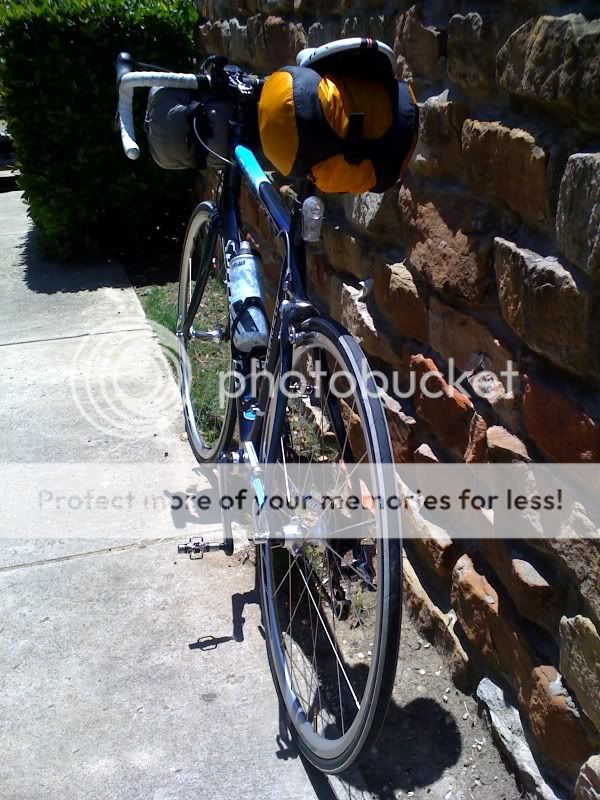
I bought the XS size rei stuff sack last weekend and was amazed that I could shove the tent down in there and compress it all the way. I'm even using the compression straps to mount it on the seat. I was worried about it hitting my legs, but rode around a bit with it there to see if it would bother me and it didn't. Up front is my 35 deg down bag along with a sleeping pad. All hand positions are still totally usable. Total of about 3 pounds on the front and about 2.5 pounds on the rear. Tent poles will go on one side of the backpack in the outside pocket. Stakes will be in the backpack as well.
The main downside? The rei stuff sack is only technically water resistant and the sleeping bag stuff sack is probably not even that. I've got a three week window in Texas to do a 3 day trip, so I can imagine I will find a no rain window, but the prospect is less than optimal. If push comes to shove, I can probably cram the sleeping back into my pack, which I have a nice rain cover for.
Haven't really gotten to the loading of the backpack stuff just yet. I imagine it will be more simple than last time because I won't be taking all of my winter stuff like last time. Mostly just stove, food, "kitchen", toiletries and clothes. Shooting for under ten pounds in the pack including a full 2 liter water bladder. But that is a lot of water...
I bought the XS size rei stuff sack last weekend and was amazed that I could shove the tent down in there and compress it all the way. I'm even using the compression straps to mount it on the seat. I was worried about it hitting my legs, but rode around a bit with it there to see if it would bother me and it didn't. Up front is my 35 deg down bag along with a sleeping pad. All hand positions are still totally usable. Total of about 3 pounds on the front and about 2.5 pounds on the rear. Tent poles will go on one side of the backpack in the outside pocket. Stakes will be in the backpack as well.
The main downside? The rei stuff sack is only technically water resistant and the sleeping bag stuff sack is probably not even that. I've got a three week window in Texas to do a 3 day trip, so I can imagine I will find a no rain window, but the prospect is less than optimal. If push comes to shove, I can probably cram the sleeping back into my pack, which I have a nice rain cover for.
Haven't really gotten to the loading of the backpack stuff just yet. I imagine it will be more simple than last time because I won't be taking all of my winter stuff like last time. Mostly just stove, food, "kitchen", toiletries and clothes. Shooting for under ten pounds in the pack including a full 2 liter water bladder. But that is a lot of water...
05-14-11 | 03:49 PM
#15

Real Men Ride Ordinaries
Joined: Sep 2008
Posts: 3,723
Likes: 3
The real question is, why is it unfortunate that your job requires you to go camping: I know quite a few people who would do awful things for a job like that.
05-14-11 | 10:48 PM
#16
Senior Member
Joined: Jan 2007
Posts: 2,766
Likes: 1
From: NE Tx
Bikes: Tour Easy, Linear USS, Lightening Thunderbolt, custom DF, Raleigh hybrid, Felt time trial
The main downside? The rei stuff sack is only technically water resistant and the sleeping bag stuff sack is probably not even that. I've got a three week window in Texas to do a 3 day trip, so I can imagine I will find a no rain window, but the prospect is less than optimal.
I like your packing set up. Took a bit of doing to figure it out and do it neatly. Be interesting to hear how you and the back pack get along.
Interesting that you, at 6'2" consider the Spitfire 1 adequate. I based my 5'10" limit on how I, at 5'7", fit in it. As for the free standing controvery, I notice my buddies always seem to place a few stakes around their "free standing" tents, and occasionally cussing the hard ground.
05-16-11 | 11:28 PM
#17
Thread Starter
Vain, But Lacking Talent
Joined: Aug 2009
Posts: 5,510
Likes: 81
From: Denton, TX
Bikes: Trek Domane 5.9 DA 9000, Trek Crockett Pink Frosting w/105 5700
Ok, well I took to the task of sorting out the rest of the gear and food for the trip. Here is the list along with some illustrations:
All weights are in grams unless noted:
For the above pictured bike:
On bike:
Front bag:
straps (2) 57
stuff sack 52
35 deg bag 1031
sleeping pad 464
Front total 1604
Rear Bag:
tent 574
fly 456
stuff sack 56
Rear Total: 1086
On bike total: 2690
Or about 5.93 pounds.

Backpack:
hydration bladder 94
pack 790
Clothes:
shorts 300
merino shirt 156
socks 59
Kitchen:
pot 35
stove 19
bottle of fuel 284
container 63
box matches 6
fire starters (5) 7
spork 9
Toiletries:
bag 11
soap/shampoo 131
deodorant 50
toothbrush 12
toothpaste 18
hand/dish soap 12
shower wipes 87
wet wipes 41
sunscreen 109
lip balm 9
towel 53
Tent:
poles 250
stakes 40
Misc:
bandanna 31
batteries 78
headphones 17
headlamp 28
ID/debit 8
keys 15
phone 134
knife: 79
phone charger 44
U lock 630
pack cover 60
camera 178
Tool kit:
bag 7
pump 58
tube 85
patch kit 3
multi tool 67
Pack total: 4167
Or about 9.19 pounds before food
Total base before food: 6857 grams or about 15.12 pounds. Pretty happy with that as it cuts about 7 pounds off from my last attempt.
Food:
dinner (2) 482
Oatmeal (6) 228
cocoa (3) 91
bar/gels 200
powder (9) 63
Total: 1064
Total w/o water 7921
Or about 17.46 pounds.
Loaded pack, tent poles in side pocket:

Energy gels in strap pockets:

Items loaded into top pocket for ease of access:

Total weight of the pack before water is 5231 grams or about 11.53 pounds. And as I type this, I realized also I planned on bringing a paperback, so there's that as well. Putting on the pack and adjusting the straps, it really feels like nothing. With water, it will definitely put on some weight, probably another 4 pounds with a full hydration bladder. So no more than 16.5 pounds tops. I'm sure I've done more than that on any given commute. I'll fill up the bladder and put some miles on the whole setup tomorrow on my commute. I may do it and decide I'd rather skip the hydration bladder and just run the bottles alone. But running out of water is kind of a terrible thing.
All weights are in grams unless noted:
For the above pictured bike:
On bike:
Front bag:
straps (2) 57
stuff sack 52
35 deg bag 1031
sleeping pad 464
Front total 1604
Rear Bag:
tent 574
fly 456
stuff sack 56
Rear Total: 1086
On bike total: 2690
Or about 5.93 pounds.
Backpack:
hydration bladder 94
pack 790
Clothes:
shorts 300
merino shirt 156
socks 59
Kitchen:
pot 35
stove 19
bottle of fuel 284
container 63
box matches 6
fire starters (5) 7
spork 9
Toiletries:
bag 11
soap/shampoo 131
deodorant 50
toothbrush 12
toothpaste 18
hand/dish soap 12
shower wipes 87
wet wipes 41
sunscreen 109
lip balm 9
towel 53
Tent:
poles 250
stakes 40
Misc:
bandanna 31
batteries 78
headphones 17
headlamp 28
ID/debit 8
keys 15
phone 134
knife: 79
phone charger 44
U lock 630
pack cover 60
camera 178
Tool kit:
bag 7
pump 58
tube 85
patch kit 3
multi tool 67
Pack total: 4167
Or about 9.19 pounds before food
Total base before food: 6857 grams or about 15.12 pounds. Pretty happy with that as it cuts about 7 pounds off from my last attempt.
Food:
dinner (2) 482
Oatmeal (6) 228
cocoa (3) 91
bar/gels 200
powder (9) 63
Total: 1064
Total w/o water 7921
Or about 17.46 pounds.
Loaded pack, tent poles in side pocket:
Energy gels in strap pockets:
Items loaded into top pocket for ease of access:
Total weight of the pack before water is 5231 grams or about 11.53 pounds. And as I type this, I realized also I planned on bringing a paperback, so there's that as well. Putting on the pack and adjusting the straps, it really feels like nothing. With water, it will definitely put on some weight, probably another 4 pounds with a full hydration bladder. So no more than 16.5 pounds tops. I'm sure I've done more than that on any given commute. I'll fill up the bladder and put some miles on the whole setup tomorrow on my commute. I may do it and decide I'd rather skip the hydration bladder and just run the bottles alone. But running out of water is kind of a terrible thing.
Last edited by WalksOn2Wheels; 05-16-11 at 11:44 PM. Reason: formatting...
05-18-11 | 12:45 PM
#18
Thread Starter
Vain, But Lacking Talent
Joined: Aug 2009
Posts: 5,510
Likes: 81
From: Denton, TX
Bikes: Trek Domane 5.9 DA 9000, Trek Crockett Pink Frosting w/105 5700
Well, I put in about 14 miles on this setup on my commute yesterday. All in all, it went pretty well. The stuff sack mounted to the seat did start loosening itself. I think for a full day of riding, I'll tie the loose ends together to prevent slippage. Also, the bag on front tended to shift, so I'll have to be more careful about mounting it next time, making sure the straps are evenly spaced and cinched down tightly. I also managed to pick up one of those small bags that mount just behind the steerer on top of the top tube. I was able to put my gels, bars and tools in there, so that took another pound off of the pack and onto the bike. But in the end, that really only offsets the paperback I forgot to add to my list.
All in all, I think it will work out pretty well, but we'll find out for sure next week. I'll probably leave on my trip sometime Sunday or Monday morning.
All in all, I think it will work out pretty well, but we'll find out for sure next week. I'll probably leave on my trip sometime Sunday or Monday morning.
05-18-11 | 04:32 PM
#19
Senior Member
Joined: Sep 2008
Posts: 5,300
Likes: 115
What might help for the front is one or two long pieces of webbing that is secured along the long direction of the stuff sack then velcroed or buckled/fastek onto either or both the bar drops or brake hoods. The smaller bag I had was secured to the hoods and drops holding the bag away from the tops of the bars allowing for a full grip on the top. In your case it'll help stop some fore/aft and side to side swaying. It looks like your front bag is pretty free to flop around the cross connection of the webbing onto the bars.

Thread
Thread Starter
Forum
Replies
Last Post
a1rabbit
Touring
57
04-22-10 02:58 PM
