


Replacing Cassette-Do I need a torque wrench
 02-04-16 | 05:33 PM
#1
Thread Starter
Senior Member
Joined: Aug 2012
Posts: 275
Likes: 1
Replacing Cassette-Do I need a torque wrench
My daughter is building a bike from scratch.
I think she is getting a bit anal.
First she sprayed the inside of her frame with fogging oil to help prevent rust/corrosion.
She was than tightening the cassette onto the hub.. I told her to just use the lock ring tool and tighten by hand.
She insists on using a torque wrench.
Is this really necessary? and if so what should it be calibrated at.
I have never used a torque wrench to change cassettes
I think she is getting a bit anal.
First she sprayed the inside of her frame with fogging oil to help prevent rust/corrosion.
She was than tightening the cassette onto the hub.. I told her to just use the lock ring tool and tighten by hand.
She insists on using a torque wrench.
Is this really necessary? and if so what should it be calibrated at.
I have never used a torque wrench to change cassettes
 02-04-16 | 05:38 PM
#2

Senior Member


Joined: Feb 2012
Posts: 19,381
Likes: 5,527
From: Rochester, NY
Bikes: Stewart S&S coupled sport tourer, Stewart Sunday light, Stewart Commuting, Stewart Touring, Co Motion Tandem, Stewart 3-Spd, Stewart Track, Fuji Finest, Mongoose Tomac ATB, GT Bravado ATB, JCP Folder, Stewart 650B ATB
If the mechanic (and I use that term loosely) has a good feel for tightness then, NO. But if the mechanic is ham fisted or too OCD to know what's good enough then YES. Andy.
 02-04-16 | 05:56 PM
#4

The space coyote lied.


Joined: Sep 2008
Posts: 48,904
Likes: 11,094
From: dusk 'til dawn.
Bikes: everywhere
My daughter is building a bike from scratch.
I think she is getting a bit anal.
First she sprayed the inside of her frame with fogging oil to help prevent rust/corrosion.
She was than tightening the cassette onto the hub.. I told her to just use the lock ring tool and tighten by hand.
She insists on using a torque wrench.
Is this really necessary? and if so what should it be calibrated at.
I have never used a torque wrench to change cassettes
I think she is getting a bit anal.
First she sprayed the inside of her frame with fogging oil to help prevent rust/corrosion.
She was than tightening the cassette onto the hub.. I told her to just use the lock ring tool and tighten by hand.
She insists on using a torque wrench.
Is this really necessary? and if so what should it be calibrated at.
I have never used a torque wrench to change cassettes
If you mean just turning one of these with your bare hand, then no, that's not gonna be good enough unless she has incredible gripping and arm strength.
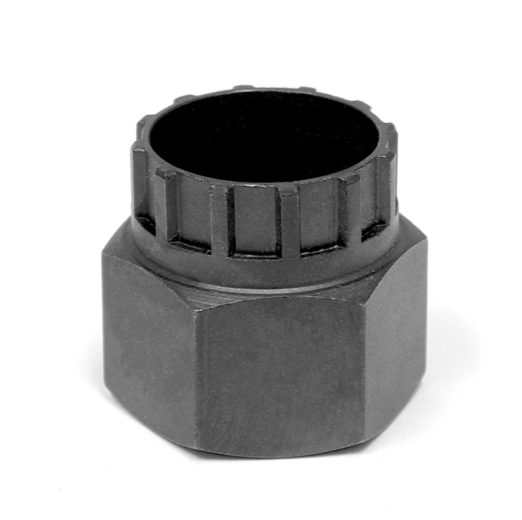
If you mean something like this, then yeah, tighten by hand should be fine, don't be afraid of the clicks.

Same with the mother of all cassette lockring tools:

First style tool with a 12" crescent or a socket wrench with a standard ratchet handle will fork fine, too.
 02-04-16 | 05:59 PM
#5
Senior Member
Joined: Jun 2013
Posts: 4,094
Likes: 2
From: Bozeman
Bikes: 199? Landshark Roadshark, 198? Mondonico Diamond, 1987 Panasonic DX-5000, 1987 Bianchi Limited, Univega... Chrome..., 1989 Schwinn Woodlands, Motobecane USA Record, Raleigh Tokul 2
No, you don't need one for a cassette. Turn it with a 12 inch wrench till it stops turning with reasonable pressure. (Don't put your weight on it.) It clicks when you tighten it. Generally it'll tighten with a bunch of clicks, then get caught on one. I'll usually go one or two more clicks then call it good.
 02-04-16 | 08:08 PM
#7
Senior Member
Joined: May 2015
Posts: 1,719
Likes: 1
From: Colorado
 x2
02-04-16 | 08:40 PM
x2
02-04-16 | 08:40 PM
#8

Senior Member
Joined: Oct 2014
Posts: 195
Likes: 4
Hi kenshireen,
I recommend using a torque wrench. As dsbrantjr wrote, "40 Nm is a surprisingly large amount" and it's true. I use SRAM cassettes on all my family's bikes and they use 40 Nm. I would never have tightened the aluminum SRAM lockring as tight as I should if I was doing it "by hand" and I think I have a fairly good "feel" for this kind of work.
When purchasing a torque wrench, I recommend going "old school" and buying the old "beam" type because they don't go out of calibration as easily as the "click" type. Park Tool's TW-1 and TW-2 are good examples. Plus, they are usually less expensive. If you purchase a click type, be wary of the cheap ones because they may not be calibrated correctly. And be extra wary of inexpensive automotive click-type torque wrenches because some only work in one direction. Bicycles have a number of prominent parts that use reverse threads (drive-side bottom bracket end caps and pedals) so your daughter should have a torque wrench that works in both directions.
Torque is much more important with modern bikes than old bikes. I care for two carbon-frame bikes in my family and you MUST be very mindful of torque or you can damage the frames, carbon handlebars and aerobars. I think your daughter is probably showing wisdom by recognizing the benefit and, in some cases, need for a torque wrench.
The range of torque used in bikes is quite wide. Some components may require only 2-5 Nm of torque like the bottle cage bolts attached to a carbon frame. They must be tight enough so the parts don't rattle apart on a bumpy road---but if they are tightened too much, they may pull the metal sleeves out of the carbon. Other components may require over 500 Nm of torque (like a bottom bracket end cap). It is impossible for one torque wrench to handle such a wide range accurately. So most bike mechanics have two---a small low-range torque wrench for small torques and a larger high-range torque wrench for big torques.
Finally, there is one more thing your daughter may need to know. One way to achieve a good grip at a lower torque is to use friction compound at the joint. It is available at most any bike shop (I use Park Tool SAC-2). It is used for most joints that include carbon. But it is just as good with metal joints and is becoming popular with softer metals like aluminum. It allows you to get a good joint that won't move or squeak at a lower torque, thereby not over-tightening and breaking bike parts.
Kind regards, RoadLight
I recommend using a torque wrench. As dsbrantjr wrote, "40 Nm is a surprisingly large amount" and it's true. I use SRAM cassettes on all my family's bikes and they use 40 Nm. I would never have tightened the aluminum SRAM lockring as tight as I should if I was doing it "by hand" and I think I have a fairly good "feel" for this kind of work.
When purchasing a torque wrench, I recommend going "old school" and buying the old "beam" type because they don't go out of calibration as easily as the "click" type. Park Tool's TW-1 and TW-2 are good examples. Plus, they are usually less expensive. If you purchase a click type, be wary of the cheap ones because they may not be calibrated correctly. And be extra wary of inexpensive automotive click-type torque wrenches because some only work in one direction. Bicycles have a number of prominent parts that use reverse threads (drive-side bottom bracket end caps and pedals) so your daughter should have a torque wrench that works in both directions.
Torque is much more important with modern bikes than old bikes. I care for two carbon-frame bikes in my family and you MUST be very mindful of torque or you can damage the frames, carbon handlebars and aerobars. I think your daughter is probably showing wisdom by recognizing the benefit and, in some cases, need for a torque wrench.
The range of torque used in bikes is quite wide. Some components may require only 2-5 Nm of torque like the bottle cage bolts attached to a carbon frame. They must be tight enough so the parts don't rattle apart on a bumpy road---but if they are tightened too much, they may pull the metal sleeves out of the carbon. Other components may require over 500 Nm of torque (like a bottom bracket end cap). It is impossible for one torque wrench to handle such a wide range accurately. So most bike mechanics have two---a small low-range torque wrench for small torques and a larger high-range torque wrench for big torques.
Finally, there is one more thing your daughter may need to know. One way to achieve a good grip at a lower torque is to use friction compound at the joint. It is available at most any bike shop (I use Park Tool SAC-2). It is used for most joints that include carbon. But it is just as good with metal joints and is becoming popular with softer metals like aluminum. It allows you to get a good joint that won't move or squeak at a lower torque, thereby not over-tightening and breaking bike parts.
Kind regards, RoadLight
Last edited by RoadLight; 02-04-16 at 08:43 PM.
02-04-16 | 08:58 PM
#9
Full Member
Joined: Dec 2014
Posts: 346
Likes: 3
From: Retired to Penang Malaysia originally from UK
Bikes: My 1978 Raleigh from new, 1995 Trek, & constant changing & rebuilding of other bike projects.
Yes Shimano data sheets on cassette do state a torque value, they have to, to protect themselves, but dealing with mechnics, nuts bolts, torque wrenches all my life one has a good feel on something being suitably tight for its application, I never use a torque wrench on a bike unless its CF: but if someone has no experience then best they follow the manufacturer's set value.
02-04-16 | 09:57 PM
#10
Senior Member
Joined: Feb 2012
Posts: 19,381
Likes: 5,527
From: Rochester, NY
Bikes: Stewart S&S coupled sport tourer, Stewart Sunday light, Stewart Commuting, Stewart Touring, Co Motion Tandem, Stewart 3-Spd, Stewart Track, Fuji Finest, Mongoose Tomac ATB, GT Bravado ATB, JCP Folder, Stewart 650B ATB
Yes Shimano data sheets on cassette do state a torque value, they have to, to protect themselves, but dealing with mechnics, nuts bolts, torque wrenches all my life one has a good feel on something being suitably tight for its application, I never use a torque wrench on a bike unless its CF: but if someone has no experience then best they follow the manufacturer's set value.
02-05-16 | 11:49 AM
#11
Banned
Joined: Jun 2010
Posts: 43,586
Likes: 1,380
From: NW,Oregon Coast
Bikes: 8
If a Touring build , consider how you will get the cassette off , when a drive side spoke breaks in the field .
Maybe the Fiber Fix emergency one will get to to a shop. but if not going to Max Torque , but Adequate Instead,
Its possible to do a field repair with a real spare spoke.
Maybe the Fiber Fix emergency one will get to to a shop. but if not going to Max Torque , but Adequate Instead,
Its possible to do a field repair with a real spare spoke.
02-05-16 | 12:28 PM
#12
Senior Member
Joined: Oct 2014
Posts: 4,843
Likes: 17
From: Central PA
Bikes: 2016 Black Mountain Cycles Monster Cross v5, 2015 Ritchey Road Logic, 1998 Specialized Rockhopper, 2017 Raleigh Grand Prix
She was than tightening the cassette onto the hub.. I told her to just use the lock ring tool and tighten by hand.
She insists on using a torque wrench.
Is this really necessary? and if so what should it be calibrated at.
I have never used a torque wrench to change cassettes
She insists on using a torque wrench.
Is this really necessary? and if so what should it be calibrated at.
I have never used a torque wrench to change cassettes
02-05-16 | 12:31 PM
#13
Senior Member
Joined: May 2013
Posts: 4,400
Likes: 106
From: SF Bay Area
Bikes: Bianchi Infinito (Celeste, of course)
The high torque value is designed to firmly clamp the cogs together and distribute the load across all the cogs. With low torque, each cog acts essentially independently. Theoretically, the high torque value is better for preventing gouged free-hubs. And yes, 40 N-m (30 ft*lbs) is far tighter than I would have ever imagined. You really need a 16in wrench.
02-05-16 | 12:38 PM
#14
Senior Member
Joined: Jun 2013
Posts: 4,094
Likes: 2
From: Bozeman
Bikes: 199? Landshark Roadshark, 198? Mondonico Diamond, 1987 Panasonic DX-5000, 1987 Bianchi Limited, Univega... Chrome..., 1989 Schwinn Woodlands, Motobecane USA Record, Raleigh Tokul 2
The high torque value is designed to firmly clamp the cogs together and distribute the load across all the cogs. With low torque, each cog acts essentially independently. Theoretically, the high torque value is better for preventing gouged free-hubs. And yes, 40 N-m (30 ft*lbs) is far tighter than I would have ever imagined. You really need a 16in wrench.
02-05-16 | 12:58 PM
#15

Senior Member
Joined: Jan 2008
Posts: 15,106
Likes: 4,765
From: Beaverton, OR
Bikes: Yes
The high torque value is designed to firmly clamp the cogs together and distribute the load across all the cogs. With low torque, each cog acts essentially independently. Theoretically, the high torque value is better for preventing gouged free-hubs. And yes, 40 N-m (30 ft*lbs) is far tighter than I would have ever imagined. You really need a 16in wrench.
Aluminum freehubs are a curse sent to punish cyclists for being weight weenies. Every time I'm shopping for wheels and I see something with a really low listed weight I remind myself that my rims are as light as is practical for me (~420g) and that any weight savings would come from too few spokes and/or a super light freehub, which even if titanium ($$$) wouldn't actually provide the supposed "rotating mass" bonus, and go back to being happy with my dependable but kind of heavy wheels. </rant>
__________________
My Bikes
My Bikes
02-05-16 | 02:20 PM
#16
Senior Member
Joined: Sep 2015
Posts: 1,695
Likes: 114
From: New Jersey
Aluminum freehubs are a curse sent to punish cyclists for being weight weenies. Every time I'm shopping for wheels and I see something with a really low listed weight I remind myself that my rims are as light as is practical for me (~420g) and that any weight savings would come from too few spokes and/or a super light freehub, which even if titanium ($$$) wouldn't actually provide the supposed "rotating mass" bonus, and go back to being happy with my dependable but kind of heavy wheels. </rant>
02-05-16 | 02:41 PM
#17
Senior Member
Joined: Dec 2010
Posts: 9,694
Likes: 2,616
From: northern Deep South
Bikes: Fuji Touring, Novara Randonee
I'd be pleasantly surprised if my daughter recognized a torque wrench if she tripped over it... I can't think of a reason to dissuade a young mechanic from using one. After they've learned for a while, perhaps they'll get confident enough to skip it.
I have had a cassette lockring come unscrewed on me, fortunately just a couple of miles from a SAG stop with a mechanic (it was a supported ride). I haven't pulled the torque wrench out for that lockring yet, I just go for really tight. But I do measure the torque on my bottom brackets.
I have had a cassette lockring come unscrewed on me, fortunately just a couple of miles from a SAG stop with a mechanic (it was a supported ride). I haven't pulled the torque wrench out for that lockring yet, I just go for really tight. But I do measure the torque on my bottom brackets.
02-05-16 | 02:45 PM
#18

aka Tom Reingold
Joined: Jan 2009
Posts: 44,338
Likes: 6,637
From: New York, NY, and High Falls, NY, USA
Bikes: 1962 Rudge Sports, 1971 Raleigh Super Course, 1971 Raleigh Pro Track, 1974 Raleigh International, 1975 Viscount Fixie, 1982 McLean, 1996 Lemond (Ti), 2002 Burley Zydeco tandem
What are the consequences of using insufficient torque? The design looks smart enough that it wouldn't be anything horrible.
__________________
Tom Reingold, tom@noglider.com
New York City and High Falls, NY
Blogs: The Experienced Cyclist; noglider's ride blog
“When man invented the bicycle he reached the peak of his attainments.” — Elizabeth West, US author
Please email me rather than PM'ing me. Thanks.
Tom Reingold, tom@noglider.com
New York City and High Falls, NY
Blogs: The Experienced Cyclist; noglider's ride blog
“When man invented the bicycle he reached the peak of his attainments.” — Elizabeth West, US author
Please email me rather than PM'ing me. Thanks.
02-05-16 | 02:49 PM
#20

Senior Member
Joined: May 2008
Posts: 9,102
Likes: 6,009
From: Zang's Spur, CO
A big clunk every time you start pedaling, and random clunks.
In my case, it was loose enough that I could grab the cassette and make it visibly wobble.
Quite a few miles elapsed between installation, and the lockring getting loose enough to start clunking.
02-05-16 | 02:53 PM
#21
Senior Member
Joined: Jan 2008
Posts: 15,106
Likes: 4,765
From: Beaverton, OR
Bikes: Yes
A bit off topic, but I'd just like to say that I have one of these, and it is easily my favorite tool. I limped by for years with the FR-5 and an adjustable wrench, but since I bought the Crombie I find myself looking for reasons to use it. It's a wonderfully designed tool. Future generations will point to it as evidence that we were visited by benevolent aliens with superior technology.
__________________
My Bikes
My Bikes
02-05-16 | 05:20 PM
#22
Senior Member
Joined: Apr 2009
Posts: 54
Likes: 2
thread locking compound
Since I seldom use the mating serrated lockring inner cog (custom ratios), I don't know if the stated torque is correct. So I always use a reusable thread locking compound like Vibratite.
You need to be careful with a torque value: While the steel lockrings I have are indeed marked 40kg-m, the aluminum ones are marked 400kg-cm.
You need to be careful with a torque value: While the steel lockrings I have are indeed marked 40kg-m, the aluminum ones are marked 400kg-cm.
Last edited by flyboy2160; 02-06-16 at 12:31 AM.
02-05-16 | 05:33 PM
#23
The space coyote lied.
Joined: Sep 2008
Posts: 48,904
Likes: 11,094
From: dusk 'til dawn.
Bikes: everywhere
Since I seldom use the mating serrated lockring inner cog (custom ratios), I don't know if t he stated torque is correct. So I always use a reusable thread locking compound like Vibratite.
You need to be careful with a torque value: While the steel lockrings I have are indeed marked 40kg-m, the aluminum ones are marked 400kg-cm.
You need to be careful with a torque value: While the steel lockrings I have are indeed marked 40kg-m, the aluminum ones are marked 400kg-cm.
02-05-16 | 06:21 PM
#24

Senior Member
Joined: Oct 2004
Posts: 4,224
Likes: 6
No, you don't need a torque wrench on cassette lock rings provided you are not ham fisted. I'll share a story. I once ruined a Shimano Dura-Ace hub by stripping the lock ring while replacing the cassette. Luckily, Shimano warrantied it, to my surprise. So, now, I use a torque wrench. I'll be the first to admit that I am a bit ham fisted though.

Thread
Thread Starter
Forum
Replies
Last Post
robertorolfo
Bicycle Mechanics
21
11-19-18 10:06 PM
box opener
Bicycle Mechanics
47
07-20-17 09:38 AM
Noctilux.95
Bicycle Mechanics
17
10-21-16 11:49 AM
