


Microshift Front Dertailleur Issue with SRAM Apex system.
 06-17-23 | 05:39 PM
#1
Thread Starter
Full Member
Joined: Dec 2013
Posts: 334
Likes: 148
Microshift Front Dertailleur Issue with SRAM Apex system.
Okay,
so this could be quite an esoteric question, and I am in a unicorn situation, but hear me out.
Background:
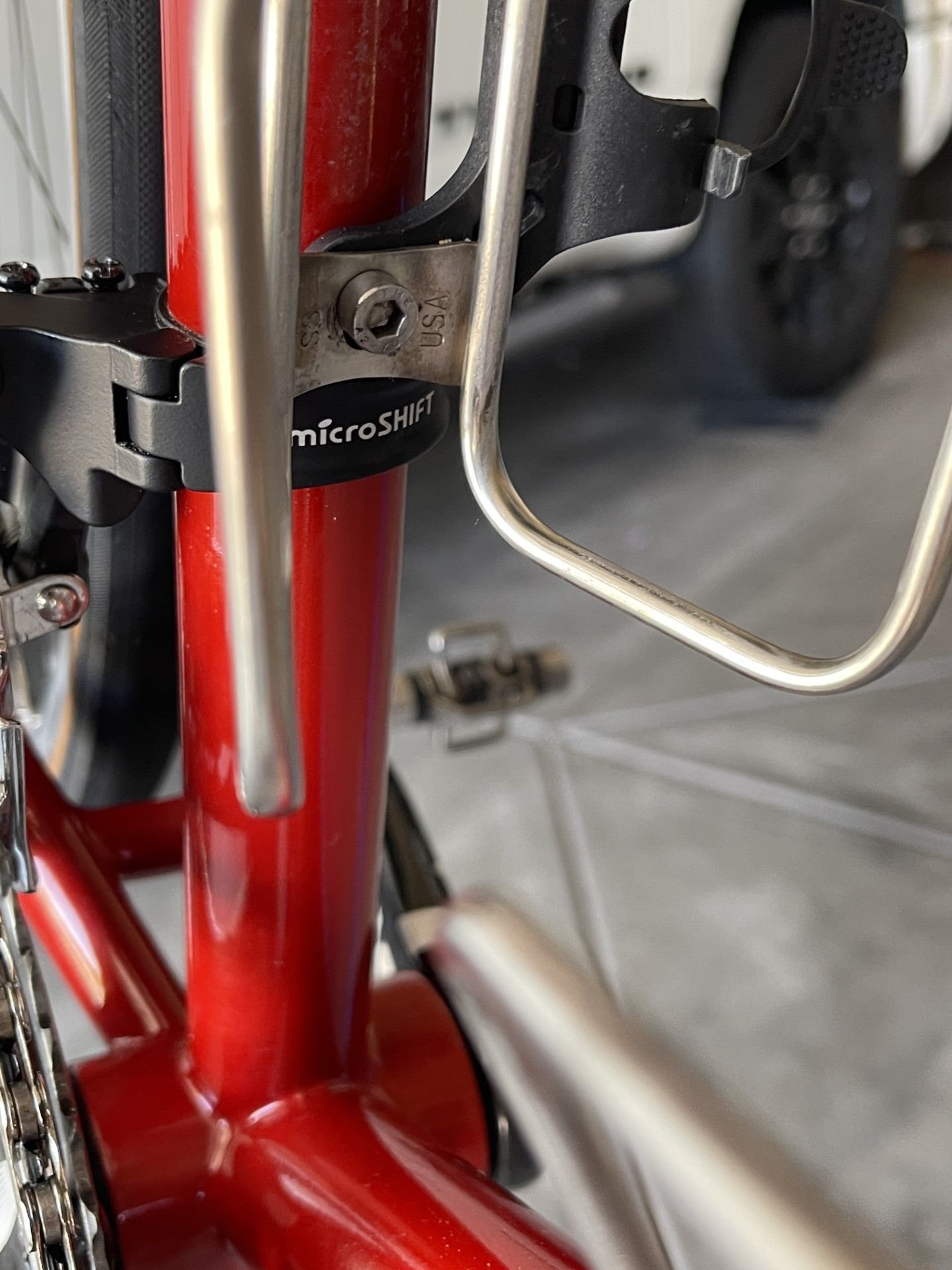
Originally had a Redline Conquest Pro frame from 2011/2012, equipped with SRAM Apex drive train. I ended-up running the bike into my garage while on a roof rack, destroying the frame. I hired a local custom builder (JamesFrames from Boulder), to build a custom steel frame with the exact same specifications. When I had it built up with the components, I needed to replace the front derailleur because the way JamesFrames ran the cabling (with all cables, (i) Rear DR, (ii) Rear Brake, and (iii) Front DR along the top-tube), meant that the front derailleur wire ran from the top-rear of the top tube down the seat tube and into the derailleur (as opposed to the original Redline, which ran the Front DR cable under the down-tube).
Because of this, I needed to replace the OEM SRAM Apex front derailleur with a Microshift derailleur.
Issue:
Whenever I am in the large front ring, and the smallest two COGS on the 10 speed cassette, I get chain rub. So me, being an at-home wanna-be mechanic, ended up thinking the trim maybe drifted and needed to be adjusted. However, what I discovered was that when I adjusted the trim to ensure no chain rub when in the smallest two rear cogs, and large front ring, it created a huge problem. When shifting from the small ring to the big ring using SRAM's Doubletap system, the front derailleur cage would literally cause the right crank arm to basically hit the derailleur cage causing the crank arm to hit and stop moving violently.
So in order to ensure I do not end up with either a crash, broken front derailleur, or crank arm, I have to set the limit screw such that, I cannot use the smallest two cogs on the cassette when in the large front ring. Being this is a cross bike in theory, racing cross likely means those two cogs are not generally going to be used "as much" as other cogs, and this is not going to impact me. However, also wanting to use this as a gravel bike, those two cogs actually could be important depending on the terrain.
Question:
Is this just a compatibility issue with using a Microshift FD with the SRAM Apex gruppo, and the way the Microshift derailleur reacts to the "throw" of the SRAM doubletap system means this is really not anything that can be fixed? I wonder if there is something about the SRAM Apex front derailleur that limits how far out the cage moves when shifting into the big ring, vs. where it settles, as opposed to the Microshift FD, which when you shift up, it extends a few MM's farther out vs. where it settled once you shift.

so this could be quite an esoteric question, and I am in a unicorn situation, but hear me out.
Background:
Originally had a Redline Conquest Pro frame from 2011/2012, equipped with SRAM Apex drive train. I ended-up running the bike into my garage while on a roof rack, destroying the frame. I hired a local custom builder (JamesFrames from Boulder), to build a custom steel frame with the exact same specifications. When I had it built up with the components, I needed to replace the front derailleur because the way JamesFrames ran the cabling (with all cables, (i) Rear DR, (ii) Rear Brake, and (iii) Front DR along the top-tube), meant that the front derailleur wire ran from the top-rear of the top tube down the seat tube and into the derailleur (as opposed to the original Redline, which ran the Front DR cable under the down-tube).
Because of this, I needed to replace the OEM SRAM Apex front derailleur with a Microshift derailleur.
Issue:
Whenever I am in the large front ring, and the smallest two COGS on the 10 speed cassette, I get chain rub. So me, being an at-home wanna-be mechanic, ended up thinking the trim maybe drifted and needed to be adjusted. However, what I discovered was that when I adjusted the trim to ensure no chain rub when in the smallest two rear cogs, and large front ring, it created a huge problem. When shifting from the small ring to the big ring using SRAM's Doubletap system, the front derailleur cage would literally cause the right crank arm to basically hit the derailleur cage causing the crank arm to hit and stop moving violently.
So in order to ensure I do not end up with either a crash, broken front derailleur, or crank arm, I have to set the limit screw such that, I cannot use the smallest two cogs on the cassette when in the large front ring. Being this is a cross bike in theory, racing cross likely means those two cogs are not generally going to be used "as much" as other cogs, and this is not going to impact me. However, also wanting to use this as a gravel bike, those two cogs actually could be important depending on the terrain.
Question:
Is this just a compatibility issue with using a Microshift FD with the SRAM Apex gruppo, and the way the Microshift derailleur reacts to the "throw" of the SRAM doubletap system means this is really not anything that can be fixed? I wonder if there is something about the SRAM Apex front derailleur that limits how far out the cage moves when shifting into the big ring, vs. where it settles, as opposed to the Microshift FD, which when you shift up, it extends a few MM's farther out vs. where it settled once you shift.
 06-17-23 | 06:32 PM
#2
Clark W. Griswold


Joined: Mar 2014
Posts: 18,448
Likes: 6,758
From: ,location, location
Bikes: Foundry Chilkoot Ti W/Ultegra Di2, Salsa Timberjack Ti, Cinelli Mash Work RandoCross Fun Time Machine, 1x9 XT Parts Hybrid, Co-Motion Cascadia, Specialized Langster, Phil Wood Apple VeloXS Frame (w/DA 7400), R+M Supercharger2 Rohloff, Habanero Ti 26
It is a difference in pull most likely and with it being indexed that could be causing it. I have not mixed Microshift and SRAM personally but would have to imagine it is different. It could be adjustment as well it might work with the proper adjustment but I would put more money on the cable pull ratios being off. Though SRAM never really got the FD thing and that is why they went so hard into 1X not because it was the best thing ever but they just really couldn't make a good reliable well loved FD like Shimano so they said we can work to fix the problem or get some marketing.
06-18-23 | 06:31 AM
#3
Thread Starter
Full Member
Joined: Dec 2013
Posts: 334
Likes: 148
veganbikes Thanks for the feedback. I thought I was going crazy with something as simple as a limit screw adjustment. I guess unless I take the time and effort to get the frame brazed with the ability to run the FD cable down the down tube, I may just be stuck with this set-up and chain rub issue. At the end of the day, how often are we really running our smallest two rear COGS for an extended period of time? I suppose, I could try to evaluate if there are SRAM specific derailleurs that would accept the FD cable coming down the seat-tube, however, I am guessing that the reason the bike shop (which put together this bike), selected this Microshift front derailleur is precisely because, SRAM never designed a front derailleur to accept a cable in this manner.
06-18-23 | 06:47 AM
#4

Senior Member

Joined: Jun 2005
Posts: 2,920
Likes: 1,002
From: Louisville KY
Bikes: 06 Lemond Reno, 98 GT Timberline
The Microshift site will show specs for their FDs so you can check the model of FD to see if it is compatible: microSHIFT
06-18-23 | 06:56 AM
#5

Senior Member
Joined: Apr 2016
Posts: 3,910
Likes: 1,812
Okay,
so this could be quite an esoteric question, and I am in a unicorn situation, but hear me out.
Background:
Originally had a Redline Conquest Pro frame from 2011/2012, equipped with SRAM Apex drive train. I ended-up running the bike into my garage while on a roof rack, destroying the frame. I hired a local custom builder (JamesFrames from Boulder), to build a custom steel frame with the exact same specifications. When I had it built up with the components, I needed to replace the front derailleur because the way JamesFrames ran the cabling (with all cables, (i) Rear DR, (ii) Rear Brake, and (iii) Front DR along the top-tube), meant that the front derailleur wire ran from the top-rear of the top tube down the seat tube and into the derailleur (as opposed to the original Redline, which ran the Front DR cable under the down-tube).
Because of this, I needed to replace the OEM SRAM Apex front derailleur with a Microshift derailleur
so this could be quite an esoteric question, and I am in a unicorn situation, but hear me out.
Background:
Originally had a Redline Conquest Pro frame from 2011/2012, equipped with SRAM Apex drive train. I ended-up running the bike into my garage while on a roof rack, destroying the frame. I hired a local custom builder (JamesFrames from Boulder), to build a custom steel frame with the exact same specifications. When I had it built up with the components, I needed to replace the front derailleur because the way JamesFrames ran the cabling (with all cables, (i) Rear DR, (ii) Rear Brake, and (iii) Front DR along the top-tube), meant that the front derailleur wire ran from the top-rear of the top tube down the seat tube and into the derailleur (as opposed to the original Redline, which ran the Front DR cable under the down-tube).
Because of this, I needed to replace the OEM SRAM Apex front derailleur with a Microshift derailleur
06-18-23 | 04:00 PM
#7
Thread Starter
Full Member
Joined: Dec 2013
Posts: 334
Likes: 148
The Microshift site will show specs for their FDs so you can check the model of FD to see if it is compatible: microSHIFT
Anyways, going to look into the problem solvers as a solution. I do worry the pulley solution will increase the cable length, and add potentially less precise shifting, but really, front derailleurs in general are not precise instruments, but generally still more at heart with friction shifting.
06-18-23 | 06:15 PM
#8

Senior Member
Joined: Jul 2015
Posts: 7,495
Likes: 3,300
From: NW Oregon
Bikes: 1982 Trek 930R Custom, '91 Diamondback Ascent w/ XT, XTR updates, Fuji Team Pro CF road flyer, Specialized Sirrus Gravel Convert, '09 Comencal Meta 5.5 XC, '02 Marin MBX500, '84 Gitane Criterium bike
From Bike Radar....
What is cable pull ratio?
Cable pull ratio is the amount the derailleur moves for every millimetre of cable pulled through by the shifter. Microshift and Shimano use the same cable pull ratio for certain products, making their components compatible. The exception is Microshift’s Acolyte, Advent and Advent X groupsets that use the brand’s proprietary pull ratio.The range is not compatible with SRAM drivetrain components because it uses a different cable pull ratio.
conclusion: the shop bone headed this swap, Badly.
determine the Seat tube size, then search: SRAM (seat tube size here) Top Pull Front Derailleur.
you can get a refund from the shop for THEIR MISTAKE, and use that to finance the correct Front Derailleur
then search for a different shop or insist on a less bone-headed mechanic.

and if the search results turn up Zero top pull SRAM Front derailleurs that match your pull ratio,,, get the pulley setup mentioned earlier.. Front Ders are NOT "precision shifting", ever.
and Welcome to the SRAM ZONE Zone zone zone....
Last edited by maddog34; 06-18-23 at 06:37 PM.
 06-18-23 | 11:05 PM
#9
Thread Starter
Full Member
Joined: Dec 2013
Posts: 334
Likes: 148
From Bike Radar....
What is cable pull ratio?
Cable pull ratio is the amount the derailleur moves for every millimetre of cable pulled through by the shifter. Microshift and Shimano use the same cable pull ratio for certain products, making their components compatible. The exception is Microshift’s Acolyte, Advent and Advent X groupsets that use the brand’s proprietary pull ratio.The range is not compatible with SRAM drivetrain components because it uses a different cable pull ratio.
conclusion: the shop bone headed this swap, Badly.
determine the Seat tube size, then search: SRAM (seat tube size here) Top Pull Front Derailleur.
you can get a refund from the shop for THEIR MISTAKE, and use that to finance the correct Front Derailleur
then search for a different shop or insist on a less bone-headed mechanic.
and if the search results turn up Zero top pull SRAM Front derailleurs that match your pull ratio,,, get the pulley setup mentioned earlier.. Front Ders are NOT "precision shifting", ever.
and Welcome to the SRAM ZONE Zone zone zone....
As an aside, what I am appreciating more, are the benefits of doing ( or at least trying) to so your own maintenance at home. It offers such a greater opportunity to better understand your own bikes, components and evern components yo-u do not own yet, but likely need.
06-19-23 | 12:59 AM
#10
Senior Member
Joined: Jul 2015
Posts: 7,495
Likes: 3,300
From: NW Oregon
Bikes: 1982 Trek 930R Custom, '91 Diamondback Ascent w/ XT, XTR updates, Fuji Team Pro CF road flyer, Specialized Sirrus Gravel Convert, '09 Comencal Meta 5.5 XC, '02 Marin MBX500, '84 Gitane Criterium bike
maddog34 Hey - thanks so much for the insight and information. I am starting to feel a little snookered by the shop, and them not at the very least, reaching out to me about the situation with the FD compatibility issue.
As an aside, what I am appreciating more, are the benefits of doing ( or at least trying) to so your own maintenance at home. It offers such a greater opportunity to better understand your own bikes, components and evern components yo-u do not own yet, but likely need.
As an aside, what I am appreciating more, are the benefits of doing ( or at least trying) to so your own maintenance at home. It offers such a greater opportunity to better understand your own bikes, components and evern components yo-u do not own yet, but likely need.
i should add this.. the shop may have been doing their best to get your new frame in place and working... the Selection of New top pull shifters is kinda drying up since most frame Builders use Bottom Pull Ft. der.cable routing now... Or No ft. cable route because of 1x12... Or NO Shift cable routing, AKA: Electronic shifting.
Last edited by maddog34; 06-19-23 at 01:18 AM.
06-19-23 | 06:07 AM
#11
Senior Member
Joined: Apr 2016
Posts: 3,910
Likes: 1,812
Anyways, going to look into the problem solvers as a solution. I do worry the pulley solution will increase the cable length, and add potentially less precise shifting, but really, front derailleurs in general are not precise instruments, but generally still more at heart with friction shifting.
06-19-23 | 03:06 PM
#12
Senior Member
Joined: Jul 2015
Posts: 7,495
Likes: 3,300
From: NW Oregon
Bikes: 1982 Trek 930R Custom, '91 Diamondback Ascent w/ XT, XTR updates, Fuji Team Pro CF road flyer, Specialized Sirrus Gravel Convert, '09 Comencal Meta 5.5 XC, '02 Marin MBX500, '84 Gitane Criterium bike
If a bike is ridden regularly, Shift cables should be changed about once a year anyway.. MAYBE every two years, depending on how often the rider needs to shift during rides, and if the bike has brifters on it...
ever spent an hour or so getting a cable remnant out of a brifter? i have.. it sucks. imagine doing that along the side of a busy highway.... a SAG wagon arrives.. it's fully loaded.. and the "mechanic" onboard is not really a mechanic, just an "eager to help" kid with no actual parts, some harbor freight tools, but no pick awl... and you are obliged to explain why you won't be needing his help... while digging out the cable end with a tiny screwdriver meant for adjusting limit screws (That brifter was never quite the same).... along a busy highway... as the rest of the STP riders pass you by... ten miles from the finish line.
the cable remnant came out about two minutes after i finally chased the sag wagon dude away... the new cable slid in easily.. almost as if the bike said " we've tortured him enough for NOT SWAPPING in new cables sooner!"...
PS.. "cable stretch" is an imaginary issue, once the cable settles into place.
Last edited by maddog34; 06-19-23 at 03:14 PM.
06-19-23 | 10:05 PM
#13

Mostly harmless ™
Joined: Nov 2010
Posts: 4,463
Likes: 244
From: Novi Sad
Bikes: Heavy, with friction shifters
The first thing I would check is the FD cage alignment and height.
Fixing that might solve the problem.
The next thing I'd check is the chainline.
Also, to avoid misunderstanding:
Does the large front ring combined with smallest two rear chainrings (the ones most outward, away from the bike) cause rubbing?
Because, if it's the largest front ring with the largest two rear chainrings (the "slowest" gears, closest to the frame), then we're probably dealing with cross-chaining and some chain rub might be inevitable, depending on your chainstay length (which is ridiculously short on most modern bikes).
Relja
Fixing that might solve the problem.
The next thing I'd check is the chainline.
Also, to avoid misunderstanding:
Does the large front ring combined with smallest two rear chainrings (the ones most outward, away from the bike) cause rubbing?
Because, if it's the largest front ring with the largest two rear chainrings (the "slowest" gears, closest to the frame), then we're probably dealing with cross-chaining and some chain rub might be inevitable, depending on your chainstay length (which is ridiculously short on most modern bikes).
Relja
06-19-23 | 11:58 PM
#14
Senior Member
Joined: Jul 2015
Posts: 7,495
Likes: 3,300
From: NW Oregon
Bikes: 1982 Trek 930R Custom, '91 Diamondback Ascent w/ XT, XTR updates, Fuji Team Pro CF road flyer, Specialized Sirrus Gravel Convert, '09 Comencal Meta 5.5 XC, '02 Marin MBX500, '84 Gitane Criterium bike
The first thing I would check is the FD cage alignment and height.
Fixing that might solve the problem.
The next thing I'd check is the chainline.
Also, to avoid misunderstanding:
Does the large front ring combined with smallest two rear chainrings (the ones most outward, away from the bike) cause rubbing?
Because, if it's the largest front ring with the largest two rear chainrings (the "slowest" gears, closest to the frame), then we're probably dealing with cross-chaining and some chain rub might be inevitable, depending on your chainstay length (which is ridiculously short on most modern bikes).
Relja
Fixing that might solve the problem.
The next thing I'd check is the chainline.
Also, to avoid misunderstanding:
Does the large front ring combined with smallest two rear chainrings (the ones most outward, away from the bike) cause rubbing?
Because, if it's the largest front ring with the largest two rear chainrings (the "slowest" gears, closest to the frame), then we're probably dealing with cross-chaining and some chain rub might be inevitable, depending on your chainstay length (which is ridiculously short on most modern bikes).
Relja
Pull ratio issue, since Microshift uses it's own pull ratios for the Advent/AdventX series, and SRAM shifters don't play well with others, anyway........ coupled with a Chaincage that's WAY too high in the back... yep.. needs a different Der., and/or the stock SRAM Apex back on, and a reverser pulley (best choice).
this came about because a frame builder re-routed the Ft. der. cable along the top tube, and a shop got too creative......
06-20-23 | 03:19 AM
#15
Mostly harmless ™
Joined: Nov 2010
Posts: 4,463
Likes: 244
From: Novi Sad
Bikes: Heavy, with friction shifters
From the Original post... "Because of this, I needed to replace the OEM SRAM Apex front derailleur with a Microshift derailleur."
Pull ratio issue, since Microshift uses it's own pull ratios for the Advent/AdventX series, and SRAM shifters don't play well with others, anyway........ coupled with a Chaincage that's WAY too high in the back... yep.. needs a different Der., and/or the stock SRAM Apex back on, and a reverser pulley (best choice).
this came about because a frame builder re-routed the Ft. der. cable along the top tube, and a shop got too creative......
Pull ratio issue, since Microshift uses it's own pull ratios for the Advent/AdventX series, and SRAM shifters don't play well with others, anyway........ coupled with a Chaincage that's WAY too high in the back... yep.. needs a different Der., and/or the stock SRAM Apex back on, and a reverser pulley (best choice).
this came about because a frame builder re-routed the Ft. der. cable along the top tube, and a shop got too creative......
If that is the case, it's worth setting it correctly, and then testing if the shifting will be acceptably good (or acceptably bad
 ) for the rider.
06-20-23 | 01:00 PM
) for the rider.
06-20-23 | 01:00 PM
#16
Senior Member
Joined: Jul 2015
Posts: 7,495
Likes: 3,300
From: NW Oregon
Bikes: 1982 Trek 930R Custom, '91 Diamondback Ascent w/ XT, XTR updates, Fuji Team Pro CF road flyer, Specialized Sirrus Gravel Convert, '09 Comencal Meta 5.5 XC, '02 Marin MBX500, '84 Gitane Criterium bike
now.. add the fact that the Advent Groups are meant for mostly MTB use... guess what usually happens when you shift an MTB front der. to the large ring of a compact road crankset? Cage rub on the small ring, which, in turn, limits outward range of motion.
and, in extreme cases, the "too high" tail bridge of the ft. der. can interfere with the chain... although this is more common on triple cranks...
Last edited by maddog34; 06-20-23 at 01:14 PM.
