


Down shift aids on chainring
 02-21-24 | 07:56 AM
#1
Thread Starter
Junior Member

Joined: Oct 2017
Posts: 181
Likes: 55
From: Ottawa, ON, Canada
Bikes: 1974 PX-10E steep angles, sold, 1977 Witcomb stolen, 1980 Roberts 1 speed, 1987 Cyclops 3 x 6 friction triple crank, 2010 Masi Commuter 1 speed, 2017 Ribble 525 2 x 10 with Ergos
Down shift aids on chainring
I am running a KMC x8 chain on a Campagnolo Racing Triple 9 sp. 30-40-50 chainset with Racing Triple FD. The down shift from middle to granny is very sluggish due to chain length between cage contact and ring contact points, a fundamental issue with a triple set-up. I notice that the TA rings for this chainset have pairs of shortened teeth. Are these downshift aids? Would filing a few pairs of teeth down help the Campagnolo middle ring to let the chain go?
oldschoolbike
oldschoolbike
 02-21-24 | 09:22 AM
#2
Senior Member

Joined: Oct 2023
Posts: 1,711
Likes: 1,012
From: New Jersey
I can't answer your question, but I am interested in what others have to say.
A bike's shifting is really designed like a Houdini level magic trick - the goal is to keep the chain locked in a chosen gear no matter what, until of course it gets the magic touch from the derailleur that moves it easily and instantly at the push of a distant control.
A bike's shifting is really designed like a Houdini level magic trick - the goal is to keep the chain locked in a chosen gear no matter what, until of course it gets the magic touch from the derailleur that moves it easily and instantly at the push of a distant control.
02-21-24 | 09:34 AM
#3

aged to perfection


Joined: Jun 2009
Posts: 2,242
Likes: 1,659
From: PacNW
Bikes: Dinucci Allez 2.0, Richard Sachs, Alex Singer, Serotta, Masi GC, Raleigh Pro Mk.1, Hetchins, etc
I think the short teeth are UP shift aids
check your chain tension - should not be too tight on the middle ring.
also check the ANGLE of your front derailleur. outer plate should be parallel to the plane of the chainrings.
you MIGHT try bending the "toe" of the cage in just a tiny bit. would need to see the actual problem to give you better guidance.
/markp
check your chain tension - should not be too tight on the middle ring.
also check the ANGLE of your front derailleur. outer plate should be parallel to the plane of the chainrings.
you MIGHT try bending the "toe" of the cage in just a tiny bit. would need to see the actual problem to give you better guidance.
/markp
02-21-24 | 09:47 AM
#4

Senior Member

Joined: Feb 2012
Posts: 19,359
Likes: 5,492
From: Rochester, NY
Bikes: Stewart S&S coupled sport tourer, Stewart Sunday light, Stewart Commuting, Stewart Touring, Co Motion Tandem, Stewart 3-Spd, Stewart Track, Fuji Finest, Mongoose Tomac ATB, GT Bravado ATB, JCP Folder, Stewart 650B ATB
Shimano early in their pursuit of better shifting (early 1980s) came up with (knowing Shimano's patent research dept, likely "borrowed" the idea) with what they called "W Cut" ring teeth. The tops of a pair of teeth were cut down in height, reasoning being that the chain wouldn't have to climb up as far to get over the teeth to move sideways to the inner ring. It worked fairly well and a trick/mod I have done to many non shift ramped/pinned rings to enhance their shifting. In my home made versions I increase the number of paired cut down teeth from two pairs about opposite each other to 5 pairs distributed evenly around the rings..
Having said the W Cut helps with shifting is all great it discounts the vastly larger component in the shifting system, the rider. Or more to the point the riders control box between the ears. I don't think I can count on the number of fellow club riders and so many customers who complain about front shifting, double and triples. Those who listen and take advice find that many of their issues go away after they learn and use best shifting techniques. Andy
Having said the W Cut helps with shifting is all great it discounts the vastly larger component in the shifting system, the rider. Or more to the point the riders control box between the ears. I don't think I can count on the number of fellow club riders and so many customers who complain about front shifting, double and triples. Those who listen and take advice find that many of their issues go away after they learn and use best shifting techniques. Andy
__________________
AndrewRStewart
AndrewRStewart
02-21-24 | 09:50 AM
#5

Facts just confuse people

Joined: Jul 2017
Posts: 19,341
Likes: 7,062
From: Mississippi
Bikes: Tarmac Disc Comp Di2 - 2020
Another vote for checking your chain tension. Don't know about your short teeth. I always imagined that all the various ways they sculpt teeth on rings is mainly for shifting to the next larger ring.
How loose is your chain when in the small/small combo? If you shortened the chain, then is there enough left to get into the big/big?
How loose is your chain when in the small/small combo? If you shortened the chain, then is there enough left to get into the big/big?
02-21-24 | 10:04 AM
#6
Senior Member
Joined: Oct 2023
Posts: 1,711
Likes: 1,012
From: New Jersey
It worked fairly well and a trick/mod I have done to many non shift ramped/pinned rings to enhance their shifting. In my home made versions I increase the number of paired cut down teeth from two pairs about opposite each other to 5 pairs distributed evenly around the rings..
02-21-24 | 04:30 PM
#7
Senior Member
Joined: Apr 2007
Posts: 7,754
Likes: 1,738
Am I missing something? You are using an 8 speed chain with a 9 speed crank? I might suggest that you try a 9 speed chain and see if that helps. Even if you have an 8 speed cassette - the 9 speed chain will work fine with that.
02-21-24 | 04:45 PM
#8

You probably already know this, but it can't hurt to check the basics: many triples on bikes seem to shift best to the granny when the chain is on one of the innermost sprockets in back. I usually do that shift when the chain's on the biggest sprocket or one of the two next largest ones.
Also, the difference between sluggish and reasonably quick shifts to the granny can be a matter of repositioning the front derailleur so that the rear of the cage is just a degree or two further in toward the frame.
And, of course, make sure to confirm that the vertical gap between the bottom of the cage and the top of the teeth on the big chainring is as it should be. About a nickel's thickness, if I remember correctly.
Also, the difference between sluggish and reasonably quick shifts to the granny can be a matter of repositioning the front derailleur so that the rear of the cage is just a degree or two further in toward the frame.
And, of course, make sure to confirm that the vertical gap between the bottom of the cage and the top of the teeth on the big chainring is as it should be. About a nickel's thickness, if I remember correctly.
Last edited by Trakhak; 02-21-24 at 04:48 PM.
 02-21-24 | 06:36 PM
#9
Senior Member
Joined: Jan 2016
Posts: 1,515
Likes: 644
Here is Shimano's reasoning for the shortened teeth profile in the early SG chainrings (late 80's). Similar to some of their earlier attempts to modify the teeth's shape. These were designed to release mainly in 2 points.
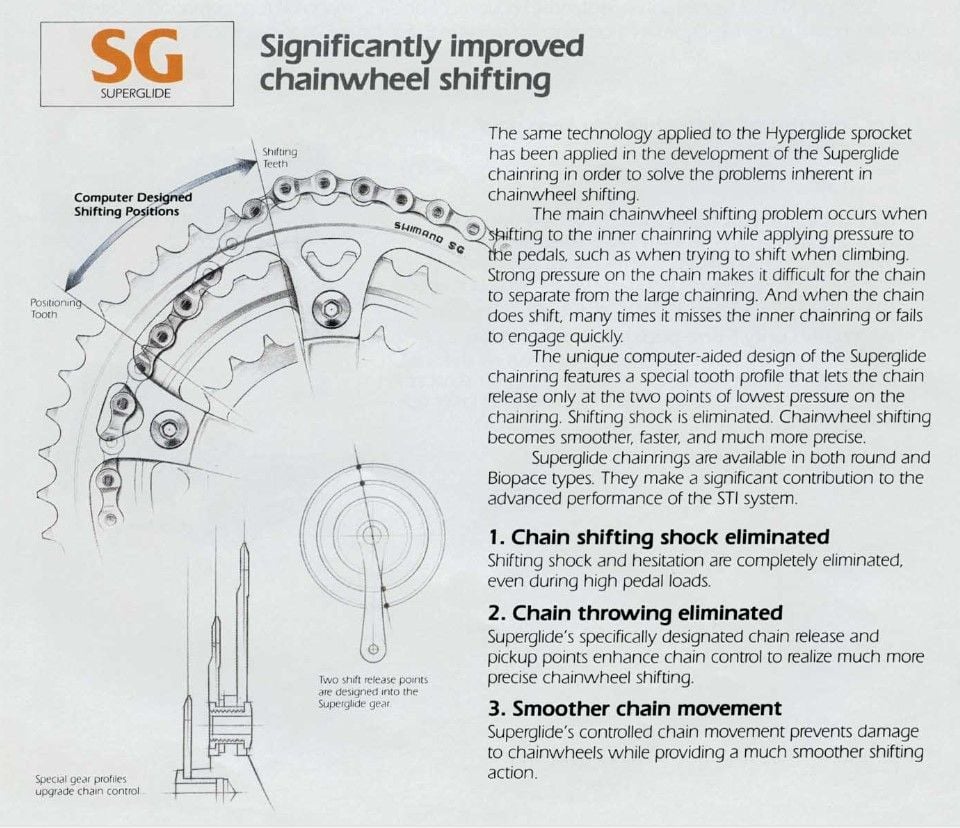
A few years later they introduced the SG-X. More similar to what is common today, adding pins, plates, hooks, varying teeth profiles, etc. to aid upshifting. Cranks in this era also began to use chainrings in sets to 'clock' the rings so the distance between the teeths of adjacent rings would match the pitch of the chain. Over the years Shimano and others have modified these ideas in many ways.
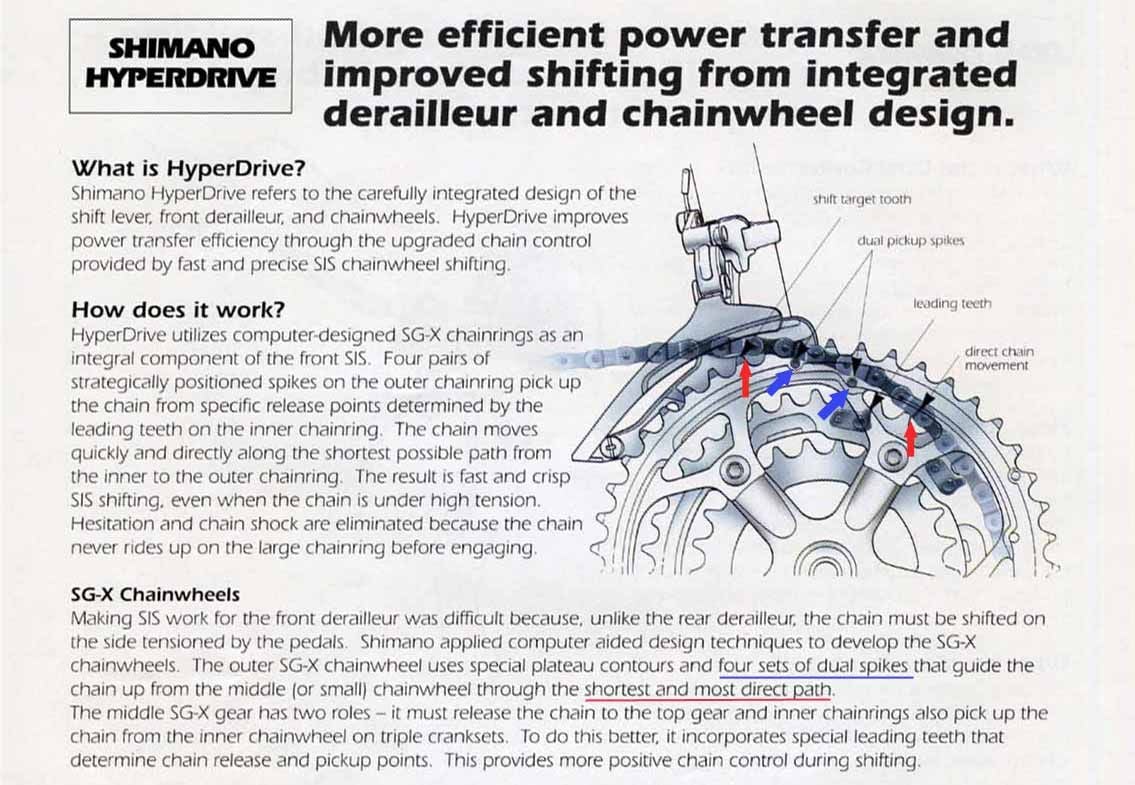
A few years later they introduced the SG-X. More similar to what is common today, adding pins, plates, hooks, varying teeth profiles, etc. to aid upshifting. Cranks in this era also began to use chainrings in sets to 'clock' the rings so the distance between the teeths of adjacent rings would match the pitch of the chain. Over the years Shimano and others have modified these ideas in many ways.
02-21-24 | 06:42 PM
#10
Senior Member
Joined: Oct 2023
Posts: 1,711
Likes: 1,012
From: New Jersey
Very, very cool to see the diagrams.
I did not appreciate that a front derailleur has to work on the tight part of the chain while the rear derailleur can work on the slack part of the chain.
I did not appreciate that a front derailleur has to work on the tight part of the chain while the rear derailleur can work on the slack part of the chain.
Last edited by ScottCommutes; 02-21-24 at 06:48 PM.
02-21-24 | 07:05 PM
#11
Senior Member
Joined: Oct 2008
Posts: 1,873
Likes: 358
From: Right where I'm supposed to be
Bikes: Franklin Frames Custom, Rivendell Bombadil
Seeing that I've ridden basic non-pinned/ramped double and triple rings my entire life without issues friction shifting the FD, obviously these "aides" are not necessary. Clever marketing would have you believe you can't live without them... Oh the humanity ! I wouldn't go modifying any chainring teeth. I too suspect either the angle or possibly the height of the FD. I do all my own bike work save make the frame and I've found FD's are highly flexible in their mounting height. I know what the instruction manuals included with the FD's show on paper, but in the real world sometimes a little higher or lower is what works. I'm all about experimenting when what the book says doesn't work. (often !)
Also, more details on your shifting are needed. It's sluggish shifting for mid to small ring in what cogs ? Myself I've never used the tiny ring for anything but 3(of 7) or 4(of 9) cogs or else I'm back on the middle ring. Yet some people as I've read think they can use it on all cogs..... yikes ! Generally when I shift from mid to tiny it's in either the smallest or 2nd cog.
Also, more details on your shifting are needed. It's sluggish shifting for mid to small ring in what cogs ? Myself I've never used the tiny ring for anything but 3(of 7) or 4(of 9) cogs or else I'm back on the middle ring. Yet some people as I've read think they can use it on all cogs..... yikes ! Generally when I shift from mid to tiny it's in either the smallest or 2nd cog.
02-22-24 | 10:13 AM
#12

Senior Member
Joined: Apr 2009
Posts: 2,914
Likes: 1,932
From: NorCal
Seeing that I've ridden basic non-pinned/ramped double and triple rings my entire life without issues friction shifting the FD, obviously these "aides" are not necessary. Clever marketing would have you believe you can't live without them... Oh the humanity ! I wouldn't go modifying any chainring teeth. I too suspect either the angle or possibly the height of the FD. I do all my own bike work save make the frame and I've found FD's are highly flexible in their mounting height. I know what the instruction manuals included with the FD's show on paper, but in the real world sometimes a little higher or lower is what works. I'm all about experimenting when what the book says doesn't work. (often !)
Also, more details on your shifting are needed. It's sluggish shifting for mid to small ring in what cogs ? Myself I've never used the tiny ring for anything but 3(of 7) or 4(of 9) cogs or else I'm back on the middle ring. Yet some people as I've read think they can use it on all cogs..... yikes ! Generally when I shift from mid to tiny it's in either the smallest or 2nd cog.
Also, more details on your shifting are needed. It's sluggish shifting for mid to small ring in what cogs ? Myself I've never used the tiny ring for anything but 3(of 7) or 4(of 9) cogs or else I'm back on the middle ring. Yet some people as I've read think they can use it on all cogs..... yikes ! Generally when I shift from mid to tiny it's in either the smallest or 2nd cog.
02-22-24 | 12:39 PM
#13

Senior Member

Joined: Jul 2005
Posts: 4,988
Likes: 709
From: Boulder County, CO
Bikes: '80 Masi Gran Criterium, '12 Trek Madone, early '60s Frejus track
Make sure your derailleur is mounted as low as possible. The outer plate should clear the big ring by 1.5-2.0 mm, and the inner plate should clear the middle ring by at least that amount. Also try easing off the inner limit screw slightly. Try this before doing anything heroic like bending the cage.
02-22-24 | 08:02 PM
#14
Senior Member
Joined: Feb 2012
Posts: 19,359
Likes: 5,492
From: Rochester, NY
Bikes: Stewart S&S coupled sport tourer, Stewart Sunday light, Stewart Commuting, Stewart Touring, Co Motion Tandem, Stewart 3-Spd, Stewart Track, Fuji Finest, Mongoose Tomac ATB, GT Bravado ATB, JCP Folder, Stewart 650B ATB
You are not alone in not looking at the gear system as an upper and a lower split. I began teaching how to shift classes with this tensioned top half and un tensioned lower half a long time ago. Andy
__________________
AndrewRStewart
AndrewRStewart
02-22-24 | 08:07 PM
#15
Senior Member
Joined: Feb 2012
Posts: 19,359
Likes: 5,492
From: Rochester, NY
Bikes: Stewart S&S coupled sport tourer, Stewart Sunday light, Stewart Commuting, Stewart Touring, Co Motion Tandem, Stewart 3-Spd, Stewart Track, Fuji Finest, Mongoose Tomac ATB, GT Bravado ATB, JCP Folder, Stewart 650B ATB
Seeing that I've ridden basic non-pinned/ramped double and triple rings my entire life without issues friction shifting the FD, obviously these "aides" are not necessary. Clever marketing would have you believe you can't live without them... Oh the humanity ! I wouldn't go modifying any chainring teeth. I too suspect either the angle or possibly the height of the FD. I do all my own bike work save make the frame and I've found FD's are highly flexible in their mounting height. I know what the instruction manuals included with the FD's show on paper, but in the real world sometimes a little higher or lower is what works. I'm all about experimenting when what the book says doesn't work. (often !)
Also, more details on your shifting are needed. It's sluggish shifting for mid to small ring in what cogs ? Myself I've never used the tiny ring for anything but 3(of 7) or 4(of 9) cogs or else I'm back on the middle ring. Yet some people as I've read think they can use it on all cogs..... yikes ! Generally when I shift from mid to tiny it's in either the smallest or 2nd cog.
Also, more details on your shifting are needed. It's sluggish shifting for mid to small ring in what cogs ? Myself I've never used the tiny ring for anything but 3(of 7) or 4(of 9) cogs or else I'm back on the middle ring. Yet some people as I've read think they can use it on all cogs..... yikes ! Generally when I shift from mid to tiny it's in either the smallest or 2nd cog.
Bravo for you being the choir that don't have to learn how to shift. But it's too bad that you are the exception. Andy
__________________
AndrewRStewart
AndrewRStewart
02-23-24 | 06:06 AM
#16
Highly Enriched Driftium
Joined: Apr 2017
Posts: 6,810
Likes: 2,202
10 and 10 are not big jumps. The shifting aids on modern chainrings are designed to aid things like 16 tooth jumps, and mostly for upshifting (pins, ramps), but also downshifting (gates, i.e., reduced tooth height) for doing so under higher chain tension than in the past. Way back when, derailleurs were all designed for road bikes. Downshifting while climbing steeps on a mountain bike requires a stronger push. My Microshift 9 speed triple FD which I retrofit for 2X on my folder, the spring is *ridiculously* strong, my hands were not strong enough to use the left gripshift, I had to fit a lever/trigger, and even then I need to push with right thumb inline of pressure, not left thumb swinging an arc. This is WAY stronger spring than I need for downshifting, but it was probably designed for mountain climbs and muck. I only bike on road. The Microshift is the only one that fits my FD adaptor design, Shimano didn't, linkage interferes, I'm still looking for one with softer spring.
Last edited by Duragrouch; 02-23-24 at 06:09 AM.
02-23-24 | 08:59 AM
#17

Old fart
Joined: Nov 2004
Posts: 26,378
Likes: 5,297
From: Appleton WI
Bikes: Several, mostly not name brands.
They are necessary when using indexed front shifting with a derailleur and shifter that don't allow trimming to eliminate scraping the chain on the derailleur cage. To make indexed front shifting idiot-proof, the shifter does not allow trimming; you're either in one gear or the other. To eliminate scraping, the derailleur cage is made wider to provide more clearance without scraping. But this degrades shifting efficiency, so pins and ramps are added to the chainrings to facilitate shifting even with a wide derailleur cage.
02-23-24 | 12:40 PM
#18
Senior Member
Joined: Dec 2015
Posts: 916
Likes: 468
From: San Diego
Bikes: 1978 Bruce Gordon, 1977 Lippy, 199? Lippy tandem, Bike Friday NWT, 1982 Trek 720, 2012 Rivendell Atlantis, 1983 Bianchi Specialissima? 1998 Serotta Atlanta, 1981 Dave Moulton
A worn chain can also lead to sluggish shifting up front.
02-23-24 | 08:00 PM
#19
Thread Starter
Junior Member
Joined: Oct 2017
Posts: 181
Likes: 55
From: Ottawa, ON, Canada
Bikes: 1974 PX-10E steep angles, sold, 1977 Witcomb stolen, 1980 Roberts 1 speed, 1987 Cyclops 3 x 6 friction triple crank, 2010 Masi Commuter 1 speed, 2017 Ribble 525 2 x 10 with Ergos
Yes, the wider cage is part of the problem. Maybe I should put my pre-indexed Campagnolo Record FD back on, if it can handle 50-40-26, or look for a pre-indexing triple FD that can. To validate the wide cage theory, I do get an improved middle to granny shift now that I have installed a Deda Dog Fang and adjusted the inner stop inward about 3 mm from almost rubbing in bottom gear. This will work until I arrange a couple of sets of shortened teeth on the middle ring, and won't mess up anything else because I am friction shifting this FD.
It's all about what you want, not what the manufacturers give you. I want a snappy and reliable middle to granny shift and I am on the way to getting it..
oldschoolbike
It's all about what you want, not what the manufacturers give you. I want a snappy and reliable middle to granny shift and I am on the way to getting it..
oldschoolbike
02-23-24 | 09:16 PM
#20

Senior Member
Joined: May 2008
Posts: 10,106
Likes: 2,760
From: Fredericksburg, Va
Bikes: ? Proteous, '65 Frejus TDF, '73 Bottecchia Giro d'Italia, '83 Colnago Superissimo, '84 Trek 610, '84 Trek 760, '88 Pinarello Veneto, '88 De Rosa Pro, '89 Pinarello Montello, 'Litespeed Catalyst'94 Burley Duet, 97 Specialized RockHopper, 2010 Langster
I have a Campagnolo Racing T with 52/42/30 that shifts great with a Record triple FD. A 50/40/30 was acquired but the high end was too low for down hills. Rear is 9 speed 13/26.
 P1050228 on Flickr
P1050228 on Flickr
__________________
Bikes don't stand alone. They are two tired.
Bikes don't stand alone. They are two tired.
02-23-24 | 09:16 PM
#21
Highly Enriched Driftium
Joined: Apr 2017
Posts: 6,810
Likes: 2,202
I have a theory about that. I don't think it's due to stretch, but rather, side-plate-gap, i.e., the gap between the outer and inner side plates on the links. More gap means less lateral stiffness of the chain. Once or twice in the life of a chain, I pull the chain off, clean well, and then, adjust the side plate gap with a chain tool. Not so tight the links bind, but eliminating that gap, doing an even job so the amount of pin protuding on each side is the same. Then remount the chain and lube. I don't know if this helps, if it reduces stretch, if it causes any increase in friction when the chainline is off on crossed-gears. I'll have to remember to look at what the gap is from the factory, the next new chain I buy.
02-23-24 | 10:06 PM
#22

Senior Member
Joined: Oct 2014
Posts: 14,171
Likes: 5,299
From: Portland, OR
Bikes: (2) ti TiCycles, 2007 w/ triple and 2011 fixed, 1979 Peter Mooney, ~1983 Trek 420 now fixed and ~1973 Raleigh Carlton Competition gravel grinder
They are necessary when using indexed front shifting with a derailleur and shifter that don't allow trimming to eliminate scraping the chain on the derailleur cage. To make indexed front shifting idiot-proof, the shifter does not allow trimming; you're either in one gear or the other. To eliminate scraping, the derailleur cage is made wider to provide more clearance without scraping. But this degrades shifting efficiency, so pins and ramps are added to the chainrings to facilitate shifting even with a wide derailleur cage.
I want my FDs to shift reliably from the smaller cogs in back, when I am still rolling fast up that hill. Then, little speed lost and I get to shift just in back as the hill steepens and I slow. Yes, old racer thinking but also using inertia to make the hill easier. As an aging cyclist, why wouldn't I want that?
02-23-24 | 10:15 PM
#23
Senior Member
Joined: Oct 2014
Posts: 14,171
Likes: 5,299
From: Portland, OR
Bikes: (2) ti TiCycles, 2007 w/ triple and 2011 fixed, 1979 Peter Mooney, ~1983 Trek 420 now fixed and ~1973 Raleigh Carlton Competition gravel grinder
I have a Campagnolo Racing T with 52/42/30 that shifts great with a Record triple FD. A 50/40/30 was acquired but the high end was too low for down hills. Rear is 9 speed 13/26.
P1050228 on Flickr
P1050228 on FlickrQuestion, [MENTION=124730]SJX426[/MENTION], what are the BCDs of that Campy crankset? I could go out and measure so don't you but if you know off the top of your head, TIA. I need to start ramping down those big rings!
Edit: beautiful bike!
02-23-24 | 11:11 PM
#24

Senior Member

Joined: Apr 2011
Posts: 12,701
Likes: 4,832
I doubt there is much that can be done with ring design. The shift happens over quite a few teeth.
I would want to look at the FD adjustment.
02-24-24 | 08:06 AM
#25
Senior Member
Joined: May 2008
Posts: 10,106
Likes: 2,760
From: Fredericksburg, Va
Bikes: ? Proteous, '65 Frejus TDF, '73 Bottecchia Giro d'Italia, '83 Colnago Superissimo, '84 Trek 610, '84 Trek 760, '88 Pinarello Veneto, '88 De Rosa Pro, '89 Pinarello Montello, 'Litespeed Catalyst'94 Burley Duet, 97 Specialized RockHopper, 2010 Langster
I rode Cycle Oregon last Sept on that exact combo except 7-speed. Sweet, sweet shifting. My standard forever (starting with the TA Cyclotourist, then Avocet, then Sugino was 52 or 53-42-28m then 24. Recently the 52-42 has shrunk to 50-38 and the like.
Question, [MENTION=124730]SJX426[/MENTION], what are the BCDs of that Campy crankset? I could go out and measure so don't you but if you know off the top of your head, TIA. I need to start ramping down those big rings!
Edit: beautiful bike!
Question, [MENTION=124730]SJX426[/MENTION], what are the BCDs of that Campy crankset? I could go out and measure so don't you but if you know off the top of your head, TIA. I need to start ramping down those big rings!
Edit: beautiful bike!
__________________
Bikes don't stand alone. They are two tired.
Bikes don't stand alone. They are two tired.