


getting into "home" wheel truing don't want to buy the wrong tools .
 02-12-10 | 04:56 AM
#1

Thread Starter
Senior Member
Joined: Sep 2008
Posts: 131
Likes: 0
From: n.j.
Bikes: Specialized Roubaix pro / Specialized Stumpjumper xtr
getting into "home" wheel truing don't want to buy the wrong tools .
i am looking into getting into truing my own wheels. i read all the stickies on other forums and see a wide range of tools out there .. i see a lot of tools on e bay that are affordable but dint want to buy the junk on there..
i see a lot of parks t-s-2 on there and they came out with the t-s-2.2 and the few differences is it will except a 29er with out removing the tire and the hub widths.. would u go the 2.2 route?
can you guys list a set of tools that you would get ?
Rotor Truing Fork?
Spoke Tension Meter ?
i see a lot of parks t-s-2 on there and they came out with the t-s-2.2 and the few differences is it will except a 29er with out removing the tire and the hub widths.. would u go the 2.2 route?
can you guys list a set of tools that you would get ?
Rotor Truing Fork?
Spoke Tension Meter ?
 02-12-10 | 05:09 AM
#2
Senior Member
Joined: Mar 2008
Posts: 8,687
Likes: 297
Wheel building/trueing can be done at just about any level of complexity. At an elegant minimum you need a nipple wrench, a bike to stick the wheel in and a good eye.
I'd recommend going for a tensiometer straight off the bat. It's not absolutely necessary, but it makes any conversation you'd want to have about the wheels ever so much easier in the future.
You can build OK wheels w/o one, but in terms of diagnostics it's a great help if you're trying to figure out the cause of a wheel failure.
Trueing stands can be bought, built from scrap or bodged together from discarded forks and cable ties. Nice ones are - nice, but not critical. Pretty much anything can do the trick unless it's too flexy.
I'd recommend going for a tensiometer straight off the bat. It's not absolutely necessary, but it makes any conversation you'd want to have about the wheels ever so much easier in the future.
You can build OK wheels w/o one, but in terms of diagnostics it's a great help if you're trying to figure out the cause of a wheel failure.
Trueing stands can be bought, built from scrap or bodged together from discarded forks and cable ties. Nice ones are - nice, but not critical. Pretty much anything can do the trick unless it's too flexy.
02-12-10 | 08:48 AM
#3
Senior Member
Joined: May 2008
Posts: 679
Likes: 1
From: Calgary, Alberta
Spoke wrench and a red crayon. I spin the wheel, hold the crayon near the rim and the high spots on that side show up. Do the same on the other side and make adjustments. It's a little basic but does the job for me and have never felt like looking for more tools.
But everyone is different, specially city folk...
best wishes,
lloyd
But everyone is different, specially city folk...
best wishes,
lloyd
02-12-10 | 09:31 AM
#4
Senior Member
Joined: Oct 2005
Posts: 5,820
Likes: 133
I would start by just truing in the bike frame. All you need is the right spoke wrench. Remove one brake pad on front and rear brakes and tru using the remaining pad as a guide. By flipping the wheel, you will also be able to get perfect dish without the need for a dishing tool.
__________________
Il faut de l'audace, encore de l'audace, toujours de l'audace
1980 3Rensho-- 1975 Raleigh Sprite 3spd
1990s Raleigh M20 MTB--2007 Windsor Hour (track)
1988 Ducati 750 F1
Il faut de l'audace, encore de l'audace, toujours de l'audace
1980 3Rensho-- 1975 Raleigh Sprite 3spd
1990s Raleigh M20 MTB--2007 Windsor Hour (track)
1988 Ducati 750 F1
02-12-10 | 09:33 AM
#5

Great State of Varmint
Joined: Sep 2008
Posts: 7,476
Likes: 18
From: Dante's Third Ring
A spoke-wrench, in the wrong hands, is easily the most expensive little tool anyone can own. Read up thoroughly on the subject before use. It's not rocket-science, but it does require dedication and an understanding on what, why, and how you're about to true a wheel. If you tighten one spoke on one side of the rim - loosen the other spoke opposite an equal amount. Generally 1/8th to 1/4 of a turn.
Good luck! It's is a lot of fun once you get the technique down.
Good luck! It's is a lot of fun once you get the technique down.
02-12-10 | 09:44 AM
#6
nice idea, poor execution
Joined: Oct 2009
Posts: 395
Likes: 0
From: West Newton, MA
If you're only truing wheels, one of the home stands is perfectly adequate, and people have built wheels at home with nothing but an old fork and a zip tie, or even less, but if you want something to stand up to heavy use, the shop quality stands are best.
02-12-10 | 01:23 PM
#7

Senior Member
Joined: Feb 2005
Posts: 9,438
Likes: 9
From: Oklahoma
Bikes: Trek 5500, Colnago C-50
Whatever you decide buy a good spoke wrench, at least one size, that will fit your nipples closely and grip all four corners.
I like the Spokey brand and there are other good wrenches like the newer Park wrenches.
I like the Spokey brand and there are other good wrenches like the newer Park wrenches.
02-12-10 | 02:35 PM
#8

Senior Member
Joined: Jun 2006
Posts: 1,407
Likes: 0
I'll second what others have said, and suggest that for now you can do some good wheel truing with the wheel right on your bike, as long as you have a good eye. If you decide that you need a truing stand, the park ts-2(.2) stands are great, but there are other great options out there that will get the job done very well for MUCH less money. I built this one based on Roger Musson's plans (google his name if you're interested in checking out his wheel building e-book). It didn't take too long to build and only cost me $28 IF you include the price of the downloadable e-book. I've been extremely happy with it.
-Jeremy
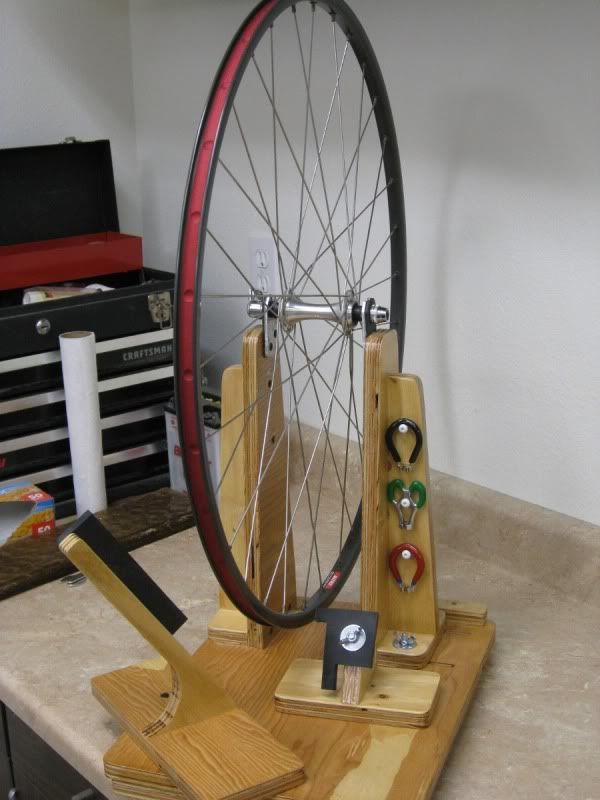
-Jeremy
02-12-10 | 02:44 PM
#9

Senior Member


Joined: Apr 2007
Posts: 12,562
Likes: 2,738
From: Thunder Bay, Ontario, Canada - burrrrr!
Bikes: 1958 Rabeneick 120D, 1968 Legnano Gran Premio, 196? Torpado Professional, 2000 Marinoni Piuma
I love the plywood home made truing stand. I made mine from aluminum angle bars with stainless steel fasteners. And these things are not all that hard to make. Even easier if one has plans.
And, if you are going to get into building wheels, get good tools: a good truing stand, even if it is home built, a set of spoke wrenches and get good ones, a dishing tool if your truing stand does not have one included, and a decent light to work with. And don't forget the hub rebuilding tools you will need also. No sense truing up a rim if the hub is shot.
I used Sheldon Brown's article as a starter and recommend it highly. He took the magic out of the activity and replace it with instruction. That said, I am sure there are other sources of how to do it instruction that might work as well or better for others.
Hope this is a help.
And, if you are going to get into building wheels, get good tools: a good truing stand, even if it is home built, a set of spoke wrenches and get good ones, a dishing tool if your truing stand does not have one included, and a decent light to work with. And don't forget the hub rebuilding tools you will need also. No sense truing up a rim if the hub is shot.
I used Sheldon Brown's article as a starter and recommend it highly. He took the magic out of the activity and replace it with instruction. That said, I am sure there are other sources of how to do it instruction that might work as well or better for others.
Hope this is a help.
02-12-10 | 02:52 PM
#10
Senior Member
Joined: Jun 2006
Posts: 1,407
Likes: 0
I love the plywood home made truing stand. I made mine from aluminum angle bars with stainless steel fasteners. And these things are not all that hard to make. Even easier if one has plans.
And, if you are going to get into building wheels, get good tools: a good truing stand, even if it is home built, a set of spoke wrenches and get good ones, a dishing tool if your truing stand does not have one included, and a decent light to work with. And don't forget the hub rebuilding tools you will need also. No sense truing up a rim if the hub is shot.
I used Sheldon Brown's article as a starter and recommend it highly. He took the magic out of the activity and replace it with instruction. That said, I am sure there are other sources of how to do it instruction that might work as well or better for others.
Hope this is a help.
And, if you are going to get into building wheels, get good tools: a good truing stand, even if it is home built, a set of spoke wrenches and get good ones, a dishing tool if your truing stand does not have one included, and a decent light to work with. And don't forget the hub rebuilding tools you will need also. No sense truing up a rim if the hub is shot.
I used Sheldon Brown's article as a starter and recommend it highly. He took the magic out of the activity and replace it with instruction. That said, I am sure there are other sources of how to do it instruction that might work as well or better for others.
Hope this is a help.
-Jeremy
02-12-10 | 03:00 PM
#11

Thrifty Bill
Joined: Jan 2008
Posts: 23,639
Likes: 1,106
From: Mans of NC & SW UT Desert
Bikes: 86 Katakura Silk, 87 Prologue X2, 88 Cimarron LE, 1975 Sekai 4000 Professional, 73 Paramount, plus more
I picked up a nice Spin Doctor truing stand off Craigs List and built a wheel with it last week. Worked great. I bought a Spin Doctor Pro workstand and the seller threw in the truing stand.
My prior wheel build was in 1976, with just a spoke wrench. That worked OK as well, but the truing stand made it a lot easier.
Read the Sheldon Brown instructions on wheel building, I thought they were great!
My next tool purchase will be a tensiometer. I do not and will not build wheels for others.
My prior wheel build was in 1976, with just a spoke wrench. That worked OK as well, but the truing stand made it a lot easier.
Read the Sheldon Brown instructions on wheel building, I thought they were great!
My next tool purchase will be a tensiometer. I do not and will not build wheels for others.
Last edited by wrk101; 02-13-10 at 04:01 PM.
02-12-10 | 05:01 PM
#12
Banned.
Joined: Oct 2004
Posts: 1,363
Likes: 2
What did everyone do before tension meters? None of the people I know who build wheels use them. My last build, I laced them up trued them then a friend came over tightened them up and siad this is what they should feel like. I said dont I need a tension meter? He laughed, told me what the tension on them was. I told him he was full of it. Ended up betting a 6 pack on it. Went to the LBS bummed the use of their meter. He was spot on. I gues 20 years of experence is a good thing.
02-12-10 | 05:31 PM
#13
Senior Member
Joined: Feb 2005
Posts: 9,438
Likes: 9
From: Oklahoma
Bikes: Trek 5500, Colnago C-50
What did everyone do before tension meters? None of the people I know who build wheels use them. My last build, I laced them up trued them then a friend came over tightened them up and siad this is what they should feel like. I said dont I need a tension meter? He laughed, told me what the tension on them was. I told him he was full of it. Ended up betting a 6 pack on it. Went to the LBS bummed the use of their meter. He was spot on. I gues 20 years of experence is a good thing.
02-12-10 | 07:41 PM
#14
Banned.
Joined: Oct 2004
Posts: 1,363
Likes: 2
02-12-10 | 09:02 PM
#15
cab horn

Joined: Jun 2004
Posts: 28,353
Likes: 30
From: Toronto
Bikes: 1987 Bianchi Campione
You can probably get away without one building a 32/36h straight gauge spokes onto some box/semi aero rim. Doesn't mean the tool itself useless.
02-12-10 | 09:03 PM
#16
cab horn
Joined: Jun 2004
Posts: 28,353
Likes: 30
From: Toronto
Bikes: 1987 Bianchi Campione
They built wheels that would be labelled amateur quality nowadays.
Because they suck. Tensionmeters allow you to consistently, reliably and confidently build a wheel at the correct tension every single time and without fail. Regardless of the hub/rim or type of spoke used.
None of the people I know who build wheels use them.


