


Frame pulling
 08-31-17 | 01:38 AM
#1
Thread Starter
Junior Member
Joined: Aug 2017
Posts: 8
Likes: 0
Frame pulling
I recently bought a nishiki with wheels out of true so I need them replaced but I found out that modern rims don't fit on my bike and a mechanic suggested I pulled my frame to fit current 135mm hubs instead of the retro 125 is this ideal what are the consequences? Old rims are hard to find and my frame is steel
Last edited by Lonelyitsuki; 08-31-17 at 01:38 AM. Reason: Mistake
 08-31-17 | 02:05 AM
#2

Senior Member


Joined: Nov 2014
Posts: 27,576
Likes: 5,453
From: Eugene, Oregon, USA
Look up cold setting.
It doesn't take much, and is commonly done. But it isn't necessary for 5,6,or 7 speed rear ends.
Is that a road bike frame (130 mm spacing), or MTB (135 mm spacing)?
It doesn't take much, and is commonly done. But it isn't necessary for 5,6,or 7 speed rear ends.
Is that a road bike frame (130 mm spacing), or MTB (135 mm spacing)?
08-31-17 | 02:39 AM
#3

Ride, Wrench, Swap, Race

Joined: Jan 2010
Posts: 9,813
Likes: 1,790
From: Northern California
Bikes: Cheltenham-Pedersen racer, Boulder F/S Paris-Roubaix, Varsity racer, '52 Christophe, '62 Continental, '92 Merckx, '75 Limongi, '76 Presto, '72 Gitane SC, '71 Schwinn SS, etc.
I don't like the term "pull" as applied here, since it suggests pulling the frame's dropout ends apart with opposing force.
Frames actually need to be widened by working on one side at a time, so that each side's increase in width can be measured off of the other side while there is no force being applied to the reference side.
Simply wedging the two sides apart always results in one side yielding more than the other, since the frame tubes aren't identical in terms of dimensions, processing and heat exposure history during frame assembly. So you end up with a widened frame that positions the rear wheel off-center, with the critical frame alignment being lost in the process.
Bending steel tubing is simple for people who are familiar with bending steel tubing, who won't over-widen the frame or perhaps even buckle a frame tube. The force applied is focused on the thicker chainstay, with the seatstay more or less going along for the ride since it is springier due to it's smaller diameter. Arriving at the correct width increase on each side is generally a repeated process best approached from the state of too little rather than too much bending, though a final correction of 1-2mm of reverse bending tends to produce a more stress-relieved and robust alignment, and can be done using far less force than expected.
Frames actually need to be widened by working on one side at a time, so that each side's increase in width can be measured off of the other side while there is no force being applied to the reference side.
Simply wedging the two sides apart always results in one side yielding more than the other, since the frame tubes aren't identical in terms of dimensions, processing and heat exposure history during frame assembly. So you end up with a widened frame that positions the rear wheel off-center, with the critical frame alignment being lost in the process.
Bending steel tubing is simple for people who are familiar with bending steel tubing, who won't over-widen the frame or perhaps even buckle a frame tube. The force applied is focused on the thicker chainstay, with the seatstay more or less going along for the ride since it is springier due to it's smaller diameter. Arriving at the correct width increase on each side is generally a repeated process best approached from the state of too little rather than too much bending, though a final correction of 1-2mm of reverse bending tends to produce a more stress-relieved and robust alignment, and can be done using far less force than expected.
08-31-17 | 03:03 AM
#4
Thread Starter
Junior Member
Joined: Aug 2017
Posts: 8
Likes: 0
08-31-17 | 04:15 AM
#5

What??? Only 2 wheels?

Joined: Apr 2010
Posts: 13,496
Likes: 940
From: Boston-ish, MA
Bikes: 72 Peugeot UO-8, 82 Peugeot TH8, 87 Bianchi Brava, 76? Masi Grand Criterium, 74 Motobecane Champion Team, 86 & 77 Gazelle champion mondial, 81? Grandis, 82? Tommasini, 83 Peugeot PF10
Your "retro 125" is really 126 (with few exceptions) inside to inside, for a 6-speed FW and hub. Plenty of those around.
__________________
Real cyclists use toe clips.
With great bikes comes great responsibility.
jimmuller
Real cyclists use toe clips.
With great bikes comes great responsibility.
jimmuller
08-31-17 | 04:24 AM
#6
Senior Member
Joined: Dec 2014
Posts: 5,350
Likes: 5,159
From: Central Virginia
Bikes: Numerous
You have a few options. Modern road wheels are spaced at 130 mm, whereas mountain bike wheels are spaced at 135 mm. If you cold set your Nishiki to 130 mm for a modern road wheel then the rest of your drive train probably should be updated to accommodate an 8,9,10, or 11 speed rear cog set. That will be a big and potentially expensive overhaul.
I'm assuming your Nishiki is a 6 or 7 speed rear cluster. Simplest fix is true or rehab your current rear wheel. Another option is buy a similar used rear wheel in good shape. Feel free to post details and/or pics of the bike and we can give you some more specific advice.
I'm assuming your Nishiki is a 6 or 7 speed rear cluster. Simplest fix is true or rehab your current rear wheel. Another option is buy a similar used rear wheel in good shape. Feel free to post details and/or pics of the bike and we can give you some more specific advice.
__________________
N = '96 Colnago C40, '04 Wilier Alpe D'Huez, '10 Colnago EPS, '85 Merckx Pro, '89 Merckx Century, '86 Tommasini Professional, '04 Teschner Aero FX Pro, '05 Alan Carbon Cross, '86 De Rosa Professional, '95 Gios Compact Pro, '95 Carrera Zeus, ‘81 Masi Gran Criterium, ‘81 Merckx Pro, ‘89 Cinelli Supercorsa, ‘83 Bianchi Specialissima, ‘VO Randonneur, Ritchey Breakaway Steel, Rivendell Rambouillet, Heron Randonneur, ‘92 Ciöcc Columbus EL
N = '96 Colnago C40, '04 Wilier Alpe D'Huez, '10 Colnago EPS, '85 Merckx Pro, '89 Merckx Century, '86 Tommasini Professional, '04 Teschner Aero FX Pro, '05 Alan Carbon Cross, '86 De Rosa Professional, '95 Gios Compact Pro, '95 Carrera Zeus, ‘81 Masi Gran Criterium, ‘81 Merckx Pro, ‘89 Cinelli Supercorsa, ‘83 Bianchi Specialissima, ‘VO Randonneur, Ritchey Breakaway Steel, Rivendell Rambouillet, Heron Randonneur, ‘92 Ciöcc Columbus EL
08-31-17 | 05:39 AM
#7
Banned.
Joined: Jul 2013
Posts: 1,941
Likes: 272
I recently bought a nishiki with wheels out of true so I need them replaced but I found out that modern rims don't fit on my bike and a mechanic suggested I pulled my frame to fit current 135mm hubs instead of the retro 125 is this ideal what are the consequences? Old rims are hard to find and my frame is steel
08-31-17 | 05:54 AM
#8

Senior Member
Joined: Apr 2012
Posts: 21,774
Likes: 5,685
From: Middle Earth (aka IA)
Bikes: A bunch of old bikes and a few new ones
I recently bought a nishiki with wheels out of true so I need them replaced but I found out that modern rims don't fit on my bike and a mechanic suggested I pulled my frame to fit current 135mm hubs instead of the retro 125 is this ideal what are the consequences? Old rims are hard to find and my frame is steel
Here is a 126 wheelset for $109 plus shipping, https://www.velomine.com/index.php?ma...oducts_id=3135
Velomine is a very good company.
08-31-17 | 05:59 AM
#9
Senior Member
Joined: Oct 2015
Posts: 6,280
Likes: 611
From: Los Angeles
Bikes: 78 Masi Criterium, 68 PX10, 2016 Mercian King of Mercia, Rivendell Clem Smith Jr
I'm inclined to agree. I don't have the bike in front of me, but most wheels can be trued - if the mechanic knows how. If they do need replacement, 126 OLD wheels are available. Wheelmaster Sun M13ii with dt spokes are like $135 a pair (or less). Any competent bike shop will charge you that to "pull" or respread and realign a frame to 130. Rebuilding the wheels with new rims is another option. Depends on the quality of hubs you have.
Respreading a frame to 130 - modern road - is certainly possible, but it must be done by a person that knows how to do it properly - including frame and dropout realignment. If the shop doesn't have the correct tools to spread and realign a frame, definitely do not let them do it. 135?? NO! If you do this, you will likely need an all new drivetrain. Shifters, cassette, crankset, derailleurs. Maybe not every single piece, but most of it. It absolutely will cost more than keeping the old standard spacing.
IOW, take it to a shop that knows how to true a wheel.
Respreading a frame to 130 - modern road - is certainly possible, but it must be done by a person that knows how to do it properly - including frame and dropout realignment. If the shop doesn't have the correct tools to spread and realign a frame, definitely do not let them do it. 135?? NO! If you do this, you will likely need an all new drivetrain. Shifters, cassette, crankset, derailleurs. Maybe not every single piece, but most of it. It absolutely will cost more than keeping the old standard spacing.
IOW, take it to a shop that knows how to true a wheel.
Last edited by Salamandrine; 08-31-17 at 06:03 AM.
08-31-17 | 06:02 AM
#10
Senior Member
Joined: Feb 2011
Posts: 807
Likes: 10
Modern road hubs are 130mm, not 135. 135 is a mtb spec. While you could choose to use a 135mm hub, why? If you go with a road hub at 130mm, you don't need to respace the rear end unless you really want to. You will easily be able to pull the dropouts wider (it's only 4mm) each time you shove the wheel in.
Also, how badly out of true are the old wheels? Based on the bad advice you've already had from your mechanic, I'd get a second opinion at another shop and see if the wheels can be retrued. If not, the cheapest option may be a prebuilt wheel but you might want to rebuild using the existing hubs, assuming the bearings are still good.
Also, how badly out of true are the old wheels? Based on the bad advice you've already had from your mechanic, I'd get a second opinion at another shop and see if the wheels can be retrued. If not, the cheapest option may be a prebuilt wheel but you might want to rebuild using the existing hubs, assuming the bearings are still good.
08-31-17 | 07:06 AM
#11

Bianchi Goddess
Joined: Apr 2009
Posts: 28,890
Likes: 4,133
From: Shady Pines Retirement Fort Wayne, In
Bikes: Too many to list here check my signature.
I recently bought a nishiki with wheels out of true so I need them replaced but I found out that modern rims don't fit on my bike and a mechanic suggested I pulled my frame to fit current 135mm hubs instead of the retro 125 is this ideal what are the consequences? Old rims are hard to find and my frame is steel
If they are trying to sell you 700c wheels you may also need new brakes.....you don't want that you just need the right 27" wheels.
I forgot the freewheel (the cogs on the back wheel). they should screw off your old wheel and on to the new ones and you should not have to buy a cassette style stack of cogs.
Where do you live? I am sure there is one of near by who would be happy to help you sort this out.
__________________
“One morning you wake up, the girl is gone, the bikes are gone, all that's left behind is a pair of old tires and a tube of tubular glue, all squeezed out"
Sugar "Kane" Kowalczyk
“One morning you wake up, the girl is gone, the bikes are gone, all that's left behind is a pair of old tires and a tube of tubular glue, all squeezed out"
Sugar "Kane" Kowalczyk
Last edited by Bianchigirll; 08-31-17 at 09:43 AM.
08-31-17 | 08:14 AM
#12

Senior Member
Joined: May 2010
Posts: 874
Likes: 6
From: Memphis, TN
Bikes: 1982 Trek 613, 1988 Panasonic MC 2500, 1981 Schwinn Super Sport, 1975 Raleigh Super Course MKII, 1985 Miyata 210
I don't like the term "pull" as applied here, since it suggests pulling the frame's dropout ends apart with opposing force.
Frames actually need to be widened by working on one side at a time, so that each side's increase in width can be measured off of the other side while there is no force being applied to the reference side.
Simply wedging the two sides apart always results in one side yielding more than the other, since the frame tubes aren't identical in terms of dimensions, processing and heat exposure history during frame assembly. So you end up with a widened frame that positions the rear wheel off-center, with the critical frame alignment being lost in the process.
Bending steel tubing is simple for people who are familiar with bending steel tubing, who won't over-widen the frame or perhaps even buckle a frame tube. The force applied is focused on the thicker chainstay, with the seatstay more or less going along for the ride since it is springier due to it's smaller diameter. Arriving at the correct width increase on each side is generally a repeated process best approached from the state of too little rather than too much bending, though a final correction of 1-2mm of reverse bending tends to produce a more stress-relieved and robust alignment, and can be done using far less force than expected.
Frames actually need to be widened by working on one side at a time, so that each side's increase in width can be measured off of the other side while there is no force being applied to the reference side.
Simply wedging the two sides apart always results in one side yielding more than the other, since the frame tubes aren't identical in terms of dimensions, processing and heat exposure history during frame assembly. So you end up with a widened frame that positions the rear wheel off-center, with the critical frame alignment being lost in the process.
Bending steel tubing is simple for people who are familiar with bending steel tubing, who won't over-widen the frame or perhaps even buckle a frame tube. The force applied is focused on the thicker chainstay, with the seatstay more or less going along for the ride since it is springier due to it's smaller diameter. Arriving at the correct width increase on each side is generally a repeated process best approached from the state of too little rather than too much bending, though a final correction of 1-2mm of reverse bending tends to produce a more stress-relieved and robust alignment, and can be done using far less force than expected.
08-31-17 | 08:31 AM
#13


feros ferio

Joined: Jul 2000
Posts: 22,398
Likes: 1,865
From: www.ci.encinitas.ca.us
Bikes: 1959 Capo Modell Campagnolo; 1960 Capo Sieger (2); 1962 Carlton Franco Suisse; 1970 Peugeot UO-8; 1982 Bianchi Campione d'Italia; 1988 Schwinn Project KOM-10;
The issue with any cold set is symmetry -- you need to ensure that both sides are pulled by the same amount, assuming you started with a symmetrical frame.
__________________
"Far and away the best prize that life offers is the chance to work hard at work worth doing." --Theodore Roosevelt
Capo: 1959 Modell Campagnolo, S/N 40324; 1960 Sieger (2), S/N 42624, 42597
Carlton: 1962 Franco Suisse, S/N K7911
Peugeot: 1970 UO-8, S/N 0010468
Bianchi: 1982 Campione d'Italia, S/N 1.M9914
Schwinn: 1988 Project KOM-10, S/N F804069
"Far and away the best prize that life offers is the chance to work hard at work worth doing." --Theodore Roosevelt
Capo: 1959 Modell Campagnolo, S/N 40324; 1960 Sieger (2), S/N 42624, 42597
Carlton: 1962 Franco Suisse, S/N K7911
Peugeot: 1970 UO-8, S/N 0010468
Bianchi: 1982 Campione d'Italia, S/N 1.M9914
Schwinn: 1988 Project KOM-10, S/N F804069
08-31-17 | 08:34 AM
#14
Senior Member
Joined: Nov 2014
Posts: 27,576
Likes: 5,453
From: Eugene, Oregon, USA
It is likely that 135mm will eventually be adopted by road standards, but we're not there yet, and I wouldn't be too eager to jump ahead of the game. There are also reasons why the industry isn't eager to change.
Technically the current standard is the 131mm, but everyone seems to ignore that extra mm.
As far as cold setting or not, there are equally valid arguments either way. I run friction shifters on my old bike with 9 speed on the rear and vintage 5/6 speed on the front. So far I haven't cold set it, but run an off center rim instead. Since I have several bikes, there would be advantages to making everything match, but I prefer having one wheel set per bike anyway.
Technically the current standard is the 131mm, but everyone seems to ignore that extra mm.
As far as cold setting or not, there are equally valid arguments either way. I run friction shifters on my old bike with 9 speed on the rear and vintage 5/6 speed on the front. So far I haven't cold set it, but run an off center rim instead. Since I have several bikes, there would be advantages to making everything match, but I prefer having one wheel set per bike anyway.
08-31-17 | 08:43 AM
#15
Senior Member
Joined: Oct 2015
Posts: 6,280
Likes: 611
From: Los Angeles
Bikes: 78 Masi Criterium, 68 PX10, 2016 Mercian King of Mercia, Rivendell Clem Smith Jr
Not to derail OP's thread here, but would you advise against this method based on this, dddd?
https://youtu.be/YdibmxBuMy0
https://youtu.be/YdibmxBuMy0
In every LBS where I ever worked, we used the Park frame bending tools for any bending. Sides got tugged separately. Those same alignment tools are used to constantly check alignment and dropouts are done as the last step. You can use a wood beam like he shows, but I suspect if you placed it vertically like that it would dent the seat tube. Lay it flat.
08-31-17 | 09:00 AM
#16

Senior Member
Joined: Aug 2011
Posts: 22,676
Likes: 2,642
From: CID
Bikes: 1991 Bianchi Eros, 1964 Armstrong, 1988 Diamondback Ascent, 1988 Bianchi Premio, 1987 Bianchi Sport SX, 1980s Raleigh mixte (hers), All-City Space Horse (hers)
+1 to the above. I don't see the point of even trying the threaded rod method, since you're back to the 2x4 anyway if you find that one side bent out further than the other.
08-31-17 | 09:31 AM
#17

Full Member
Joined: Apr 2012
Posts: 387
Likes: 17
From: Iowa
Bikes: COLNAGO! Litespeed, Motobecane, Peugeot, Gitane, Fuji, Nishiki, Centurion, Panasonic, Giant, Trek, Cannondale, Raleigh, Bianchi, Winsor
+ 1. 126 mm wheels are available and even if you want to spread the rear triangle, you should spread it to 130 rather than 135 since this is a road bike and the less you spread your frame the better.
Here is a 126 wheelset for $109 plus shipping, Sun CR18 Road Bike Sealed Bearing 700c Wheelset 126mm Rear [072774744381] - $109.00 Velomine.com : Worldwide Bicycle Shop, fixed gear track bike wheelsets campagnolo super record vintage bike
Velomine is a very good company.
Here is a 126 wheelset for $109 plus shipping, Sun CR18 Road Bike Sealed Bearing 700c Wheelset 126mm Rear [072774744381] - $109.00 Velomine.com : Worldwide Bicycle Shop, fixed gear track bike wheelsets campagnolo super record vintage bike
Velomine is a very good company.
08-31-17 | 09:40 AM
#18
Senior Member
Joined: Apr 2012
Posts: 21,774
Likes: 5,685
From: Middle Earth (aka IA)
Bikes: A bunch of old bikes and a few new ones
08-31-17 | 09:57 AM
#19
Bianchi Goddess
Joined: Apr 2009
Posts: 28,890
Likes: 4,133
From: Shady Pines Retirement Fort Wayne, In
Bikes: Too many to list here check my signature.
Frankly I don't understand why anyone would even consider coldsetting what is likely a Hi Ten frame anyway unless the mechanic is clueless to the existence of 27" wheels with a freewheel hub
__________________
“One morning you wake up, the girl is gone, the bikes are gone, all that's left behind is a pair of old tires and a tube of tubular glue, all squeezed out"
Sugar "Kane" Kowalczyk
“One morning you wake up, the girl is gone, the bikes are gone, all that's left behind is a pair of old tires and a tube of tubular glue, all squeezed out"
Sugar "Kane" Kowalczyk
08-31-17 | 11:56 AM
#20

Bike Butcher of Portland
Joined: Jul 2014
Posts: 12,444
Likes: 7,978
From: Portland, OR
Bikes: It's complicated.
Simply wedging the two sides apart always results in one side yielding more than the other, since the frame tubes aren't identical in terms of dimensions, processing and heat exposure history during frame assembly. So you end up with a widened frame that positions the rear wheel off-center, with the critical frame alignment being lost in the process.
__________________
If someone tells you that you have enough bicycles and you don't need any more, stop talking to them. You don't need that kind of negativity in your life.
If someone tells you that you have enough bicycles and you don't need any more, stop talking to them. You don't need that kind of negativity in your life.
08-31-17 | 01:25 PM
#21
Senior Member
Joined: Jan 2008
Posts: 15,103
Likes: 4,733
From: Beaverton, OR
Bikes: Yes
Not to derail OP's thread here, but would you advise against this method based on this, dddd?
https://youtu.be/YdibmxBuMy0
https://youtu.be/YdibmxBuMy0
The key point is, you need to check the alignment regardless of the method you use and you should expect to have to make corrections, which you can't really do with the threaded rod. A 2x4 can be used to supplement. The DIY alignment gauge that RJ describes is functionally equivalent to the Park F A G-2 (I hope that doesn't get auto-censored) assuming you don't get warped wood (I hope that doesn't get auto-censored either). It's cheap and IME much easier than the string method Sheldon describes.
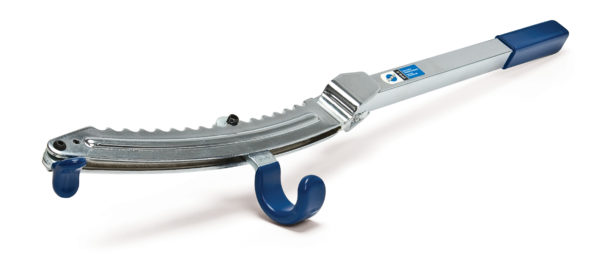
That said, I've also cold set a frame with the proper tool (the Park FFS-2) and that is much easier and will usually involve less back and forth. The FFS-2 would also be a very handy tool to have around in the event of a zombie apocalypse.
Regardless of the method you use, go slowly, measure often, make small adjustments.
__________________
My Bikes
My Bikes
08-31-17 | 07:08 PM
#23
What??? Only 2 wheels?
Joined: Apr 2010
Posts: 13,496
Likes: 940
From: Boston-ish, MA
Bikes: 72 Peugeot UO-8, 82 Peugeot TH8, 87 Bianchi Brava, 76? Masi Grand Criterium, 74 Motobecane Champion Team, 86 & 77 Gazelle champion mondial, 81? Grandis, 82? Tommasini, 83 Peugeot PF10
When I first rode my Gran Sport, a bare and slightly abuse frame I got really cheap, I discovered it had been stretched to 126. I also discovered that the skewer didn't always grip the DOs enough. It turns out that the DOs weren't aligned very well, probably from the stretching process. Once they were straightened the axle slipping stopped. If you're going to stretch the rear, do check that the DOs are parallel to each other and the bike's centerline.
__________________
Real cyclists use toe clips.
With great bikes comes great responsibility.
jimmuller
Real cyclists use toe clips.
With great bikes comes great responsibility.
jimmuller
09-01-17 | 12:43 AM
#24
Ride, Wrench, Swap, Race
Joined: Jan 2010
Posts: 9,813
Likes: 1,790
From: Northern California
Bikes: Cheltenham-Pedersen racer, Boulder F/S Paris-Roubaix, Varsity racer, '52 Christophe, '62 Continental, '92 Merckx, '75 Limongi, '76 Presto, '72 Gitane SC, '71 Schwinn SS, etc.
It's true that rear frame offset of even several mm is darn near impossible to notice while actually riding.
It's also darn unsightly to see the tire/rim way off the centerline of the brake caliper!
At the front fork however, even a 1mm offset at the tire's contact patch with the road will have the bike "pulling" (self-steering) to the opposite side that the contact patch is offset toward from the frame's centerline.
Threaded-rod method is ok to consider as a thought experiment, and I'm for free speech, but it is so time-consuming to unwind the nut(s) with each figurative "heave" on the chainstays to check on one's progress. It sounds like torture having to do it that way, not to mention the near-inevitable bending of only one chainstay, twice as far as one would want (ouch).
Someone mentioned using a straight piece of wood, ...I have never seen a straight piece of lumber.
A good "read" on dropout alignment is how "springy" that the QR lever action feels as one flips the lever closed. A springy feel that requires more than half of the lever's 180-degree arc to adequately clamp the axle is an almost-sure sign that the dropouts aren't parallel.
In the world of "flipper" bikes, this is generally the only check of dropout alignment I will bother with, unless wheel installation difficulty or inward/outward "rotation" of the rear derailer during QR securing is noted.
I have "upgraded" many five-speed bikes to six speeds where lesser-quality hubs are used simply by taking advantage of generous unused space between the freewheel and dropout. I might have to add only a 1mm washer to the driveside axle spacer stack to fit a standard 6s freewheel if 1) a modern chain is used and 2) there is no derailer mounting claw nut protruding into the available space. Campy and other higher-end hubs usually leave a lot less unused clearance so would need more spacer thickness added and corrective wheel dishing to go with that, and perhaps even a longer axle.
It's also darn unsightly to see the tire/rim way off the centerline of the brake caliper!
At the front fork however, even a 1mm offset at the tire's contact patch with the road will have the bike "pulling" (self-steering) to the opposite side that the contact patch is offset toward from the frame's centerline.
Threaded-rod method is ok to consider as a thought experiment, and I'm for free speech, but it is so time-consuming to unwind the nut(s) with each figurative "heave" on the chainstays to check on one's progress. It sounds like torture having to do it that way, not to mention the near-inevitable bending of only one chainstay, twice as far as one would want (ouch).
Someone mentioned using a straight piece of wood, ...I have never seen a straight piece of lumber.
A good "read" on dropout alignment is how "springy" that the QR lever action feels as one flips the lever closed. A springy feel that requires more than half of the lever's 180-degree arc to adequately clamp the axle is an almost-sure sign that the dropouts aren't parallel.
In the world of "flipper" bikes, this is generally the only check of dropout alignment I will bother with, unless wheel installation difficulty or inward/outward "rotation" of the rear derailer during QR securing is noted.
I have "upgraded" many five-speed bikes to six speeds where lesser-quality hubs are used simply by taking advantage of generous unused space between the freewheel and dropout. I might have to add only a 1mm washer to the driveside axle spacer stack to fit a standard 6s freewheel if 1) a modern chain is used and 2) there is no derailer mounting claw nut protruding into the available space. Campy and other higher-end hubs usually leave a lot less unused clearance so would need more spacer thickness added and corrective wheel dishing to go with that, and perhaps even a longer axle.
Last edited by dddd; 09-01-17 at 12:55 AM.
09-01-17 | 01:02 AM
#25
Senior Member
Joined: Jan 2008
Posts: 15,103
Likes: 4,733
From: Beaverton, OR
Bikes: Yes
I got a piece of oak at the Home Despot, that was like an inch and a half by half an inch or something and four feet long. I guess it was intended for craft projects or something. It rests flat on my granite kitchen counter so I'm willing to trust it for measuring rear dropout alignment.
__________________
My Bikes
My Bikes