


Lugged vs. Welded?
 10-11-10 | 04:45 AM
#26

Senior Member
Joined: Apr 2010
Posts: 3,081
Likes: 10
From: vermont
Bikes: Many
Welders of high production frames usually weld only 1/3 or so of two to three joints on a frame and the frame "tumbles" from bench to bench. They usually use a amperage pulser or a cold wire feed unit and fully robotic frame welding machines are also used (though more costly than kidnapped children) It's really the same as modern production lug work as it's an employee learning a simple part of a complicated process. Pretty much like any other type production (white or blue collar) job. There was a time when lugged frames were being built at a rate comparable to modern TIG production frame output and with the same care and artistic consideration (something between sporadic and none) though somehow the years have transformed them to art. ( ask me, I have several examples)
I make custom aluminum frames quite a bit. I also design and fabricate ALL the pieces of the frame except the cable stops. I also draw the tubes to the desired shape as well as bend/form the chainstays and do the stay end work. I design and make all the fixtures for manufacturing/welding/inspection/heat treating and final assembly. I don't usually work from a kit (there are exceptions) of any type and every single materials thickness, fastener shape and diameter is also my decision. I design my own cutters and weld my saw blades. There is nothing automatic about my welding process. The metal is applied to the joint with a filler rod just like fillet brazing (bronze welding?) and I control the amperage of a 10,000 degree arc held between my finger tips. I have worked with welding machine designers to improve the species as well as metallurgists and tube designers to provide a welders input. I have hundreds of variables to control while welding. and another dozen on the control panel. I contour the shape of my welding current (as one would view on oscilloscope) to meet my needs. I also mix my inert shielding gasses as needed. I have filed a few welds and with the filler being the same color as the base material on aluminum, requires far more skill than finishing brass on steel. Brass is soft,steel is much harder as well.
When "real" frame builders come for a visit they remove their hat and it stays in hand until they walk out the door.
I didn't write this to insult other craftsmen or methods, I just thought folks might like some insight to a process at this point far more rare than traditional frame building. I am looking forward to building a lugged frame at some point when I calm down (LOL)
I don't want to shock anyone with ghastly images so here is a link.
https://www.flickr.com/photos/frankth...n/photostream/
I make custom aluminum frames quite a bit. I also design and fabricate ALL the pieces of the frame except the cable stops. I also draw the tubes to the desired shape as well as bend/form the chainstays and do the stay end work. I design and make all the fixtures for manufacturing/welding/inspection/heat treating and final assembly. I don't usually work from a kit (there are exceptions) of any type and every single materials thickness, fastener shape and diameter is also my decision. I design my own cutters and weld my saw blades. There is nothing automatic about my welding process. The metal is applied to the joint with a filler rod just like fillet brazing (bronze welding?) and I control the amperage of a 10,000 degree arc held between my finger tips. I have worked with welding machine designers to improve the species as well as metallurgists and tube designers to provide a welders input. I have hundreds of variables to control while welding. and another dozen on the control panel. I contour the shape of my welding current (as one would view on oscilloscope) to meet my needs. I also mix my inert shielding gasses as needed. I have filed a few welds and with the filler being the same color as the base material on aluminum, requires far more skill than finishing brass on steel. Brass is soft,steel is much harder as well.
When "real" frame builders come for a visit they remove their hat and it stays in hand until they walk out the door.
I didn't write this to insult other craftsmen or methods, I just thought folks might like some insight to a process at this point far more rare than traditional frame building. I am looking forward to building a lugged frame at some point when I calm down (LOL)
I don't want to shock anyone with ghastly images so here is a link.
https://www.flickr.com/photos/frankth...n/photostream/
 10-11-10 | 10:02 AM
#27
Senior Member
Joined: Jun 2009
Posts: 375
Likes: 0
I have nothing but respect for good welding, but where's the art in it? Do you make creative decisions for the joints? Or is the perfection of the bead your goal? I suppose the freedom from preset angles forced by the lugs, and the manipulation of the shape of the tubes are artistic, so I thank you for setting me straight on that. Guess I'm just an old school Luggite!
10-11-10 | 10:03 AM
#28

aka Tom Reingold


Joined: Jan 2009
Posts: 44,302
Likes: 6,559
From: New York, NY, and High Falls, NY, USA
Bikes: 1962 Rudge Sports, 1971 Raleigh Super Course, 1971 Raleigh Pro Track, 1974 Raleigh International, 1975 Viscount Fixie, 1982 McLean, 1996 Lemond (Ti), 2002 Burley Zydeco tandem
On Saturday, I met Ryan of Folk Engineered. It's a two-person business. The other is his wife. He brazes steel custom frames. They're gorgeous. He still believes in the superiority of brazed steel frames. He has his point of view, and I respect it. His products are beautiful, and you pay for them. I'm glad to know the craft hasn't died and that he's a mere six miles from my home.
https://folkengineered.com/

https://folkengineered.com/
__________________
Tom Reingold, tom@noglider.com
New York City and High Falls, NY
Blogs: The Experienced Cyclist; noglider's ride blog
“When man invented the bicycle he reached the peak of his attainments.” — Elizabeth West, US author
Please email me rather than PM'ing me. Thanks.
Tom Reingold, tom@noglider.com
New York City and High Falls, NY
Blogs: The Experienced Cyclist; noglider's ride blog
“When man invented the bicycle he reached the peak of his attainments.” — Elizabeth West, US author
Please email me rather than PM'ing me. Thanks.
10-11-10 | 10:42 AM
#29
aka Tom Reingold
Joined: Jan 2009
Posts: 44,302
Likes: 6,559
From: New York, NY, and High Falls, NY, USA
Bikes: 1962 Rudge Sports, 1971 Raleigh Super Course, 1971 Raleigh Pro Track, 1974 Raleigh International, 1975 Viscount Fixie, 1982 McLean, 1996 Lemond (Ti), 2002 Burley Zydeco tandem
I have nothing but respect for good welding, but where's the art in it? Do you make creative decisions for the joints? Or is the perfection of the bead your goal? I suppose the freedom from preset angles forced by the lugs, and the manipulation of the shape of the tubes are artistic, so I thank you for setting me straight on that. Guess I'm just an old school Luggite!
__________________
Tom Reingold, tom@noglider.com
New York City and High Falls, NY
Blogs: The Experienced Cyclist; noglider's ride blog
“When man invented the bicycle he reached the peak of his attainments.” — Elizabeth West, US author
Please email me rather than PM'ing me. Thanks.
Tom Reingold, tom@noglider.com
New York City and High Falls, NY
Blogs: The Experienced Cyclist; noglider's ride blog
“When man invented the bicycle he reached the peak of his attainments.” — Elizabeth West, US author
Please email me rather than PM'ing me. Thanks.
10-11-10 | 12:16 PM
#30

Senior Member
Joined: Jun 2008
Posts: 689
Likes: 13
From: Somewhere North of Detroit and moving fast!
Bikes: 1976 Fuji America 1980 Fuji America 1984 Fuji America TS V 1982 Fuji Royale II 1993 Trek 970 1997 Trek 5000 2004 Trek Calypso 2007 Trek Portland 2008 Surly LTH
10-11-10 | 12:20 PM
#31
Senior Member
Joined: Jun 2008
Posts: 689
Likes: 13
From: Somewhere North of Detroit and moving fast!
Bikes: 1976 Fuji America 1980 Fuji America 1984 Fuji America TS V 1982 Fuji Royale II 1993 Trek 970 1997 Trek 5000 2004 Trek Calypso 2007 Trek Portland 2008 Surly LTH
I have nothing but respect for good welding, but where's the art in it? Do you make creative decisions for the joints? Or is the perfection of the bead your goal? I suppose the freedom from preset angles forced by the lugs, and the manipulation of the shape of the tubes are artistic, so I thank you for setting me straight on that. Guess I'm just an old school Luggite!
10-11-10 | 12:25 PM
#32

grad stud.
Joined: Apr 2010
Posts: 674
Likes: 1
From: Houston, TX
Bikes: 1987 Schwinn Voyageur
While not exactly an art, you can certainly tell quality of the tig weld the same way you can tell quality of a lug. Messy big blobs of welding can be just as indicative of a crappy factory-line job as cheap, chunky lugs.
+1 on the historical note for welded vs tig'd frames. I'd say most of the best (non-custom) frames are all tig'd nowadays.
+1 on the historical note for welded vs tig'd frames. I'd say most of the best (non-custom) frames are all tig'd nowadays.
10-11-10 | 02:45 PM
#33
Senior Member
Joined: Oct 2008
Posts: 2,929
Likes: 2
But a frame may not be a strength-limited design. It may be a fatigue life limited design. It could be that the strength of both vastly exceeds what is required (at least, I hope so) and that both have adequate (or infinite) fatigue life given the loading conditions.
10-11-10 | 03:08 PM
#34
aka Tom Reingold
Joined: Jan 2009
Posts: 44,302
Likes: 6,559
From: New York, NY, and High Falls, NY, USA
Bikes: 1962 Rudge Sports, 1971 Raleigh Super Course, 1971 Raleigh Pro Track, 1974 Raleigh International, 1975 Viscount Fixie, 1982 McLean, 1996 Lemond (Ti), 2002 Burley Zydeco tandem
It seems that most steel frames have more than adequate fatigue life for most riders. So far, most aluminum frames are holding up well, too. If the fatigue life is as good as steel, that's good, but the failure mode of steel is preferable. Steel warns you for a long time before it fails.
That's not to say I recommend against aluminum frames. I own two. I don't ride terribly hard, and I have so many bikes that I don't ride any one bike very much, so I'm not a good frame lifespan tester.
The only experience I have with carbon fiber bikes is as a test rider.
And I have no experience with titanium frames.
That's not to say I recommend against aluminum frames. I own two. I don't ride terribly hard, and I have so many bikes that I don't ride any one bike very much, so I'm not a good frame lifespan tester.
The only experience I have with carbon fiber bikes is as a test rider.
And I have no experience with titanium frames.
__________________
Tom Reingold, tom@noglider.com
New York City and High Falls, NY
Blogs: The Experienced Cyclist; noglider's ride blog
“When man invented the bicycle he reached the peak of his attainments.” — Elizabeth West, US author
Please email me rather than PM'ing me. Thanks.
Tom Reingold, tom@noglider.com
New York City and High Falls, NY
Blogs: The Experienced Cyclist; noglider's ride blog
“When man invented the bicycle he reached the peak of his attainments.” — Elizabeth West, US author
Please email me rather than PM'ing me. Thanks.
10-11-10 | 05:10 PM
#35
Senior Member
Joined: Oct 2008
Posts: 2,929
Likes: 2
I would bet that the only time relative strength comes into play on bicycle frame is during a crash, specifically a front end crash into a relatively immovable object. I think then you may see a difference between a welded, welded and ground-down and a lugged and brazed frame. Then again, maybe not even then, if the strength margins are high enough.
10-11-10 | 05:11 PM
#36
Senior Member
Joined: Oct 2008
Posts: 2,929
Likes: 2
It seems that most steel frames have more than adequate fatigue life for most riders. So far, most aluminum frames are holding up well, too. If the fatigue life is as good as steel, that's good, but the failure mode of steel is preferable. Steel warns you for a long time before it fails.
"It could be ... that both have adequate (or infinite) fatigue life given the loading conditions. "
10-11-10 | 07:20 PM
#37
aka Tom Reingold
Joined: Jan 2009
Posts: 44,302
Likes: 6,559
From: New York, NY, and High Falls, NY, USA
Bikes: 1962 Rudge Sports, 1971 Raleigh Super Course, 1971 Raleigh Pro Track, 1974 Raleigh International, 1975 Viscount Fixie, 1982 McLean, 1996 Lemond (Ti), 2002 Burley Zydeco tandem
Yes, that was my way of stating my agreement with you. 
And I agree that strength is adequate for most frames, too, so I guess that means that fatigue is more important than strength. Does this make sense?
Tom
And I agree that strength is adequate for most frames, too, so I guess that means that fatigue is more important than strength. Does this make sense?
Tom
__________________
Tom Reingold, tom@noglider.com
New York City and High Falls, NY
Blogs: The Experienced Cyclist; noglider's ride blog
“When man invented the bicycle he reached the peak of his attainments.” — Elizabeth West, US author
Please email me rather than PM'ing me. Thanks.
Tom Reingold, tom@noglider.com
New York City and High Falls, NY
Blogs: The Experienced Cyclist; noglider's ride blog
“When man invented the bicycle he reached the peak of his attainments.” — Elizabeth West, US author
Please email me rather than PM'ing me. Thanks.
10-11-10 | 07:42 PM
#38
Senior Member
Joined: Oct 2008
Posts: 2,929
Likes: 2
The thing about warnings is, you have to watch for them and heed them when they appear.
Recently, there have been several threads on the topic of, "Is this frame okay to ride?" The thread typically contains images of a buckled tube(s) that was the obvious result of a front end collision.
Recently, there have been several threads on the topic of, "Is this frame okay to ride?" The thread typically contains images of a buckled tube(s) that was the obvious result of a front end collision.
10-11-10 | 10:04 PM
#39

curmudgineer
Joined: Dec 2009
Posts: 4,417
Likes: 113
From: Chicago SW burbs
Bikes: 2 many 2 fit here
If you are onto a worthwhile model for stress analysis of welded joints, I for one would like to learn more about it. A complete response should include definition of the parent material, filler material, temperature-time history of the filler & adjacent material, welding process (TIG, MIG, stick... ?), description of the as-welded bead characteristics, assumptions about the grinding/smoothing process, a physical explanation for why the smoothing process weakens the joint, and an explanation for how bending at 90 degrees is relevant to the design conditions for the joint in question. Without this information, I maintain that your original assertion is merely a generalization without qualification.
10-12-10 | 06:09 AM
#40

Senior Member
Joined: May 2010
Posts: 3,904
Likes: 36
From: Hurricane Alley , Florida
Bikes: Treks (USA), Schwinn Paramount, Schwinn letour,Raleigh Team Professional, Gazelle GoldLine Racing, 2 Super Mondias, Carlton Professional.
With all due respect, that's not much of a response in a serious discussion. Can you elaborate on what the physical phenomena are that are playing a role in your hypothesis?
If you are onto a worthwhile model for stress analysis of welded joints, I for one would like to learn more about it. A complete response should include definition of the parent material, filler material, temperature-time history of the filler & adjacent material, welding process (TIG, MIG, stick... ?), description of the as-welded bead characteristics, assumptions about the grinding/smoothing process, a physical explanation for why the smoothing process weakens the joint, and an explanation for how bending at 90 degrees is relevant to the design conditions for the joint in question. Without this information, I maintain that your original assertion is merely a generalization without qualification.
If you are onto a worthwhile model for stress analysis of welded joints, I for one would like to learn more about it. A complete response should include definition of the parent material, filler material, temperature-time history of the filler & adjacent material, welding process (TIG, MIG, stick... ?), description of the as-welded bead characteristics, assumptions about the grinding/smoothing process, a physical explanation for why the smoothing process weakens the joint, and an explanation for how bending at 90 degrees is relevant to the design conditions for the joint in question. Without this information, I maintain that your original assertion is merely a generalization without qualification.
Mike
10-12-10 | 07:07 AM
#41

Senior Member
Joined: May 2009
Posts: 2,741
Likes: 151
From: Kitchener, ON
I have nothing but respect for good welding, but where's the art in it? Do you make creative decisions for the joints? Or is the perfection of the bead your goal? I suppose the freedom from preset angles forced by the lugs, and the manipulation of the shape of the tubes are artistic, so I thank you for setting me straight on that. Guess I'm just an old school Luggite!
I'll have my TIG ticket one day, and I know that TIG (or fillet braze if you stick to steel) is a lot more flexible and precise.
I'm an ironworker and a lot of drawings will specify NOT to grind or finish the weld aside from paint. I think if you have a solid weld on a bicycle, you likely have a joint that is much stronger than the tubing, so you can afford to lose a bit of strength if the appearance is important, but I don't see people grinding down joints on plans or boats or anything, so personally I think at best it's extraneous and at worst foolish. I also find the "stack of dimes" appearance as equally attractive as a nice lugged joint. I dream about metal sometimes too, so take that with a grain of salt
10-12-10 | 08:43 AM
#42


Decrepit Member
Joined: Aug 2005
Posts: 10,488
Likes: 92
From: Santa Rosa, California
Bikes: Waterford 953 RS-22, several Paramounts
All very good points, take a home made airplane. Which many of them are made of welded tubing and the welding is some of the most accurate and perfect to be seen. NONE of them are ground down and smoothed over, because it WEAKENS the joint. Oh... and it won't be air worthy. So the question still is, will grinding a perfect weld bead that has very good penetration weaken it? Yep. If you need more scientific data on this, I guess I have to look for my school books from when I went to aircraft mechanic school and got my A&P licence back in the early 70's. Still, if you want to build anything with welded joints and grind them down even to the base metal, that's YOUR choice. I, would cover the weld bead with a filler metal and grind that smooth so as not to compromise the weld. Again, YOU can do what YOU want on you weld beads.
Mike
Mike
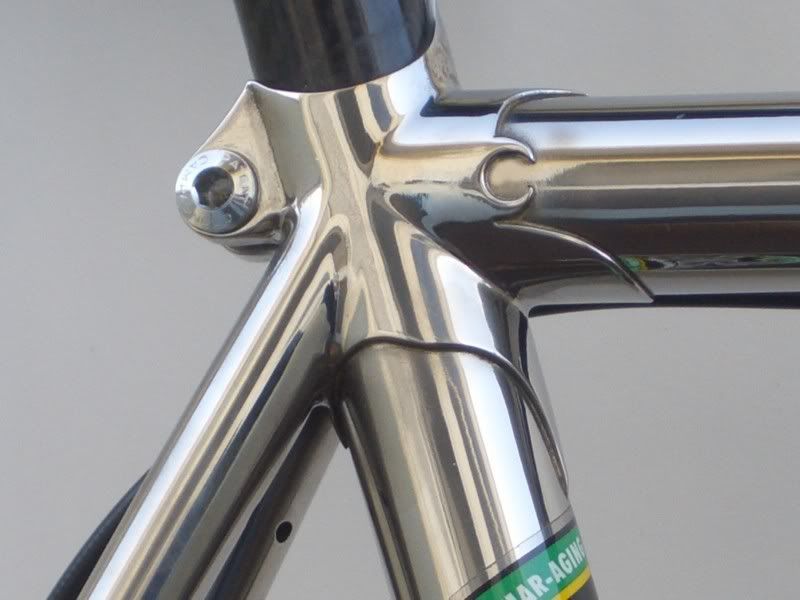
These seat stays were TIG welded and the beads were then smoothed by grinding and polishing. The result is a joint that has superior fatigue performance and the pleasing aesthetics of a smooth fillet.

 10-12-10 | 09:05 AM
#44

Curmudgeon in Training
Joined: May 2009
Posts: 1,956
Likes: 11
From: Rural Retreat, VA
Bikes: 1974 Gazelle Champion Mondial, 2010 Cannondale Trail SL, 1988 Peugeot Nice, 1992ish Stumpjumper Comp,1990's Schwinn Moab
I'm with Scooper. As long as a sufficient amount of weld is left in place the weld should be fine. Creating a uniform surface should create a more uniform stress load. Where one could run into a problem is filing a weld down to it's lowest point and that lowest point actually being too low... i.e. welder error.
I'll not bring the 'art' argument in as I think welding well is incredibly difficult. In shop class I could lay awesome arc welding beads but I know I can't even begin to MIG or TIG. It's a craft, no doubt about it. While the outcome might not be aesthetically pleasing to all.... it's still an art form.
I'll not bring the 'art' argument in as I think welding well is incredibly difficult. In shop class I could lay awesome arc welding beads but I know I can't even begin to MIG or TIG. It's a craft, no doubt about it. While the outcome might not be aesthetically pleasing to all.... it's still an art form.
 10-12-10 | 10:31 AM
#46
Senior Member
Joined: May 2010
Posts: 3,904
Likes: 36
From: Hurricane Alley , Florida
Bikes: Treks (USA), Schwinn Paramount, Schwinn letour,Raleigh Team Professional, Gazelle GoldLine Racing, 2 Super Mondias, Carlton Professional.
Smoothing a weld bead is a personal choice. But it's not mine for the reasons I have mentioned. Really don't care what someone else does to a welded piece. I have smoothed over some beads that have a large lump or two, but never even with the surface. Maybe I should have mentioned I too am a welder, these days mainly oxy/act. and arc welding. I Don't like to arc welding, but sometimes the larger equipment we have needs to be repaired. I can wire feed and TIG weld, also braze and silver solder. I would love to have more time to TIG weld. That said, if you weld and don't like the bead YOU laid down, by all means grind it smooth and even with the surface.
Mike
Mike
10-12-10 | 12:21 PM
#47
Senior Member
Joined: Oct 2008
Posts: 2,929
Likes: 2
I was thinking about improving weld strength and fatigue life with post-weld processing. It seems to me, if you processed thee weld in a way that left it with some residual compressive stress, you would achieve a net increase in tensile strength and might also an increase in its fatigue resistance to tensile loading.
So, how does one do this?
If you grit blast the weld, you might build in a compressive stress. Shot peening is a commercial process done for exactly this reason - it smooths the surface and builds in a compressive stress.
If your "grinding" removes surface flaws (stress concentrations) you could also achieve a net increasse in strength and fatigue life. I would think this is especially true for aluminum and other notch sensitive materials.
If your grinding gets the surface hot, you might inadvertently be doing a post-weld annealling of the material. This typically improves the morphology and minimizes defects.
Then again, if your grinding/smoothing adds defects or puts the surfacein tension rather than compression or,... there are as many ways to screw things up as there are ways to improve them.
The key to quality is workmanship and process control.
ETA - oops, I just reviewed the lecture notes and they say the same thing. Scooper truly wins. He said it first.
So, how does one do this?
If you grit blast the weld, you might build in a compressive stress. Shot peening is a commercial process done for exactly this reason - it smooths the surface and builds in a compressive stress.
If your "grinding" removes surface flaws (stress concentrations) you could also achieve a net increasse in strength and fatigue life. I would think this is especially true for aluminum and other notch sensitive materials.
If your grinding gets the surface hot, you might inadvertently be doing a post-weld annealling of the material. This typically improves the morphology and minimizes defects.
Then again, if your grinding/smoothing adds defects or puts the surfacein tension rather than compression or,... there are as many ways to screw things up as there are ways to improve them.
The key to quality is workmanship and process control.
ETA - oops, I just reviewed the lecture notes and they say the same thing. Scooper truly wins. He said it first.
Last edited by Mike Mills; 10-12-10 at 12:25 PM.
10-12-10 | 12:43 PM
#48
Senior Member
Joined: Oct 2004
Posts: 1,744
Likes: 3
From: Toronto, Ontario
Bikes: Miele Azsora, Kuwahara Cascade
Ok, so what about a mass-produced lugged frame vs. a hand-welded frame?
10-12-10 | 12:56 PM
#49
aka Tom Reingold
Joined: Jan 2009
Posts: 44,302
Likes: 6,559
From: New York, NY, and High Falls, NY, USA
Bikes: 1962 Rudge Sports, 1971 Raleigh Super Course, 1971 Raleigh Pro Track, 1974 Raleigh International, 1975 Viscount Fixie, 1982 McLean, 1996 Lemond (Ti), 2002 Burley Zydeco tandem
OK, what about an organically grown apple sold in a fair trade market compared with a bad picture of a toy that mimics an artificially-flavored orange candy?
__________________
Tom Reingold, tom@noglider.com
New York City and High Falls, NY
Blogs: The Experienced Cyclist; noglider's ride blog
“When man invented the bicycle he reached the peak of his attainments.” — Elizabeth West, US author
Please email me rather than PM'ing me. Thanks.
Tom Reingold, tom@noglider.com
New York City and High Falls, NY
Blogs: The Experienced Cyclist; noglider's ride blog
“When man invented the bicycle he reached the peak of his attainments.” — Elizabeth West, US author
Please email me rather than PM'ing me. Thanks.
10-12-10 | 01:10 PM
#50
Senior Member
Joined: May 2010
Posts: 3,904
Likes: 36
From: Hurricane Alley , Florida
Bikes: Treks (USA), Schwinn Paramount, Schwinn letour,Raleigh Team Professional, Gazelle GoldLine Racing, 2 Super Mondias, Carlton Professional.
Whenever I weld, I like to make the bead as uniform as possible, with the correct amount of penetration. A perfect bead is a beautiful sight, something to be proud of. Would you really grind a weld on thin bike tubing? I would like to see that, it must turn out really nice........
Mike
Mike