


On Paraffin Wax...
 10-01-12 | 11:56 AM
#51

Mad bike riding scientist


Joined: Nov 2004
Posts: 29,146
Likes: 6,204
From: Denver, CO
Bikes: Some silver ones, a red one, a black and orange one, and a few titanium ones
Kinda technically, a 'paraffin' is any hydrocarbon. It's a common named used by (older than me) chemists to describe any saturated hydrocarbon. Paraffin wax is a long chain hydrocarbon of 20 to 40 carbon units that is a solid at room temperature. The oil above is less than 20 carbon units but probably more than about 10...which is kerosene/diesel fuel.
__________________
Stuart Black
Dreamin' of Bemidji Down the Mississippi (in part)
Plan Epsilon Around Lake Michigan in the era of Covid
Gold Fever Three days of dirt in Colorado
Pokin' around the Poconos A cold ride around Lake Erie
Dinosaurs in Colorado A mountain bike guide to the Purgatory Canyon dinosaur trackway
Solo Without Pie. The search for pie in the Midwest.
Picking the Scablands. Washington and Oregon, 2005. Pie and spiders on the Columbia River!
Stuart Black
Dreamin' of Bemidji Down the Mississippi (in part)
Plan Epsilon Around Lake Michigan in the era of Covid
Gold Fever Three days of dirt in Colorado
Pokin' around the Poconos A cold ride around Lake Erie
Dinosaurs in Colorado A mountain bike guide to the Purgatory Canyon dinosaur trackway
Solo Without Pie. The search for pie in the Midwest.
Picking the Scablands. Washington and Oregon, 2005. Pie and spiders on the Columbia River!

 10-01-12 | 01:11 PM
#53

Thread Starter
Senior Member
Joined: Sep 2012
Posts: 71
Likes: 0
From: Guam USA
Bikes: 2011 Giant Advanced SL ISP, 2008 Advanced ISP
Yep, I was kidding about the boxes.
Nope, I'm serious about the foil pan. I was planning to put it in the oven on bake at lowest heat and increase from there if necessary.
Now I'm glad you warned me off of it. The box of wax says expressly to not try to melt it in the oven: "Never melt directly in pan over fire, hot plate or in hot oven." It says to heat it in a pan over boiling water, as in a double boiler.
So here goes nothing:
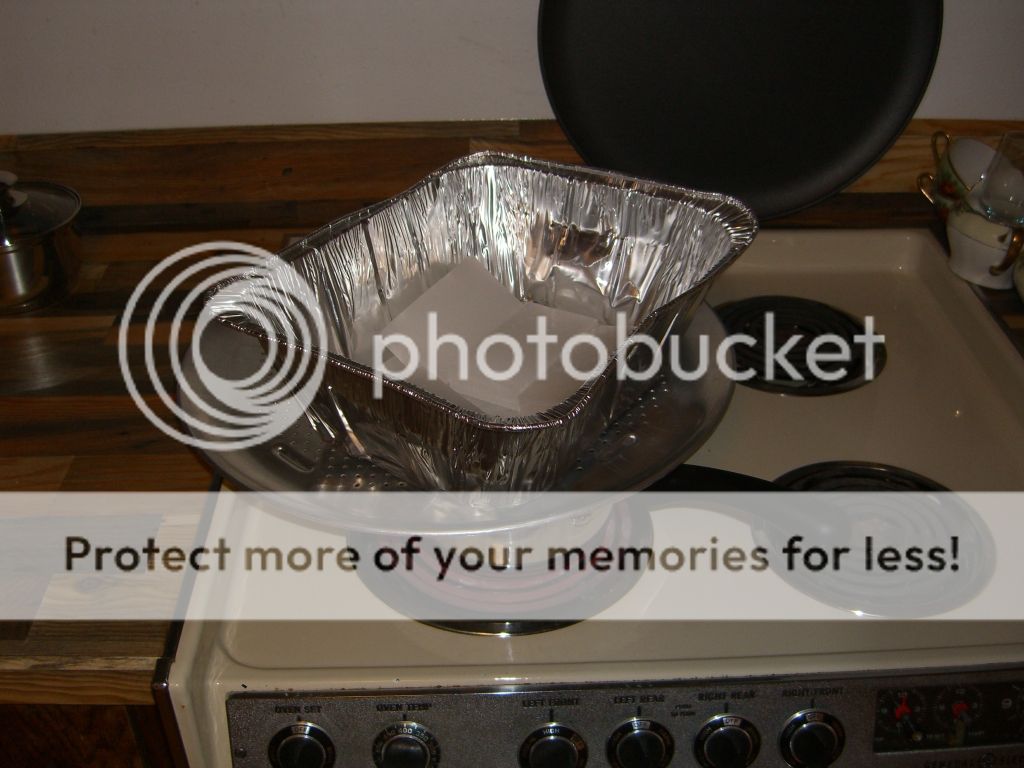
Nope, I'm serious about the foil pan. I was planning to put it in the oven on bake at lowest heat and increase from there if necessary.
Now I'm glad you warned me off of it. The box of wax says expressly to not try to melt it in the oven: "Never melt directly in pan over fire, hot plate or in hot oven." It says to heat it in a pan over boiling water, as in a double boiler.
So here goes nothing:
10-01-12 | 01:17 PM
#54

Descends like a rock
Joined: Oct 2010
Posts: 4,034
Likes: 16
From: Fort Worth, TX
Bikes: Scott Foil, Surly Pacer
Kinda technically, a 'paraffin' is any hydrocarbon. It's a common named used by (older than me) chemists to describe any saturated hydrocarbon. Paraffin wax is a long chain hydrocarbon of 20 to 40 carbon units that is a solid at room temperature. The oil above is less than 20 carbon units but probably more than about 10...which is kerosene/diesel fuel.
 10-01-12 | 01:42 PM
#56
Thread Starter
Senior Member
Joined: Sep 2012
Posts: 71
Likes: 0
From: Guam USA
Bikes: 2011 Giant Advanced SL ISP, 2008 Advanced ISP
Note the little tupperware stand to raise the pot closer to the chain and the wax almost filling the pot to the top. This allows more links to drape into the chain=less time to finish revolution. Also note my super fancy cardboard drip mat--no mess I hate scraping wax off the floor!
10-05-12 | 05:01 PM
#57

Senior Member

Joined: Jun 2009
Posts: 3,119
Likes: 159
From: Kalamazoo, Mi.
Bikes: Sam, The Hunq and that Old Guy, Soma Buena Vista, Giant Talon 2, Brompton
Note the little tupperware stand to raise the pot closer to the chain and the wax almost filling the pot to the top. This allows more links to drape into the chain=less time to finish revolution. Also note my super fancy cardboard drip mat--no mess I hate scraping wax off the floor!
I still like soaking the chain until the bubbles go away, it makes me feel more thorough. On another point, the temperature of riding means nothing. I live in Michigan, we have whatever range of temp you want and waxing is not affected.
Marc
10-05-12 | 09:01 PM
#58
Thread Starter
Senior Member
Joined: Sep 2012
Posts: 71
Likes: 0
From: Guam USA
Bikes: 2011 Giant Advanced SL ISP, 2008 Advanced ISP
You can still wait for bubbles with my drape method--I can leave the draped section in the wax for as long as I wish though 10 seconds seems long enough to get the job done. I don't like breaking the chain every time I wax.
10-06-12 | 09:09 AM
#59

Living the Dream
Joined: Apr 2009
Posts: 449
Likes: 0
From: DFW Metroplex
Bikes: 2015 AWOL Frameset with custom drivetrain, 20?? Windsor Tourist, 2010 Specialized Secteur
I've been on the fence for a while about trying the wax method. This thread has gotten me thinking about it again.
10-06-12 | 11:48 AM
#60
Thread Starter
Senior Member
Joined: Sep 2012
Posts: 71
Likes: 0
From: Guam USA
Bikes: 2011 Giant Advanced SL ISP, 2008 Advanced ISP
I've always thought those quick disconnect links were unreliable--maybe I'm wrong? If so, why doesn't Shimano offer a quick disconnect link then? So the "downside" (however small) is reliability but regardless, I still see no time advantage in removing the chain. Since I can run my installed chain draped through wax in 5 minutes or less, why would I wish to remove the chain? What's the advantage for splitting the chain?
10-06-12 | 01:20 PM
#61
Living the Dream
Joined: Apr 2009
Posts: 449
Likes: 0
From: DFW Metroplex
Bikes: 2015 AWOL Frameset with custom drivetrain, 20?? Windsor Tourist, 2010 Specialized Secteur
What do you mean, reliability?
I use the SRAM quick disconnect and haven't had any problems.
My only thought was that taking the link apart and dipping the chain once would seem easier than dipping a loop and then moving to another section, then another, and another....
I use the SRAM quick disconnect and haven't had any problems.
My only thought was that taking the link apart and dipping the chain once would seem easier than dipping a loop and then moving to another section, then another, and another....
10-06-12 | 05:58 PM
#62

Senior Member
Joined: Apr 2012
Posts: 7,391
Likes: 13
From: Memphis TN area
Bikes: 2011 Felt Z85 (road/commuter), 2006 Marin Pine Mountain (utility/commuter E-bike), 1995 KHS Alite 1000 (gravel grinder)
My KHS has a quick disconnect link and I've also never had problems.
The upside I see to the OP's method is that you should never have to touch the chain. If you take it off and dip it in wax, then you have to get it out of the wax and put it back on the bike, which may or may not have a negative on the wax coating.
The upside I see to the OP's method is that you should never have to touch the chain. If you take it off and dip it in wax, then you have to get it out of the wax and put it back on the bike, which may or may not have a negative on the wax coating.
10-06-12 | 06:04 PM
#63
Thread Starter
Senior Member
Joined: Sep 2012
Posts: 71
Likes: 0
From: Guam USA
Bikes: 2011 Giant Advanced SL ISP, 2008 Advanced ISP
What do you mean, reliability?
I use the SRAM quick disconnect and haven't had any problems.
My only thought was that taking the link apart and dipping the chain once would seem easier than dipping a loop and then moving to another section, then another, and another....
I use the SRAM quick disconnect and haven't had any problems.
My only thought was that taking the link apart and dipping the chain once would seem easier than dipping a loop and then moving to another section, then another, and another....
I just offer my drape method here for those who don't trust quick disconnect links and/or like splitting chains often. Perhaps some here read about waxing chains but were generally turned off because of the chain breaking requirement as described on every blog. My whole point here is to provide a faster and easier alternative to breaking chains for waxing.
That is always the argument for oil VS wax ya know...that is, since you MUST break the chain you may as well just clean it with solvent and use fresh oil. False.
10-06-12 | 06:16 PM
#64
Thread Starter
Senior Member
Joined: Sep 2012
Posts: 71
Likes: 0
From: Guam USA
Bikes: 2011 Giant Advanced SL ISP, 2008 Advanced ISP
My KHS has a quick disconnect link and I've also never had problems.
The upside I see to the OP's method is that you should never have to touch the chain. If you take it off and dip it in wax, then you have to get it out of the wax and put it back on the bike, which may or may not have a negative on the wax coating.
The upside I see to the OP's method is that you should never have to touch the chain. If you take it off and dip it in wax, then you have to get it out of the wax and put it back on the bike, which may or may not have a negative on the wax coating.
10-07-12 | 10:16 AM
#66

Senior Member
Joined: Jul 2006
Posts: 11,373
Likes: 8
From: Columbus, OH
Bikes: '08 Surly Cross-Check, 2011 Redline Conquest Pro, 2012 Spesh FSR Comp EVO, 2015 Trek Domane 6.2 disc
I may have missed it in skimming the thread, but I didn't see anything in the process about actually cleaning the grit and grime from the chain before the re-waxing process. Just that the hot wax will melt the old stuff. Sure, it will... but all that does is briefly resuspend any particulate matter and allow it to penetrate the rollers while you create a dip bath of it for the rest of the chain. In a relatively clean environment, it could work. If your roads are really gross and parts pick up a lot of contamination, maybe not so much.
I'm curious as to why you clean and do this with a fresh new chain, though. Stock from the factory, chains are lubed with GLEITMO (or some other similar lube) which is designed specifically for the application. No need to clean and relube a new chain, just stick wtih the stock stuff until it needs a first scrub-down.
My personal choice in cleaners is mineral spirits because a gallon is $7 at the hardware store and I can recycle a jar of it for a few dozen cleanings by just letting it settle and then pouring off the clean part to re-use. I save the dirty bit for the neighbourhood 'household chemicals disposal day' and drop it off there for appropriate disposal. A single gallon lasted me for almost 3 years of cleaning 3 bikes worth of chains and parts.
For lubricants, I like Finish Line products for the commuter and my MTB. I've been using Finish Line Wet on my CX bike for soggy conditions, and plain old 3-in-1 oil for dry conditions. It's lightweight, runs smooth, and works well for everything from chains to freewheel pawls to cables. For about $3.00 a bottle, it's cheaper than Finish Line Dry, too.
I'm curious as to why you clean and do this with a fresh new chain, though. Stock from the factory, chains are lubed with GLEITMO (or some other similar lube) which is designed specifically for the application. No need to clean and relube a new chain, just stick wtih the stock stuff until it needs a first scrub-down.
My personal choice in cleaners is mineral spirits because a gallon is $7 at the hardware store and I can recycle a jar of it for a few dozen cleanings by just letting it settle and then pouring off the clean part to re-use. I save the dirty bit for the neighbourhood 'household chemicals disposal day' and drop it off there for appropriate disposal. A single gallon lasted me for almost 3 years of cleaning 3 bikes worth of chains and parts.
For lubricants, I like Finish Line products for the commuter and my MTB. I've been using Finish Line Wet on my CX bike for soggy conditions, and plain old 3-in-1 oil for dry conditions. It's lightweight, runs smooth, and works well for everything from chains to freewheel pawls to cables. For about $3.00 a bottle, it's cheaper than Finish Line Dry, too.
__________________
"I feel like my world was classier before I found cyclocross."
- Mandi M.
"I feel like my world was classier before I found cyclocross."
- Mandi M.
10-07-12 | 11:20 AM
#67

Unlisted member
Joined: Dec 2005
Posts: 6,192
Likes: 435
From: Chicagoland
Bikes: Specialized Hardrock
I like the teflon lube. It's nice a clean like the waxed chains shown above, but tough enough for motorcycle use. Mechbegon uses it too, he's posted some pictures of his drivetrain after riding in the nasty weather.
10-07-12 | 11:40 AM
#68
Thread Starter
Senior Member
Joined: Sep 2012
Posts: 71
Likes: 0
From: Guam USA
Bikes: 2011 Giant Advanced SL ISP, 2008 Advanced ISP
I may have missed it in skimming the thread, but I didn't see anything in the process about actually cleaning the grit and grime from the chain before the re-waxing process. Just that the hot wax will melt the old stuff. Sure, it will... but all that does is briefly resuspend any particulate matter and allow it to penetrate the rollers while you create a dip bath of it for the rest of the chain. In a relatively clean environment, it could work. If your roads are really gross and parts pick up a lot of contamination, maybe not so much.
I'm curious as to why you clean and do this with a fresh new chain, though. Stock from the factory, chains are lubed with GLEITMO (or some other similar lube) which is designed specifically for the application. No need to clean and relube a new chain, just stick wtih the stock stuff until it needs a first scrub-down.
I'm curious as to why you clean and do this with a fresh new chain, though. Stock from the factory, chains are lubed with GLEITMO (or some other similar lube) which is designed specifically for the application. No need to clean and relube a new chain, just stick wtih the stock stuff until it needs a first scrub-down.
If you don't remove the factory lube from the new chain the wax won't stick to it like glue. Since the new chain comes broken already, I feel this is the best time to clean it thoroughly by using solvent once. Then I use the supplied Shimano break-off pin to install and never take the chain off the bike again.
10-07-12 | 08:37 PM
#69

Senior Member
Joined: Jun 2008
Posts: 100
Likes: 0
From: Flint, MI
Bikes: '12 C-dale HT; '89 C-dale sr300; Trek 820
Does rain effect the waxed chain? Like you, I suspect, I spend a fair bit of time riding in the rain.
10-08-12 | 07:03 AM
#70
Mad bike riding scientist
Joined: Nov 2004
Posts: 29,146
Likes: 6,204
From: Denver, CO
Bikes: Some silver ones, a red one, a black and orange one, and a few titanium ones
I may have missed it in skimming the thread, but I didn't see anything in the process about actually cleaning the grit and grime from the chain before the re-waxing process. Just that the hot wax will melt the old stuff. Sure, it will... but all that does is briefly resuspend any particulate matter and allow it to penetrate the rollers while you create a dip bath of it for the rest of the chain. In a relatively clean environment, it could work. If your roads are really gross and parts pick up a lot of contamination, maybe not so much.
I'm curious as to why you clean and do this with a fresh new chain, though. Stock from the factory, chains are lubed with GLEITMO (or some other similar lube) which is designed specifically for the application. No need to clean and relube a new chain, just stick wtih the stock stuff until it needs a first scrub-down.
My personal choice in cleaners is mineral spirits because a gallon is $7 at the hardware store and I can recycle a jar of it for a few dozen cleanings by just letting it settle and then pouring off the clean part to re-use. I save the dirty bit for the neighbourhood 'household chemicals disposal day' and drop it off there for appropriate disposal. A single gallon lasted me for almost 3 years of cleaning 3 bikes worth of chains and parts.
For lubricants, I like Finish Line products for the commuter and my MTB. I've been using Finish Line Wet on my CX bike for soggy conditions, and plain old 3-in-1 oil for dry conditions. It's lightweight, runs smooth, and works well for everything from chains to freewheel pawls to cables. For about $3.00 a bottle, it's cheaper than Finish Line Dry, too.
I'm curious as to why you clean and do this with a fresh new chain, though. Stock from the factory, chains are lubed with GLEITMO (or some other similar lube) which is designed specifically for the application. No need to clean and relube a new chain, just stick wtih the stock stuff until it needs a first scrub-down.
My personal choice in cleaners is mineral spirits because a gallon is $7 at the hardware store and I can recycle a jar of it for a few dozen cleanings by just letting it settle and then pouring off the clean part to re-use. I save the dirty bit for the neighbourhood 'household chemicals disposal day' and drop it off there for appropriate disposal. A single gallon lasted me for almost 3 years of cleaning 3 bikes worth of chains and parts.
For lubricants, I like Finish Line products for the commuter and my MTB. I've been using Finish Line Wet on my CX bike for soggy conditions, and plain old 3-in-1 oil for dry conditions. It's lightweight, runs smooth, and works well for everything from chains to freewheel pawls to cables. For about $3.00 a bottle, it's cheaper than Finish Line Dry, too.
A major flaw with this technique is that it has no water resistance. Water will get under the wax and has a stronger affinity for the metal then the wax does. You could make the hard canning wax more effective at resisting water by mixing in a soft wax and/or some oil. The wax would be more flexible and less likely to just break and flake off the chain. You could also add solvents to bring down the melting point and put it in bottles so that you could lubricant the chain when needed and/or avoid all the issues of dealing with molten wax. But, of course, someone has already done that.
__________________
Stuart Black
Dreamin' of Bemidji Down the Mississippi (in part)
Plan Epsilon Around Lake Michigan in the era of Covid
Gold Fever Three days of dirt in Colorado
Pokin' around the Poconos A cold ride around Lake Erie
Dinosaurs in Colorado A mountain bike guide to the Purgatory Canyon dinosaur trackway
Solo Without Pie. The search for pie in the Midwest.
Picking the Scablands. Washington and Oregon, 2005. Pie and spiders on the Columbia River!
Stuart Black
Dreamin' of Bemidji Down the Mississippi (in part)
Plan Epsilon Around Lake Michigan in the era of Covid
Gold Fever Three days of dirt in Colorado
Pokin' around the Poconos A cold ride around Lake Erie
Dinosaurs in Colorado A mountain bike guide to the Purgatory Canyon dinosaur trackway
Solo Without Pie. The search for pie in the Midwest.
Picking the Scablands. Washington and Oregon, 2005. Pie and spiders on the Columbia River!
10-08-12 | 07:03 AM
#71
Senior Member
Joined: Jun 2009
Posts: 3,119
Likes: 159
From: Kalamazoo, Mi.
Bikes: Sam, The Hunq and that Old Guy, Soma Buena Vista, Giant Talon 2, Brompton
10-08-12 | 07:05 AM
#72
Senior Member
Joined: Jun 2009
Posts: 3,119
Likes: 159
From: Kalamazoo, Mi.
Bikes: Sam, The Hunq and that Old Guy, Soma Buena Vista, Giant Talon 2, Brompton
I may have missed it in skimming the thread, but I didn't see anything in the process about actually cleaning the grit and grime from the chain before the re-waxing process. Just that the hot wax will melt the old stuff. Sure, it will... but all that does is briefly resuspend any particulate matter and allow it to penetrate the rollers while you create a dip bath of it for the rest of the chain. In a relatively clean environment, it could work. If your roads are really gross and parts pick up a lot of contamination, maybe not so much.
I'm curious as to why you clean and do this with a fresh new chain, though. Stock from the factory, chains are lubed with GLEITMO (or some other similar lube) which is designed specifically for the application. No need to clean and relube a new chain, just stick wtih the stock stuff until it needs a first scrub-down.
My personal choice in cleaners is mineral spirits because a gallon is $7 at the hardware store and I can recycle a jar of it for a few dozen cleanings by just letting it settle and then pouring off the clean part to re-use. I save the dirty bit for the neighbourhood 'household chemicals disposal day' and drop it off there for appropriate disposal. A single gallon lasted me for almost 3 years of cleaning 3 bikes worth of chains and parts.
For lubricants, I like Finish Line products for the commuter and my MTB. I've been using Finish Line Wet on my CX bike for soggy conditions, and plain old 3-in-1 oil for dry conditions. It's lightweight, runs smooth, and works well for everything from chains to freewheel pawls to cables. For about $3.00 a bottle, it's cheaper than Finish Line Dry, too.
I'm curious as to why you clean and do this with a fresh new chain, though. Stock from the factory, chains are lubed with GLEITMO (or some other similar lube) which is designed specifically for the application. No need to clean and relube a new chain, just stick wtih the stock stuff until it needs a first scrub-down.
My personal choice in cleaners is mineral spirits because a gallon is $7 at the hardware store and I can recycle a jar of it for a few dozen cleanings by just letting it settle and then pouring off the clean part to re-use. I save the dirty bit for the neighbourhood 'household chemicals disposal day' and drop it off there for appropriate disposal. A single gallon lasted me for almost 3 years of cleaning 3 bikes worth of chains and parts.
For lubricants, I like Finish Line products for the commuter and my MTB. I've been using Finish Line Wet on my CX bike for soggy conditions, and plain old 3-in-1 oil for dry conditions. It's lightweight, runs smooth, and works well for everything from chains to freewheel pawls to cables. For about $3.00 a bottle, it's cheaper than Finish Line Dry, too.
I always soak the chains in solvent overnight, and I never do it to a brand new chain. I will use the factory lube until I think it needs a good cleaning.
Marc
10-08-12 | 07:36 AM
#73

Senior Member
Joined: Apr 2011
Posts: 15,278
Likes: 342
From: Alpharetta, GA
Bikes: Nashbar Road
Hot wax will act the same as mineral spirits. It will dissolve the old lubricant (wax, oil, bacon grease, etc.). The only difference is that the mineral spirits will evaporate after use. The wax will remain on the chain. The wax being used here seems to be canning wax which is a hard wax. Gleitmo is composed of something like petroleum jelly, which is actually a soft wax.
A major flaw with this technique is that it has no water resistance. Water will get under the wax and has a stronger affinity for the metal then the wax does. You could make the hard canning wax more effective at resisting water by mixing in a soft wax and/or some oil. The wax would be more flexible and less likely to just break and flake off the chain. You could also add solvents to bring down the melting point and put it in bottles so that you could lubricant the chain when needed and/or avoid all the issues of dealing with molten wax. But, of course, someone has already done that.
A major flaw with this technique is that it has no water resistance. Water will get under the wax and has a stronger affinity for the metal then the wax does. You could make the hard canning wax more effective at resisting water by mixing in a soft wax and/or some oil. The wax would be more flexible and less likely to just break and flake off the chain. You could also add solvents to bring down the melting point and put it in bottles so that you could lubricant the chain when needed and/or avoid all the issues of dealing with molten wax. But, of course, someone has already done that.
10-08-12 | 08:30 AM
#74
Mad bike riding scientist
Joined: Nov 2004
Posts: 29,146
Likes: 6,204
From: Denver, CO
Bikes: Some silver ones, a red one, a black and orange one, and a few titanium ones
If you are going to heat it; none. Molten wax is already a flammable mixture. Adding solvent is only going to increase the flammability. White Lightning, Finishline, etc. all add mineral spirits to dissolve the wax...which is the same as adding solvents to bring down the melting point.
Now I'm going to put on my safety nanny hat: There are all kinds of safety issues that you need to take into account when using molten wax. As a molten mixture, the stuff presents a constant burn hazard. Spill it on your skin and the wax will trap the heat and cause a much more severe burn than other materials. If you use it like Alupang does, you will have to melt it somewhere and carry it to the bike. The possibility of spilling large amounts on yourself increases greatly when you start moving it around.
Canning wax does burn, as in flames. I learned this at a very tender age. My brother and I were doing Viking funerals with carved boats. We added canning wax to help consume the 'body'. It melted nicely and was burning steadily until it flared. It shot a flame 4 feet into the air from about a tablespoon of wax. We quit doing Viking funerals. Candles don't flare like that because of additives, like stearates, are used to slow down the burn process. You wouldn't want to add stearates to wax you use as a lubricant because it hardens the wax which is already almost too hard for lubrication applications.
Now I'm going to put on my safety nanny hat: There are all kinds of safety issues that you need to take into account when using molten wax. As a molten mixture, the stuff presents a constant burn hazard. Spill it on your skin and the wax will trap the heat and cause a much more severe burn than other materials. If you use it like Alupang does, you will have to melt it somewhere and carry it to the bike. The possibility of spilling large amounts on yourself increases greatly when you start moving it around.
Canning wax does burn, as in flames. I learned this at a very tender age. My brother and I were doing Viking funerals with carved boats. We added canning wax to help consume the 'body'. It melted nicely and was burning steadily until it flared. It shot a flame 4 feet into the air from about a tablespoon of wax. We quit doing Viking funerals. Candles don't flare like that because of additives, like stearates, are used to slow down the burn process. You wouldn't want to add stearates to wax you use as a lubricant because it hardens the wax which is already almost too hard for lubrication applications.
__________________
Stuart Black
Dreamin' of Bemidji Down the Mississippi (in part)
Plan Epsilon Around Lake Michigan in the era of Covid
Gold Fever Three days of dirt in Colorado
Pokin' around the Poconos A cold ride around Lake Erie
Dinosaurs in Colorado A mountain bike guide to the Purgatory Canyon dinosaur trackway
Solo Without Pie. The search for pie in the Midwest.
Picking the Scablands. Washington and Oregon, 2005. Pie and spiders on the Columbia River!
Stuart Black
Dreamin' of Bemidji Down the Mississippi (in part)
Plan Epsilon Around Lake Michigan in the era of Covid
Gold Fever Three days of dirt in Colorado
Pokin' around the Poconos A cold ride around Lake Erie
Dinosaurs in Colorado A mountain bike guide to the Purgatory Canyon dinosaur trackway
Solo Without Pie. The search for pie in the Midwest.
Picking the Scablands. Washington and Oregon, 2005. Pie and spiders on the Columbia River!
10-22-12 | 07:47 AM
#75
Descends like a rock
Joined: Oct 2010
Posts: 4,034
Likes: 16
From: Fort Worth, TX
Bikes: Scott Foil, Surly Pacer
This thread inspired me to give wax a try. So far, I'm getting 100-200 mi on a freshly waxed chain - so this is a once per week ordeal. I have a quicklink and just pull the chain off and drop it in the pot of wax. Installing the chain is really easy. The stiff, cooled wax makes it really easy to bend the chain just how you want to thread it through the derailleurs and such. Much easier than installing a limp, well-oiled chain.
The drivetrain is very quiet with the wax lube... until its not. I noticed a little noise on the way to work one morning, then on the way home within a few miles it went from a little noise to sounding like I was running a nasty, dry rusty old chain. The best part, though, everything is CLEAN and it stays clean. My chain doesnt attract and pick up grime now. I'm definitely going to keep doing this. I'm going to wait on my other bike until I need to swap chains. The chain on the there is a grimy mess and has a pretty good number of miles on it already - not really worth trying to clean up.
Anyone have any magic tips for cleaning a nasty cassette?
The drivetrain is very quiet with the wax lube... until its not. I noticed a little noise on the way to work one morning, then on the way home within a few miles it went from a little noise to sounding like I was running a nasty, dry rusty old chain. The best part, though, everything is CLEAN and it stays clean. My chain doesnt attract and pick up grime now. I'm definitely going to keep doing this. I'm going to wait on my other bike until I need to swap chains. The chain on the there is a grimy mess and has a pretty good number of miles on it already - not really worth trying to clean up.
Anyone have any magic tips for cleaning a nasty cassette?
Last edited by pallen; 10-22-12 at 07:52 AM.