


Wheel Circumference Physics
 08-15-24 | 08:47 AM
#26
Senior Member


Joined: Sep 2007
Posts: 15,308
Likes: 1,779
From: Far beyond the pale horizon.
I think the proposed explanation is that the deformation of the tire under weight is consistent for the entire revolution, thus the reduced radius is consistent for the entire revolution and therefore the effective circumference loaded is less than an unloaded circumference.
Edit: note that "patch" below refers to the contact patch (the part of the tire that is touching the road).
Note that the result you are looking for is the horizontal distance the center of the axle moves with a full rotation of the wheel.
This is related to the patch radius (the distance of the axle to the ground directly under it). With a load, the patch radius is smaller than the tire radius.
The axle is rotating around an "imaginary" circle that has the patch radius. That is, this circle would be the size of the wheel if the wheel was perfectly rigid (no patch deformity).
The (C) distance the axle moves horizontally in a full rotation is equal to the (C) circumference of the patch circle.
(Imagine the patch radius below rotating full circle.)

The only number that matters is the vertical patch radius. You really only need to measure this number (accurately). That's kind of hard to do. So, people measure the roll-out distance instead (which is the circumference of the patch-radius circle).
What is going on elsewhere with the tire (the tire radius) doesn't matter at all. (The tire radius isn't strictly constant anyway.)
======================================================================
Note that the actual radius to use is the "rolling" (or effective) radius but it's hard to explain what is going on with that. (This was somewhat clarified below.)
The rolling radius would be forward of the contact patch and (generally?) would be larger than the patch radius but smaller than the tire radius.
Last edited by njkayaker; 08-16-24 at 08:45 AM.
 08-15-24 | 09:33 AM
#27
Senior Member
Joined: Sep 2007
Posts: 15,308
Likes: 1,779
From: Far beyond the pale horizon.
The distance length of the circumference does not change when loaded, it stays the same, as when unloaded.
When going from an unloaded state to a loaded state, the radius changes at this contact point area, but the vital idea
to keep in mind is that one complete revolution equals one circumference distance length of forward travel distance.
Opinions welcome please thank you.
When going from an unloaded state to a loaded state, the radius changes at this contact point area, but the vital idea
to keep in mind is that one complete revolution equals one circumference distance length of forward travel distance.
Opinions welcome please thank you.
If the radius changes (due to different loads, mostly), the circumference changes.
With a higher load, the bicycle moves a shorter distance with each full rotation of the wheel.
The "circumference" (the path of the outer edge) of the tire doesn't change but it doesn't matter what that number is (as long as the patch radius is the same).
Last edited by njkayaker; 08-15-24 at 09:49 AM.
08-15-24 | 09:58 AM
#28
Senior Member
Joined: Jul 2009
Posts: 8,233
Likes: 11,281
Bikes: Colnago, Van Dessel, Factor, Cervelo, Ritchey
Sort of.
Note that the result you are looking for is the horizontal distance the center of the axle moves with a full rotation of the wheel.
This is related to the patch radius (the distance of the axle to the ground directly under it). With a load, the patch radius is smaller than the tire radius.
The axle is rotating around an "imaginary" circle that has the patch radius. That is, this circle would be the size of the wheel if the wheel was perfectly rigid (no patch deformity).
The (C) distance the axle moves horizontally in a full rotation is equal to the (C) circumference of the patch circle.
(Imagine the patch radius below rotating full circle.)
The only number that matters is the vertical patch radius.
Note that the result you are looking for is the horizontal distance the center of the axle moves with a full rotation of the wheel.
This is related to the patch radius (the distance of the axle to the ground directly under it). With a load, the patch radius is smaller than the tire radius.
The axle is rotating around an "imaginary" circle that has the patch radius. That is, this circle would be the size of the wheel if the wheel was perfectly rigid (no patch deformity).
The (C) distance the axle moves horizontally in a full rotation is equal to the (C) circumference of the patch circle.
(Imagine the patch radius below rotating full circle.)
The only number that matters is the vertical patch radius.
Your theory is incorrect. The effective radius of a tire is less than the unloaded radius, but greater than the loaded ("patch") radius that you show.
You really only need to measure this number (accurately). That's kind of hard to do. So, people measure the roll-out distance instead (which is the circumference of the patch-radius circle).
08-15-24 | 10:08 AM
#29
Senior Member
Joined: Sep 2007
Posts: 15,308
Likes: 1,779
From: Far beyond the pale horizon.
"Tire radius" (in my illustration) is the radius of the part of the tire that isn't at the patch on a loaded wheel.
Tire radius (loaded) > patch radius (loaded). As I said and as the illustration shows.
This tire radius (loaded) is going to be very close to tire radius (unloaded). But we don't care about these numbers at all (we only care about the patch radius),
??? It seems it would be harder to load the bike and take that measurement. You'd probably need two people.
?? I said this.
??? This is what the illustration is showing. The effective radius of the tire is irrelevant. Only the patch radius matters.
Last edited by njkayaker; 08-15-24 at 10:33 AM.
08-15-24 | 10:17 AM
#30
Senior Member
Joined: Jul 2009
Posts: 8,233
Likes: 11,281
Bikes: Colnago, Van Dessel, Factor, Cervelo, Ritchey
???
"Tire radius" (in my illustration) is the radius of the part of the tire that isn't at the patch on a loaded wheel.
Tire radius > patch radius (as the illustration shows).
This radius is going to be very close to the radius of an unloaded wheel
??? It seems it would be harder to load the bike and take that measurement. You'd probably need two people.
?? I said this.
??? This is what the illustration is showing. The effective radius of the tire is irrelevant. Only the patch radius matters.
"Tire radius" (in my illustration) is the radius of the part of the tire that isn't at the patch on a loaded wheel.
Tire radius > patch radius (as the illustration shows).
This radius is going to be very close to the radius of an unloaded wheel
??? It seems it would be harder to load the bike and take that measurement. You'd probably need two people.
?? I said this.
??? This is what the illustration is showing. The effective radius of the tire is irrelevant. Only the patch radius matters.
08-15-24 | 10:23 AM
#31
Senior Member
Joined: Sep 2007
Posts: 15,308
Likes: 1,779
From: Far beyond the pale horizon.
No, it doesn't (the illustration is correct).
Tire radius (loaded) > Patch radius (loaded). <<== what we are both saying.
The circle (with the tire radius) is larger than the circle with the patch radius.
The illustration shows the two circles (the patch circle is smaller and inside the tire radius circle).
Last edited by njkayaker; 08-15-24 at 10:43 AM.
08-15-24 | 10:49 AM
#32
Senior Member
Joined: Jul 2009
Posts: 8,233
Likes: 11,281
Bikes: Colnago, Van Dessel, Factor, Cervelo, Ritchey
????
No, it doesn't (the illustration is correct).
Tire radius (loaded) > Patch radius (loaded). <<== what we are both saying.
The circle (with the tire radius) is larger than the circle with the patch radius.
The illustration shows the two circles (the patch circle is smaller and inside the tire radius circle).
No, it doesn't (the illustration is correct).
Tire radius (loaded) > Patch radius (loaded). <<== what we are both saying.
The circle (with the tire radius) is larger than the circle with the patch radius.
The illustration shows the two circles (the patch circle is smaller and inside the tire radius circle).
08-15-24 | 10:52 AM
#33
Senior Member
Joined: Sep 2007
Posts: 15,308
Likes: 1,779
From: Far beyond the pale horizon.
Look at the illustration.
It's the vertical distance from the center of the wheel to the ground. It's pointing directly at the part of tire that is being compressed.
You "figured it out" here too.
Last edited by njkayaker; 08-15-24 at 01:56 PM.
08-15-24 | 11:04 AM
#34
Senior Member
Joined: Jul 2009
Posts: 8,233
Likes: 11,281
Bikes: Colnago, Van Dessel, Factor, Cervelo, Ritchey
Unloaded radius > effective radius > loaded (patch) radius
08-15-24 | 11:06 AM
#35
Newbie
Joined: Jul 2024
Posts: 9
Likes: 1
Let us agree on a few things, one complete revolution of the rim equals one complete revolution of the tire.
If you cut the tire circle at one point and lay it flat on the ground in a straight line, like a belt, one complete revolution of the circle equals
one full length of this belt, this does not change, ever, squish or no squish. This distance does not change if it gets squished under load or no squish under no load.
One rev of the wheel equals one circumference distance. Assume there is not any slip during squish load footprint.
I fully realize there other variables going on, at the squish load spot, compression, temperature, ect, but all these are irrelevant
until the understanding of the belt theory is understood. Am def willing and able to hear all opinions about this subject.
If you cut the tire circle at one point and lay it flat on the ground in a straight line, like a belt, one complete revolution of the circle equals
one full length of this belt, this does not change, ever, squish or no squish. This distance does not change if it gets squished under load or no squish under no load.
One rev of the wheel equals one circumference distance. Assume there is not any slip during squish load footprint.
I fully realize there other variables going on, at the squish load spot, compression, temperature, ect, but all these are irrelevant
until the understanding of the belt theory is understood. Am def willing and able to hear all opinions about this subject.
08-15-24 | 11:07 AM
#36
Newbie
Joined: Jul 2024
Posts: 9
Likes: 1
Let us agree on a few things, one complete revolution of the rim equals one complete revolution of the tire.
If you cut the tire circle at one point and lay it flat on the ground in a straight line, like a belt, one complete revolution of the circle equals
one full length of this belt, this does not change, ever, squish or no squish. This distance does not change if it gets squished under load or no squish under no load.
One rev of the wheel equals one circumference distance. Assume there is not any slip during squish load footprint.
I fully realize there other variables going on, at the squish load spot, compression, temperature, ect, but all these are irrelevant
until the understanding of the belt theory is understood. Am def willing and able to hear all opinions about this subject.
If you cut the tire circle at one point and lay it flat on the ground in a straight line, like a belt, one complete revolution of the circle equals
one full length of this belt, this does not change, ever, squish or no squish. This distance does not change if it gets squished under load or no squish under no load.
One rev of the wheel equals one circumference distance. Assume there is not any slip during squish load footprint.
I fully realize there other variables going on, at the squish load spot, compression, temperature, ect, but all these are irrelevant
until the understanding of the belt theory is understood. Am def willing and able to hear all opinions about this subject.
08-15-24 | 11:11 AM
#37
Senior Member
Joined: Sep 2007
Posts: 15,308
Likes: 1,779
From: Far beyond the pale horizon.
With that definition, your theory is incorrect. The effective radius of the tire is larger than what you're calling the "patch" radius, and it is related to the tire circumference (or roll-out) by the familiar L = 2 * pi * radius.
Unloaded radius > effective radius > loaded (patch) radius
Unloaded radius > effective radius > loaded (patch) radius
 I said this multiple times! The illustration clearly shows it!
Your "effective radius" isn't clear. (The actual effective radius is the patch radius.)
I suspect it's more like:
"Tire radius (loaded) approximately equal to tire-radius (loaded) > loaded (patch) radius."
(But we don't care about either tire radius. We only care about the patch radius.)
Last edited by njkayaker; 08-15-24 at 11:57 AM.
08-15-24 | 11:16 AM
#38
Senior Member
Joined: Sep 2007
Posts: 15,308
Likes: 1,779
From: Far beyond the pale horizon.
Let us agree on a few things, one complete revolution of the rim equals one complete revolution of the tire.
If you cut the tire circle at one point and lay it flat on the ground in a straight line, like a belt, one complete revolution of the circle equals
one full length of this belt, this does not change, ever, squish or no squish. This distance does not change if it gets squished under load or no squish under no load.
If you cut the tire circle at one point and lay it flat on the ground in a straight line, like a belt, one complete revolution of the circle equals
one full length of this belt, this does not change, ever, squish or no squish. This distance does not change if it gets squished under load or no squish under no load.
It's important to keep in mind that the loaded tire isn't a circle. It's a deformed circle (there's a flat part at the bottom). It's also important to be clear that circumference is an attribute of an actual circle (or ellipse).
This is where you are making a mistake.
There are two circumferences to keep mind of: (1) the circle with the tire radius and (2) the circle with the "patch radius" (the vertical distance between the center of the wheel and the ground). (The tire perimeter is a third thing to keep in mind.)
The circumference that matters is the second one. This is the 2*(vertical distance) * Pi circle. The vertical distance varies with the load (it's shorter with heavier loads). Thus. the circumference varies with load (as does the horizontal distance travelled). (The tire perimeter is irrelevant.)
Look at my illustration.
Tanks are an extreme example of what is going on. The distance travelled in a rotation is the circumference of the circle with the radius of the wheel axis to the round (not the track length). The tire perimeter is like the track: it doesn't matter how long it is.

===============================================
(1) Consider what the deal would be if you removed the tire and just ran on a raw rim. Note that this would be what would happen if you had an extreme load (or no air in the tire).
In this case, the horizontal distance would be equal to the circumference of the rim.
(2) Now, imagine running on a raw rim that was as big as the wheel with a fully-inflated tire. Or on the same rim but with a solid tire that doesn't compress.
In this case, circle and circumference is larger, which means the horizontal distance would be larger than case (1).
So, the circumference of a real wheel is going to be between case (1) and case (2). The circumference will be smaller with more load or less pressure.
Last edited by njkayaker; 08-15-24 at 01:59 PM.
 08-15-24 | 04:44 PM
#39


pan y agua

Joined: Aug 2005
Posts: 31,812
Likes: 1,234
From: Jacksonville
Bikes: Willier Zero 7; Merlin Extralight; Calfee Dragonfly tandem, Calfee Adventure tandem; Cervelo P2; Motebecane Ti Fly 29er; Motebecanne Phantom Cross; Schwinn Paramount Track bike
Again, a simple roll out test, one loaded and one unloaded will give the answer. Of course that might not be as fun as several pages of physics arguments.
__________________
You could fall off a cliff and die.
You could get lost and die.
You could hit a tree and die.
OR YOU COULD STAY HOME AND FALL OFF THE COUCH AND DIE.
You could fall off a cliff and die.
You could get lost and die.
You could hit a tree and die.
OR YOU COULD STAY HOME AND FALL OFF THE COUCH AND DIE.
08-15-24 | 04:46 PM
#40
pan y agua
Joined: Aug 2005
Posts: 31,812
Likes: 1,234
From: Jacksonville
Bikes: Willier Zero 7; Merlin Extralight; Calfee Dragonfly tandem, Calfee Adventure tandem; Cervelo P2; Motebecane Ti Fly 29er; Motebecanne Phantom Cross; Schwinn Paramount Track bike
I’m going to start a new thread as a tangent to this one: How many Angels can dance on the contact patch of a 28mm tire, loaded, or unloaded.
__________________
You could fall off a cliff and die.
You could get lost and die.
You could hit a tree and die.
OR YOU COULD STAY HOME AND FALL OFF THE COUCH AND DIE.
You could fall off a cliff and die.
You could get lost and die.
You could hit a tree and die.
OR YOU COULD STAY HOME AND FALL OFF THE COUCH AND DIE.
08-15-24 | 06:04 PM
#41

Zoom zoom zoom zoom bonk
Joined: Sep 2006
Posts: 4,927
Likes: 988
From: New Zealand
Bikes: Giant Defy, Trek 1.7c, BMC GF02, Trek Marlin 6, Scott Sub 35, Kona Rove, Trek Verve+2
Is the contact patch compressed horizontally due to the torque exerted by the rider?
08-15-24 | 10:37 PM
#42
Senior Member
Joined: Jul 2009
Posts: 8,233
Likes: 11,281
Bikes: Colnago, Van Dessel, Factor, Cervelo, Ritchey
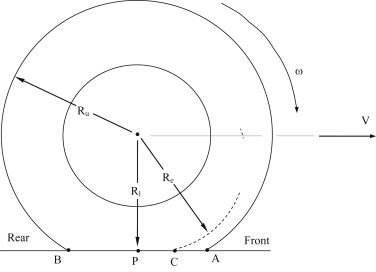
The following diagram shows the relationship between the three radii, where Ru = unloaded radius, Rl = loaded radius, and Re = effective radius. Your illustration shows the effective radius and the "patch" radius as being the same. They are not, in general.
08-16-24 | 01:54 AM
#43
Senior Member


Joined: Apr 2019
Posts: 3,903
Likes: 1,494
From: UK

Last edited by choddo; 08-16-24 at 02:05 AM.
08-16-24 | 01:55 AM
#44
Senior Member
Joined: Apr 2019
Posts: 3,903
Likes: 1,494
From: UK
What’s the definition of the “effective radius” there? Cos based on the image alone it’s “distance from hub to an arbritrary dotted line”. Does PC=CA? And if so, why?
08-16-24 | 02:12 AM
#45
Zoom zoom zoom zoom bonk
Joined: Sep 2006
Posts: 4,927
Likes: 988
From: New Zealand
Bikes: Giant Defy, Trek 1.7c, BMC GF02, Trek Marlin 6, Scott Sub 35, Kona Rove, Trek Verve+2
08-16-24 | 02:30 AM
#46

Broken neck Ken
Joined: Oct 2008
Posts: 5,221
Likes: 3,520
From: Portland, OR
Bikes: Trek Domane SL6 Gen 3, Soma Fog Cutter, Detroit Bikes Sparrow FG, Trek Mt Track XCNimbus MUni
Indeed, one of the biggest improvements in going from cyclocomputer + cue sheet to GPS for long distance navigation, is eliminating the need for math in your head. Cue sheet says turn right at 47.18 miles, from which you have to subtract 0.62 in your head due to error, and remember the result before the turn comes. Then let's say there's another turn at 47.29, which is pretty quick so you have to decide ahead of time whether to remember 0.11 and add that upon turning, or subtract 0.62 again and remember two results, or just hope there's only one road in close proximity. Keeping in mind the 0.62 becomes 0.63 after a bit, now try that short on sleep on day two or three. Then add rain, with required efforts to keep the cue sheet dry. The best is when the cue says turn at T in the road, in which case you give the brain a break and ride to the T.
An errorless cyclocomputer would have been a game changer.
With GPS you just obey the GPS. Every turn is easy like a T. Admittedly something is lost when navigation becomes effortless, but alas sometimes GPS fails and one is forced to a backup method. Which can be fun in its own way.
An errorless cyclocomputer would have been a game changer.
With GPS you just obey the GPS. Every turn is easy like a T. Admittedly something is lost when navigation becomes effortless, but alas sometimes GPS fails and one is forced to a backup method. Which can be fun in its own way.
Last edited by downtube42; 08-16-24 at 02:40 AM.
08-16-24 | 02:55 AM
#47
Senior Member
Joined: Apr 2019
Posts: 3,903
Likes: 1,494
From: UK
Ok I think I understand what tomato coupe is saying but I think he’s wrong for weights in bike territory as opposed to cars.
Figure 8.12 of this suggests the effective radius actually being smaller than the patch radius for weights below 1200N (about 120kilos)
https://www.sciencedirect.com/topics...rolling-radius
Figure 8.12 of this suggests the effective radius actually being smaller than the patch radius for weights below 1200N (about 120kilos)
https://www.sciencedirect.com/topics...rolling-radius
08-16-24 | 07:56 AM
#48
Senior Member
Joined: Sep 2007
Posts: 15,308
Likes: 1,779
From: Far beyond the pale horizon.
https://www.sciencedirect.com/topics...%20the%20wheel.
So, you are saying the actual radius to use is somewhat larger than the patch radius. So, sure, what I said was not quite correct. It's still explains closely-enough why the unloaded radius is wrong (too large).
So, you are correct but explained it very poorly.
How different is this effective radius from the patch radius?
===========================
So, to be clear...
The actual radius to use for measuring distance per rotation is called the "effective" or ("rolling") radius. You can't really measure it directly, which is why one does a roll-out measurement.
https://www.tractorbynet.com/forums/...2#post-4599241
Talking about the loaded (patch) radius is a simplification. I think it's a useful simplification: it would be impossible to talk about the effective (rolling) radius without being clear about the loaded radius.
===========================
Note that the effective radius is different between "free rolling" and "driven" wheels.
So, there are situations where the effective radius can be smaller than the loaded (patch) radius. (This might not be the case when bicycling.)
https://liu.diva-portal.org/smash/get/diva2:1762057/FULLTEXT01.pdf
While driving, the driven wheels will get a driving torque. This torque will lead to tire slip, which will make the wheel speed larger than if no slip occurred. This will push up the center of rotation and decrease the effective rolling radius, making it smaller than the loaded rolling radius [7]. If instead the vehicle is braking, the wheels will skid and the wheel speed is smaller than if no skid occurred [7]. This means that the center of rotation will be pushed down and the effective rolling radius will be greater than the unloaded radius.
Last edited by njkayaker; 08-16-24 at 08:39 AM.
08-16-24 | 08:40 AM
#49
Senior Member
Joined: Jul 2009
Posts: 8,233
Likes: 11,281
Bikes: Colnago, Van Dessel, Factor, Cervelo, Ritchey
Originally Posted by choddo
Figure 8.12 of this suggests the effective radius actually being smaller than the patch radius for weights below 1200N (about 120kilos)
https://www.sciencedirect.com/topics...rolling-radius
https://www.sciencedirect.com/topics...rolling-radius
08-16-24 | 08:42 AM
#50
Senior Member
Joined: Jul 2009
Posts: 8,233
Likes: 11,281
Bikes: Colnago, Van Dessel, Factor, Cervelo, Ritchey
Indeed, one of the biggest improvements in going from cyclocomputer + cue sheet to GPS for long distance navigation, is eliminating the need for math in your head. Cue sheet says turn right at 47.18 miles, from which you have to subtract 0.62 in your head due to error, and remember the result before the turn comes. Then let's say there's another turn at 47.29, which is pretty quick so you have to decide ahead of time whether to remember 0.11 and add that upon turning, or subtract 0.62 again and remember two results, or just hope there's only one road in close proximity. Keeping in mind the 0.62 becomes 0.63 after a bit, now try that short on sleep on day two or three. Then add rain, with required efforts to keep the cue sheet dry. The best is when the cue says turn at T in the road, in which case you give the brain a break and ride to the T.
An errorless cyclocomputer would have been a game changer.
With GPS you just obey the GPS. Every turn is easy like a T. Admittedly something is lost when navigation becomes effortless, but alas sometimes GPS fails and one is forced to a backup method. Which can be fun in its own way.
An errorless cyclocomputer would have been a game changer.
With GPS you just obey the GPS. Every turn is easy like a T. Admittedly something is lost when navigation becomes effortless, but alas sometimes GPS fails and one is forced to a backup method. Which can be fun in its own way.
Last edited by tomato coupe; 08-16-24 at 08:46 AM.