


Geometry?
 12-09-13 | 09:58 AM
#51

Senior Member

Joined: Dec 2009
Posts: 28,682
Likes: 63
From: Houston, TX
Bikes: 1990 Romic Reynolds 531 custom build, Merlin Works CR Ti custom build, super light Workswell 066 custom build
Heh. Thanks on the clips bit. I initially started them for the Missus, who hadn't been involved in any sprints etc (most women haven't, even those that race often, and she's only done one race). It became a learning tool. Since 2010 it's also become a safety thing - in 2009 someone intentionally crashed those around him, including me, and I broke my first bone in my life (in 27 seasons of racing). He escaped serious sanctions only because two of his teammates lied under oath (2 teammates and him said he braked to avoid someone; one of those teammates had been dropped and couldn't have seen the front of the field, and the reality was that he tried to push the guy next to him out of the way and then suddenly swerved across the road while we were going almost 30 mph). Anyway… I was told that if I had video or photographic evidence that it would have sealed the (USA Cycling) hearing. I went and bought the Contour helmet cam after that, have two more (spares mainly), and record every race and every training ride I can. The training ride recordings are for the same reason but more morbid - if a car kills me hopefully there'll be a record of it. Anyway... I try to make the clips entertaining (for me - it's all music by my two brothers and bands they've been in) as well as educational (for others watching). What's interesting is that I've pointed out a couple pinch points on courses and I found that over a year or two racers approach those pinch points with a bit more caution/respect than before (New Britain / Nutmeg, Tuesday Nights, Bethel). I'd like to think they watched my clips but it may just be coincidence. Heh.
I have some thoughts here on my bar placement.
My bars, with a 15 cm drop, are not quite below the tire:
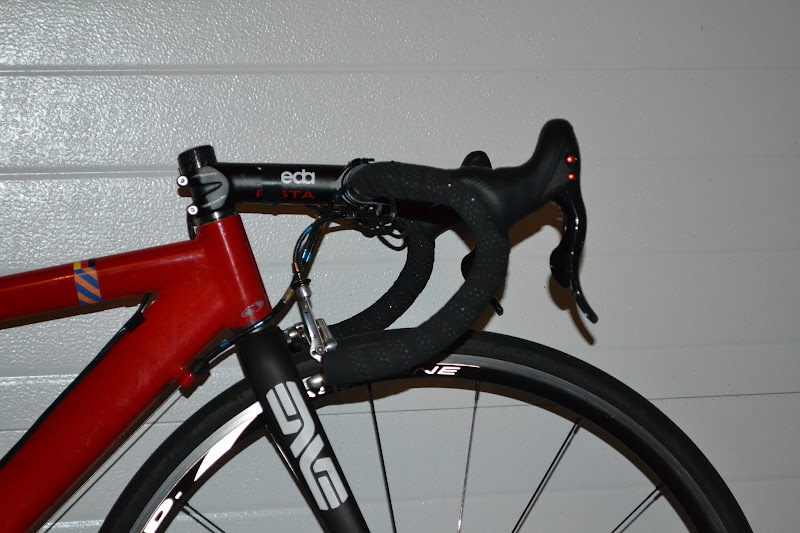
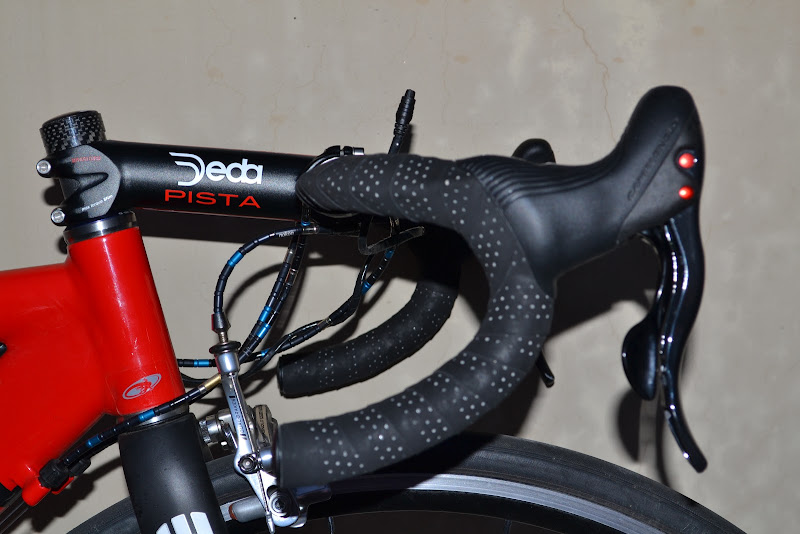
With the compact bars (12 cm drop), they're above. My back hurt with these bars but I really like the drops shape so I'm getting a stem that will let me use these bars:
Side view of my position using the regular bars with 12 cm stem, so old style bars. The bar has 15 cm drop. It's 4 to go and I'm just started to get dropped (M35+, 2011, Red Trolley Crit in San Diego) and so I'm forward, digging deep, hoping the group eases and I can close a 40 or 50 meter gap. Never happened, I stopped the next lap to watch the finish. You can see that it's not an extreme position. I don't have a flexible back - I'm hard pressed to touch my toes and I even have a hard time putting jeans on - but this position works for me. I'm comfortable for however long I can ride - the day after the race I did 6.5 hours on the bike, going up Palomar from my SoCal "home base". On long rides like those I spend most of the last couple hours in the drops - it's the most comfortable position for me once I'm fatigued.

So that's the drop bit.
As far as front end weight, you need weight on the front end. Generally speaking if you lose the front end you're hitting the deck. Therefore weight the front end. If the rear slides, no biggie. It may worry someone that doesn't know (like a non-racer on a group ride) but in a race virtually no one blinks in a Cat 3 field if someone does something like plant a pedal and skip their rear wheel to the side a foot. Not a biggie because nothing happens. Front wheel goes… biggie. It's possible to recover from a front wheel slide but it's very hard and relies on instinctive reactions, not thinking and such.
I put as much weight on the front as possible. I slide forward on the saddle. I'm on the drops. I sometimes find myself pressing down on the bars even though that does nothing to actually change the load on the front tire. Get the front wheel through the turn okay and everything will follow.
I've had some pretty close calls in corners where I've maintained control, not because I'm a great bike handler but because my weight distribution allowed me to do whatever I instinctively tried to do. In one race, on the last corner (acute angle, downhill leading into an uphill, off camber exit line, had been wet earlier) the guy in front of me, on the hoods (a huge no-no - too much weight up high, much less brake control, easy to lose grip), laid his bike down hard. We were going maybe 30 mph? and he was maybe 4th or so in line. I braked, went around him, and sprinted to the line, and although I was keyed up because it was the last lap, his fall didn't faze me. No adrenaline rush, no panic, just "go left, don't hit curb, shift down, go, shift up…"
What I find is that if I get scared going into a turn I push back on the saddle. This makes the front end light, makes the bike harder to steer, gives less traction, it's bad all around. When I don't give in and stay forward, weight the front, I can carve arcs well. I learned this when I did a 35 minute descent that I'd only ridden up just before (Palomar Mountain, SoCal). I only see the road once or twice a year and I can't remember all the corners, yet by the third or fourth time I did the road I was blasting down it fast enough that in a mile I dropped my SoCal host so hard that it took him a minute to catch up (I stopped, worried he flatted or something). There are a bunch of switchbacks and curves, some high speed, and massive drop offs if you go over some of the guard rails. I could corner really aggressively once I kept myself from moving back on the saddle. I had to take confidence in my ability to corner, force myself to take late apex lines to give me the most leeway in the second non-visible part of the turns, and things worked out fine. When I backed up on my bike, unweighting the front end, it lost responsiveness and didn't corner well.
I have some thoughts here on my bar placement.
My bars, with a 15 cm drop, are not quite below the tire:
With the compact bars (12 cm drop), they're above. My back hurt with these bars but I really like the drops shape so I'm getting a stem that will let me use these bars:
Side view of my position using the regular bars with 12 cm stem, so old style bars. The bar has 15 cm drop. It's 4 to go and I'm just started to get dropped (M35+, 2011, Red Trolley Crit in San Diego) and so I'm forward, digging deep, hoping the group eases and I can close a 40 or 50 meter gap. Never happened, I stopped the next lap to watch the finish. You can see that it's not an extreme position. I don't have a flexible back - I'm hard pressed to touch my toes and I even have a hard time putting jeans on - but this position works for me. I'm comfortable for however long I can ride - the day after the race I did 6.5 hours on the bike, going up Palomar from my SoCal "home base". On long rides like those I spend most of the last couple hours in the drops - it's the most comfortable position for me once I'm fatigued.
So that's the drop bit.
As far as front end weight, you need weight on the front end. Generally speaking if you lose the front end you're hitting the deck. Therefore weight the front end. If the rear slides, no biggie. It may worry someone that doesn't know (like a non-racer on a group ride) but in a race virtually no one blinks in a Cat 3 field if someone does something like plant a pedal and skip their rear wheel to the side a foot. Not a biggie because nothing happens. Front wheel goes… biggie. It's possible to recover from a front wheel slide but it's very hard and relies on instinctive reactions, not thinking and such.
I put as much weight on the front as possible. I slide forward on the saddle. I'm on the drops. I sometimes find myself pressing down on the bars even though that does nothing to actually change the load on the front tire. Get the front wheel through the turn okay and everything will follow.
I've had some pretty close calls in corners where I've maintained control, not because I'm a great bike handler but because my weight distribution allowed me to do whatever I instinctively tried to do. In one race, on the last corner (acute angle, downhill leading into an uphill, off camber exit line, had been wet earlier) the guy in front of me, on the hoods (a huge no-no - too much weight up high, much less brake control, easy to lose grip), laid his bike down hard. We were going maybe 30 mph? and he was maybe 4th or so in line. I braked, went around him, and sprinted to the line, and although I was keyed up because it was the last lap, his fall didn't faze me. No adrenaline rush, no panic, just "go left, don't hit curb, shift down, go, shift up…"
What I find is that if I get scared going into a turn I push back on the saddle. This makes the front end light, makes the bike harder to steer, gives less traction, it's bad all around. When I don't give in and stay forward, weight the front, I can carve arcs well. I learned this when I did a 35 minute descent that I'd only ridden up just before (Palomar Mountain, SoCal). I only see the road once or twice a year and I can't remember all the corners, yet by the third or fourth time I did the road I was blasting down it fast enough that in a mile I dropped my SoCal host so hard that it took him a minute to catch up (I stopped, worried he flatted or something). There are a bunch of switchbacks and curves, some high speed, and massive drop offs if you go over some of the guard rails. I could corner really aggressively once I kept myself from moving back on the saddle. I had to take confidence in my ability to corner, force myself to take late apex lines to give me the most leeway in the second non-visible part of the turns, and things worked out fine. When I backed up on my bike, unweighting the front end, it lost responsiveness and didn't corner well.
 12-09-13 | 10:58 AM
#52
Senior Member

Joined: Feb 2007
Posts: 15,410
Likes: 188
From: Tariffville, CT
Bikes: Tsunami road bikes, Dolan DF4 track
I have no personal reason to dispute your approach, no experience at all that I can bring to the discussion. But isn't it true that the traditional fit guys like Lemond liked to relax the seat tube and push the saddle way back? Am I remembering that correctly? How does that correlate to your approach? Different type of riding?
He went the high position in 1981? when he turned pro - it was really evident in 1983 when he won Worlds. I think Guimard raised his saddle 5 cm when Lemond turned pro for Renault-Elf (and he told Lemond that if the saddle had been at the "right height" he'd have won the Junior Worlds Pursuit instead of getting second). In the picture of him winning the 1983 Worlds his legs are really extended. I emulated his position, for me, but have come down a bit from that (and he did too, lowering his saddle a bit from that 1983 height).
Keep in mind that at the same time as Lemond's first Worlds win Davis Phinney was tearing it up domestically in crits. He had a forward position, suited for his prime event, the 100km TTT. When he started doing longer races (back then a long stage in the Tour would be 300km) he dropped his saddle, moved it back a bit, moved his cleats back on his shoe, all to move his power curve a bit down. Less peaky, more steady state.
Although I'll ride for up to 6 or 7 hours most of my rides are 1-2 hours long and my races are usually an hour or so. 3 hours for me is pretty long - I'd only hit that race distance if I did two long races in a day - although I'm fine doing rides that length, meaning it's not a stretch. Anyway my environment includes crit racing, where I average maybe 160-190 watts, with a few peaks here and there. If I were riding solo it would equal a 15-18 mph training ride. My long rides average 130-150 watts, averaging maybe 14-15 mph. My threshold is a touch over 200w, so maybe a 22-23 mph solo pace.
Based on my low threshold (which I didn't know was so low until recently so I never "rode to my expectations" for the first 25 years I raced) it's a waste of time trying to hang with the guys doing 250-350 watts avg on hills and such. My strength is in my top end, my peak power, my sustainable power over 20 seconds or so. Therefore I gravitated toward a position that makes the most of my peak power, sort of like Davis Phinney when he focused on the 100km TTT.
I sacrifice a bit of my steady state power. In fact in the old days I'd adjust my saddle down and back for the winter, for my long steady training rides. Nowadays I do those rides all year so I don't bother adjusting my saddle, I just leave it in the "summer" position, perhaps dropping it a touch to make room for thicker clothing. Realistically though I might have gained 10 or 20 watts steady/average by sacrificing that forward position. I'd lose a good 3-5 mph in my sprint (in the old days), I'd lose 2-3 mph in my 'bridge' speed (when trying to cross to a group in front of me), but I'd have a bit more power when climbing for more than 10 minutes. Not worth it. I raced a few times with the lower position, imagining in my head that this was the first step to me turning pro, but I never did well in races that even involved minor climbing over longer-than-normal-to-me (40+ mile) races. Therefore I reverted to my normal high/forward position.
__________________
"...during the Lance years, being fit became the No. 1 thing. Totally the only thing. It’s a big part of what we do, but fitness is not the only thing. There’s skills, there’s tactics … there’s all kinds of stuff..." Tim Johnson
"...during the Lance years, being fit became the No. 1 thing. Totally the only thing. It’s a big part of what we do, but fitness is not the only thing. There’s skills, there’s tactics … there’s all kinds of stuff..." Tim Johnson
12-09-13 | 05:16 PM
#53

Thread Starter
Senior Member
Joined: Mar 2011
Posts: 663
Likes: 0
From: Floriduh
Bikes: 2011 Neuvation FC100, 2013 Mercier Kilo TT Pro, 1984 Peugeot SV-L
I'm really liking my new position so far. As I said before, the saddle is approx 2cm higher and 1cm more forward. I feel like it's easier to grab the bars further out and to bend my elbows a bit more without rotating forward (unsure why this is, as my reach should be exactly the same). My legs also feel less "cramped" while riding seated for long periods of time. Before I would have to stand occasionally to stretch them out, using mostly hamstrings. Now I feel like I'm using the muscles more evenly, although I can sense I have a bit of tension behind my knee from having to extend further.
Back to the handling thing...
My former (we didn't see eye-to-eye on some personal matters) coach was a former professional, Junior National Team, Team Director, NCC and NRC racer, etc etc. He told me to think of cornering like riding a unicycle. Weight bias is generally on the rear wheel and steering input is done through the hips. To relate this more realistically, the front wheel is mainly for stability. Theoretically, by this thinking, you could perfectly navigate a corner without touching the handlebars at all. He also suggested that during an especially tight or hard corner, weight bias should be shifted backwards and center of gravity lowered. With the weight bias on the rear of the bike, proper countersteering measures can increase angle of attack without increasing lean angle of the bike, in theory increasing traction over a greater degree of cornering effort.
There is also the benefit that, in the event of lost traction, the bike tends to drift before it full out slides. Of course, this increases the risk of a high-side crash, but it also increases the likelihood the bike can be saved. I've experienced corners where both the front and rear tire were skidding, without falling down.
This doesn't come without downsides, of course. In the event of a severe loss of traction, the result is total system failure. Both wheels wash out simultaneously and there is nothing the rider can do to remedy the situation. This is a slight contrast to a forward weight bias in which the front wheel washes out.
Also, with a rear weight bias, the sliding rear wheel can be treated as a tool, rather than a problem. By temporarily unweighting the rear wheel, the rider can initiate a slide and then return weight to the wheel when they are ready to resume power. This is much more commonly seen in mountain biking and cyclocross than road riding, but I have used it at least once.*
*During a spirited group ride (this particular ride encompasses 3 individual mini races and the riders treat it very much like a race), coming into a left-hand corner approx 800m from the finish @ about 25mph. I was about 10th wheel but wanted to try for the sprint. I left the group and went to dive bomb the corner, accelerating to just below 30, right as #3 rider had the same plan. He cut in front of me and hit my handlebars with his hip. (This as we're entering the corner). I weighted the front end, grabbed a handful of rear brake, and fish tailed through the corner ending up right on his tail to take 2nd in the sprint. I'll admit, none of this was done in conscious thought, but rather more like something of a flash back to riding bmx as a kid.
All-in-all it ended well, and it certainly could have been a very dangerous crash at that speed.
Back to the handling thing...
My former (we didn't see eye-to-eye on some personal matters) coach was a former professional, Junior National Team, Team Director, NCC and NRC racer, etc etc. He told me to think of cornering like riding a unicycle. Weight bias is generally on the rear wheel and steering input is done through the hips. To relate this more realistically, the front wheel is mainly for stability. Theoretically, by this thinking, you could perfectly navigate a corner without touching the handlebars at all. He also suggested that during an especially tight or hard corner, weight bias should be shifted backwards and center of gravity lowered. With the weight bias on the rear of the bike, proper countersteering measures can increase angle of attack without increasing lean angle of the bike, in theory increasing traction over a greater degree of cornering effort.
There is also the benefit that, in the event of lost traction, the bike tends to drift before it full out slides. Of course, this increases the risk of a high-side crash, but it also increases the likelihood the bike can be saved. I've experienced corners where both the front and rear tire were skidding, without falling down.
This doesn't come without downsides, of course. In the event of a severe loss of traction, the result is total system failure. Both wheels wash out simultaneously and there is nothing the rider can do to remedy the situation. This is a slight contrast to a forward weight bias in which the front wheel washes out.
Also, with a rear weight bias, the sliding rear wheel can be treated as a tool, rather than a problem. By temporarily unweighting the rear wheel, the rider can initiate a slide and then return weight to the wheel when they are ready to resume power. This is much more commonly seen in mountain biking and cyclocross than road riding, but I have used it at least once.*
*During a spirited group ride (this particular ride encompasses 3 individual mini races and the riders treat it very much like a race), coming into a left-hand corner approx 800m from the finish @ about 25mph. I was about 10th wheel but wanted to try for the sprint. I left the group and went to dive bomb the corner, accelerating to just below 30, right as #3 rider had the same plan. He cut in front of me and hit my handlebars with his hip. (This as we're entering the corner). I weighted the front end, grabbed a handful of rear brake, and fish tailed through the corner ending up right on his tail to take 2nd in the sprint. I'll admit, none of this was done in conscious thought, but rather more like something of a flash back to riding bmx as a kid.
All-in-all it ended well, and it certainly could have been a very dangerous crash at that speed.
12-09-13 | 05:34 PM
#54
Thread Starter
Senior Member
Joined: Mar 2011
Posts: 663
Likes: 0
From: Floriduh
Bikes: 2011 Neuvation FC100, 2013 Mercier Kilo TT Pro, 1984 Peugeot SV-L
Given my current thoughts on bike positioning and handling, it's absolutely mind-boggling that you can go through a corner at all set up like that. Your saddle is basically directly over the BB, your rear foot is entirely behind your butt, and your biceps are angled negatively (0* representing perpendicular to the ground).
Don't take this the wrong way. I've seen your videos and have seen for myself that you have no trouble taking a corner.
Your bike is setup very much like a cat 1-2 tt bike. (Pros must abide by the saddle/BB rule).
12-10-13 | 02:01 AM
#55
Senior Member
Joined: Feb 2007
Posts: 15,410
Likes: 188
From: Tariffville, CT
Bikes: Tsunami road bikes, Dolan DF4 track
Given my current thoughts on bike positioning and handling, it's absolutely mind-boggling that you can go through a corner at all set up like that. Your saddle is basically directly over the BB, your rear foot is entirely behind your butt, and your biceps are angled negatively (0* representing perpendicular to the ground).
Don't take this the wrong way. I've seen your videos and have seen for myself that you have no trouble taking a corner.
Your bike is setup very much like a cat 1-2 tt bike. (Pros must abide by the saddle/BB rule).
I'm not very good at proofs, meaning proving something is something. I'm more caveman in that respect - I try something, with some thinking, and if it work it works even if my reasoning may be flawed. I've been off base for sure but I've also been right (even though I didn't know why - I've had other people actually go out and prove my theories for me, just to "double check" what I was saying).
A more forward weighted position will allow the rear to break loose before the front. Not sure if you were saying that but that's what I've found. I have locked up and/or slid the front (for example in the city once I had to brake really hard as I came up to a light post-sprint - a whole lot of anti-freeze over oil on the ground acted as lubricant and I slid the front wheel a good 5 or 10 feet and somehow stayed upright). With a rearward weight bias the front becomes light and easily knocked off line, whether by other riders or by surface irregularities.
Whether for better or worse I've apparently modeled my set up in favor of oversteer, not understeer. It wasn't conscious, it's just that I've fallen when my front wheel got swept out sideways and I didn't like it. Keep in mind that no matter what I do to try and move weight forward I still have a lot of weight on the rear wheel. It's sort of a relative thing, like saying that Porsche balanced out their 911 by moving a lot of weight forward. The bias might have been something like 75% rear / 25% front and now it's 65% rear and 35% front, a major change (and totally made up in my mind but I think the second number has a basis in reality). However the result still is an extremely heavy rear weight bias, it's just less so. On the bike I know I still load the rear tire more than the front, it's just that it's loaded "less more". I feel extremely uncomfortable when the front tire goes off line. The rear, no biggie, and I've even used snap oversteer (usually when inadvertently planting a pedal in a hairpin) to get through a turn better.
It's possible that I've been cornering well in spite of my set up but I don't think so. I tried a more rear bias set up (that "winter set up" I mentioned before) and it definitely didn't work for me.
At any rate the kicker is that in that picture I'm a bit forward on the saddle but not as far forward as I could be in the throes of a final lap push for position in a crit. In some corners I'd slide much more forward on the saddle.
Relating to saddle/BB - I bought an Ares saddle (short nose saddle for those that don't know it) specifically to see if I could set up a bike to meet UCI specs. Since the still-new and very-expensive-to-me saddle has never been mounted I don't know the answer to this question.
As far as the bike design, I commissioned the black "aero" frame at the end of 2010, taking delivery in early 2011. After I was done admiring it and all that I realized that I'd ordered a 1998 technology TT frame. Ha. I had that moment of recognition when I was on the trainer watching some Tour DVD. They showed Laurent Dufaux starting his prologue in the 1998 Tour (the Festina affair) and I was like "Wait! His frame is just like mine!". One of these years I may get into the right decade of bike tech.
__________________
"...during the Lance years, being fit became the No. 1 thing. Totally the only thing. It’s a big part of what we do, but fitness is not the only thing. There’s skills, there’s tactics … there’s all kinds of stuff..." Tim Johnson
"...during the Lance years, being fit became the No. 1 thing. Totally the only thing. It’s a big part of what we do, but fitness is not the only thing. There’s skills, there’s tactics … there’s all kinds of stuff..." Tim Johnson
12-10-13 | 08:13 AM
#56
Thread Starter
Senior Member
Joined: Mar 2011
Posts: 663
Likes: 0
From: Floriduh
Bikes: 2011 Neuvation FC100, 2013 Mercier Kilo TT Pro, 1984 Peugeot SV-L
Aero bikes still don't have me 100% convinced. Although not marketed as an aero bike, I think Focus has the right idea with their D shaped tubing on the Izalco Team.
I didn't like Treks before... but now they look more like bicycle versions of Volvo's than actual bicycles to me.
I didn't like Treks before... but now they look more like bicycle versions of Volvo's than actual bicycles to me.
12-10-13 | 09:11 AM
#57
Senior Member
Joined: Feb 2007
Posts: 15,410
Likes: 188
From: Tariffville, CT
Bikes: Tsunami road bikes, Dolan DF4 track
Aero bikes still don't have me 100% convinced. Although not marketed as an aero bike, I think Focus has the right idea with their D shaped tubing on the Izalco Team.
I didn't like Treks before... but now they look more like bicycle versions of Volvo's than actual bicycles to me.
I didn't like Treks before... but now they look more like bicycle versions of Volvo's than actual bicycles to me.
For example when I first assembled the orange bike, and for the year I raced it, the bearings weren't right. They were so wrong that I did a little experiment in SoCal immediately after I built it during my 2010 trip there. I got going down one of the many hills, maybe 35 mph, maybe 40 mph. I shifted into some tiny gear, like a 39x21 or so, and then pedaled at various rpms to see if my SRM would pick up anything, any resistance. I thought I might see a watt here and there but I had no idea what would happen.
At about 90 rpm I'd see 6 or 7 watts. At the fastest rpm I tried, 150 rpm, I saw 15 watts. I never engaged the freehub, i.e. I never pedaled fast enough to transmit power to the hub. Therefore all the wattage I was seeing was purely in mechanical friction resistance, and since the chain/pulleys don't generate much it was all in the BB bearings. (To give some idea of the friction I couldn't spin the crank more than about a half revolution and with one arm installed it would basically freeze when you let go, i.e. the single arm wouldn't fall to the bottom.)
I've since bought a BB30 reamer (cutting edge to fit a BB handle) and I sometimes see 1 watt if I repeat the experiment. Therefore the BB bearings were the culprit.
However, the year I had the "high resistance BB" I won and placed in enough races to upgrade to Cat 2. I had the second best season of my life, after an incredible-for-me 1992 season. The BB friction didn't hold me back, and in fact in some races I was dragging my rear brake on the hill in order to slow myself down.
Therefore in my world 10 or 20 watts isn't a big deal. I'm not going to make more or less money, I won't place much better or worse. The things holding me back are much bigger than a bit of friction in the bearings or some air resistance in the frame design. My limiters are more significant than those things - it's being a dad and things like that, doing stuff that I feel is more important than being what one of my teammates calls "an intramural star" aka "pro Cat 3".
If I could spend that frame money on a frame again I'd get a combination of the two bikes, the red and black ones. If I could I'd get a lighter bike, just because, but the red frame is close to optimal for me. The orange frame was 1450 grams I think, the black 1650, and the shortened and filed down orange one (now red) was 1300g. This is a solid pound heavier than the sort of standard 900g carbon frames out there (especially given my frame's small size).
I wouldn't change the geometry, keeping it the same as the red bike as it is now. I'd want to see if I could get more tire clearance and that's about it.
__________________
"...during the Lance years, being fit became the No. 1 thing. Totally the only thing. It’s a big part of what we do, but fitness is not the only thing. There’s skills, there’s tactics … there’s all kinds of stuff..." Tim Johnson
"...during the Lance years, being fit became the No. 1 thing. Totally the only thing. It’s a big part of what we do, but fitness is not the only thing. There’s skills, there’s tactics … there’s all kinds of stuff..." Tim Johnson
12-11-13 | 06:36 AM
#58
Thread Starter
Senior Member
Joined: Mar 2011
Posts: 663
Likes: 0
From: Floriduh
Bikes: 2011 Neuvation FC100, 2013 Mercier Kilo TT Pro, 1984 Peugeot SV-L
I did a bit of research and found that ISO and French headsets both have the same steer-tube insertion diameter of 30.2mm. This means that converting to 1" threadless is definitely possible and probably something I will do as soon as the budget allows.
12-11-13 | 07:03 AM
#59
Senior Member
Joined: Dec 2009
Posts: 28,682
Likes: 63
From: Houston, TX
Bikes: 1990 Romic Reynolds 531 custom build, Merlin Works CR Ti custom build, super light Workswell 066 custom build
Yes, the only differences between French and standard US is/was the threads on threaded steerers AND A 0.1 MM LARGER CROWN RACE ON THE FRENCH. That slightly smaller crown race diameter on the threadless fork should make no difference at all especially if you use sealed cartridge bearings. They don't depend upon perfect fit with the nominal external crown race like loose balls used to. Besides the crown races for use with sealed cartridges are often split nowadays to allow easier installation on the fork. That makes 0.1 mm insignificant.
12-11-13 | 08:56 PM
#60
Thread Starter
Senior Member
Joined: Mar 2011
Posts: 663
Likes: 0
From: Floriduh
Bikes: 2011 Neuvation FC100, 2013 Mercier Kilo TT Pro, 1984 Peugeot SV-L
I just got all the components in the mail today. First order of business is to ream out the inside of the fork (The adapter fits, but stops halfway down). I'm a bit excited 
To get us back on track with geometry... I rode a friend's Trek 3 series Madone yesterday on a group ride. It's a 52cm and somehow it felt really small to me. He had it set up with the stem as low as it'd go (with the high-stack headset cap), 80mm stem, and seatpost relatively low I guess. The bike felt pretty nice in a straight line, even though the drops were about where I'm used to having my hoods. However, it cornered like a veritable boat. (I'm not familiar with the geo specs of that particular frame).
One thing I did notice was how light the bike was. It's nothing special, really... standard bontrager components and Shimano 105 with Forte brakes... but it just felt like a feather compared to the other bikes I've ridden.
To get us back on track with geometry... I rode a friend's Trek 3 series Madone yesterday on a group ride. It's a 52cm and somehow it felt really small to me. He had it set up with the stem as low as it'd go (with the high-stack headset cap), 80mm stem, and seatpost relatively low I guess. The bike felt pretty nice in a straight line, even though the drops were about where I'm used to having my hoods. However, it cornered like a veritable boat. (I'm not familiar with the geo specs of that particular frame).
One thing I did notice was how light the bike was. It's nothing special, really... standard bontrager components and Shimano 105 with Forte brakes... but it just felt like a feather compared to the other bikes I've ridden.

Thread
Thread Starter
Forum
Replies
Last Post
The Golden Boy
Classic & Vintage
22
02-05-18 11:04 AM


