


Stress around the Bottom Bracket & The Rider
 08-30-25 | 03:30 PM
#26

Senior Member


Joined: Apr 2009
Posts: 3,699
Likes: 5,479
From: Seattle
I think "flex" for most people means deflecting below yield, where it does return to the original shape. That's not much deflection for a paperclip, because the steel is so weak. You can only spring it a short distance before it yields, but as long as you stay in that narrow envelope, it'll spring back many times with no damage. You'll get bored long before it fatigues.
 08-30-25 | 04:14 PM
#27

Senior Member

Joined: Apr 2011
Posts: 12,627
Likes: 4,781
Really? You're saying CF can be stress cycled forever (like mild or HSLA steel) and never fatigue? I didn't think that was true (but am ready to learn to something of course). I thought this was quite an unusual property fairly unique to steel (due to dislocations diffusing).
But unlike the charts of steel and aluminum showing fatigue life, there isn't one like that for carbon. Essentially, as long as you don't bend it far enough to hit the breaking point, you aren't accumulating stress damage. And that likely has something to do with the fact that CF, unlike aluminum, steel or Ti, can't be deformed. It has no plastic deformation limit; it either breaks or not.
I think you also see steel's fatigue limit as an advantage, but it only prevents steel breaking if it never is stressed above that level. Real world, strong riders eventually break steel frames from fatigue. And thinner, narrower tubed steel frames don't last as long.
What's funny is that I have seen more steel bikes with fatigue failures than I have seen on any aluminum bike - including all those bonded Treks and Vitus frames. It could be simply because those bikes are constructed in a way that have fewer stress risers, unlike steel with lugs and chainstay bridges. And, bonded aluminum frames have never had a hot torch applied to them, decreasing the material strength.
So the reality is much more complicated than a materials chart would suggest.

 08-31-25 | 01:27 AM
#28
Senior Member

Joined: Dec 2019
Posts: 1,187
Likes: 387
https://www.research.ed.ac.uk/files/..._BlackText.pdf
But unlike the charts of steel and aluminum showing fatigue life, there isn't one like that for carbon. Essentially, as long as you don't bend it far enough to hit the breaking point, you aren't accumulating stress damage. And that likely has something to do with the fact that CF, unlike aluminum, steel or Ti, can't be deformed. It has no plastic deformation limit; it either breaks or not.

What's funny is that I have seen more steel bikes with fatigue failures than I have seen on any aluminum bike - including all those bonded Treks and Vitus frames. It could be simply because those bikes are constructed in a way that have fewer stress risers, unlike steel with lugs and chainstay bridges. And, bonded aluminum frames have never had a hot torch applied to them, decreasing the material strength.
So the reality is much more complicated than a materials chart would suggest.
So the reality is much more complicated than a materials chart would suggest.
08-31-25 | 02:46 PM
#29

Senior Member

Joined: Jun 2004
Posts: 3,147
Likes: 553
From: Torrance, CA
Bikes: Homebuilt steel
Sorry if I missed it in this thread, but I'd be calling Surly and asking them for their assessment, and fix. Even if it involves paying. Most good shops would see that damage and at least discount the repair.
In a more general sense, our rider seems to be hard on frames. Next purchase, I'd be looking for something STOUT. Thick tubes, very sturdy.
In a more general sense, our rider seems to be hard on frames. Next purchase, I'd be looking for something STOUT. Thick tubes, very sturdy.
09-05-25 | 04:40 PM
#30
Senior Member
Joined: Apr 2011
Posts: 12,627
Likes: 4,781
Sorry if I missed it in this thread, but I'd be calling Surly and asking them for their assessment, and fix. Even if it involves paying. Most good shops would see that damage and at least discount the repair.
In a more general sense, our rider seems to be hard on frames. Next purchase, I'd be looking for something STOUT. Thick tubes, very sturdy.
In a more general sense, our rider seems to be hard on frames. Next purchase, I'd be looking for something STOUT. Thick tubes, very sturdy.
09-05-25 | 07:21 PM
#32
Senior Member
Joined: Apr 2011
Posts: 12,627
Likes: 4,781
09-06-25 | 12:49 PM
#33

Thread Starter
BIKE RIDE

Joined: Jun 2014
Posts: 2,215
Likes: 1,002
From: Michigan
Bikes: GUNNAR CrossHairs / Riv RoadUno / TrekBike 950
THIS ONE, BABY!!
I am to TIG Welds what Chuck Norris is to..... like everything else.
10-26-25 | 05:03 PM
#34
Thread Starter
BIKE RIDE
Joined: Jun 2014
Posts: 2,215
Likes: 1,002
From: Michigan
Bikes: GUNNAR CrossHairs / Riv RoadUno / TrekBike 950
"oops, I did it again"
I had hoped by now I would be posting my repaired and coated SteamRoller. Alas, the frame repair dude is not done yet. I'm trying to be chill, as he does have a full time job teaching at a technical college. But we are coming up on two months.....
That is not today's topic. I was 'bout to start a whole 'nother thread and realized this is one is on topic - the topic: 1989 Panasonic MountCat 3500, which is now --- drum roll please --- cracked at the bottom bracket.
Yes - no way you saw that coming.
Here, take a look.
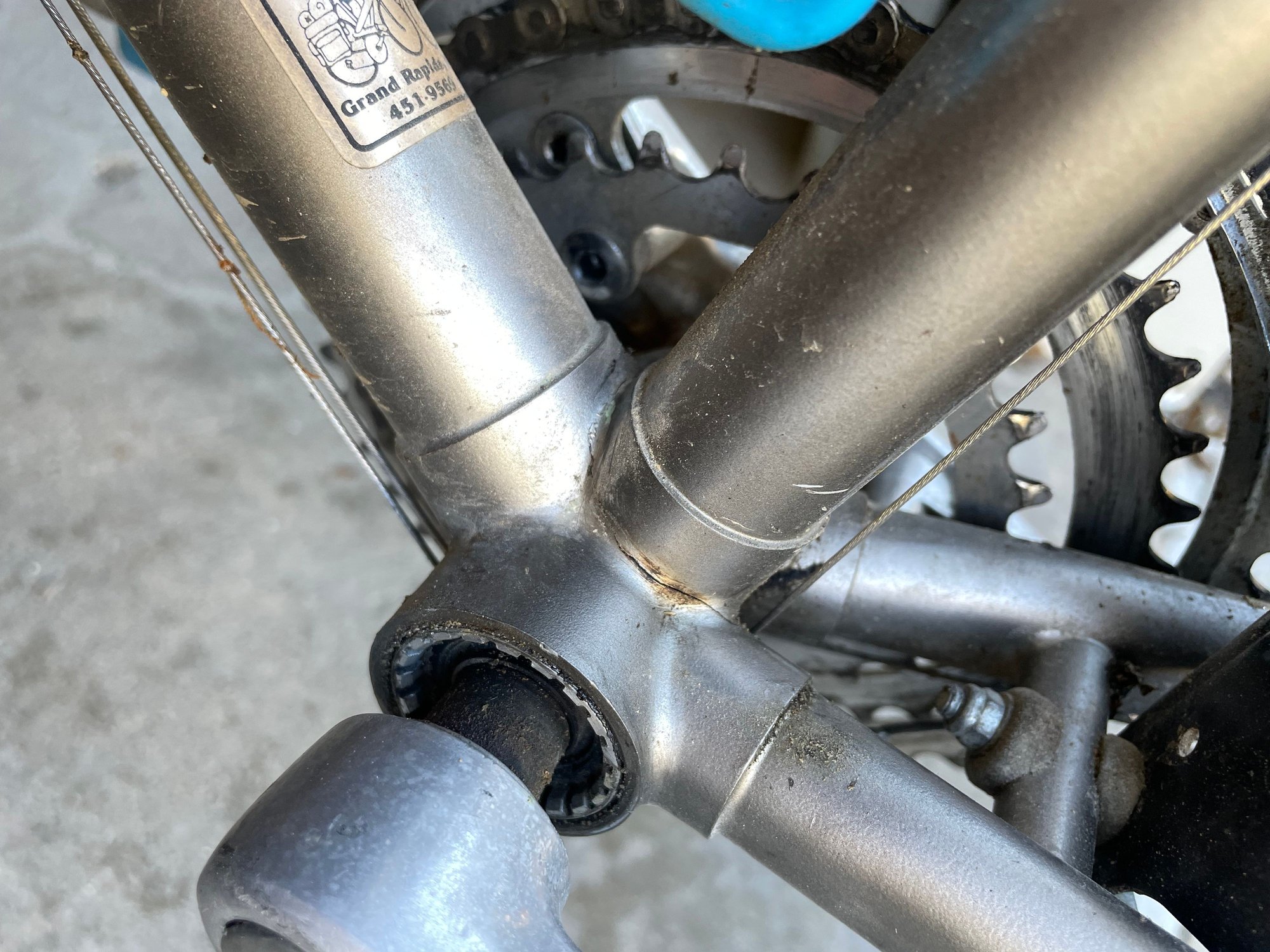

After the previous crack in the SteamRoller I got to thinking - is my hillbilly method of stepping on the NDS pedal, then throwing the right leg over the bike seat as I'm off an rolling causing this?
Or maybe I should rephrase that in the affirmative - I'm causing these all failures - or significantly contributing - by using the 'cowboy kickoff'. I stopped a month or so ago. I've had the PanaCat for about 3 ish years I think. So it's had this abuse going on for about that long.
To rehash how many times this has happened:
- a freebie RockHopper I used for 5 or so year before it cracked. An early '90s version I got from a co-worker around 2015 I think.
- a GUNNAR CrossHairs I got new in 2019. It cracked in the same way 3 or so years later, and was repaired / painted under warranty. (Thank you! Mr. Schwinn! ~ had no hassles. )
- the SteamRoller I got maybe two years ago, but also had the fixed gear riding stresses
- now my 1989 Panasonic. I thought the lugs would be more robuster. I guess not....
Any disagreement on my redneck ways being the cause of these miseries?
I'm hoping I can replace this with a new Rivendell.
Comments on the Sam HIllborne vs. the Appaloosa would be appreciated, if anyone is familiar with them. I have a RoadUno now with swept back bars, so I think I'd prefer a sized down Hillborne with drops. The always safe-side RivFolks recommend about a max payload of 225lbs. For loaded touring, I'd be right at that for the start of a tour. The Appaloosa would give more factors of safety..... which I probably need!
cheers.
That is not today's topic. I was 'bout to start a whole 'nother thread and realized this is one is on topic - the topic: 1989 Panasonic MountCat 3500, which is now --- drum roll please --- cracked at the bottom bracket.
Yes - no way you saw that coming.
Here, take a look.
After the previous crack in the SteamRoller I got to thinking - is my hillbilly method of stepping on the NDS pedal, then throwing the right leg over the bike seat as I'm off an rolling causing this?
Or maybe I should rephrase that in the affirmative - I'm causing these all failures - or significantly contributing - by using the 'cowboy kickoff'. I stopped a month or so ago. I've had the PanaCat for about 3 ish years I think. So it's had this abuse going on for about that long.
To rehash how many times this has happened:
- a freebie RockHopper I used for 5 or so year before it cracked. An early '90s version I got from a co-worker around 2015 I think.
- a GUNNAR CrossHairs I got new in 2019. It cracked in the same way 3 or so years later, and was repaired / painted under warranty. (Thank you! Mr. Schwinn! ~ had no hassles. )
- the SteamRoller I got maybe two years ago, but also had the fixed gear riding stresses
- now my 1989 Panasonic. I thought the lugs would be more robuster. I guess not....
Any disagreement on my redneck ways being the cause of these miseries?
I'm hoping I can replace this with a new Rivendell.
Comments on the Sam HIllborne vs. the Appaloosa would be appreciated, if anyone is familiar with them. I have a RoadUno now with swept back bars, so I think I'd prefer a sized down Hillborne with drops. The always safe-side RivFolks recommend about a max payload of 225lbs. For loaded touring, I'd be right at that for the start of a tour. The Appaloosa would give more factors of safety..... which I probably need!
cheers.
10-26-25 | 05:17 PM
#35

Senior Member
Joined: Feb 2012
Posts: 19,342
Likes: 5,459
From: Rochester, NY
Bikes: Stewart S&S coupled sport tourer, Stewart Sunday light, Stewart Commuting, Stewart Touring, Co Motion Tandem, Stewart 3-Spd, Stewart Track, Fuji Finest, Mongoose Tomac ATB, GT Bravado ATB, JCP Folder, Stewart 650B ATB
Two BB shell crackings with the same rider sure would make some take a look at the common item, the rider. But I'll suggest that knowing how the Asians liked their automated brazing stations and ran them pretty hot (at least in many of the vids and shots I've seen) overheated joints are a likely contributor. What might be interesting (at least to me) would be a photo of the BB shell's interior and whether the seat tube was actually mitered to follow the socket's bottom or square cut (thus cost savings). I'll also bet that this BB shell was joined with a bronze filler, requiring pretty high heat to get the filler flowing. Andy
__________________
AndrewRStewart
AndrewRStewart
10-26-25 | 05:42 PM
#36
Thread Starter
BIKE RIDE
Joined: Jun 2014
Posts: 2,215
Likes: 1,002
From: Michigan
Bikes: GUNNAR CrossHairs / Riv RoadUno / TrekBike 950
Two BB shell crackings with the same rider sure would make some take a look at the common item, the rider. But I'll suggest that knowing how the Asians liked their automated brazing stations and ran them pretty hot (at least in many of the vids and shots I've seen) overheated joints are a likely contributor. What might be interesting (at least to me) would be a photo of the BB shell's interior and whether the seat tube was actually mitered to follow the socket's bottom or square cut (thus cost savings). I'll also bet that this BB shell was joined with a bronze filler, requiring pretty high heat to get the filler flowing. Andy
I'll get the crank pulled later in the week and snap some pics.
Considering I paid $200 for the whole bike, I'm not planning on getting it repaired. Maybe I'll see if the new LBS owner is interested in the bike. He's taking Doug Fattic's class.
thanks
10-26-25 | 05:48 PM
#37
Senior Member
Joined: Apr 2011
Posts: 12,627
Likes: 4,781
I know I sure would like to blame someone else for all my problems! Ha!
I'll get the crank pulled later in the week and snap some pics.
Considering I paid $200 for the whole bike, I'm not planning on getting it repaired. Maybe I'll see if the new LBS owner is interested in the bike. He's taking Doug Fattic's class.
thanks
I'll get the crank pulled later in the week and snap some pics.
Considering I paid $200 for the whole bike, I'm not planning on getting it repaired. Maybe I'll see if the new LBS owner is interested in the bike. He's taking Doug Fattic's class.
thanks
10-26-25 | 07:41 PM
#38

Senior Member
Joined: Jul 2023
Posts: 1,960
Likes: 1,202
From: "Driftless" WI
Bikes: 1972 Motobecane Grand Record, 2023 Specialized Tarmac SL7,'26 Spesh Diverge, '22 Kona Dew+
Riding a two-wheeled contraption, by pedal-power alone, with the stresses imparted on the bottom bracket housing the pedals' connection to the rest of the drive train, imparts some major stresses into the frame where said BB is joined to the other bits.
'Cowboy kickoffs' not withstanding, where a BB connects to the rest of the frame. has to be the most significantly stressed part of a bicycle's frame construction.
I'm not surprised the OP's frames suffer cracks at those joins on a repeated basis... he's on the far right of the Bell Curve after all, a machine among mere mortals giving frame engineers nightmares.
'Cowboy kickoffs' not withstanding, where a BB connects to the rest of the frame. has to be the most significantly stressed part of a bicycle's frame construction.
I'm not surprised the OP's frames suffer cracks at those joins on a repeated basis... he's on the far right of the Bell Curve after all, a machine among mere mortals giving frame engineers nightmares.
__________________
"Bramo assai,poco spero,nulla chieggio."
"Bramo assai,poco spero,nulla chieggio."
10-26-25 | 11:06 PM
#39
Senior Member
Joined: Apr 2011
Posts: 12,627
Likes: 4,781
Riding a two-wheeled contraption, by pedal-power alone, with the stresses imparted on the bottom bracket housing the pedals' connection to the rest of the drive train, imparts some major stresses into the frame where said BB is joined to the other bits.
'Cowboy kickoffs' not withstanding, where a BB connects to the rest of the frame. has to be the most significantly stressed part of a bicycle's frame construction.
I'm not surprised the OP's frames suffer cracks at those joins on a repeated basis... he's on the far right of the Bell Curve after all, a machine among mere mortals giving frame engineers nightmares.
'Cowboy kickoffs' not withstanding, where a BB connects to the rest of the frame. has to be the most significantly stressed part of a bicycle's frame construction.
I'm not surprised the OP's frames suffer cracks at those joins on a repeated basis... he's on the far right of the Bell Curve after all, a machine among mere mortals giving frame engineers nightmares.
10-27-25 | 04:57 AM
#40
Thread Starter
BIKE RIDE
Joined: Jun 2014
Posts: 2,215
Likes: 1,002
From: Michigan
Bikes: GUNNAR CrossHairs / Riv RoadUno / TrekBike 950
10-27-25 | 06:01 AM
#41
Senior Member
Joined: Jul 2023
Posts: 1,960
Likes: 1,202
From: "Driftless" WI
Bikes: 1972 Motobecane Grand Record, 2023 Specialized Tarmac SL7,'26 Spesh Diverge, '22 Kona Dew+
__________________
"Bramo assai,poco spero,nulla chieggio."
"Bramo assai,poco spero,nulla chieggio."
10-27-25 | 06:40 AM
#42
Senior Member
Joined: Apr 2011
Posts: 12,627
Likes: 4,781
Ah, so your comments did not pertain to the newest failure?
10-27-25 | 07:27 AM
#43
Senior Member
Joined: Feb 2012
Posts: 19,342
Likes: 5,459
From: Rochester, NY
Bikes: Stewart S&S coupled sport tourer, Stewart Sunday light, Stewart Commuting, Stewart Touring, Co Motion Tandem, Stewart 3-Spd, Stewart Track, Fuji Finest, Mongoose Tomac ATB, GT Bravado ATB, JCP Folder, Stewart 650B ATB
" a BB connects to the rest of the frame. has to be the most significantly stressed part of a bicycle's frame construction." spclark
Perhaps but it's the fork I'm most worried about WRT failure. Every other member of a frame has both ends joined to another member EXCEPT the fork. That poor steerer is a cantilevered beam, even the fork blades are connected at the dropouts via the front axle but that steerer has only wall thickness going for it Andy.
Andy.
Perhaps but it's the fork I'm most worried about WRT failure. Every other member of a frame has both ends joined to another member EXCEPT the fork. That poor steerer is a cantilevered beam, even the fork blades are connected at the dropouts via the front axle but that steerer has only wall thickness going for it
Andy.
__________________
AndrewRStewart
AndrewRStewart
10-27-25 | 04:51 PM
#45
Senior Member
Joined: Jul 2023
Posts: 1,960
Likes: 1,202
From: "Driftless" WI
Bikes: 1972 Motobecane Grand Record, 2023 Specialized Tarmac SL7,'26 Spesh Diverge, '22 Kona Dew+
Nope.
I admit I hadn't been following this thread that closely when I posted what I did... the OP's suffered yet another BB failure? Or the joints where other frame components connect to his BB have failed, again? But in some way different than what had been referred to in earlier posts?
Can we perhaps agree that bicycles are engineered to withstand a wide range of fairly well understood stresses during common usage? Also that the OP perhaps represents an extreme case beyond which the engineering constraints of durability are routinely being compromised?
If MRV's seeing repeated failures in various fabrications at the same point of frame design my take is that he's routinely subjecting his frames to stresses that are beyond what those frames' designers and engineers expected their work to have to endure. He's essentially behaving as a destructive testing consort. (Make no mistake here MRV please! This isn't to be taken personally in any way!!)
True enough, and I agree that failure of a fork stands a greater chance of being catastrophic than failure of a BB (keeping this within the boundaries of this thread's title) or the various tubes connected to it. Full loss of one of the only two contact points a bicycle has with the surface it's being ridden upon is something to be avoided. Designers and engineers have had decades of experience that contribute to their better understanding of how frame geometry and materials fabrication can go towards ensuring longevity, where the stresses involved can be quantified.
I admit I hadn't been following this thread that closely when I posted what I did... the OP's suffered yet another BB failure? Or the joints where other frame components connect to his BB have failed, again? But in some way different than what had been referred to in earlier posts?
Can we perhaps agree that bicycles are engineered to withstand a wide range of fairly well understood stresses during common usage? Also that the OP perhaps represents an extreme case beyond which the engineering constraints of durability are routinely being compromised?
If MRV's seeing repeated failures in various fabrications at the same point of frame design my take is that he's routinely subjecting his frames to stresses that are beyond what those frames' designers and engineers expected their work to have to endure. He's essentially behaving as a destructive testing consort. (Make no mistake here MRV please! This isn't to be taken personally in any way!!)
Perhaps but it's the fork I'm most worried about WRT failure. Every other member of a frame has both ends joined to another member EXCEPT the fork. That poor steerer is a cantilevered beam, even the fork blades are connected at the dropouts via the front axle but that steerer has only wall thickness going for it Andy.
Andy.
__________________
"Bramo assai,poco spero,nulla chieggio."
"Bramo assai,poco spero,nulla chieggio."
Last edited by spclark; 10-27-25 at 05:03 PM.
10-27-25 | 05:06 PM
#46
Senior Member
Joined: Jul 2023
Posts: 1,960
Likes: 1,202
From: "Driftless" WI
Bikes: 1972 Motobecane Grand Record, 2023 Specialized Tarmac SL7,'26 Spesh Diverge, '22 Kona Dew+
Also for your prescience in knowing your limitations while at the same time gaining experience in real world stress testing.
__________________
"Bramo assai,poco spero,nulla chieggio."
"Bramo assai,poco spero,nulla chieggio."
10-27-25 | 05:11 PM
#47
Senior Member
Joined: Jul 2023
Posts: 1,960
Likes: 1,202
From: "Driftless" WI
Bikes: 1972 Motobecane Grand Record, 2023 Specialized Tarmac SL7,'26 Spesh Diverge, '22 Kona Dew+
10-27-25 | 05:21 PM
#48
Senior Member
Joined: Jul 2023
Posts: 1,960
Likes: 1,202
From: "Driftless" WI
Bikes: 1972 Motobecane Grand Record, 2023 Specialized Tarmac SL7,'26 Spesh Diverge, '22 Kona Dew+
This one?
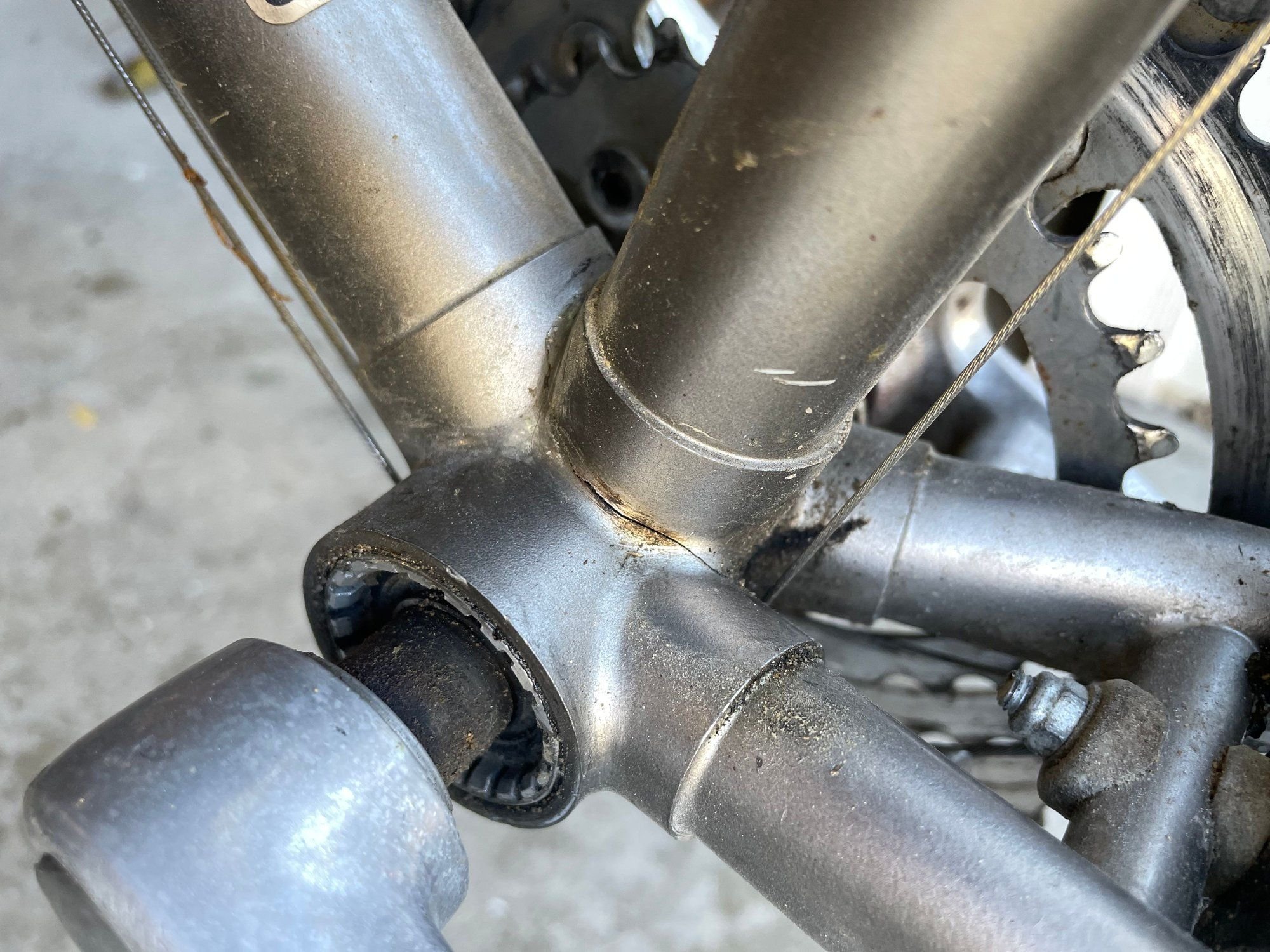
Not specifically, no. But that did prompt me to add my comment, intended as more of a generalization than specific to this latest failure.
That's a 1989 steel framed Panasonic? I'd like to know more about its history over the 36 years since fabrication, what condition the rest of the frame components were in once that damage became evident.
In the pic I see rust migrated through paint at the juncture of the seat tube / down tube / chain stay join. Everything manmade fails in time.
Not specifically, no. But that did prompt me to add my comment, intended as more of a generalization than specific to this latest failure.
That's a 1989 steel framed Panasonic? I'd like to know more about its history over the 36 years since fabrication, what condition the rest of the frame components were in once that damage became evident.
In the pic I see rust migrated through paint at the juncture of the seat tube / down tube / chain stay join. Everything manmade fails in time.
__________________
"Bramo assai,poco spero,nulla chieggio."
"Bramo assai,poco spero,nulla chieggio."
10-27-25 | 05:52 PM
#49

Senior Member
Joined: Oct 2014
Posts: 14,150
Likes: 5,273
From: Portland, OR
Bikes: (2) ti TiCycles, 2007 w/ triple and 2011 fixed, 1979 Peter Mooney, ~1983 Trek 420 now fixed and ~1973 Raleigh Carlton Competition gravel grinder
Perspective - all of those frames were designed and built to serve the vast majority of people well. There are outliers. Sounds like you are one of them.
A good frame ridden by its intended rider will be strong enough and have enough well assembled and welded/brazed material that stresses stay in the lower realms where good steel lasts virtually forever. (I doubt my 150 pounds has much detrimental effect on the medium weight mostly 531 Peter Mooney I've got ~54k miles on.) But if a 190 pound track sprint specialist put those miles on at the same relative intensity as I rode, it would be a tired frame now.
And last - any frame can be ridden to failure. Just gotta find a big and strong enough rider. What the bike designer/maker can do is do his best to see it that when that failure happens, it is not in a life-threatening manner. Here, all three of your frames failed nicely. Broken BBs, lower downtubes and chainstays are rarely a big issue. Often even rideable home. Forks, steerers, head tubes and the headtube to top/down tube joint failures can have major consequences to you.
I've lived through a fork failure. Biggest event of my life. And two BBs and two chainstays. Finished all four of those rides. Repaired or had repaired three of them. (The fourth was under warranty.)
A good frame ridden by its intended rider will be strong enough and have enough well assembled and welded/brazed material that stresses stay in the lower realms where good steel lasts virtually forever. (I doubt my 150 pounds has much detrimental effect on the medium weight mostly 531 Peter Mooney I've got ~54k miles on.) But if a 190 pound track sprint specialist put those miles on at the same relative intensity as I rode, it would be a tired frame now.
And last - any frame can be ridden to failure. Just gotta find a big and strong enough rider. What the bike designer/maker can do is do his best to see it that when that failure happens, it is not in a life-threatening manner. Here, all three of your frames failed nicely. Broken BBs, lower downtubes and chainstays are rarely a big issue. Often even rideable home. Forks, steerers, head tubes and the headtube to top/down tube joint failures can have major consequences to you.
I've lived through a fork failure. Biggest event of my life. And two BBs and two chainstays. Finished all four of those rides. Repaired or had repaired three of them. (The fourth was under warranty.)