


Drag Brake Proof of Concept
 02-11-26 | 11:28 AM
#1
Thread Starter
Senior Member

Joined: Nov 2012
Posts: 5,175
Likes: 1,929
Drag Brake Proof of Concept
Found a disc brake conversion kit on Amazon last week. My daughter was ordering some things from the "Zon" and I had her add this to the order. It is made for vertical drop out and aluminum frames, however I do believe I can do a few mods to make it fit this 1986 Fuji Sundance frame without too much fuss.
Right now in mock up the wheel spins just fine. Next step are the necessary mods to secure it to the frame and clear the fender and rear rack. Once done it will function with it's own lever as a drag brake much like a tandem has a drum drag on it.
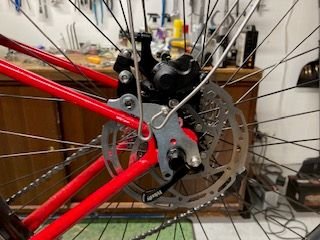
Right now in mock up the wheel spins just fine. Next step are the necessary mods to secure it to the frame and clear the fender and rear rack. Once done it will function with it's own lever as a drag brake much like a tandem has a drum drag on it.
 02-15-26 | 08:05 AM
#3
Senior Member

Joined: Jul 2010
Posts: 13,903
Likes: 1,241
From: Montreal Canada
Found a disc brake conversion kit on Amazon last week. My daughter was ordering some things from the "Zon" and I had her add this to the order. It is made for vertical drop out and aluminum frames, however I do believe I can do a few mods to make it fit this 1986 Fuji Sundance frame without too much fuss.
Right now in mock up the wheel spins just fine. Next step are the necessary mods to secure it to the frame and clear the fender and rear rack. Once done it will function with it's own lever as a drag brake much like a tandem has a drum drag on it.
Right now in mock up the wheel spins just fine. Next step are the necessary mods to secure it to the frame and clear the fender and rear rack. Once done it will function with it's own lever as a drag brake much like a tandem has a drum drag on it.
If this disc works, why not just use it alone instead of also he original brake, I mean only have one rear brake lever vs two?
02-15-26 | 09:37 PM
#4

Senior Member

Joined: Feb 2004
Posts: 3,812
Likes: 434
From: Thailand..........currently Nakhon Ricefield, moving to the beach soon.
Bikes: inferior steel....alas....noodly aluminium assploded
There must be a reason all drag brakes are drums.
I assume that constant application on a disc will overheat and glaze the wee, tiny pads.
Without a stoker, you won't have two rear brake levers.
The drag brake would be operated with a friction thumb shifter.
02-16-26 | 12:07 AM
#5

Senior Member
Joined: Jul 2011
Posts: 2,923
Likes: 525
From: Turku, Finland, Europe
Bikes: 2011 Specialized crux comp, 2013 Specialized Rockhopper Pro
Only it won't function like a tandem drag brake, at least not for long.
There must be a reason all drag brakes are drums.
I assume that constant application on a disc will overheat and glaze the wee, tiny pads.
Without a stoker, you won't have two rear brake levers.
The drag brake would be operated with a friction thumb shifter.
There must be a reason all drag brakes are drums.
I assume that constant application on a disc will overheat and glaze the wee, tiny pads.
Without a stoker, you won't have two rear brake levers.
The drag brake would be operated with a friction thumb shifter.
There are ways to make a disc brake more heat resistant and prevent pad glazing. Mechanic caliper, 203mm or even 220mm rotor, metallic pads and added rotor thickness (tektro makes a rotor that's 2.3mm thick. Standard is 1.6mm or 1.8mm)
02-16-26 | 12:15 AM
#6
Senior Member

Joined: Mar 2010
Posts: 2,616
Likes: 2,198
I wonder how a drum brake is able to withstand more prolonged drag braking than a properly specced disc brake. Drum brakes are enclosed so not much heat dissipation from the actually heating elements of the brake.
There are ways to make a disc brake more heat resistant and prevent pad glazing. Mechanic caliper, 203mm or even 220mm rotor, metallic pads and added rotor thickness (tektro makes a rotor that's 2.3mm thick. Standard is 1.6mm or 1.8mm)
There are ways to make a disc brake more heat resistant and prevent pad glazing. Mechanic caliper, 203mm or even 220mm rotor, metallic pads and added rotor thickness (tektro makes a rotor that's 2.3mm thick. Standard is 1.6mm or 1.8mm)
02-16-26 | 01:11 AM
#7
Senior Member
Joined: Jul 2011
Posts: 2,923
Likes: 525
From: Turku, Finland, Europe
Bikes: 2011 Specialized crux comp, 2013 Specialized Rockhopper Pro
But that’s not what the OP has built. Drum brakes in these applications have the advantage of much more mass and surface area to dissipate heat. They also have the advantage of much larger brake pad surface area. Santana made a disc based drag brake but it was over 250mm and Hope made one which was a vented design like in vehicles. Both were very specialized and had limited adoption in an already limited marketplace.
As far as I understood the system is not yet complete, ie. changes can still be made. Rotors are cheap so getting a thicker one should be a non issue.
It needs to be said that with metallic pads it takes quite a lot of effort to overheat a mechanic disc brake to a point where it fails or even meaningfully loses power.
02-16-26 | 01:41 AM
#8
Highly Enriched Driftium


Joined: Apr 2017
Posts: 6,659
Likes: 2,149
Found a disc brake conversion kit on Amazon last week. My daughter was ordering some things from the "Zon" and I had her add this to the order. It is made for vertical drop out and aluminum frames, however I do believe I can do a few mods to make it fit this 1986 Fuji Sundance frame without too much fuss.
Right now in mock up the wheel spins just fine. Next step are the necessary mods to secure it to the frame and clear the fender and rear rack. Once done it will function with it's own lever as a drag brake much like a tandem has a drum drag on it.
Right now in mock up the wheel spins just fine. Next step are the necessary mods to secure it to the frame and clear the fender and rear rack. Once done it will function with it's own lever as a drag brake much like a tandem has a drum drag on it.
The adapter bracket is secured under the quick release or nut, and also using the small threaded holes for the fender stays; Do yourself a favor and immediately replace those bolts with ones long enough to peek out the inboard side of those holes; That way, when the heads shear off flush, you'll be able to easily extract the bolt, rather that trying to turn it with a dental tool or such. Ask me how I know. Also, you can put a nut on the inboard protruding tip of the bolt, to keep them from coming loose when not desired. Which then makes it easy to use some anti-seize on the threaded hole, making extraction easier, and preventing rust adhesion.

 02-16-26 | 03:56 AM
#9
Thread Starter
Senior Member
Joined: Nov 2012
Posts: 5,175
Likes: 1,929
My apologies for radio silence, been busy working on motor vehicles and just yesterday started modifying the brake mount. The drag brake is for a single person bike, not a tandem. Weight load will be significantly less than a tandem. Hoping a 160 rotor will do the job as it is as large as the frame will accept. Doing this more for winter fun project than for actual application on a touring rig, however if it works out as envisioned, then I will keep it on the bike.
As for the Suntour chain stay mounted brakes, they work exceptionally well, better than cantis or V-brakes. Coupled with the Can Creek EC5 brake levers they are remarkably easy to apply, as in power brakes in a car vs the old non-power brakes (first car had 4 wheel drums and they were a handful in panic stops). Love the modulation. I have the KoolStop salmon pads on them and will put these things up against any rim brake out there including hyro rim brakes. Yes, they are that good. Road use only, off road the position collects crud and makes them less effective.
As for the Suntour chain stay mounted brakes, they work exceptionally well, better than cantis or V-brakes. Coupled with the Can Creek EC5 brake levers they are remarkably easy to apply, as in power brakes in a car vs the old non-power brakes (first car had 4 wheel drums and they were a handful in panic stops). Love the modulation. I have the KoolStop salmon pads on them and will put these things up against any rim brake out there including hyro rim brakes. Yes, they are that good. Road use only, off road the position collects crud and makes them less effective.
02-16-26 | 12:18 PM
#10
Thread Starter
Senior Member
Joined: Nov 2012
Posts: 5,175
Likes: 1,929
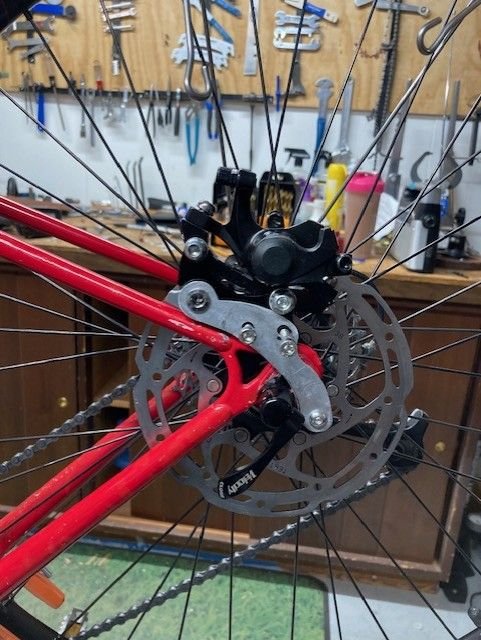
Final mock up of the mount. I don't have anything outside of hand tools, but it turned out as expected. Changed the steel clamping plate to aluminum, and modified a front post mount adapter for the rear as the rear adapter would have needed some mods, and it is the only rear adapter I have, and I have 4 of the fronts.
Now onto the lever. I don't want it on the handlebar as there is no room left up there with a bike computer, phone mount, light, and bar end shifters. May look into mounting the lever on the stem, "top cap", or on the seat post, which seems to me the best option.
02-16-26 | 01:42 PM
#11
Senior Member

Joined: Aug 2010
Posts: 12,717
Likes: 2,104
From: Madison, WI
Bikes: 1961 Ideor, 1966 Perfekt 3 Speed AB Hub, 1994 Bridgestone MB-6, 2006 Airnimal Joey, 2009 Thorn Sherpa, 2013 Thorn Nomad MkII, 2015 VO Pass Hunter, 2017 Lynskey Backroad, 2017 Raleigh Gran Prix, 1980s Bianchi Mixte on a trainer. Others are now gone.
02-16-26 | 02:32 PM
#13
Thread Starter
Senior Member
Joined: Nov 2012
Posts: 5,175
Likes: 1,929
Yes, it will be a friction shifter. I toyed with the idea of an indexed shifter simply because I had one in 8 speed, but decided to fabricate a clamp for this particular shifter will be more time consuming than making one for the friction shifter.
I put interrupter brakes on my daughters touring bike and they work better than the drop bar levers. She prefers them as well because they are easier to access and use. Unfortunately I don't have space on the bars for anymore things. Bag mount, phone mount and computer take it up. I had something on the stem, but the cable hits the top tube when turning. I am unable to reorient the cable exit from the shifter to accommodate the top tube.
One more thing, I have that long tail on the clamp plate to serve as a bump stop for the QR lever. Upon putting the wheel in there is no need to visually center the rim between the brake pads. Just pull the wheel back to the top and clamp it tight. I have a spacer on the other side that serves the same purpose.
I put interrupter brakes on my daughters touring bike and they work better than the drop bar levers. She prefers them as well because they are easier to access and use. Unfortunately I don't have space on the bars for anymore things. Bag mount, phone mount and computer take it up. I had something on the stem, but the cable hits the top tube when turning. I am unable to reorient the cable exit from the shifter to accommodate the top tube.
One more thing, I have that long tail on the clamp plate to serve as a bump stop for the QR lever. Upon putting the wheel in there is no need to visually center the rim between the brake pads. Just pull the wheel back to the top and clamp it tight. I have a spacer on the other side that serves the same purpose.
02-18-26 | 10:42 AM
#14
Thread Starter
Senior Member
Joined: Nov 2012
Posts: 5,175
Likes: 1,929
Finished in raw form, meaning the drag brake is functional, but untested. Cable housing is taped down instead of using zip ties and cable clamps. Below are pics of the shifter used and where I ended up mounting it without making a new band clamp. The caliper mount puts the load on the seat stay and the two eyelet bolts. The tail that drops below the drop out serves as a bump stop for the QR lever so that I do not need to center the wheel between the rim brake pads.
If it dries up a little today, I will take the thing out for a test run on a short, but steep hill near me. Everything used is from my parts bins except for the disc brake conversion kit. Ditched the steel clamp plate and have a piece of flat aluminum instead, cut away some of the converter that is behind the drop out to make wheel installation possible. Modified a front 160/140 post mount adapter to work in the rear and allow more pad to contact the rotor.
I do not have the correct tools to do precision work, thus good enough became the standard.
Fortunately since I was modifying the post mount adapter, I was able to angle the flat surface where the caliper rests so that it is almost perfectly aligned with the rotor. Unable to use convex/concave spacers for alignment due to rotor size being only 160mm. Would need a 180 or larger to do that and the frame won't clear that size rotor.
Edit: Tested bike in unloaded condition. Works as advertised. Can easily stop the bike with just the drag brake. I do believe once loaded with 20-30 pounds of gear and my fat butt the drag brake will work as expected.
If it dries up a little today, I will take the thing out for a test run on a short, but steep hill near me. Everything used is from my parts bins except for the disc brake conversion kit. Ditched the steel clamp plate and have a piece of flat aluminum instead, cut away some of the converter that is behind the drop out to make wheel installation possible. Modified a front 160/140 post mount adapter to work in the rear and allow more pad to contact the rotor.
I do not have the correct tools to do precision work, thus good enough became the standard.
Fortunately since I was modifying the post mount adapter, I was able to angle the flat surface where the caliper rests so that it is almost perfectly aligned with the rotor. Unable to use convex/concave spacers for alignment due to rotor size being only 160mm. Would need a 180 or larger to do that and the frame won't clear that size rotor.
Edit: Tested bike in unloaded condition. Works as advertised. Can easily stop the bike with just the drag brake. I do believe once loaded with 20-30 pounds of gear and my fat butt the drag brake will work as expected.
Last edited by TiHabanero; 02-18-26 at 01:22 PM. Reason: Added info
02-18-26 | 03:25 PM
#15
Full Member
Joined: Apr 2025
Posts: 304
Likes: 126
Those disc brake adapters are generally considered unsafe. The frame just wasn't designed for the torque on the stays like that. Last time a company you could actually sue tried it they had to add a torque arm going up to v-brake boss:

Even for people with steel bikes who can weld an adapter on, they generally add an extra bar of reinforcement between the seat stay and the chain stay when they do for this reason.
Even for people with steel bikes who can weld an adapter on, they generally add an extra bar of reinforcement between the seat stay and the chain stay when they do for this reason.
02-18-26 | 04:52 PM
#16
Thread Starter
Senior Member
Joined: Nov 2012
Posts: 5,175
Likes: 1,929
Inanek, the frame is a mid-80's mountain frame. Everything was overbuilt at that time. Stays are thick and I am unconcerned with failure of the tube. Using as a drag brake there is no harsh stopping forces being applied all at once, rather it is a steady force caused by dragging the pads on the rotor to control speed. Very different kind of stress being applied to the seat stay than a full on stopping brake.
Anyway, it will be interesting to use in the mountains in the coming years. Unfortunately this coming summer will not test it fully, but the following summer, if all goes as planned, the brake will be tested thoroughly.
Anyway, it will be interesting to use in the mountains in the coming years. Unfortunately this coming summer will not test it fully, but the following summer, if all goes as planned, the brake will be tested thoroughly.
02-19-26 | 10:49 AM
#17
Senior Member
Joined: Aug 2010
Posts: 12,717
Likes: 2,104
From: Madison, WI
Bikes: 1961 Ideor, 1966 Perfekt 3 Speed AB Hub, 1994 Bridgestone MB-6, 2006 Airnimal Joey, 2009 Thorn Sherpa, 2013 Thorn Nomad MkII, 2015 VO Pass Hunter, 2017 Lynskey Backroad, 2017 Raleigh Gran Prix, 1980s Bianchi Mixte on a trainer. Others are now gone.
... ... and just yesterday started modifying the brake mount. The drag brake is for a single person bike, not a tandem. Weight load will be significantly less than a tandem. Hoping a 160 rotor will do the job as it is as large as the frame will accept. Doing this more for winter fun project than for actual application on a touring rig, however if it works out as envisioned, then I will keep it on the bike.
As for the Suntour chain stay mounted brakes, they work exceptionally well, better than cantis or V-brakes. Coupled with the Can Creek EC5 brake levers they are remarkably easy to apply, as in power brakes in a car vs the old non-power brakes (first car had 4 wheel drums and they were a handful in panic stops). Love the modulation. I have the KoolStop salmon pads on them and will put these things up against any rim brake out there including hyro rim brakes. Yes, they are that good. Road use only, off road the position collects crud and makes them less effective.
As for the Suntour chain stay mounted brakes, they work exceptionally well, better than cantis or V-brakes. Coupled with the Can Creek EC5 brake levers they are remarkably easy to apply, as in power brakes in a car vs the old non-power brakes (first car had 4 wheel drums and they were a handful in panic stops). Love the modulation. I have the KoolStop salmon pads on them and will put these things up against any rim brake out there including hyro rim brakes. Yes, they are that good. Road use only, off road the position collects crud and makes them less effective.
When people first started using disc brake mounts as the torque control lever for a Rohloff hub, I was surprised that the frames did not fail. But from that we have learned that frames with a disc brake mount are built to be strong enough to handle the torque from a Rohloff hub. I would assume that your disc brake can put a lot of torque on the dropout of a rim brake frame.
Do a google search for images of broken frames and rohloff hubs and you will see lots of photos of rim brake frames that cracked from the torque that a Rohloff hub can put on a frame.
I pulled this image that shows a cracked frame with a Rohloff hub from the internet from using that search.

My 1960s vintage utility bike with drum brakes (rear hub is a Sturmey Archer 3 speed, with drum) is in storage behind some other stuff, but I managed to get a photo of the brake and torque arm to include here (the bike is hanging from the ceiling from the front wheel, thus forward on the bike is up in the photo):

You can see that the torque arm is attached to the chainstay so that the brake does not apply all torque to the dropout, some of that force is applied to the steel chainstay.
So, I suggest you do not try to do any panic stops with that disc brake modification you fabricated, especially down hill.
02-19-26 | 11:51 AM
#18
Full Member
Joined: Apr 2025
Posts: 304
Likes: 126
Looks like some safer adapters come with reinforced skewers too, which is interesting:
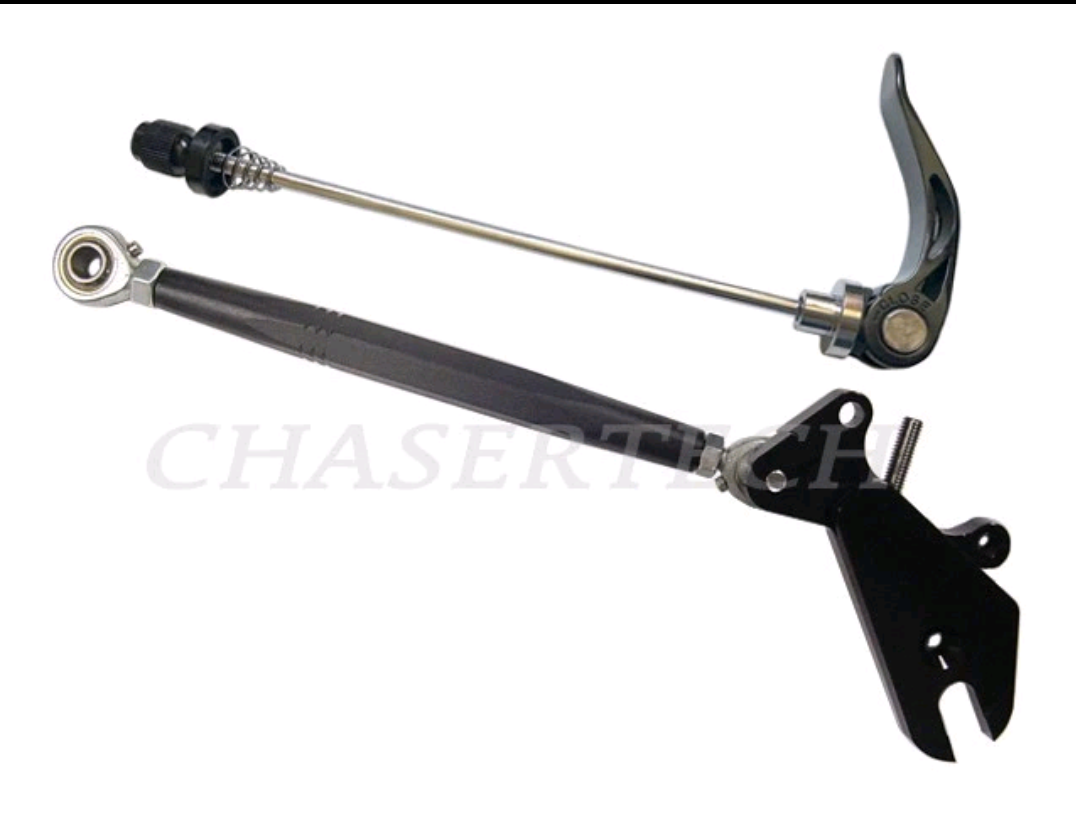
https://ebay.us/m/ERppMa
For steel, though, people just weld in an extra support:

I've heard 70's/80's CrMo frames aren't as tough as people expect because that more expensive grade of steel was used to allow thinner tubes and a lighter bike rather than to increase strength. Also mountain bikes back then didn't do all the ridiculous jumps and drops and obstacle courses and black diamond trails and whatnot modern full suspension mountain bikes get up to.
https://ebay.us/m/ERppMa
For steel, though, people just weld in an extra support:
I've heard 70's/80's CrMo frames aren't as tough as people expect because that more expensive grade of steel was used to allow thinner tubes and a lighter bike rather than to increase strength. Also mountain bikes back then didn't do all the ridiculous jumps and drops and obstacle courses and black diamond trails and whatnot modern full suspension mountain bikes get up to.
02-19-26 | 01:30 PM
#19
Thread Starter
Senior Member
Joined: Nov 2012
Posts: 5,175
Likes: 1,929
Certainly can appreciate the concern of a drop out failure or a tube failure. If it fails, ce la vie. The frame and fork alone are 7 pounds. the thing is a tank. If the stays are less than .9mm at the ends, it would surprise me. My guess is they are more likely 1mm. I did give thought to brazing on brake mounts, however in the future I can remove the brake adapter and have a completely stock frame. Not that it matters, but I find something of value in that.
The picture of the Roloff hub and drop out failure looks like the brazed joint failed. Am I seeing that correctly?
The torque arm on the drum is necessary in order for it to work, without it the pads simply spin with the hub when applied. Same principle as a brake arm on a kickback hub.
The picture of the Roloff hub and drop out failure looks like the brazed joint failed. Am I seeing that correctly?
The torque arm on the drum is necessary in order for it to work, without it the pads simply spin with the hub when applied. Same principle as a brake arm on a kickback hub.
Last edited by TiHabanero; 02-19-26 at 01:37 PM. Reason: Fill in
02-19-26 | 03:39 PM
#20
Senior Member
Joined: Aug 2010
Posts: 12,717
Likes: 2,104
From: Madison, WI
Bikes: 1961 Ideor, 1966 Perfekt 3 Speed AB Hub, 1994 Bridgestone MB-6, 2006 Airnimal Joey, 2009 Thorn Sherpa, 2013 Thorn Nomad MkII, 2015 VO Pass Hunter, 2017 Lynskey Backroad, 2017 Raleigh Gran Prix, 1980s Bianchi Mixte on a trainer. Others are now gone.
Certainly can appreciate the concern of a drop out failure or a tube failure. If it fails, ce la vie. The frame and fork alone are 7 pounds. the thing is a tank. If the stays are less than .9mm at the ends, it would surprise me. My guess is they are more likely 1mm. I did give thought to brazing on brake mounts, however in the future I can remove the brake adapter and have a completely stock frame. Not that it matters, but I find something of value in that.
The picture of the Roloff hub and drop out failure looks like the brazed joint failed. Am I seeing that correctly?
The torque arm on the drum is necessary in order for it to work, without it the pads simply spin with the hub when applied. Same principle as a brake arm on a kickback hub.
The picture of the Roloff hub and drop out failure looks like the brazed joint failed. Am I seeing that correctly?
The torque arm on the drum is necessary in order for it to work, without it the pads simply spin with the hub when applied. Same principle as a brake arm on a kickback hub.
My heavy duty touring bike with the Rohloff hub has reinforcing similar to that shown in the recent post by Inanek, below:

There is no separate torque arm on that Rohloff, it has a square part that fits inside that non-drive side dropout that is extra long and reinforced. This frame came with both a disc mount and also V brake mount, I use V brakes on it.
I obviously did not wipe off the oil leakage very often on this trip. I think my hub has a bad oil seal in it, it has always leaked since the day I bought it.
Photo below shows that square part that goes into the dropout to control torque.
 02-19-26 | 06:01 PM
#21
Thread Starter
Senior Member
Joined: Nov 2012
Posts: 5,175
Likes: 1,929
Tourist in MSN, is the Roloff hub planetary geared? That explains the need for the tab that fits the drop out. I have only seen one on a bike, never have inspected off a bike. They are nice hubs from what I have been told by owners of said hub.
02-19-26 | 08:44 PM
#24
Senior Member
Joined: Aug 2010
Posts: 12,717
Likes: 2,104
From: Madison, WI
Bikes: 1961 Ideor, 1966 Perfekt 3 Speed AB Hub, 1994 Bridgestone MB-6, 2006 Airnimal Joey, 2009 Thorn Sherpa, 2013 Thorn Nomad MkII, 2015 VO Pass Hunter, 2017 Lynskey Backroad, 2017 Raleigh Gran Prix, 1980s Bianchi Mixte on a trainer. Others are now gone.
Rohloff has three planetary gears.
https://www.rohloff.de/fileadmin//ro...0014_bild1.png
One of the planetary gears is essentially a low range like the low range on a 4X4 transfer case for a heavy duty pickup truck. Gears 1 thru 7 use that third planetary gear, which is why gears 1 thru 7 are noisier than 8 thru 14. Gear 11 is direct drive.
https://www.rohloff.de/fileadmin//ro...0014_bild1.png
One of the planetary gears is essentially a low range like the low range on a 4X4 transfer case for a heavy duty pickup truck. Gears 1 thru 7 use that third planetary gear, which is why gears 1 thru 7 are noisier than 8 thru 14. Gear 11 is direct drive.
02-19-26 | 09:13 PM
#25

Firm but gentle
Joined: Feb 2007
Posts: 694
Likes: 172
From: Oregon
Bikes: Custom Ti Quiring 29Plus, 2005 Litespeed Tuscany, Carver Gnarvester, Soma Pescadero, Jamis Hybrid
Only it won't function like a tandem drag brake, at least not for long.
There must be a reason all drag brakes are drums.
I assume that constant application on a disc will overheat and glaze the wee, tiny pads.
Without a stoker, you won't have two rear brake levers.
The drag brake would be operated with a friction thumb shifter.
There must be a reason all drag brakes are drums.
I assume that constant application on a disc will overheat and glaze the wee, tiny pads.
Without a stoker, you won't have two rear brake levers.
The drag brake would be operated with a friction thumb shifter.