


How do I disassemble Simplex retrofriction shifter?
 06-26-08 | 06:34 PM
#1


How do I disassemble Simplex retrofriction shifter?
I've come into a few of these, and I'm trying to get them apart to clean them up, since they're gunky. I have everything apart, except for the assemblies labeled 3677 and 3678 in this diagram, the lever, spring and the bushing inside the spring.
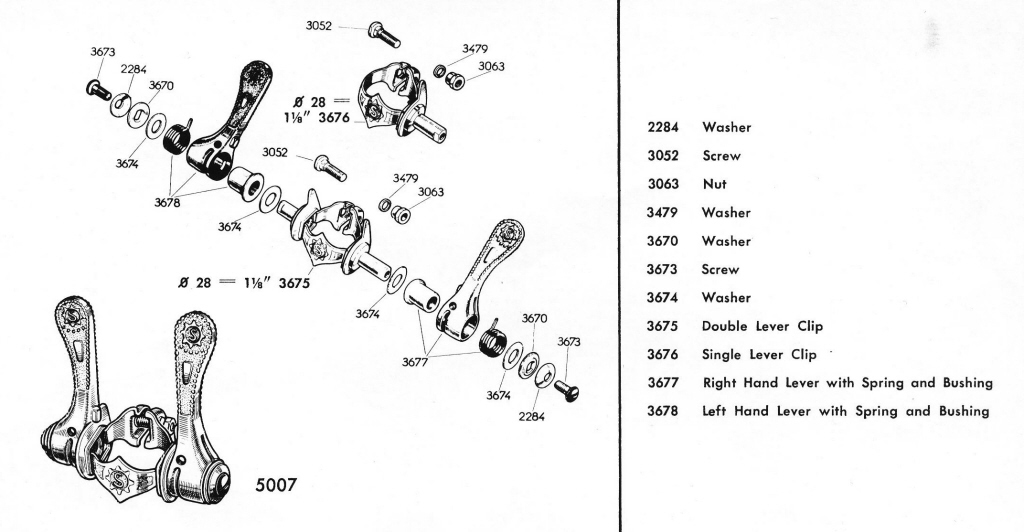
Can someone please give me a clue?
Can someone please give me a clue?
 06-26-08 | 07:05 PM
#2

If I own it, I ride it


Joined: Nov 2005
Posts: 5,685
Likes: 820
From: Cardinal Country
Bikes: Lejeune(14), Raleigh, Raysport, Jan De Reus, Gazelle, Masi, B. Carré(4), Springfield, Greg Lemond, Andre Bertin, Schwinn Paramount
LOL...I too have disassembled my retro-frictions and gotten as far as you. I am not so sure you want to take them down any further. I believe the spring is tensioned and it might be tough to get it back in properly. It appears that the bushing is a press fit. Might try just soaking them in a solution.
06-26-08 | 07:39 PM
#3
OK, though it's against my principles to stop taking things apart until they're broken, I will consider leaving well enough alone. I'm not sure that I can stop myself, but I will try .
Another question: I have the later model type (not like those shown above) that have the cutout in the lever. All of the ones I have seem to have a nylon washer at the end of the screw, that makes it difficult (but not impossible for a determined tinkerer) to remove the screw. Does that washer serve any other purpose than to keep the screw from falling out? They look pretty chewed up to me.
And a third question: I have three rights and a left. Anyone want to trade a left for a right? I have both unmarked, and "Simplex" branded.
Another question: I have the later model type (not like those shown above) that have the cutout in the lever. All of the ones I have seem to have a nylon washer at the end of the screw, that makes it difficult (but not impossible for a determined tinkerer) to remove the screw. Does that washer serve any other purpose than to keep the screw from falling out? They look pretty chewed up to me.
And a third question: I have three rights and a left. Anyone want to trade a left for a right? I have both unmarked, and "Simplex" branded.
Last edited by Charles Wahl; 06-26-08 at 07:44 PM.
06-26-08 | 09:54 PM
#4
Vintage French Bike Fan
Joined: Jun 2007
Posts: 628
Likes: 0
From: Portland, OR
Bikes: Peugeot UO-8, Peugeot 80's 12 spd
Never taken these apart (don't own a set... yet) but in my experience taking way too many things apart, anything that has a spring under any real tension is asking for trouble if you take it apart. Not that you can't get it back together, but it's going to be more of a PITA than anything else. Witness the trigger on my Ryobi drill last weekend... It works, but it took nearly an hour to get it back together properly.
Karl
Karl
Last edited by karmat; 06-26-08 at 09:58 PM.
06-27-08 | 06:11 AM
#5
From looking at these, and the diagram such as above, it seems to me that the operating principle is that when the lever is pushed the way that pulls derailer cable, the bushing (that I can't remove) is turning in a direction that is "opening" the spring (easier); while when the lever is moved in the direction that slackens the derailer cable, the bushing rotates so that friction tightens the spring against it (harder).
Is that a correct assessment?
What isolates the tension screw on the outside from the operation of the rest of the assembly, so that repeated use of the lever doesn't tend to loosen the screw, as is common with the old standard Campagnolo shifters (and probably most simple, as opposed to Simplex, ones)?
Or do they have to be tightened at regular intervals too, only with a tool?
Is that a correct assessment?
What isolates the tension screw on the outside from the operation of the rest of the assembly, so that repeated use of the lever doesn't tend to loosen the screw, as is common with the old standard Campagnolo shifters (and probably most simple, as opposed to Simplex, ones)?
Or do they have to be tightened at regular intervals too, only with a tool?
06-27-08 | 10:20 AM
#6
Who cares, just ride it!
Joined: Jun 2006
Posts: 989
Likes: 5
From: Melbourne
Bikes: 1992ish Davidson Impulse, 1981 Apollo Gran Sport SS, 2006 Salsa Las Cruces, 2010 Soma Double Cross
Another question: I have the later model type (not like those shown above) that have the cutout in the lever. All of the ones I have seem to have a nylon washer at the end of the screw, that makes it difficult (but not impossible for a determined tinkerer) to remove the screw. Does that washer serve any other purpose than to keep the screw from falling out? They look pretty chewed up to me.
One was actually missing on mine, so that is why I was so perplexed as to why one bolt was just rattling around, ready to fall out, and the other seemed stuck in place.
-Leigh
06-27-08 | 10:40 AM
#7
If I own it, I ride it
Joined: Nov 2005
Posts: 5,685
Likes: 820
From: Cardinal Country
Bikes: Lejeune(14), Raleigh, Raysport, Jan De Reus, Gazelle, Masi, B. Carré(4), Springfield, Greg Lemond, Andre Bertin, Schwinn Paramount
Another question: I have the later model type (not like those shown above) that have the cutout in the lever. All of the ones I have seem to have a nylon washer at the end of the screw, that makes it difficult (but not impossible for a determined tinkerer) to remove the screw. Does that washer serve any other purpose than to keep the screw from falling out? They look pretty chewed up to me.
From looking at these, and the diagram such as above, it seems to me that the operating principle is that when the lever is pushed the way that pulls derailer cable, the bushing (that I can't remove) is turning in a direction that is "opening" the spring (easier); while when the lever is moved in the direction that slackens the derailer cable, the bushing rotates so that friction tightens the spring against it (harder).
Is that a correct assessment?
What isolates the tension screw on the outside from the operation of the rest of the assembly, so that repeated use of the lever doesn't tend to loosen the screw, as is common with the old standard Campagnolo shifters (and probably most simple, as opposed to Simplex, ones)?
Or do they have to be tightened at regular intervals too, only with a tool?
Is that a correct assessment?
What isolates the tension screw on the outside from the operation of the rest of the assembly, so that repeated use of the lever doesn't tend to loosen the screw, as is common with the old standard Campagnolo shifters (and probably most simple, as opposed to Simplex, ones)?
Or do they have to be tightened at regular intervals too, only with a tool?
Anyone have the band, part 3675, they want to part with?
06-29-08 | 05:29 PM
#8

Senior Member

Joined: Jan 2008
Posts: 2,421
Likes: 22
From: Aurora, IL
Bikes: '73 Raleigh RRA, 1986 Trek 500 commuter
I have the later version w/cutout as well. I have had them apart partway, but I don't recall removing a spring or bushing. I had to laugh when I read
I've done that so many times myself... resist temptation! Mine once set for tension are trouble free, much moreso than the Campy NRs I also have.
Originally Posted by Charles Wahl
OK, though it's against my principles to stop taking things apart until they're broken, I will consider leaving well enough alone. I'm not sure that I can stop myself, but I will try .
03-03-13 | 07:10 PM
#9

Senior Member
Joined: Aug 2008
Posts: 4,134
Likes: 192
From: Somerville, MA and Catskill Mtns
Reviving this thread from 4.5 years in the grave, because I have a similar quandary and another factoid to add to the mystery of the retrofriction. I am trying to remove the bushing (3677/3678) from a couple of sets of retrofrictions and can't seem to get them out. It seems the spring may be tightly wound around the bushing, and that's creating the press-fit.
Interestingly, there is a significant difference in the shape of the bushing on the braze-on version. The bushing has two step-up collars, whereas the bushing on the clamp-on lever has one step-up collar. This means the levers are not interchangeable between braze-on mounts and clamp-on mounts. Bummer, because I have a braze-on set, and a spare clamp, and I'm trying to convert the braze-on set to clamp-on... but I can't!
Interestingly, there is a significant difference in the shape of the bushing on the braze-on version. The bushing has two step-up collars, whereas the bushing on the clamp-on lever has one step-up collar. This means the levers are not interchangeable between braze-on mounts and clamp-on mounts. Bummer, because I have a braze-on set, and a spare clamp, and I'm trying to convert the braze-on set to clamp-on... but I can't!
03-03-13 | 07:44 PM
#10
Senior Member
Joined: Jan 2008
Posts: 2,421
Likes: 22
From: Aurora, IL
Bikes: '73 Raleigh RRA, 1986 Trek 500 commuter
Yeah, that is strange, but I had heard that the braze-ons were not interchangeable with the clamp-ons as well. Are the bosses on Simplex bands different from standard Campy-style bosses? Must be.
I thought someone had posted recently that they had used a Huret band and retapped the threading on the boss to mount some braze on retrofrictions on.
I thought someone had posted recently that they had used a Huret band and retapped the threading on the boss to mount some braze on retrofrictions on.
03-03-13 | 08:30 PM
#11

Senior Member
Joined: Jul 2007
Posts: 1,154
Likes: 15
From: Chattanooga
Bikes: '93 Bridgestone RB-1, '91 Specialized Allez Epic, '85 Raleigh Team Pro, '78 Andre Bertin, early '90s F. Moser Leader AX , '85 Centurion Equipe, '98 Litespeed Tuscany, '89 Klein Quantum, '80 Nishiki Superbe, '83 Peckham, '84 Fuji Opus III
I converted the braze on type to a Huret band. As I recall, I didn't even have to rethread for new bolts/screws, just went to Ace Hdwe. and found one with proper diameter and correct new thread.
J
J
03-03-13 | 10:20 PM
#12

missing in action
Joined: Nov 2007
Posts: 4,483
Likes: 54
Reviving this thread from 4.5 years in the grave, because I have a similar quandary and another factoid to add to the mystery of the retrofriction. I am trying to remove the bushing (3677/3678) from a couple of sets of retrofrictions and can't seem to get them out. It seems the spring may be tightly wound around the bushing, and that's creating the press-fit.
Interestingly, there is a significant difference in the shape of the bushing on the braze-on version. The bushing has two step-up collars, whereas the bushing on the clamp-on lever has one step-up collar. This means the levers are not interchangeable between braze-on mounts and clamp-on mounts. Bummer, because I have a braze-on set, and a spare clamp, and I'm trying to convert the braze-on set to clamp-on... but I can't!
Interestingly, there is a significant difference in the shape of the bushing on the braze-on version. The bushing has two step-up collars, whereas the bushing on the clamp-on lever has one step-up collar. This means the levers are not interchangeable between braze-on mounts and clamp-on mounts. Bummer, because I have a braze-on set, and a spare clamp, and I'm trying to convert the braze-on set to clamp-on... but I can't!
Having said that, there's really no good reason to strip them apart that far unless they're really dirty inside or you want to lube them. I added a bit of wheel bearing grease to mine before reassembly, and it didn't affect the action at all.
07-10-15 | 10:31 AM
#13

Senior Member
Joined: Jul 2015
Posts: 127
Likes: 0
From: Portland, Oregon
Bikes: Vitus 979, 1981 Peugeot Super Competition PXN10E, Peugeot P18T, Crescent Pepita Special 318 Rando, 1984 Ross Mt. Whitney, 1974 Schwinn Le Tour, Soma Grand Randonneur V.2
I understand this is an old thread... but I just can't help replying.. I can't for the life of me remove the actual screw from the simplex retroflection levers. as the screw turns left, it undoes itself from the boss, but cannot be removed from the lever... and if I try turned not the washer underneath that, but the metal ring beneath that, the part on the other side also moves...
07-10-15 | 11:23 AM
#14
Senior Member
Joined: Jan 2008
Posts: 2,421
Likes: 22
From: Aurora, IL
Bikes: '73 Raleigh RRA, 1986 Trek 500 commuter
IIRC, on my pair of braze-on mounted levers, the mounting screw had a nylon retaining ring on the backside to keep the screw from falling out when the lever is taken off of the bike. I replaced the screws in mine with SS allen hex head since the originals were chewed up and rusting, so I just popped them off an I believe I replaced the nylon retainers on the new screws.
07-10-15 | 02:35 PM
#15

Senior Member
Joined: Jul 2009
Posts: 11,128
Likes: 39
Bikes: 1986 Alan Record Carbonio, 1985 Vitus Plus Carbone 7, 1984 Peugeot PSV, 1972 Line Seeker, 1986(est.) Medici Aerodynamic (Project), 1985(est.) Peugeot PY10FC
Yes just place appropriate sized bolt at the tip of the mounting screw at the opening on the lever assembly and push it in. It will push the mounting screw through the nylon retaining washer enough that you can pull at the head of the mounting screw to remove it from the lever. Not sure if you really need the nylon retainig washer to keep the lever working, but I try to always put it back into the lever to retain the screw. It keeps all the parts together when you have the lever off the bosses. To put back the nylon washer and mounting screw together in the lever, I use a short piece of aluminum tubing or something similar that will fit into the hole in back of the lever, drop in the washer into the hole, and push or turn the mounting screw back through it. Did it so many times that it's second nature for me now, and the short aluminum tube is a regularly used item in my tool box. As for taking the clutch spring and related hat shaped plastic bushing off the lever, it can be done by carefully picking at th spring tip at the lever slot with a small screw driver carefully with a small flat tipped screwdriver. But be aware that some are harder to take out than others, depending on the lever ' s condition.
Last edited by Chombi; 07-10-15 at 02:42 PM.

Thread
Thread Starter
Forum
Replies
Last Post
gaucho777
Classic & Vintage
26
12-10-18 08:35 PM
Kimmo
Bicycle Mechanics
43
08-30-14 11:59 AM
