


Reflectors - better than lights!
 08-10-12 | 04:33 PM
#26

Senior Member

Joined: Sep 2010
Posts: 8,954
Likes: 388
From: NE Indiana
Bikes: 2020 Masi Giramondo 700c; 2013 Lynskey Peloton; 1992 Giant Rincon; 1989 Dawes needs parts; 1985 Trek 660; 1985 Fuji Club; 1984 Schwinn Voyager; 1984 Miyata 612; 1977 Raleigh Competition GS
I use reflective gear and lights. Some of the riding I do requires it, but I feel uncomfortable without reflective gear even though I have lights. I was out in my car chasing a rider on a randonnee once, and was a little worried about catching him because I was worried about his visibility. When I caught him, his reflective gear was incredibly bright. His lights were also bright, but they are smaller.
I don't have reflective tape on any of my bikes any more. It probably shows up, but a reflective vest and ankle bands are much more visible. The reflective ankle bands moving up and down are pretty hard to ignore. I'm a believer in pedal reflectors too.
I don't have reflective tape on any of my bikes any more. It probably shows up, but a reflective vest and ankle bands are much more visible. The reflective ankle bands moving up and down are pretty hard to ignore. I'm a believer in pedal reflectors too.
I don't use pedal reflectors, I already use ankle band reflectors, and my shoes have built in reflectors, I don't need anything else. But the up and down motion of a pedal, shoe or ankle band reflector does crab ones attention...as long as it's not down pouring rain at night. Serfas, and probably others, do make a active battery powered glowing ankle band that is better then the reflectors.
 08-10-12 | 05:41 PM
#27
Thread Starter
Senior Member
Joined: Jul 2012
Posts: 93
Likes: 0
From: Finland
As a visual demo, here's my bike and myself decked with massive amounts of reflectivity, plus active lighting. I've set a powerful flashlight next to the camera to show the reflective stuff. I'm heading towards a 500-foot-long right-turn lane that I need to pass safely. If you're the driver doing 60mph and looking to hit that exit lane, the taillights are far more effective than even an all-out reflective arsenal for giving you time to plan a safe exit.
As you can see, at about 30 seconds into the video, which is a range a car will cover in a few seconds, my reflective profile has dwindled to something on par with the roadside marker posts. My taillights are waaaaay better.
If I'm looking at it correctly, you pass the camera at 0:08, you can still be identified a cyclist at 0:30, and the reflectors stop being visible at around 0:40 mark. A car passes the camera at 0:42, and it reaches you around 0:55, so I'd say the driver sees the first glint of reflectors about 13 seconds out.
If you're doing about 15 MPH, you'd be about 235 yards away at 0:40. Sounds about right for reflector performance. The "identification distance" would be about 150 yards.
I have to agree that reflectors don't work further than 15 seconds away if your speed difference is 40 MPH, though. That's pretty much the calculated range as well, I think it matches your video pretty well.
Now all we need is this video in reverse, to see how the passing driver sees rear lights + reflectors

Last edited by proileri; 08-10-12 at 06:02 PM.
08-10-12 | 08:28 PM
#28

Senior Member

Joined: Jul 2002
Posts: 6,956
Likes: 6
That's a great video.
If I'm looking at it correctly, you pass the camera at 0:08, you can still be identified a cyclist at 0:30, and the reflectors stop being visible at around 0:40 mark. A car passes the camera at 0:42, and it reaches you around 0:55, so I'd say the driver sees the first glint of reflectors about 13 seconds out.
If you're doing about 15 MPH, you'd be about 235 yards away at 0:40. Sounds about right for reflector performance. The "identification distance" would be about 150 yards.
If I'm looking at it correctly, you pass the camera at 0:08, you can still be identified a cyclist at 0:30, and the reflectors stop being visible at around 0:40 mark. A car passes the camera at 0:42, and it reaches you around 0:55, so I'd say the driver sees the first glint of reflectors about 13 seconds out.
If you're doing about 15 MPH, you'd be about 235 yards away at 0:40. Sounds about right for reflector performance. The "identification distance" would be about 150 yards.

Don't get me wrong, not many people love reflective stuff more than I do. But I think it's irresponsible to start threads claiming reflectors are better than lights.

 08-10-12 | 08:59 PM
#29
Thread Starter
Senior Member
Joined: Jul 2012
Posts: 93
Likes: 0
From: Finland
However, I think it's important for people to notice that reflectors actually are a very valuable and inexpensive piece of safety equipment. Some people assume that you don't need reflectors or that they couldn't improve your safety if you have a good light or two, which is a silly way to think. In fact, I think both active and passive lights should be mandatory, as they are in some countries.
That last video is really telling of the lack of ability of reflectors. If some of you have missed it go back and look again, there is a small 3" wide by maybe 3' tall break away warning bar with reflectors on it just to the left of the car on the center line just before the intersection, you don't even see the reflectors till you're almost on it.
It's a good point, though. Small yellow reflectors aren't picked up very well to the background of reds. Blue reflectors would be better in that application, I think.
Last edited by proileri; 08-10-12 at 09:18 PM.
08-11-12 | 12:33 AM
#30
Marqueteur
Joined: Dec 2005
Posts: 81
Likes: 0
Bikes: Primary: Specialized crossroads; Secondary: seldom used specialized MTB
Interesting noting all the people who like pedal/ankle reflectors. I have come to the conclusion that the former are entirely useless, and the latter are probably sketchy at best - on my bike at least. Of course, I'll admit that my four panniers which I never ride without have something to do with that. I do have various reflective strips on my panniers, which I expect do a pretty decent job of spelling "unusual" at first sight.
My tail lights, on the other hand, have been reported to me as "very good" and "easy to see from a long way away" without my prompting the statement. A genuine automotive brake light (in tail light mode with the brake mode working as designed for the front brake), and using a truck marker light with 180 degree visibility above. I also have a 3" red automotive reflector in between the two. The reflector is indeed quite bright, and the reflective material on my bags seems to be as well, but it is the lights I trust most.
Tor
My tail lights, on the other hand, have been reported to me as "very good" and "easy to see from a long way away" without my prompting the statement. A genuine automotive brake light (in tail light mode with the brake mode working as designed for the front brake), and using a truck marker light with 180 degree visibility above. I also have a 3" red automotive reflector in between the two. The reflector is indeed quite bright, and the reflective material on my bags seems to be as well, but it is the lights I trust most.
Tor
08-11-12 | 12:55 PM
#31
Senior Member
Joined: Jul 2002
Posts: 6,956
Likes: 6
During that most important distance of 10 seconds, a good reasonably sized reflector covers you very well.
Also, if you think a 10-second window is a good buffer for the driver of a loaded semi truck, I don't see that IRL. Out on the divided highway, I ride at the right half of a wide shoulder like this one, and the semi drivers will still divert to the left lane at long range (1/4 mile or more), if they have an opening. Given that their priority is obviously to give me tons of room without having to make last-second lane changes, I'm sure they appreciate that I do NOT start showing up at close range, particularly when traction's not so great (snow, ice, rain).
And yes, 10 seconds is close range. When I drive a car at highway speeds, my typical following distance on cars going my speed is around 8-10 seconds, let alone something I'm overtaking at a 45mph speed differential. If I'm heading for an exit ramp at 50-60mph, I want to see cyclists from as far as practical so I can allow for the possibility they're not exiting where I am, and even a modest blinkie like a SuperFlash will totally trump reflectors for that purpose in darkness. In daylight, a hi-vis outerwear does help a lot, although anecdotal reports from a co-worker shows that my best-of-breed taillights are still the first thing he noticed at 1/2 mile in daylight.

Food for thought: how many of you have been driving on the highway at night, and passed a car on the shoulder with its lights off? Cars have very good passive reflectors, it's mandatory equipment. How'd they do? Did you see, or shall I say did you notice that car from a comfortable distance at 60mph+, with plenty of time to assess your surroundings and make a lane change? I'm guessing no.
Last edited by mechBgon; 08-11-12 at 01:28 PM.
08-11-12 | 01:06 PM
#32

Galveston County Texas
Joined: Nov 2007
Posts: 33,335
Likes: 1,285
From: In The Wind
Bikes: 02 GTO, 2011 Magnum
A reflector that gradually fades into view? That's part of the problem with reflective stuff at longer ranges... it gradually ramps up in intensity. It has to reach a threshold to be conciously noticed, and then has to be assessed until it's at least recognized as an obstacle, if not a cyclist. By contrast, a flashing taillight is associated with cyclists and pedestrians in the U.S.; it has a sharp ON/OFF contrast to catch the viewer's eye rather than gradually fading into view; and its apparent intensity doesn't drop off nearly as badly with distance, rain, snow or fog.
Also, if you think a 10-second window is a good buffer for the driver of a loaded semi truck, I don't see that IRL. Out on the divided highway, I ride at the right half of a wide shoulder like this one, and the semi drivers will still divert to the left lane at long range (1/4 mile or more), if they have an opening. Given that their priority is obviously to give me tons of room without having to make last-second lane changes, I'm sure they appreciate that I do NOT start showing up at close range, particularly when traction's not so great (snow, ice, rain).
And yes, 10 seconds is close range. When I drive a car at highway speeds, my typical following distance on cars going my speed is around 8-10 seconds, let alone something I'm overtaking at a 45mph speed differential. If I'm heading for an exit ramp at 50-60mph, I want to see cyclists from as far as practical so I can allow for the possibility they're not exiting where I am, and even a modest blinkie like a SuperFlash will totally trump reflectors for that purpose in darkness. In daylight, a hi-vis outerwear does help a lot, although anecdotal reports from a co-worker shows that my best-of-breed taillights are still the first thing he noticed at 1/2 mile in daylight.
Also, if you think a 10-second window is a good buffer for the driver of a loaded semi truck, I don't see that IRL. Out on the divided highway, I ride at the right half of a wide shoulder like this one, and the semi drivers will still divert to the left lane at long range (1/4 mile or more), if they have an opening. Given that their priority is obviously to give me tons of room without having to make last-second lane changes, I'm sure they appreciate that I do NOT start showing up at close range, particularly when traction's not so great (snow, ice, rain).
And yes, 10 seconds is close range. When I drive a car at highway speeds, my typical following distance on cars going my speed is around 8-10 seconds, let alone something I'm overtaking at a 45mph speed differential. If I'm heading for an exit ramp at 50-60mph, I want to see cyclists from as far as practical so I can allow for the possibility they're not exiting where I am, and even a modest blinkie like a SuperFlash will totally trump reflectors for that purpose in darkness. In daylight, a hi-vis outerwear does help a lot, although anecdotal reports from a co-worker shows that my best-of-breed taillights are still the first thing he noticed at 1/2 mile in daylight.
__________________
Fred "The Real Fred"
Fred "The Real Fred"
08-11-12 | 01:19 PM
#33
Senior Member
Joined: Jul 2002
Posts: 6,956
Likes: 6
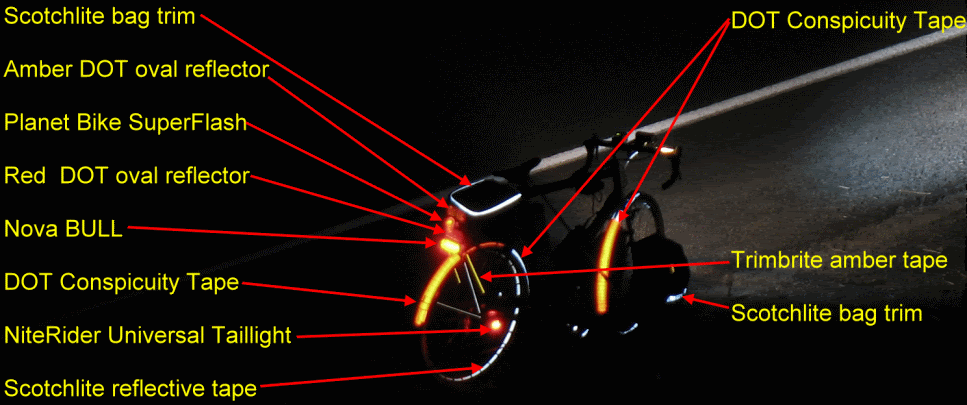
That's the Nova BULL emergency-vehicle strobe, around 120 lumens. It has a variety of modes, some of them very "ballistic" as you'd expect for its target market. In the videos I posted earlier, one shows it running quad-flash, the other shows it on double-blink. I'm not sure they're still being made, but the Whelen TIR-3 is an equivalent. I got unsolicited praise and questions about the Nova from motorists. They said they liked how I was easy to notice from long distances.
These days, similar power is available from the DiNotte line and the Cygolite Hotshot, and NiteRider's Solas will probably be another good contender in the sub-$50 market. The Solas has the rippled beam-spreader optic like the Cherry Bomb, which should cover a wider arc than the Hotshot as long as it's aimed level.
These days, similar power is available from the DiNotte line and the Cygolite Hotshot, and NiteRider's Solas will probably be another good contender in the sub-$50 market. The Solas has the rippled beam-spreader optic like the Cherry Bomb, which should cover a wider arc than the Hotshot as long as it's aimed level.
08-11-12 | 01:36 PM
#34

Broken neck Ken

Joined: Oct 2008
Posts: 5,221
Likes: 3,516
From: Portland, OR
Bikes: Trek Domane SL6 Gen 3, Soma Fog Cutter, Detroit Bikes Sparrow FG, Trek Mt Track XCNimbus MUni
More lighting and reflective gear is better, but we all need to understand that sometime we just won't be seen
08-11-12 | 02:49 PM
#35
Thread Starter
Senior Member
Joined: Jul 2012
Posts: 93
Likes: 0
From: Finland
I think cycling safety is a combination of three things: 1) active lights for long-range visibility, 2) passive lights for improved identification, improved short-range visibility and backup, and 3) correct attitude - for knowing they don't probably notice you anyway..
Motorcycle safety talks about "pretending you are invisible" - most motorcycle accidents (caused by other than the biker) happen at an intersection, when the driver doesn't notice the large, loud motorcycle with a big headlight, right in the middle of the lane! Second reason is that it's more difficult to judge the speed and distance of a motorcycle.
Interesting noting all the people who like pedal/ankle reflectors. I have come to the conclusion that the former are entirely useless, and the latter are probably sketchy at best - on my bike at least. Of course, I'll admit that my four panniers which I never ride without have something to do with that. I do have various reflective strips on my panniers, which I expect do a pretty decent job of spelling "unusual" at first sight.
One interesting application would be making your hubs 'blink' by putting reflective material halfway around them. Same thing if you place one or more reflectors on the inside of your rim.
Last edited by proileri; 08-12-12 at 12:52 AM.
08-11-12 | 02:54 PM
#36

2 Fat 2 Furious
Joined: Nov 2010
Posts: 3,996
Likes: 2
From: England
Bikes: 2009 Specialized Rockhopper Comp Disc, 2009 Specialized Tricross Sport RIP
Not necessarily even in dark conditions. When I took my SPD shoes for their first brevet the guy I rode with said how the Specialized S logos on the back were so bright they were almost dazzling. That was on a bright sunny day, in the middle of the afternoon.
__________________
"For a list of ways technology has failed to improve quality of life, press three"
"For a list of ways technology has failed to improve quality of life, press three"
08-12-12 | 09:13 AM
#37

Tractorlegs
Joined: Oct 2011
Posts: 3,185
Likes: 60
From: El Paso, TX
Bikes: Schwinn Meridian Single-Speed Tricycle
I can't agree with the OP's title, "Reflectors are Better than Lights". Reflectors are great and increase safety, but lighting is more important. Ride Free!
__________________
********************************
Trikeman
Trikeman
08-13-12 | 10:50 PM
#38
Senior Member
Joined: Sep 2010
Posts: 8,954
Likes: 388
From: NE Indiana
Bikes: 2020 Masi Giramondo 700c; 2013 Lynskey Peloton; 1992 Giant Rincon; 1989 Dawes needs parts; 1985 Trek 660; 1985 Fuji Club; 1984 Schwinn Voyager; 1984 Miyata 612; 1977 Raleigh Competition GS
That's the Nova BULL emergency-vehicle strobe, around 120 lumens. It has a variety of modes, some of them very "ballistic" as you'd expect for its target market. In the videos I posted earlier, one shows it running quad-flash, the other shows it on double-blink. I'm not sure they're still being made, but the Whelen TIR-3 is an equivalent. I got unsolicited praise and questions about the Nova from motorists. They said they liked how I was easy to notice from long distances.
These days, similar power is available from the DiNotte line and the Cygolite Hotshot, and NiteRider's Solas will probably be another good contender in the sub-$50 market. The Solas has the rippled beam-spreader optic like the Cherry Bomb, which should cover a wider arc than the Hotshot as long as it's aimed level.
These days, similar power is available from the DiNotte line and the Cygolite Hotshot, and NiteRider's Solas will probably be another good contender in the sub-$50 market. The Solas has the rippled beam-spreader optic like the Cherry Bomb, which should cover a wider arc than the Hotshot as long as it's aimed level.
And what battery does it take, how many, and how long will the the bats last?
The thing about reflectors that most of us are forgetting is that they only work as designed if the headlights on the car are properly aimed and at the right angle to the reflector.
08-14-12 | 09:57 AM
#39
Senior Member
Joined: Jul 2002
Posts: 6,956
Likes: 6
Interesting light, thanks for sharing it with us here. Have you by chance compared it the usual bicycle rear lights like the Cygolight Hotshot or the Light & Motion Vis 180, or some other such bright lights?
And what battery does it take, how many, and how long will the the bats last?
And what battery does it take, how many, and how long will the the bats last?
I have some comparison photos in this thread: https://www.bikeforums.net/showthread...cs-amp-remarks If you right-click the photo links and open them in new tabs, you can toggle back and forth. The BULL has a rippled beamspreader that puts out a wide rectangular beam.
The thing about reflectors that most of us are forgetting is that they only work as designed if the headlights on the car are properly aimed and at the right angle to the reflector.
08-14-12 | 03:14 PM
#40
Senior Member
Joined: Sep 2010
Posts: 8,954
Likes: 388
From: NE Indiana
Bikes: 2020 Masi Giramondo 700c; 2013 Lynskey Peloton; 1992 Giant Rincon; 1989 Dawes needs parts; 1985 Trek 660; 1985 Fuji Club; 1984 Schwinn Voyager; 1984 Miyata 612; 1977 Raleigh Competition GS
The BULL and similar strobeheads are designed to be wired to a vehicle's light system, and will produce full output on a range of input voltages (around 9 to 15 volts). In my case, I wired it to a 9.6-volt radio-controlled car battery first, but the connector wasn't very reliable, so then I switched to a DiNotte battery pack. I don't think I ever ran it dead, so I'm not sure how long it would run, but... a long time.
I have some comparison photos in this thread: https://www.bikeforums.net/showthread...cs-amp-remarks If you right-click the photo links and open them in new tabs, you can toggle back and forth. The BULL has a rippled beamspreader that puts out a wide rectangular beam.
Another problem with reflectors is that at closer ranges, the reflected light from the non-driver's-side headlight isn't coming back towards the driver. It's coming back towards the passenger. So what happens when the driver's-side headlight is burned out...? Yeah, reflector effectiveness takes a plunge at closer ranges. Unfortunately there are a lot of cars in my area with only one working headlight.
I have some comparison photos in this thread: https://www.bikeforums.net/showthread...cs-amp-remarks If you right-click the photo links and open them in new tabs, you can toggle back and forth. The BULL has a rippled beamspreader that puts out a wide rectangular beam.
Another problem with reflectors is that at closer ranges, the reflected light from the non-driver's-side headlight isn't coming back towards the driver. It's coming back towards the passenger. So what happens when the driver's-side headlight is burned out...? Yeah, reflector effectiveness takes a plunge at closer ranges. Unfortunately there are a lot of cars in my area with only one working headlight.
That is a good point about a headlight being out extremely limiting the effectiveness of reflectors. If you drive down a road at night that has cars parked on the street you get the same effect, very few car reflectors will reflect back anything worth noticing, so now people are expecting to be in a bike lane and a car passing them to their left be illuminated by only their reflectors...their don't work anywhere near as good as they think their working.
Great comparison shots by the way.
Last edited by rekmeyata; 08-14-12 at 03:19 PM.
08-14-12 | 03:40 PM
#41
Marqueteur
Joined: Dec 2005
Posts: 81
Likes: 0
Bikes: Primary: Specialized crossroads; Secondary: seldom used specialized MTB
Interesting light pattern on the Nova Bull. I tend to just flash my brake light if I want to be noticed (typically if I pull into traffic to make a turn), which seems to work quite well. Of course, drivers are used to stopping for the exact light I have, or at least lights built to the same standard, so any driver who can't doesn't belong on the road at all. Seems to work very well for drivers coming up behind me at 50MPH while I'm waiting to make a turn. Often they will wait behind me even though there is plenty of room for a pass on the right.
Mind telling us which model of Nova Bull you have, MechBgon?
On self-contained vs. central battery and wires, I like the latter for flexibility. I haven't gotten the switches yet, but when I do, I'll be able to control everything while riding. Also, I can and like playing around with my lights, so it makes it easier (and cheaper, I think) to keep playing with the system. 12V automotive parts or other 12V gadgets and gizmos are easy to come by, so I think it is a very convenient sort of system. Of course, if you haven't the foggiest notion how to wire things up and a soldering iron terrifies you, you might think a little differently. On the other hand, it isn't that hard to learn enough to start putting a system together.
Tor
Mind telling us which model of Nova Bull you have, MechBgon?
On self-contained vs. central battery and wires, I like the latter for flexibility. I haven't gotten the switches yet, but when I do, I'll be able to control everything while riding. Also, I can and like playing around with my lights, so it makes it easier (and cheaper, I think) to keep playing with the system. 12V automotive parts or other 12V gadgets and gizmos are easy to come by, so I think it is a very convenient sort of system. Of course, if you haven't the foggiest notion how to wire things up and a soldering iron terrifies you, you might think a little differently. On the other hand, it isn't that hard to learn enough to start putting a system together.
Tor
Last edited by Tor; 08-14-12 at 03:45 PM.
08-14-12 | 05:21 PM
#42
Senior Member
Joined: Sep 2010
Posts: 8,954
Likes: 388
From: NE Indiana
Bikes: 2020 Masi Giramondo 700c; 2013 Lynskey Peloton; 1992 Giant Rincon; 1989 Dawes needs parts; 1985 Trek 660; 1985 Fuji Club; 1984 Schwinn Voyager; 1984 Miyata 612; 1977 Raleigh Competition GS
On self-contained vs. central battery and wires, I like the latter for flexibility. I haven't gotten the switches yet, but when I do, I'll be able to control everything while riding. Also, I can and like playing around with my lights, so it makes it easier (and cheaper, I think) to keep playing with the system. 12V automotive parts or other 12V gadgets and gizmos are easy to come by, so I think it is a very convenient sort of system. Of course, if you haven't the foggiest notion how to wire things up and a soldering iron terrifies you, you might think a little differently. On the other hand, it isn't that hard to learn enough to start putting a system together.
Tor
Tor
08-14-12 | 05:56 PM
#43
Thread Starter
Senior Member
Joined: Jul 2012
Posts: 93
Likes: 0
From: Finland
Another problem with reflectors is that at closer ranges, the reflected light from the non-driver's-side headlight isn't coming back towards the driver. It's coming back towards the passenger. So what happens when the driver's-side headlight is burned out...? Yeah, reflector effectiveness takes a plunge at closer ranges. Unfortunately there are a lot of cars in my area with only one working headlight.
Car headlights aren't that directional either. The typical spread is 30-45 degrees to either side, and there's plenty of weak scattered light that spreads almost up to 90 degrees from parallel. Even the weak scattered light makes a reflector visible from close range.
However, it's good to be visible: Even the poorest kind of reflective tape/vinyl is visible to about 300 ft or a bit further. Applied around a frame tube, it becomes a 360-degree reflector that's visible in the scattered light from a single headlight.
Last edited by proileri; 08-14-12 at 06:21 PM.
08-14-12 | 08:17 PM
#44

Senior Member
Joined: Jul 2008
Posts: 3,040
Likes: 1
From: Austin, TX
Bikes: Bacchetta Giro, Strada
Originally Posted by mechBgon
Another problem with reflectors is that at closer ranges, the reflected light from the non-driver's-side headlight isn't coming back towards the driver. It's coming back towards the passenger. So what happens when the driver's-side headlight is burned out...?
Reflectors reflect the light back approximately to the source -- that's what they're designed to do, and that's what makes them effective. This source isn't the driver of the car -- it's the light itself. Now, not all the light goes right back towards the source -- it spreads out somewhat, and this makes it work when the light isn't right next to your eyes. But as you get closer to the retroreflector, the angle between your light and your eyes increases, and so the effectiveness of the reflector decreases -- THAT is what mechBgon was referring to.
Now, reflectors do work best when the light hits them close to straight on, and that's where the 2-3 facets comes into play, but that's a different matter than what mechBgon was referring to. Of course, if the reflector is close to the light, that means the object it's on is probably well illuminated -- so even if you can't really see the reflector, you can probably see the bike it's attached to.
08-14-12 | 08:36 PM
#45
Thread Starter
Senior Member
Joined: Jul 2012
Posts: 93
Likes: 0
From: Finland
You missed his point.
Reflectors reflect the light back approximately to the source -- that's what they're designed to do, and that's what makes them effective. This source isn't the driver of the car -- it's the light itself. Now, not all the light goes right back towards the source -- it spreads out somewhat, and this makes it work when the light isn't right next to your eyes. But as you get closer to the retroreflector, the angle between your light and your eyes increases, and so the effectiveness of the reflector decreases -- THAT is what mechBgon was referring to.
Reflectors reflect the light back approximately to the source -- that's what they're designed to do, and that's what makes them effective. This source isn't the driver of the car -- it's the light itself. Now, not all the light goes right back towards the source -- it spreads out somewhat, and this makes it work when the light isn't right next to your eyes. But as you get closer to the retroreflector, the angle between your light and your eyes increases, and so the effectiveness of the reflector decreases -- THAT is what mechBgon was referring to.
Bicycle reflectors are designed to reflect any incoming light back in a cone of about 3 degrees from parallel to the incoming light. If they wouldn't function at a slightly wider angle, they would be very difficult to spot - unless you are shooting laser beams from your eyes!
At about 100 ft a 3 degree angle reaches 6' from parallel, enough to be visible to the driver. This means that even a single facet reflector is visible at 100 ft out, or further, even with one headlight out. If the reflector has more than one facet, another facet will be in better reflective angle (at some point) when the car gets closer than 100 ft.
See the link in my signature for more detailed analysis

Last edited by proileri; 08-14-12 at 08:48 PM.
08-14-12 | 10:18 PM
#46
Senior Member
Joined: Jul 2002
Posts: 6,956
Likes: 6
Actually, I do know what he's talking about. This is the so-called observation angle, or how wide the light scatters from the reflector.
Bicycle reflectors are designed to reflect any incoming light back in a cone of about 3 degrees from parallel to the incoming light. If they wouldn't function at a slightly wider angle, they would be very difficult to spot - unless you are shooting laser beams from your eyes!
At about 100 ft a 3 degree angle reaches 6' from parallel, enough to be visible to the driver. This means that even a single facet reflector is visible at 100 ft out, or further, even with one headlight out. If the reflector has more than one facet, another facet will be in better reflective angle (at some point) when the car gets closer than 100 ft.
See the link in my signature for more detailed analysis
Bicycle reflectors are designed to reflect any incoming light back in a cone of about 3 degrees from parallel to the incoming light. If they wouldn't function at a slightly wider angle, they would be very difficult to spot - unless you are shooting laser beams from your eyes!
At about 100 ft a 3 degree angle reaches 6' from parallel, enough to be visible to the driver. This means that even a single facet reflector is visible at 100 ft out, or further, even with one headlight out. If the reflector has more than one facet, another facet will be in better reflective angle (at some point) when the car gets closer than 100 ft.
See the link in my signature for more detailed analysis
I think you're describing CPSC wide-angle bicycle reflectors. You're not quite grasping their design, though. Cube-corner reflectors reflect towards the light source. A CPSC wide-angle reflector does exactly that, but it has two of its three sections with the cube-corner reflectors angled to the left and right. Since the plastic cube-corner reflectors aren't metallized on their reflecting surfaces, but instead rely on the difference in refractive index between plastic and air, only 1/3 of the surface will reflect brightly from the rear.
As an example:

The reflector in the lower center that's performing well here is DOT Class II conspicuity tape, which does have metallized reflective surfaces on its micro-cubecorner reflectors and will reflect from wild input angles. The others are plastic, and suffer the effects of Total Internal Reflectance, which you can read about at a real reflector expert's site: https://www.bikexprt.com/bicycle/reflectors/index.htm But in all cases, "dim-out" will be a problem at closer ranges when the light source is a significant distance from the viewer, such as a driver whose driver-side headlight is burned out. Mr. Allen also points out the case of a semi driver, who sits much higher than his headlights.
A light, meanwhile, has none of those problems. Hmmm. And they can flash to attract attention early, not just fade into view. HMMMM. And they don't rely on the other guy to have his/her lights on, in order to work. HMMMM!
Another illustration about the problem of TIR with plastic reflectors:
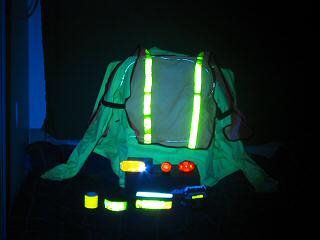
The DOT-spec reflectors aren't doing squat here, are they? They're beyond the limits of TIR. Useless pieces of plastic, from this angle. The glass-bead high-intensity reflective tape works. The microprismatic tape works. The lights REALLY work
And a third comparison for good measure... in this photo, the stuff's about 25 feet away from the camera, and being illuminated quite strongly by a 400-lumen light that's about 6 feet to the right of the camera, something like a passenger-side headlight on a car. The reflective stuff is reflecting back to the light source. The camera's seeing almost none of that. The actively-lighted items HMMM are still working.
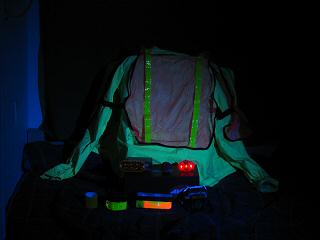
If the light were lined up with the camera, it would look like the shot below:
For those who want a minimalist setup, you can find some lights that have legit reflectors integrated. Of the ones I'm aware of, the Planet Bike BRT-5 is a good all-around pick, better than the similar Cateye LD500, and surprisingly better than the recent Cateye LD560/570 as well (in terms of both reflectivity and light output). But a Cygolite Hotshot and a piece of microprismatic reflective tape will outperform it on both fronts.
Mind telling us which model of Nova Bull you have, MechBgon?

Last edited by mechBgon; 08-14-12 at 10:45 PM.
08-14-12 | 10:43 PM
#47
Senior Member
Joined: Jul 2008
Posts: 3,040
Likes: 1
From: Austin, TX
Bikes: Bacchetta Giro, Strada
Let's suppose that bicycle reflectors reflect incoming light back in a 3 degree cone line you said. Let's say exactly a three degree cone -- no more -- just to make things simple for this example. Let's say the light and eye are 6' feet away from each other, and 100' away from the reflector. 100' * sin(3 degrees) = 5.3 feet, which is less than 6', so the reflector will not reflect *any* light back to the eye, no matter how the facets are aligned or how many there are.
Now, that's not a real world situation, as the three degree thing isn't a strict cutoff, it's more where the intensity starts going way down. In the real world, you'd still see the reflector, just not very well. (I'll ignore any reflections due to it's mirror-like covering (only works at one specific angle) and any reflected light simply due to it being a red object -- as that's really dim compared to the retroreflector reflection if the observation angle is low.)
And of course, 5.3 feet is pretty close to 6 feet. If it's too close for your example, say the cyclist is 50 feet away -- then we're talking about 2.6 feet vs. 6 feet, and it barely works as a retroreflector at all. Of course, by that point the headlights should be illuminating the entire bike pretty well, not just the reflectors.
But certainly, the multiple facets aren't there to make the observation angle larger -- they're there to make the range of entrance angles where it works well larger. The wikipedia article I gave earlier does mention the two angles, though it may not really explain the difference very well.
08-14-12 | 10:45 PM
#48

Thunder Whisperer
Joined: Apr 2008
Posts: 8,841
Likes: 7
From: NE OK
Bikes: '06 Kona Smoke
mechBgon, the next time you feel the urge to do another 'stuff reduction', send me a PM or even post up in the Pay it Forward thread in the For Sale in the Marketplace.
__________________
Community guidelines
Community guidelines
08-15-12 | 07:19 PM
#49
Marqueteur
Joined: Dec 2005
Posts: 81
Likes: 0
Bikes: Primary: Specialized crossroads; Secondary: seldom used specialized MTB
Originally Posted by rekmeyata
Flexibility? Care to elaborate on that a bit more? I would think flexibility would decrease because you have to route wires, and figure out where to put a battery pack; with a self contained system you have none of that extraneous stuff to worry about, plus there's less to go wrong with pulled wires, bad connections etc. It is true, I don't like doing electrical stuff so making it simple with a self contained system is more to my liking, but regardless, simplicity equals more flexibility, not the other way around...at least that's my opinion.
As for future expansion, I have a housing on the way to make a headlight to augment my Phillips LBL that I have added the guts of a USB car adapter to attach it to my system. Runtime (on the LBL) is vastly improved from inadequate to more than I have need of, and easily upgraded in the future if it becomes needed.
MechBgon: thanks for the link. Not sure I'll bother, but worth keeping in mind.
Tor
08-15-12 | 10:53 PM
#50
Thread Starter
Senior Member
Joined: Jul 2012
Posts: 93
Likes: 0
From: Finland
The reflector in the lower center that's performing well here is DOT Class II conspicuity tape, which does have metallized reflective surfaces on its micro-cubecorner reflectors and will reflect from wild input angles. The others are plastic, and suffer the effects of Total Internal Reflectance, which you can read about at a real reflector expert's site: https://www.bikexprt.com/bicycle/reflectors/index.htm But in all cases, "dim-out" will be a problem at closer ranges when the light source is a significant distance from the viewer, such as a driver whose driver-side headlight is burned out. Mr. Allen also points out the case of a semi driver, who sits much higher than his headlights.
You make good points, but let me approach this while considering the most usual situations and distances involved on the road:
This pic is a few feet away, from about 35 angle, which is about the max angle for a 2-facet CPSC reflector. However, as you can see, the reflectors still function at this difficult angle. On the road would mean that the car is just about zooming past you, and the reflectors are still well visible. 2-facet CPSC reflectors (I have one in my hand ATM, it's a E(3)-approved one for road vehicles) are designed with partially overlapping fields of reflection: both facets are visible to about 25 degrees from parallel, and one facet is still visible to about 35 degrees.
The second thing you can see in this pic is the wide angle of a film (= soft) reflector. It has only one facet, yet it's visible to about 35 degrees. I have measured a film reflector ("bubble wrap tape") to be visible to about 45 degree angle from parallel. However, the trade-off here is the brightness - it's the same thing as with headlights: wider angle means lower brightness. You can see that the film reflector is not as bright as the CPSCs.
The second pic gives us a nice real life viewing angle - if you're a 747 pilot looking down at someone cycling on the runway
As you can see, we are probably starting to be a bit outside 35 angle, so the CPSC reflectors have or are starting to drop off. It's nice to see the performance of the film reflectors, though. As you can see, the DOT Conspicuity Tape is pretty much the most visible thing in the pic, even from a strange angle - although the tail lights are somewhat directional, and their performance suffers a bit too from such an angle, I think. Even the humble thin Scotchlite tape and trim does quite well from such close range.
With this pic, unfortunately, 25 ft is not a good distance for estimating reflector performance. It's a fraction of a second away on the road, which makes it meaningless. Could you make the same pic from at least 50-100 ft away?
Which reflectors are those in the pic, by the way? I'm thinking the red one is a LED light, and on the same height are two hard reflectors. What I'm surprised is that the curved film reflectors are not that well visibl - could this be because of the strong 400 lumen reflection off the jacket that makes them just appear non-reflective in the pic?
In my tests, I've established that hard reflectors have their primary reflection at 2.5 degrees from parallel, and film ones have their primary reflection at about 3.8 degrees and secondary weak reflection to about 4.75 degrees. Assuming 6' distance (semi truck driver height, or blown driver side head light in a passenger car), the drop-off distance is 70 ft for film reflectors and 140 ft for a hard reflector.
This is of course assuming the reflector is right in front of the passenger side headlight - if the cyclist is on the shoulder, the angle becomes smaller, as does the drop-off distance. No difference with the semi truck light height, though.
What I ment to say was that after 50 ft or so, it doesn't matter if one headlight is out, and that at 50 ft you're visible anyways. What I ment about facets was that in addition to widening the long range arc, they give a bit of extra visibility when the car starts to pass you, as one of the facets reflects the scattered light from a headlight. Better option, however, is to use a second, film-type reflector, that's visible to wider angle.
Last edited by proileri; 08-15-12 at 11:23 PM.