


Training for Efficiency
 02-22-26 | 01:54 PM
#101

Thread Starter
climber has-been


Joined: Dec 2004
Posts: 9,143
Likes: 6,037
From: Palo Alto, CA
Bikes: Scott Addict RC Pro & R1, Felt Z1
If you actively train to improve your performance -- and you track that performance -- I'd say those are the things that move you over into the athlete category.
By that definition, it seems to me that you're an athlete.
By that definition, it seems to me that you're an athlete.
__________________
Ride, Rest, Repeat. ROUVY: terrymorse

Ride, Rest, Repeat. ROUVY: terrymorse
Last edited by terrymorse; 02-22-26 at 06:16 PM. Reason: typo correction
 02-22-26 | 02:06 PM
#102
Junior Member
Joined: Apr 2022
Posts: 187
Likes: 54
From: Ottawa
Bikes: SuperSix EVO disc (2025), Giant TCR Advanced rim (2011)
In my mind - no.
There are plenty of athletes that don’t do the work to become elite.
I guess I base it on built in abilities vs what one does with said abilities.
I understand the technical or official definition doesn’t agree… no matter how hard I was to train, no matter how many miles I rode - my peak VO2 max wouldn’t reach the off the shelf numbers of a natural born athlete.
is: "I play real sports. Not trying to be the best at exercising."
Kenny Powers!!
There are plenty of athletes that don’t do the work to become elite.
I guess I base it on built in abilities vs what one does with said abilities.
I understand the technical or official definition doesn’t agree… no matter how hard I was to train, no matter how many miles I rode - my peak VO2 max wouldn’t reach the off the shelf numbers of a natural born athlete.
is: "I play real sports. Not trying to be the best at exercising."
Kenny Powers!!
Love the quote 😂 …you have to remind some people you WOULD consider athletes that sometimes.. there are no places for burning your legs to the ground and showing everyone how strong you are.. only where you finish across the line!
 02-22-26 | 02:13 PM
#103
Junior Member
Joined: Apr 2022
Posts: 187
Likes: 54
From: Ottawa
Bikes: SuperSix EVO disc (2025), Giant TCR Advanced rim (2011)
02-22-26 | 03:31 PM
#104

I climb a lot
Joined: Mar 2023
Posts: 2,518
Likes: 5,486
From: NorCal
Bikes: Santa Cruz Blur 4 TR, Santa Cruz Hightower, Canyon Ultimate cf slx(x2), Canyon Endurace cf sl(rain bike,) Obed GVR, Ritchey Swiss Cross v3, Lauf Seigla rigid
In my mind - no.
There are plenty of athletes that don’t do the work to become elite.
I guess I base it on built in abilities vs what one does with said abilities.
I understand the technical or official definition doesn’t agree… no matter how hard I was to train, no matter how many miles I rode - my peak VO2 max wouldn’t reach the off the shelf numbers of a natural born athlete.
is: "I play real sports. Not trying to be the best at exercising."
Kenny Powers!!
There are plenty of athletes that don’t do the work to become elite.
I guess I base it on built in abilities vs what one does with said abilities.
I understand the technical or official definition doesn’t agree… no matter how hard I was to train, no matter how many miles I rode - my peak VO2 max wouldn’t reach the off the shelf numbers of a natural born athlete.
is: "I play real sports. Not trying to be the best at exercising."
Kenny Powers!!
In my own case, I do have some things that are beneficial for cycling performance(lung volume, hip mobility, femur length,) yet I also have an over-built musculoskeletal system that that would be more beneficial for a contact sport. Despite having a build that would be great for many stick and ball sports, my poor coordination means that I've pretty much sucked at every conventional sport I've tried. Get me on a MTB in technical terrain, I feel poised...put me on a basketball court and I have the foot work of a baby deer.
Last edited by Sierra_rider; 02-23-26 at 02:15 PM. Reason: bad grammar
02-23-26 | 06:54 AM
#105
Senior Member
Joined: Jan 2023
Posts: 2,387
Likes: 2,095
From: Eastern Shore MD
Bikes: Lemond Zurich/Trek ALR/Giant TCX/Stumpy 15
^^ footwork of a baby deer - I can sympathize with that.
I walked into HS, freshman year - 6' 225# solid muscle. I worked offshore on fishing boats (yep, as a 14 year old - the old days of child labor!!) and just packed on muscle. Coupled with riding BMX freestyle in my off time - just packed on more muscle.
Football coach wanted me, wrestling coach wanted me - so I joined up. BAD, BAD decision. I can finish my 40 yard dash - well, maybe tomorrow. Slow isn't even the word for it, uncoordinated isn't even the word for it. BAD is the word for it. But strong - in HS I could meet the NFL linebacker strength requirements... Linebacker have the strength, the speed of a sprinter, the agility of a gymnast - all wrapped up into one package - an athlete.
I tried power lifting, with bench press as my specialty... but I couldn't hang with the true athletes.
I get the spectrum. I get that we/I are doing athletic stuff - I personally leave the definition for those born with special abilities.
I walked into HS, freshman year - 6' 225# solid muscle. I worked offshore on fishing boats (yep, as a 14 year old - the old days of child labor!!) and just packed on muscle. Coupled with riding BMX freestyle in my off time - just packed on more muscle.
Football coach wanted me, wrestling coach wanted me - so I joined up. BAD, BAD decision. I can finish my 40 yard dash - well, maybe tomorrow. Slow isn't even the word for it, uncoordinated isn't even the word for it. BAD is the word for it. But strong - in HS I could meet the NFL linebacker strength requirements... Linebacker have the strength, the speed of a sprinter, the agility of a gymnast - all wrapped up into one package - an athlete.
I tried power lifting, with bench press as my specialty... but I couldn't hang with the true athletes.
I get the spectrum. I get that we/I are doing athletic stuff - I personally leave the definition for those born with special abilities.
02-23-26 | 10:34 AM
#106
Senior Member
Joined: Dec 2023
Posts: 618
Likes: 3,549
I'm going to be the nerd here and say that "athlete" comes from the greek word "ἆθλος", which translates to a contest for a prize or award.
That said, I'd consider anybody who is consistently striving to improve body composition and physical performance with diet and exercise as an athlete, because we can always compete against ourselves and we can always regard health as a prize to compete for.
That said, I'd consider anybody who is consistently striving to improve body composition and physical performance with diet and exercise as an athlete, because we can always compete against ourselves and we can always regard health as a prize to compete for.
 02-23-26 | 02:38 PM
#107
I climb a lot
Joined: Mar 2023
Posts: 2,518
Likes: 5,486
From: NorCal
Bikes: Santa Cruz Blur 4 TR, Santa Cruz Hightower, Canyon Ultimate cf slx(x2), Canyon Endurace cf sl(rain bike,) Obed GVR, Ritchey Swiss Cross v3, Lauf Seigla rigid
^^ footwork of a baby deer - I can sympathize with that.
I walked into HS, freshman year - 6' 225# solid muscle. I worked offshore on fishing boats (yep, as a 14 year old - the old days of child labor!!) and just packed on muscle. Coupled with riding BMX freestyle in my off time - just packed on more muscle.
Football coach wanted me, wrestling coach wanted me - so I joined up. BAD, BAD decision. I can finish my 40 yard dash - well, maybe tomorrow. Slow isn't even the word for it, uncoordinated isn't even the word for it. BAD is the word for it. But strong - in HS I could meet the NFL linebacker strength requirements... Linebacker have the strength, the speed of a sprinter, the agility of a gymnast - all wrapped up into one package - an athlete.
I tried power lifting, with bench press as my specialty... but I couldn't hang with the true athletes.
I get the spectrum. I get that we/I are doing athletic stuff - I personally leave the definition for those born with special abilities.
I walked into HS, freshman year - 6' 225# solid muscle. I worked offshore on fishing boats (yep, as a 14 year old - the old days of child labor!!) and just packed on muscle. Coupled with riding BMX freestyle in my off time - just packed on more muscle.
Football coach wanted me, wrestling coach wanted me - so I joined up. BAD, BAD decision. I can finish my 40 yard dash - well, maybe tomorrow. Slow isn't even the word for it, uncoordinated isn't even the word for it. BAD is the word for it. But strong - in HS I could meet the NFL linebacker strength requirements... Linebacker have the strength, the speed of a sprinter, the agility of a gymnast - all wrapped up into one package - an athlete.
I tried power lifting, with bench press as my specialty... but I couldn't hang with the true athletes.
I get the spectrum. I get that we/I are doing athletic stuff - I personally leave the definition for those born with special abilities.
As far as the coordination, I think that's why I always gravitated to 2 wheel sports. I learn to ride a bike at a very young age, but struggled at any conventional sports. I used to compete in offroad motorcycle racing and moto trials, being on some sort of bike is when I don't feel like a complete klutz. That eventually transitioned into bicycle racing. Even as a competitive person, the racing isn't necessarily the fun part for me. I really enjoy the process of training and improving. Besides that, just going out for a ride is incredibly fun for me.
02-24-26 | 06:53 PM
#108
Senior Member

Joined: Aug 2007
Posts: 1,372
Likes: 729
From: Columbus, Ohio
Bikes: Lynskey R230, Trek 5200, 1975 Raleigh Pro, 1973 Falcon ,Trek T50 Tandem and a 1968 Paramount in progress.
I'm going to be the nerd here and say that "athlete" comes from the greek word "ἆθλος", which translates to a contest for a prize or award.
That said, I'd consider anybody who is consistently striving to improve body composition and physical performance with diet and exercise as an athlete, because we can always compete against ourselves and we can always regard health as a prize to compete for.
That said, I'd consider anybody who is consistently striving to improve body composition and physical performance with diet and exercise as an athlete, because we can always compete against ourselves and we can always regard health as a prize to compete for.
05-01-26 | 03:35 PM
#109

Klaatu..Verata..Necktie?
Joined: May 2007
Posts: 23,556
Likes: 17,034
From: SF Bay Area
Bikes: Litespeed Ultimate, Ultegra; Canyon Endurace, 105; Battaglin MAX, Chorus; Bianchi 928 Veloce; Ritchey Road Logic, Dura Ace; Cannondale R500 RX100; Schwinn Circuit, Sante; Lotus Supreme, Dura Ace
Bringing this thread back up, because I've noticed something similar. The last two years, I keep seeing HR numbers a lot lower than I'd have expected for the speeds I'm going. A bit of context - before the Pandemic I was doing about 1000-1500 miles a year, all outdoors. In mid-2020, what with WFH, I started riding a lot more. 2021 and 2022 were both over 6000 miles, 2023 - 2025, between 4500 and 5500/year. I used intervals.icu to plot Power vs HR for every year since 2021. CLEARLY there's a big change between pre-2025 and post 2025.
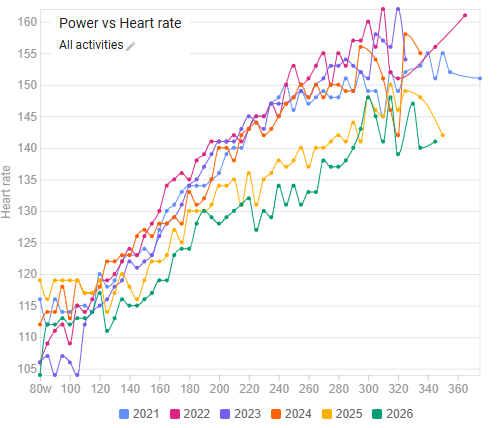
Doing FTP tests (used to do Ramp, but more recently The Grade on Zwift), I get the pretty much the same number.
This is all indoor rides, on a Smart trainer, but I feel the same thing outdoors - at the same RPE,and the same speed, my HR is a good bit lower. I don't feel any change in fitness/ability. That is, mostly I'm doing the same times on the same routes, feeling like I'm working about as hard, but instead of 150 bpm, I'm seeing 135. Of course this plays merry hell with HR zones, which I need to go back and refigure.
Terry and I are about the same age, BTW.
Doing FTP tests (used to do Ramp, but more recently The Grade on Zwift), I get the pretty much the same number.
This is all indoor rides, on a Smart trainer, but I feel the same thing outdoors - at the same RPE,and the same speed, my HR is a good bit lower. I don't feel any change in fitness/ability. That is, mostly I'm doing the same times on the same routes, feeling like I'm working about as hard, but instead of 150 bpm, I'm seeing 135. Of course this plays merry hell with HR zones, which I need to go back and refigure.
Terry and I are about the same age, BTW.
__________________
"Don't take life so serious-it ain't nohow permanent."
"Everybody's gotta be somewhere." - Eccles
"Don't take life so serious-it ain't nohow permanent."
"Everybody's gotta be somewhere." - Eccles
05-01-26 | 04:22 PM
#110
Junior Member
Joined: Apr 2022
Posts: 187
Likes: 54
From: Ottawa
Bikes: SuperSix EVO disc (2025), Giant TCR Advanced rim (2011)
Gemini…
While a lower heart rate for the same power can indicate improved fitness, in the context of masters athletes (specifically those over 60), it is often the result of several distinct physiological shifts.
1. Increased Stroke Volume (The "Bigger Pump")
One of the primary reasons you might see a lower heart rate for the same power output is an increase in stroke volume—the amount of blood ejected with each beat.
• Cardiac Remodeling: Long-term endurance training leads to "eccentric hypertrophy," where the left ventricle of the heart becomes larger and more compliant (Tanaka & Seals, 2008).
• Compensation: Because the maximum heart rate (HRmax) naturally declines with age, the body often compensates by maintaining or even increasing stroke volume to keep cardiac output (Q = \text{HR} \times \text{SV}) stable during submaximal efforts (Rowland, 2009).
• Result: If your heart can move more blood per beat, it doesn't need to beat as many times per minute to provide the oxygen required to hold a specific wattage.
2. Autonomic Nervous System Shifts
The balance between your "fight or flight" (sympathetic) and "rest and digest" (parasympathetic) systems changes as you age.
• Parasympathetic Dominance: Long-term endurance athletes often develop higher parasympathetic tone (Carter et al., 2003). This acts like a "brake" on the heart, keeping the heart rate lower during rest and submaximal exercise.
• Reduced Beta-Receptor Sensitivity: As we age, the heart's beta-receptors (which respond to adrenaline to speed up the heart) become less sensitive. This means that even when you are working hard, your heart doesn't "rev" as high as it used to for a given level of exertion (Tanaka & Seals, 2008).
3. Changes in Muscle Extraction
Efficiency isn't just about the heart; it's also about the muscles.
• Arteriovenous Oxygen Difference (a\text{-}v\text{O}_2 \text{ diff}): This measures how much oxygen the muscles extract from the blood. While some studies show this can decline with age, highly trained masters athletes often maintain excellent peripheral efficiency (capillary density and mitochondrial function).
• Economy: Interestingly, cycling economy (the oxygen cost of a given power output) generally does not decline significantly with age in trained athletes (Tanaka & Seals, 2008). If you stay lean and maintain your technique, you can remain just as "economical" at 65 as you were at 50, even if your "redline" (HRmax) has moved lower.
Is there a "Cliff" after 60?
Research indicates that while performance declines are modest between ages 35 and 60, the rate of decline in VO_2 \text{max} and peak power output often accelerates after age 60 (Tanaka & Seals, 2008). This is frequently due to a more rapid loss of muscle mass (sarcopenia) and a further reduction in maximum heart rate, which eventually limits the total cardiac output possible at "full gas."
References
Carter, J. B., Banister, E. W., & Blaber, A. P. (2003). Effect of endurance exercise on autonomic control of heart rate. Sports Medicine, 33(1), 33–46. https://doi.org/10.2165/00007256-200333010-00003
Cited by: 977
Rowland, T. (2009). Endurance athletes’ stroke volume response to progressive exercise. Sports Medicine, 39(8), 687–695. https://doi.org/10.2165/00007256-200939080-00005
Cited by: 73
Tanaka, H., & Seals, D. R. (2008). Endurance exercise performance in Masters athletes: age‐associated changes and underlying physiological mechanisms. The Journal of Physiology, 586(1), 55–63. https://doi.org/10.1113/jphysiol.2007.141879
Cited by: 773
Have you noticed your "ceiling" (max heart rate) coming down while your "cruising" heart rate at steady power stays the same?
1. Increased Stroke Volume (The "Bigger Pump")
One of the primary reasons you might see a lower heart rate for the same power output is an increase in stroke volume—the amount of blood ejected with each beat.
• Cardiac Remodeling: Long-term endurance training leads to "eccentric hypertrophy," where the left ventricle of the heart becomes larger and more compliant (Tanaka & Seals, 2008).
• Compensation: Because the maximum heart rate (HRmax) naturally declines with age, the body often compensates by maintaining or even increasing stroke volume to keep cardiac output (Q = \text{HR} \times \text{SV}) stable during submaximal efforts (Rowland, 2009).
• Result: If your heart can move more blood per beat, it doesn't need to beat as many times per minute to provide the oxygen required to hold a specific wattage.
2. Autonomic Nervous System Shifts
The balance between your "fight or flight" (sympathetic) and "rest and digest" (parasympathetic) systems changes as you age.
• Parasympathetic Dominance: Long-term endurance athletes often develop higher parasympathetic tone (Carter et al., 2003). This acts like a "brake" on the heart, keeping the heart rate lower during rest and submaximal exercise.
• Reduced Beta-Receptor Sensitivity: As we age, the heart's beta-receptors (which respond to adrenaline to speed up the heart) become less sensitive. This means that even when you are working hard, your heart doesn't "rev" as high as it used to for a given level of exertion (Tanaka & Seals, 2008).
3. Changes in Muscle Extraction
Efficiency isn't just about the heart; it's also about the muscles.
• Arteriovenous Oxygen Difference (a\text{-}v\text{O}_2 \text{ diff}): This measures how much oxygen the muscles extract from the blood. While some studies show this can decline with age, highly trained masters athletes often maintain excellent peripheral efficiency (capillary density and mitochondrial function).
• Economy: Interestingly, cycling economy (the oxygen cost of a given power output) generally does not decline significantly with age in trained athletes (Tanaka & Seals, 2008). If you stay lean and maintain your technique, you can remain just as "economical" at 65 as you were at 50, even if your "redline" (HRmax) has moved lower.
Is there a "Cliff" after 60?
Research indicates that while performance declines are modest between ages 35 and 60, the rate of decline in VO_2 \text{max} and peak power output often accelerates after age 60 (Tanaka & Seals, 2008). This is frequently due to a more rapid loss of muscle mass (sarcopenia) and a further reduction in maximum heart rate, which eventually limits the total cardiac output possible at "full gas."
References
Carter, J. B., Banister, E. W., & Blaber, A. P. (2003). Effect of endurance exercise on autonomic control of heart rate. Sports Medicine, 33(1), 33–46. https://doi.org/10.2165/00007256-200333010-00003
Cited by: 977
Rowland, T. (2009). Endurance athletes’ stroke volume response to progressive exercise. Sports Medicine, 39(8), 687–695. https://doi.org/10.2165/00007256-200939080-00005
Cited by: 73
Tanaka, H., & Seals, D. R. (2008). Endurance exercise performance in Masters athletes: age‐associated changes and underlying physiological mechanisms. The Journal of Physiology, 586(1), 55–63. https://doi.org/10.1113/jphysiol.2007.141879
Cited by: 773
Have you noticed your "ceiling" (max heart rate) coming down while your "cruising" heart rate at steady power stays the same?
 05-01-26 | 05:02 PM
#111
Klaatu..Verata..Necktie?
Joined: May 2007
Posts: 23,556
Likes: 17,034
From: SF Bay Area
Bikes: Litespeed Ultimate, Ultegra; Canyon Endurace, 105; Battaglin MAX, Chorus; Bianchi 928 Veloce; Ritchey Road Logic, Dura Ace; Cannondale R500 RX100; Schwinn Circuit, Sante; Lotus Supreme, Dura Ace
Have you noticed your "ceiling" (max heart rate) coming down while your "cruising" heart rate at steady power stays the same?
__________________
"Don't take life so serious-it ain't nohow permanent."
"Everybody's gotta be somewhere." - Eccles
"Don't take life so serious-it ain't nohow permanent."
"Everybody's gotta be somewhere." - Eccles
05-01-26 | 05:21 PM
#112
Junior Member
Joined: Apr 2022
Posts: 187
Likes: 54
From: Ottawa
Bikes: SuperSix EVO disc (2025), Giant TCR Advanced rim (2011)
05-01-26 | 06:04 PM
#113
Thread Starter
climber has-been
Joined: Dec 2004
Posts: 9,143
Likes: 6,037
From: Palo Alto, CA
Bikes: Scott Addict RC Pro & R1, Felt Z1
Bringing this thread back up, because I've noticed something similar. The last two years, I keep seeing HR numbers a lot lower than I'd have expected for the speeds I'm going. A bit of context - before the Pandemic I was doing about 1000-1500 miles a year, all outdoors. In mid-2020, what with WFH, I started riding a lot more. 2021 and 2022 were both over 6000 miles, 2023 - 2025, between 4500 and 5500/year. I used intervals.icu to plot Power vs HR for every year since 2021. CLEARLY there's a big change between pre-2025 and post 2025.
Doing FTP tests (used to do Ramp, but more recently The Grade on Zwift), I get the pretty much the same number.
This is all indoor rides, on a Smart trainer, but I feel the same thing outdoors - at the same RPE,and the same speed, my HR is a good bit lower. I don't feel any change in fitness/ability. That is, mostly I'm doing the same times on the same routes, feeling like I'm working about as hard, but instead of 150 bpm, I'm seeing 135. Of course this plays merry hell with HR zones, which I need to go back and refigure.
Terry and I are about the same age, BTW.
Doing FTP tests (used to do Ramp, but more recently The Grade on Zwift), I get the pretty much the same number.
This is all indoor rides, on a Smart trainer, but I feel the same thing outdoors - at the same RPE,and the same speed, my HR is a good bit lower. I don't feel any change in fitness/ability. That is, mostly I'm doing the same times on the same routes, feeling like I'm working about as hard, but instead of 150 bpm, I'm seeing 135. Of course this plays merry hell with HR zones, which I need to go back and refigure.
Terry and I are about the same age, BTW.

__________________
Ride, Rest, Repeat. ROUVY: terrymorse
Ride, Rest, Repeat. ROUVY: terrymorse
05-02-26 | 09:24 AM
#114
Perceptual Dullard
Joined: Sep 2009
Posts: 2,916
Likes: 1,753
Because of work commitments I spent very few hours/miles on the bike in March, and also missed the first two weeks of April due to hay fever/asthma. So when I started riding again in mid-April, you could say I was, um, well-rested. My first ride back sucked, big time. My next ride I set my best 5-minute through 10-minute MMP of the year, at pretty close to my max HR. I don't think my "efficiency" improved during the hiatus, or between my first ride and my second ride back.
05-02-26 | 10:37 AM
#115
Klaatu..Verata..Necktie?
Joined: May 2007
Posts: 23,556
Likes: 17,034
From: SF Bay Area
Bikes: Litespeed Ultimate, Ultegra; Canyon Endurace, 105; Battaglin MAX, Chorus; Bianchi 928 Veloce; Ritchey Road Logic, Dura Ace; Cannondale R500 RX100; Schwinn Circuit, Sante; Lotus Supreme, Dura Ace
It may also be worth noting that back in 2021-2023, I was doing more events on Zwift - races and group rides - where I was pushing a lot harder, as well as more structured workouts. Nowadays I'm riding at least as much but without as much intensity.
__________________
"Don't take life so serious-it ain't nohow permanent."
"Everybody's gotta be somewhere." - Eccles
"Don't take life so serious-it ain't nohow permanent."
"Everybody's gotta be somewhere." - Eccles
05-02-26 | 11:37 AM
#116
Thread Starter
climber has-been
Joined: Dec 2004
Posts: 9,143
Likes: 6,037
From: Palo Alto, CA
Bikes: Scott Addict RC Pro & R1, Felt Z1
Because of work commitments I spent very few hours/miles on the bike in March, and also missed the first two weeks of April due to hay fever/asthma. So when I started riding again in mid-April, you could say I was, um, well-rested. My first ride back sucked, big time. My next ride I set my best 5-minute through 10-minute MMP of the year, at pretty close to my max HR. I don't think my "efficiency" improved during the hiatus, or between my first ride and my second ride back.
I've also noticed a similar quick "bounce back" on the second ride after an extended rest. Power goes up, perceived exertion goes down.
Last month, I had a reaction to a vaccine that knocked me down for a couple weeks. I ended up taking 11 days of rest. The first day back on the bike felt terrible. The next day was better, and each following day was better. "Newbie" gains? From my first ride back to yesterday, my Efficiency Factor (av. power/av. heart rate) increased by 37% in 7 days.

Conclusion: Taking several days off from training isn't as devastating as it seems while you're doing it.
__________________
Ride, Rest, Repeat. ROUVY: terrymorse
Ride, Rest, Repeat. ROUVY: terrymorse
05-02-26 | 12:05 PM
#117
Klaatu..Verata..Necktie?
Joined: May 2007
Posts: 23,556
Likes: 17,034
From: SF Bay Area
Bikes: Litespeed Ultimate, Ultegra; Canyon Endurace, 105; Battaglin MAX, Chorus; Bianchi 928 Veloce; Ritchey Road Logic, Dura Ace; Cannondale R500 RX100; Schwinn Circuit, Sante; Lotus Supreme, Dura Ace
That rapid improvement was almost certainly due to a rapid "bounce back" in blood and stroke volume.
I've also noticed a similar quick "bounce back" on the second ride after an extended rest. Power goes up, perceived exertion goes down.
Last month, I had a reaction to a vaccine that knocked me down for a couple weeks. I ended up taking 11 days of rest. The first day back on the bike felt terrible. The next day was better, and each following day was better. "Newbie" gains? From my first ride back to yesterday, my Efficiency Factor (av. power/av. heart rate) increased by 37% in 7 days.
Conclusion: Taking several days off from training isn't as devastating as it seems while you're doing it.
I've also noticed a similar quick "bounce back" on the second ride after an extended rest. Power goes up, perceived exertion goes down.
Last month, I had a reaction to a vaccine that knocked me down for a couple weeks. I ended up taking 11 days of rest. The first day back on the bike felt terrible. The next day was better, and each following day was better. "Newbie" gains? From my first ride back to yesterday, my Efficiency Factor (av. power/av. heart rate) increased by 37% in 7 days.
Conclusion: Taking several days off from training isn't as devastating as it seems while you're doing it.
__________________
"Don't take life so serious-it ain't nohow permanent."
"Everybody's gotta be somewhere." - Eccles
"Don't take life so serious-it ain't nohow permanent."
"Everybody's gotta be somewhere." - Eccles


