


Bottom bracket threading, explain it to me.
 06-21-25 | 08:59 AM
#26

Senior Member


Joined: Apr 2016
Posts: 3,835
Likes: 1,768
Yes but are you talking about a cup and cone bottom bracket? This a sealed cartridge bearing BB.
Also in that gif I'm assuming the orange gear is the spindle, the light green are the ball bearings and the dark green is the cup, correct? Except that in that illustration the green gears are spinning around fixed pins, while in a bearing the balls just roll forward
Also in that gif I'm assuming the orange gear is the spindle, the light green are the ball bearings and the dark green is the cup, correct? Except that in that illustration the green gears are spinning around fixed pins, while in a bearing the balls just roll forward
 06-21-25 | 09:06 AM
#27
Senior Member
Joined: Apr 2016
Posts: 3,835
Likes: 1,768
06-21-25 | 11:41 AM
#28

Senior Member


Joined: Apr 2011
Posts: 12,647
Likes: 4,791
OK, got it, yes, the balls are rotating the reverse of the spindle. But they're along for the ride with the spindle. Worst-case forces is if the balls start to seize up, and in that case, the cup will try to rotate in the same direction as the spindle, which would try to back out the cup, except, the precession forces, based on the rotating radial load and slack in the threads, wants to rotate the cup opposite the spindle direction, tightening it.
There another thread right now, suddenly spindle got tight; Lockring had loosened just enough that the cup promptly tightened on the bearings, due to precession.
There another thread right now, suddenly spindle got tight; Lockring had loosened just enough that the cup promptly tightened on the bearings, due to precession.
The reality is that the balls are smooth and they are not rolling on either the spindle or the race, they slipping to make it possible for the spindle to turn without the cup turning in kind. Those friction forces of the balls trying to roll but being forced to slip like a car tire on ice is what pushes the cup looser or tighter.
It is also a reminder why preload is foolish - the balls are already backslipping, and preload just increases that friction more.
I don't see why you think your illustrations help clarify anything, but I don't think you get what is actually happening in a bearing system.
06-21-25 | 06:39 PM
#29
Highly Enriched Driftium

Joined: Apr 2017
Posts: 6,703
Likes: 2,173
Precession is the description of why things don't just line up, but it isn't an explanation of the forces involved: The spindle, balls and cup form an impossible gear train because the cup is not allowed to move at the rate the bearings are trying to turn it. If the spindle, bearings and cup were cogs, the spindle would be locked up. A sun and planetary gear system wouldn't be useful if the center input gear could turn without the outer ring turning in kind, and BB cups don't turn.
The reality is that the balls are smooth and they are not rolling on either the spindle or the race, they slipping to make it possible for the spindle to turn without the cup turning in kind. Those friction forces of the balls trying to roll but being forced to slip like a car tire on ice is what pushes the cup looser or tighter.
It is also a reminder why preload is foolish - the balls are already backslipping, and preload just increases that friction more.
I don't see why you think your illustrations help clarify anything, but I don't think you get what is actually happening in a bearing system.
The reality is that the balls are smooth and they are not rolling on either the spindle or the race, they slipping to make it possible for the spindle to turn without the cup turning in kind. Those friction forces of the balls trying to roll but being forced to slip like a car tire on ice is what pushes the cup looser or tighter.
It is also a reminder why preload is foolish - the balls are already backslipping, and preload just increases that friction more.
I don't see why you think your illustrations help clarify anything, but I don't think you get what is actually happening in a bearing system.

If you have a bearing without *rolling* elements, but sliding contact, that is a bushing.
Regarding precession, it's due to a radial force, that rotates direction with respect to the threads. The BB threads are set up for precession to tighten the BB cup or cartridge. If you have a fixed gear bike and they were to ride in reverse with a good amount of pedal force, the BB would back out. If you have a mid-drive bike that transmits motor power mid-spindle, and the rider is not pedaling, or just has weight on the pedals with no turning motion, the BB will not back out, because the radial force on the BB is not rotating orientation, it's all one direction from chain tension or rider weight. But if, on that same BB, the ball bearings actually seize up or stop rotating so that they are sliding on the BB, then the force on the BB cups is opposite intended direction and it will back out if the frictional force is sufficient.
Ball. Bearings. Roll. That's why they are round.
I'll have to look at your time of post, it may have been very late local to you. I've made mental errors in the wee hours.
Last edited by Duragrouch; 06-21-25 at 06:46 PM.

 06-21-25 | 08:02 PM
#31
Highly Enriched Driftium
Joined: Apr 2017
Posts: 6,703
Likes: 2,173
For both the cups and the shell? I know of engineering applications where one part had slightly (IIRC, 5%) different thread pitch in order to be self-locking.
06-21-25 | 09:22 PM
#32
Senior Member
Joined: Apr 2011
Posts: 12,647
Likes: 4,791
(bold) Respectfully, whoa-whoa-whoa. Bearing balls, when functioning properly, are rolling contact, that's actually how they are categorized as bearings. If they are not rolling but staying stationary and sliding against one or both races, that is known as bearing ball skidding, and it will flat spot the bearing ball in nothing flat, and then function is impeded from thereon. That is part of the recommendations for a slight preload on angular contact bearings, it reduces skidding. This is from online, a bearing company:
If you have a bearing without *rolling* elements, but sliding contact, that is a bushing.
Regarding precession, it's due to a radial force, that rotates direction with respect to the threads. The BB threads are set up for precession to tighten the BB cup or cartridge. If you have a fixed gear bike and they were to ride in reverse with a good amount of pedal force, the BB would back out. If you have a mid-drive bike that transmits motor power mid-spindle, and the rider is not pedaling, or just has weight on the pedals with no turning motion, the BB will not back out, because the radial force on the BB is not rotating orientation, it's all one direction from chain tension or rider weight. But if, on that same BB, the ball bearings actually seize up or stop rotating so that they are sliding on the BB, then the force on the BB cups is opposite intended direction and it will back out if the frictional force is sufficient.
Ball. Bearings. Roll. That's why they are round.
I'll have to look at your time of post, it may have been very late local to you. I've made mental errors in the wee hours.
If you have a bearing without *rolling* elements, but sliding contact, that is a bushing.
Regarding precession, it's due to a radial force, that rotates direction with respect to the threads. The BB threads are set up for precession to tighten the BB cup or cartridge. If you have a fixed gear bike and they were to ride in reverse with a good amount of pedal force, the BB would back out. If you have a mid-drive bike that transmits motor power mid-spindle, and the rider is not pedaling, or just has weight on the pedals with no turning motion, the BB will not back out, because the radial force on the BB is not rotating orientation, it's all one direction from chain tension or rider weight. But if, on that same BB, the ball bearings actually seize up or stop rotating so that they are sliding on the BB, then the force on the BB cups is opposite intended direction and it will back out if the frictional force is sufficient.
Ball. Bearings. Roll. That's why they are round.
I'll have to look at your time of post, it may have been very late local to you. I've made mental errors in the wee hours.
And really, how can you read about "excessive skidding" without wondering why there would be any skidding? That skidding is what has to happen for the reasons I stated.
Bearing preload makes sense when the bearing is going to support thousands of pounds on the axle, heat up greatly or have large load variations. None of which apply to bikes. You have all the information necessary, but keep coming to the wrong conclusions. And you didn't even understand the bearings you are preloading.
I posted at 10am. Apparently you are equally good with time conversions.
Last edited by Kontact; 06-21-25 at 09:29 PM.
06-21-25 | 09:24 PM
#33
Senior Member
Joined: Apr 2011
Posts: 12,647
Likes: 4,791
06-21-25 | 09:50 PM
#34
Highly Enriched Driftium
Joined: Apr 2017
Posts: 6,703
Likes: 2,173
The bearings aren't static, but there is simply no way that anything round can strictly roll when the spindle race diameter is different than the cup race diameter. Something has to slip, as you can clearly see in the gif I posted.
And really, how can you read about "excessive skidding" without wondering why there would be any skidding? That skidding is what has to happen for the reasons I stated.
Bearing preload makes sense when the bearing is going to support thousands of pounds on the axle, heat up greatly or have large load variations. None of which apply to bikes. You have all the information necessary, but keep coming to the wrong conclusions. And you didn't even understand the bearings you are preloading.
I posted at 10am. Apparently you are equally good with time conversions.
And really, how can you read about "excessive skidding" without wondering why there would be any skidding? That skidding is what has to happen for the reasons I stated.
Bearing preload makes sense when the bearing is going to support thousands of pounds on the axle, heat up greatly or have large load variations. None of which apply to bikes. You have all the information necessary, but keep coming to the wrong conclusions. And you didn't even understand the bearings you are preloading.
I posted at 10am. Apparently you are equally good with time conversions.
The Nuvinci/Enviolo variable speed hub uses this principle by varying the contact diameter to vary the speed ratio, with no ball slippage at any of the contact points. It is, in effect, a variable race ball bearing.
Last edited by Duragrouch; 06-21-25 at 09:58 PM.
06-21-25 | 09:55 PM
#35
Senior Member
Joined: Apr 2011
Posts: 12,647
Likes: 4,791
The bearing balls rotate. At the outer periphery, i.e., the outer race or cup, they roll with a surface movement at a given rate. Now transfer that same ball rotation rate to the bearing inner periphery, i.e., the inner race or spindle; You will have the same surface rate, no slipping, however because the inner race is smaller diameter, it will have a *higher rotational speed*, revolutions, than the speed differential at the outer race. If, for example, the inner race contact diameter is 1/2 the outer race contact diameter, the inner race rotational speed with be 2X the speed differential compared to between the balls and the outer race.
06-21-25 | 09:57 PM
#36
Highly Enriched Driftium
Joined: Apr 2017
Posts: 6,703
Likes: 2,173
Please see my second paragraph to last post, just added.
06-21-25 | 10:07 PM
#37
Senior Member
Joined: Apr 2011
Posts: 12,647
Likes: 4,791
Nuvinci has four out of four moving surfaces. A BB has two out of three. The Nuvinci does what the BB should not - turn the cups. The BB wants to turn the cups, but they can't, so the bearings slip fractionally instead.
06-21-25 | 10:22 PM
#38
Highly Enriched Driftium
Joined: Apr 2017
Posts: 6,703
Likes: 2,173
 06-21-25 | 10:58 PM
#39
Senior Member
Joined: Apr 2011
Posts: 12,647
Likes: 4,791
If you watch the balls for awhile it will be clear that their outer circumferences are not able to roll on the static outer race or the moving inner race at the same rate. You can see that the red dot on the ball is not moving as quickly as the red dot on the inner race. If all three had teeth, the structure would not turn at all.
Last edited by Kontact; 06-21-25 at 11:02 PM.
06-22-25 | 12:20 AM
#40
Highly Enriched Driftium
Joined: Apr 2017
Posts: 6,703
Likes: 2,173
If you watch the balls for awhile it will be clear that their outer circumferences are not able to roll on the static outer race or the moving inner race at the same rate. You can see that the red dot on the ball is not moving as quickly as the red dot on the inner race. If all three had teeth, the structure would not turn at all.
I haven't ruled out that you're right, by the way, but that just seems contrary to rolling bearing theory. But I need to prove it if I'm right or wrong.
I think that you believe, that the rolling contact speed between the spinning balls and inner race, must then be the rolling contact speed between the balls and outer race, because it's the same ball, and the outer race is fixed, except that can't be because the outer race is larger diameter. But in addition to spinning, that ball is also translating, and that, I think, compensates for the contact speed differential. I haven't quite got it mathed out yet. What I got is (for this specific animation):
For each 1 revolution of the inner race, each ball rotates 6 times. That means a 6:1 ratio in diameters. To get the outer race rolling diameter, it's 6/6 + 2/6 = 8/6 or 4/3 times the inner race diameter.
That's it so far. I'm straining my brain to figure out how to take into account the translation of each ball, and whether added or subtracted to the rolling contact due to the balls spinning. If it were a linear bearing, rail moving balls over a fixed rail, it's easy, it's the "2 for 1" moving rail translation versus the ball translation. But with diameters, it's going to take more thought.
EDIT: I think that 6:1 ratio above based on rotations is way off. The race diameter ratio is a lot closer to 3:2, with balls at 0.5 diameter.
Last edited by Duragrouch; 06-22-25 at 01:04 AM.
06-22-25 | 12:37 AM
#41
Senior Member
Joined: Apr 2019
Posts: 3,835
Likes: 1,456
From: UK
I agree that it doesn’t matter that the inner and outer race contact circles are different diameters
I kind of think it’s more to do with the point of highest contact force between the bearings and outer race moving around part of the circle during the power phase.
And probably the fact that they’re not perfect spheres contributes, and also have to have a tiny bit of room to move
I kind of think it’s more to do with the point of highest contact force between the bearings and outer race moving around part of the circle during the power phase.
And probably the fact that they’re not perfect spheres contributes, and also have to have a tiny bit of room to move
Last edited by choddo; 06-22-25 at 12:42 AM.
06-22-25 | 05:07 AM
#42
Senior Member
Joined: Apr 2016
Posts: 3,835
Likes: 1,768
 06-22-25 | 05:15 AM
#43
Senior Member
Joined: Apr 2016
Posts: 3,835
Likes: 1,768
If you watch the balls for awhile it will be clear that their outer circumferences are not able to roll on the static outer race or the moving inner race at the same rate. You can see that the red dot on the ball is not moving as quickly as the red dot on the inner race. If all three had teeth, the structure would not turn at all.
06-22-25 | 05:24 AM
#44
Highly Enriched Driftium
Joined: Apr 2017
Posts: 6,703
Likes: 2,173
I can't count the number of USA machine tool builders that no longer exist. Most named after the city where they started.
06-22-25 | 05:50 AM
#45


I had a bottom bracket cup loosen up on me today on a ride. It needs a somewhat specific spanner wrench to tighten which I didn't have on me, and which is probably why it came loose in the first place since I can't properly torque it. To make things worse this is an eccentric BB for a single speed conversion, which meant the chain kept tightening and the crank spindle would be out square.
Now my question is... I thought that BB reverse threading is done so that the cups self tighten as you pedal, am I wrong?
But if I look at it from the drive side for example, you tighten the BB cup CCW and you pedal CW. So doesn't pedaling actually loosen the BB? What am I missing here? Sorry if this is a dumb question
Now my question is... I thought that BB reverse threading is done so that the cups self tighten as you pedal, am I wrong?
But if I look at it from the drive side for example, you tighten the BB cup CCW and you pedal CW. So doesn't pedaling actually loosen the BB? What am I missing here? Sorry if this is a dumb question
06-22-25 | 06:36 AM
#46

Old fart


Joined: Nov 2004
Posts: 26,345
Likes: 5,249
From: Appleton WI
Bikes: Several, mostly not name brands.
 06-22-25 | 07:55 AM
#47
Senior Member
Joined: Apr 2016
Posts: 3,835
Likes: 1,768
06-22-25 | 09:28 AM
#48

Senior Member
Joined: Oct 2014
Posts: 14,159
Likes: 5,282
From: Portland, OR
Bikes: (2) ti TiCycles, 2007 w/ triple and 2011 fixed, 1979 Peter Mooney, ~1983 Trek 420 now fixed and ~1973 Raleigh Carlton Competition gravel grinder
And if the bearing seize, they go from the nice planetary Kontact gave us to a locked system that promptly unscrews cup. So keep your bearings lubed. (Pedal bearings can do the same and unscrew the pedal.)
 06-22-25 | 07:16 PM
#49
Thread Starter
Newbie
Joined: Dec 2017
Posts: 63
Likes: 18
I said in a previous post that its eccentricity was irrelevant. What I meant is that the point of my original question was simply to understand the general principle behind the reasoning of reverse threading for bottom brackets since it seems counter intuitive.
However the fact that it's eccentric could have contributed to my specific issue of it coming loose.
Maybe I just didn't tighten it properly in the first place, but it's also possible that the clocking of the eccentric cup has an effect on it. If you were to draw an imaginary vertical line that splits the BB in half, the spindle is currently positioned in front of that. I suspect that when I'm mashing and apply downward forces on the pedals the position of the spindle might want to unthread the cup. I put some Teflon tape on the thread and tighten the cup as much as possible, but if it loosens again I might want to try a slightly different gear/chain length combo so that I can clock that spindle behind that line.
The tool I would need to tighten it (and torque it), other than the manufacturer provided spanner wrench, is a 64mm socket. Not very common and very expensive if I can even find it.
Anyway a picture says a 1000 words
 06-22-25 | 09:38 PM
#50
Highly Enriched Driftium
Joined: Apr 2017
Posts: 6,703
Likes: 2,173
New comments added to previous diagram:
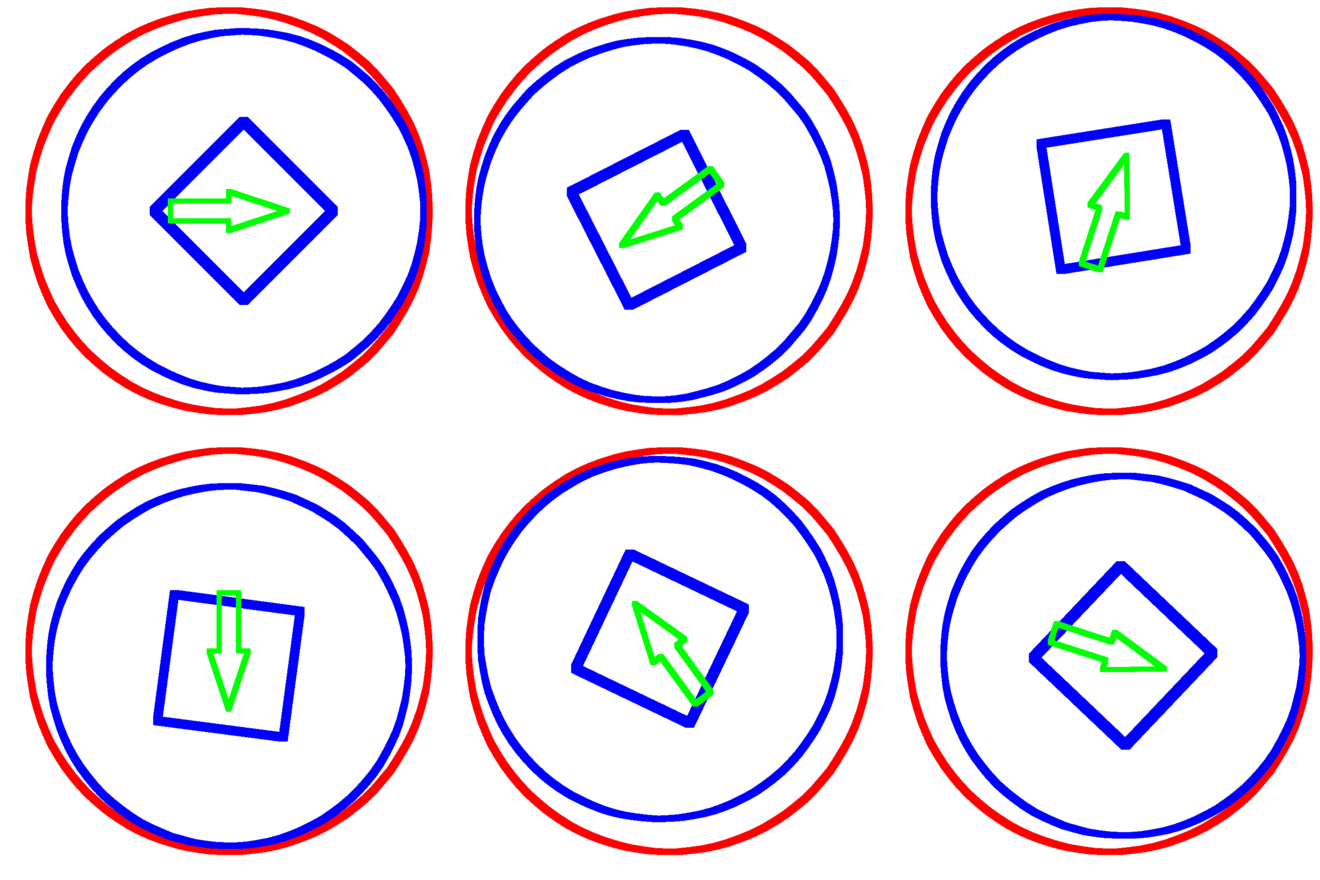
This pictured example would represent the non-drive (left) side of the bottom bracket; The pedaling force forward is to the left, counter-clockwise, and thus same is the closest contact point between the cup (blue) and the shell (red) due to rotating radial load at the bottom bracket, indicated by the green arrow (assuming any radial slack between the two threads). But then notice how the precession causes the cup to slowly rotate opposite, clockwise, to the right, thus the left side of the BB requires right hand thread to keep tight. The drive (right) side is opposite, precession to the left, so requires left hand thread.
This pictured example would represent the non-drive (left) side of the bottom bracket; The pedaling force forward is to the left, counter-clockwise, and thus same is the closest contact point between the cup (blue) and the shell (red) due to rotating radial load at the bottom bracket, indicated by the green arrow (assuming any radial slack between the two threads). But then notice how the precession causes the cup to slowly rotate opposite, clockwise, to the right, thus the left side of the BB requires right hand thread to keep tight. The drive (right) side is opposite, precession to the left, so requires left hand thread.